Ánne by Kamelia Panayotova, trans. by Dilyana Kodjamanova
Bulgarian writer Kamelia Panayotova's vivid, sensuous novel excerpt 'Ánne' – translated by Dilyana Kodjamanova – steeps in sunlit village summers, girlhood, and the complicated yearning for a mother figure.
This piece was shortlisted for the 2025 Queen Mary Wasafiri New Writing Prize.
One summer Lola suggested that we walk the five kilometres to the village fork every day. She said that we should get in shape, because in a year or two the boys would start looking at us. We had to look perfect.
Grandma willingly helped with the 'beautification'. She used to make a mixture of gas, grease, and vinegar (they used to treat us for lice with the same thing at one time), as she assured us that the mixture thickened the hair and made it very shiny. While we were waiting for the miraculous mask to do its thing, Grandma rubbed our armpits too with grease and salt — this way, they wouldn’t smell when we sweated. We sat under the sun, fully smeared. The grease melted and started to flow on our bodies and foreheads, while Grandma wiped it from time to time with an old towel. She scrubbed so hard that we burned.
Nobody knew about our walks outside the village, otherwise they would have scolded us. Several times I imagined running ahead and going home in the city. The hill was a few metres after the fork, and the way down would barely be that hard. I didn’t do it, of course. Lola and I usually walked without talking. Only from time to time did one of us show something to the other. Look, storks! Where? Over there, in front of the sunflowers. Do you want us to chase them? Nope, I’m scared. Yeah, me too. And we laughed. Then, we fell silent again. Other times, acquaintances stopped their cars next to us, and asked us where we were headed to, and whether our parents knew. Of course they do, we wouldn’t go anywhere without telling them. We felt a certain satisfaction that they always accepted this to be true. The grown-ups believed us, even though they raised their eyebrows before continuing on their way. They wished to push us further: 'Are you sure you’re not lying right now?' but they realised that if they did it, we ourselves would lose our faith in them. We would see their distrust in us, and they would be ashamed that they had doubted the purity and innocence of us children.
At the end of the summer, shortly before Lola left for the city, our walks turned more into purposeful journeys. We left around noon and tried to come back while it was still light outside. We sneaked into the peach orchards and gorged until our tongues blistered from the fruit’s fuzz. On the way back, the skin around our mouths itched and pinched at the same time, while our bellies ached from gluttony. Sometimes the evening overtook us still on the road, even before we reached our building. The sunsets were long and lavish. The sky got coloured in pink, torn apart by stretched clouds. As if time had stopped. Even though it was already September, there was still no wind, and the grass around there didn’t move — one could feel only a slight chill.
We could spend our whole lives in these moments — covered with the reddish sunlight, with skin scratched from the peaches and soil in our shoes. Once or twice, we even stopped and lay down on the asphalt. We let the chill of the upcoming autumn soak through us. Back then, I didn’t think about anyone: neither about mom nor about Thea, not even about Lola, even though she was right next to me. I just existed at the end of a summer with the sun and trees — without any worries, without any fears, without any thoughts. The walnuts’ crowns held off the autumn stoically, as if they protected us from all the evils in the world. My senses were focused on the change of seasons, as if they expected something incredible to happen once the cold approached and, at the same time, they refused to let go of the summer. The fear that it would get dark any minute now weakened, disappeared even, and got replaced by a frantic peace that I was alive. I wanted to stay alive forever. I was fusing with nature, as if roots were growing from my back and breaking through the asphalt. My feet were softening, my stretched arms were relaxing. I was turning into a blade of grass in between the cracks on the road, a tiny outgrowth of nature — as if unnecessary to anyone, yet right in place. I was part of something bigger, something huge. Only Lola’s heavy breathing brought me back to reality.
We had to make an enormous effort to go back home, because we were almost falling asleep on the dry, heated road. If we were braver, we would have probably stayed and slept there — in the middle of nowhere, in the sweet feeling that we belonged. With time, we lose that ability to adjust ourselves to nature, and for it to be enough for us. But maybe we never lose it — we just forget how to do it.
How I want to jump out of the train right now and go to the first bush I see on the road. I want to feel the pricking on my palms and back, I want my heels to make holes in the soil, bugs to crawl around me; I wish to be overwhelmed again with the feeling that I belong. To remain there forever, staring upwards. Instead, I’m watching how the landscapes are changing out the window. The view is changing really fast — rivers, hills, forests, distant peaks, towns with broken-down buildings, forgotten villages, girls with bare tummies and boys with loose tracksuits, and many grandmothers with their grandchildren. Then over again. I have forgotten to enjoy this: just being here, knowing that these places exist, and they’ll be here forever, even without me. Years after these walks, I was trying to inflict this feeling on myself. Sometimes I almost succeeded. Before I fell asleep, or during school classes, and then during university lectures, while I was studying Tourism at Sofia University. I would close my eyes, trying to recall each and every detail from that first summer of long walks with Lola. I was filled with a sleepy delight, but the voices of my classmates or colleagues quickly woke me up from the intoxication.
It was enough for me that I was trying, at least.
*
Sometimes, Lola and I would take a bunch of covers and blankets out on the porch and spend the night under the stars. We arranged them in such a way that only the end of the small awning was above us, and then we lay down and gazed at the night sky. Whenever we looked at it for more than a minute or two, Lola panicked that she would 'fly away'. That’s exactly what she said — that she was afraid of flying away, and I tried to harbour that fear with me, to feel it and share it with her.
It was August. Your mother also loved to look at the constellations, Lola’s father said at some point. She didn’t say anything back, and I had a bunch of questions. I wanted to learn everything about that mother — what was her name, what was she like, how did the two of them meet, why did he marry her, how did she die? How much did he miss her, and did he think about her often? I had never heard him talk about that, and I immediately concluded that he hadn’t talked in front of Lola either. I couldn’t grasp why she didn’t ask any questions. How come in that moment she was satisfied just with the statement that her mother had loved the constellations? Didn’t she want to know more details, like, for example, whether her mother also used to sleep on the porch like us? Didn’t she want to know much more?
I didn’t dare ask about this enigmatic woman. It wasn’t right, I shouldn’t have been interested at all. I had to think about her as if she were one of all the other strangers in the world — and who is interested in strangers? It’s true, Lola was my dearest friend, but I got to know her without a mother. I could not know, if she were not a half-orphan, whether we would be close at all. Perhaps her mother would not approve of me, just like Grandma didn’t approve of Lola. Perhaps she would forbid her to play with me and to love me, or she would blame me for Lola’s disobedience. And perhaps Lola would be completely different, and I wouldn’t be able to love her like I did. When playing, she would be boring, obedient, humble, and meek. She would not put on mismatched socks and forget to comb her hair. She would not stain her dresses with chalk and jump from trees. She would not swim in the dirty river and roll in the meadows until she was exhausted.
But there was something else, too. The main thing that I wanted to know was whether Lola’s mother – that seemingly fictional, non-existent woman who has never lived – would want to shelter me with her, the same way her father did it, in a sense. Would I designate her as my mother, and would she agree to become that. That was the only thing I wanted to know. And since I didn’t consider it right to ask straightforwardly, I hoped that Lola’s father would share some more little detail about her, something seemingly very small – like, for example, what was her favourite colour, or what did she like to eat for breakfast – but which would help me figure out whether that woman would be suitable to be my mother.
Nobody said anything more, though. We lay down like that, staring up, for some time. We stared at the Great Bear, each one of us immersed in their own thoughts. It seemed to me, though, that all three of us were thinking about Lola’s mother in a way. I closed my eyes and prayed silently, like Grandma used to do. For Lola and her father. For myself. And for her mother. I prayed to God that she would approve of me, wherever she was. I said amen and I drifted off.
At some point, I woke up from the morning’s chill. It was dark and the stars shone even brighter. For a moment, I got scared that all of them were preparing to fall down, that they would collapse upon us and destroy us. My heart began to beat. Every sleeping person has felt that, the certainty of their doom in their drowse. At that point, I felt a hand on my shoulder. I turned around and I saw that Lola’s father had spread out his arms to the sides — one for me and one for her. I felt an uncontrollable desire to hug him, to cuddle in his fatherly strength, and when I was just about to do it, he turned his body slightly away to face Lola and pressed her to himself. His hand was still underneath my neck, his palm on my shoulder, but it didn’t seem like he was comfortable: he looked crucified in his love, torn apart between me and her. And maybe it was appropriate for me to think about that back then, to realise that I would never be his real child, that he would always choose Lola over me. At that moment, though, in the starry night of our childhood, I felt only affection. Whatever was to happen from here on – even if his hand were to get stiff under my neck, even if his whole body and essence were to turn away to the other side, even if some star were to confuse its direction and fall on our heads, or the whole sky collapsed upon us — the hand of that person would forever remain reached out to me.
I pulled the cover up to my chin and fell asleep.
*
The years that I spent in the village were both the most exciting and the most terrifying in my life. I was constantly asking myself why my mother had abandoned me, until finally … she appeared. There she was, my mother, magnificent in her colourful summer dress — enormous, distant, untouchable.
I was on the verge of coming of age. I hadn’t spoken to Lola in a very long time, since forever. Summer was already here, she must have already arrived, but Grandma said that she had seen Lola’s father, and he had said Lola wouldn’t spend that summer in the village, she would stay in the town.
And all of a sudden — a funeral. That same uncle, who wasn’t a real uncle to me really, died. Just like that, out of nowhere.
Grandma fussed, cooked, put things in order — with tears in her eyes, of course. The coffin was placed carefully on two chairs in the middle of the room. A couple of relatives came to pay their respects to him, though almost nobody came to visit him when he was alive (but people were going to talk about them). Some of them came closer to the deceased, lowered their heads, and whispered something, or asked him to greet this or that relative in the other world. Others shed a few tears, hoping to believe that they really felt grief. I was the only one to completely openly enjoy his death. I felt that I had personally killed him; that I had stabbed a knife in his body for every time he had touched me. I imagined how his caresses, and his words, and above all his enormous tongue died along with him. I imagined how in that very second, when he died, he ended up in hell and was paying for everything he had done to me. I imagined him asking for the forgiveness that I wasn’t going to give him.
At that moment, in the midst of all that chaos and vanity, mom, my anne, walked in and illuminated everything. It was as if the whitewashed walls became whiter; millions of dust specks in the air came together in an evanescent whirlwind, and left the room out of surprise. She stopped at the door and looked around, though she could grasp the situation in a single quick glance. Then she asked, as if she were truly surprised: Huh, Ánne, you’re here?
There I was.
I guess that if my other, long-awaited mother had come, I would have felt the same — a giant relief. There she was, my mom, safe and sound, though I was aware of that all those years.
There I was.
I wanted to feel much more. Something big. Enormous. To run out of breath, though the room’s size didn’t allow such an opportunity, and to jump into her arms. To cry out of happiness and amazement, that I was already home — in her arms. But her appearance didn’t invite either an urge for a hug, nor any presentiment of a home in me.
There I was.
I had spent years without any news from my parents, without anybody mentioning even their names in front of me. I sat there and didn’t know what to expect, but above all, I didn’t know what my mother felt. Whether after Thea had moved out, she felt lonely and now would seek an alliance with me? Whether she was just obliged to come and didn’t want to have anything to do with me, but she also couldn’t avoid me?
There I was.
My mom stood at the door and she seemed dazzling to me. Maybe it was because I hadn’t seen her in a long time, or she had really changed, but I could sense something different in her. Something that could persuade me to forgive her, though I realised that it existed only in my imagination. Because she looked small and devastated in her black outfit — not out of grief for the deceased, but due to the enormous amounts of alcohol and constant smoking.
There I was.
Little Ánne was there. What else could I reply? What was appropriate to say apart from screaming at the top of my lungs? I wanted to cry out of amazement that my mother was there, that this time she was the one who came and couldn’t throw me out, and at the same time I wanted to punish her cruelly and irrevocably. I wanted to tell her: 'You’re not my mother, I don’t know you,' or something else that would make any mother in the world hurt. To hurt her so deeply that, out of sorrow, she would lie down in the place of the deceased.
There I was.
Indeed, the world is emptier without a mother in it. But that doesn’t always foretell death. That uncompromising emptiness which mothers leave in us when they leave us very often can’t be filled in with their presence. Sometimes, forever.
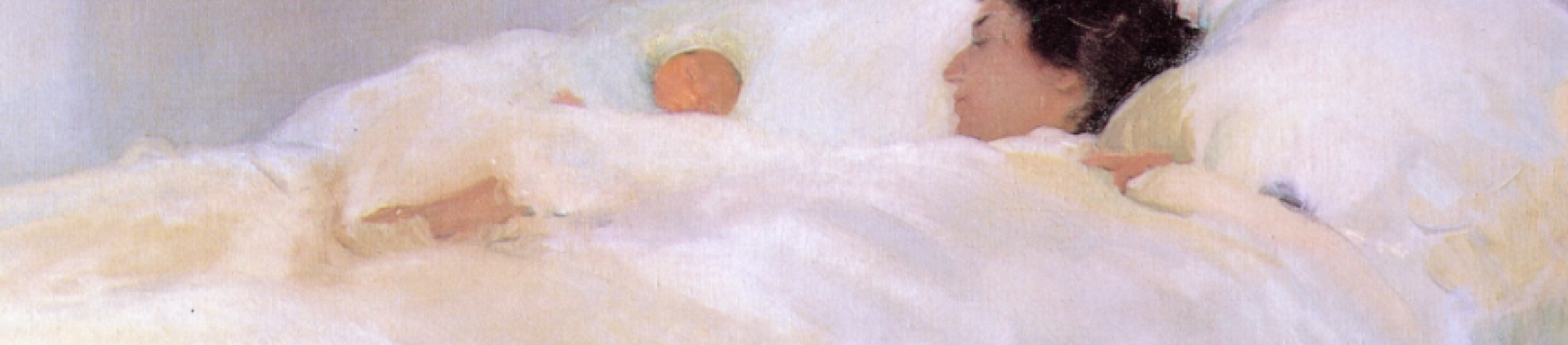
Image: Mother by Joaquín Sorolla


