
Archival Experiments: Iman Mersal’s ‘Traces of Enayat’ and Julietta Singh’s ‘No Archive Will Restore You’
As a scholar specialising in anticolonial archiving practices, Sara Salem analyses two texts – Iman Mersal’s Traces of Enayat and Julietta Singh’s No Archive Will Restore You – as 'attempts at stretching and undoing "the archive" as a fixed place or as something that can be held by an institution'. Braiding close readings and theory, Salem explores the body as an archive and archiving as radical experimentation to expand our definitions of archival engagement and what actually constitutes an archive in the first place.
This piece is commissioned in tandem with Wasafiri 127: Solidarities.
Supported by a grant from the Open Society Foundations.
The last decade has seen growing interest in the archive: What is the archive, and who can access it? What gets recorded as history, and what remains as purely memory? How do archives discipline what they contain, and are there alternative ways of organising them? These questions have given rise to various debates among archivists, academics, artists, community organisers, and beyond, many of which centre around defining an archive and the power this definition grants to those who then have access to it. Within this, there have been inspiring attempts at stretching and undoing ‘the archive’ as a fixed place or as something that can be held by an institution.
In this essay, I look at two pieces of writing that do this: Iman Mersal’s 2023 book, Traces of Enayat (translated from Arabic by Robin Moger), and Julietta Singh’s 2018 book, No Archive Will Restore You. I read these texts as archival experiments and attempts to undo the archive as a stable, fixed place, proposing instead that there is much to gain from loosening and stretching our ideas of what actually constitutes an archive. I come to these two texts as a scholar who teaches on and writes about anticolonial archiving and how to think about many kinds of archives as having recorded radical histories.
Traces of Enayat and No Archive Will Restore You are both works of non-fiction and are set in different parts of the world: Mersal writes about Egypt, while Singh’s book is a diasporic tale moving between Canada and India. Mersal traces the life of Enayat al-Zayyat, an Egyptian writer on whom not much is known. Through this process, the book reflects on archiving, on writing, and on literature more broadly as spaces through which we can understand the lives of women. Given the gaps in institutional archives in Egypt and the relative absence of Enayat within them, Mersal turns to other records as a way of piecing together Enayat’s life, producing what she calls an archival experiment.
Julietta Singh’s text considers the body as a rich archive of both our own lives and the world around us. Illness and pain are major themes in her book, leading Singh to explore her body as a deteriorating archive that is messy. Through this, she pushes at the bounds of what an archive is and can be, experimenting with form and content. As such, both Singh’s and Mersal’s books speak to the idea of archival expansion and experimentation — the focus of this essay.
Traces of Enayat
At a bookstall in Cairo, the Egyptian poet, novelist, and scholar Iman Mersal comes across a book entitled Love and Silence, written by Enayat al-Zayyat. She becomes interested in finding out everything she can about the author, whom she assumes is related to Latifa al-Zayyat, a famous novelist who wrote the modern Egyptian classic, The Open Door (1960). After discovering they are not related, Mersal takes us on a meandering journey to find out more about the elusive Enayat, whose novel has touched her deeply:
‘Sometimes a piece of writing can shake your very being. This doesn’t mean it has to be unprecedented in the history of literature or the best thing you’ve ever read. It is fate, delivering a message to help you make sense of whatever you’re going through—and at the exact moment you most need it, whether you realise it or not. When we turn to contemplate our lives, it is these works that let us see’ (Mersal 28).
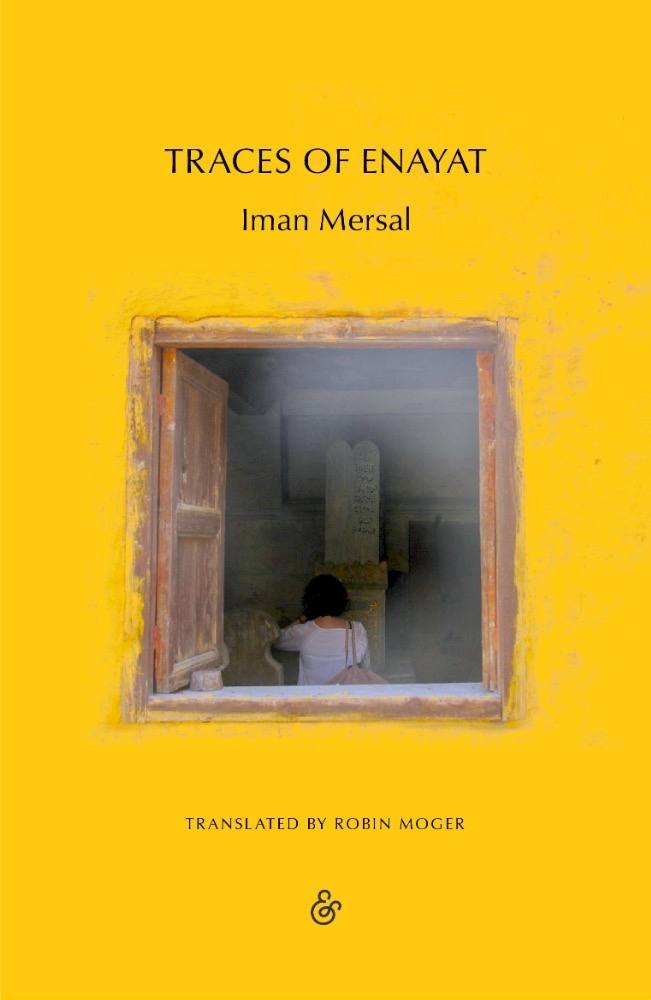
Mersal writes about Enayat as a ghostly presence that is guiding or accompanying her through the maze of archives she explores in the book, from Enayat’s grave and former apartment, to the memories of her friends and family, to the letters and other objects she left behind. She notes at the book’s beginning, during a visit to Cairo’s El-Basateen cemetery to find Enayat’s tomb, that if she didn’t find Enayat that day, ‘she would send me a sign when she was ready’ (Mersal 11). This is part of the archival experiment the text speaks to, where the journey is not defined by a researcher visiting – and thus consciously choosing when to encounter – an archive. Instead, it is the archive itself, in this instance embodied by Enayat, deciding when it is ready to be seen.
Mersal refers to Enayat as a ghost pursuing her (33). I am especially interested in the haunting nature of archives and archival figures. As Avery Gordon writes in Ghostly Matters, to be haunted by the past is an affective state, a moment when you lose your sense of stability. To experience this past through archives can produce this feeling state, where time is collapsed and the past enters the present. In a sense, to feel haunted is to feel a kind of pressure on you to register what it is that you are haunted by — haunting demands your attention (Gordon). This pressure produces its own material effects: in some parts of the book, Mersal experiences the same things Enayat writes about in her journal, such as a shared experience of depression and alienation, as well as a difficulty in finding one’s place in the world. Indeed, the cover of the book features Mersal herself at Enayat’s grave, which she was eventually able to find. She reflects on the emotional experience of this:
‘I realised that I was crying. It wasn’t grief. To be standing there in front of her headstone was the high point of our relationship. The tomb wasn’t just another detail, another catalyst to help me reconstruct her unrealised dreams, her sleeplessness, her pain: the tomb was the only place where she actually was. For her life, I had to return to the archive, to the memories of the living and my own imagination, but I felt now that at last she trusted me, that she had allowed me to reach her along a chain of chance and speculation’ (Mersal 157-8).
Mersal admits that she has an intense curiosity about Enayat because she is ‘truly unknown’ (33). According to Egyptian newspaper and magazine archives, Enayat actually never existed: ‘She is a person that these institutional archives do not see or acknowledge’ (189). Although there are files marked with her name, their contents have disappeared, likely because they were deemed irrelevant. As Mersal reminds us, ‘The ideology behind the creation of the archive is the same which takes the decision to destroy it’ (190). In other words, what is deemed marginal by society is removed from the archive. This speaks to work that details the archive as a space of power. In Michel-Rolph Trouillot’s Silencing the Past, historical narratives are always claims to truth, and these are produced in and through archives, a key moment at which silence enters the historical record (1995). In the context of a state such as Egypt, the national archives are similarly a claim to a history in which the state and its patriarchal underpinnings determine the silences and erasures in official archives. It is in this sense that there exists an ideology behind the creation of the archive, as Mersal notes, which is the same ideology that determines what is removed from the archive. Enayat as a figure who committed suicide pushes against a national and patriarchal narrative in which women always place their families ahead of themselves, and in which suicide is seen as a moral and religious sin.
How do archives discipline what they contain, and are there alternative ways of organising them?
Mersal recounts problems with using both institutional and family archives to trace Enayat. She clarifies that she does not want to fill in all the gaps in order to accurately document her life, but rather to ‘take a journey towards someone who cannot speak for themselves’ (Mersal 200). It is here that we begin to see the outlines of an archival experiment: as we move through the text with Mersal, we experience the various ways in which she attempts to piece together Enayat’s life from imperfect, incomplete records. From conversations with her best friend Nadia Lutfi, a famous Egyptian actress, to walks through the Cairo streets to find the flat where Enayat would eventually commit suicide, the journey takes place across many years and all kinds of spaces, from Enayat’s flat to her grave where she would ultimately rest, and from the apartments of her friends and family to the neighbourhood that she lived in. The archive of Enayat, then, is not fixed in place but rather fragmented across an entire city and beyond. Indeed the ‘real’ archive – a box of letters, journals, and other belongings that Mersal knows is somewhere in Nadia’s flat – never materialises. In describing this elusive box, Mersal uses descriptors we commonly hear about archives:
‘A dusty room is how I imagined it. Windowless. A room where no one had set foot in fifty years and very small indeed. How this mythical room came to occupy my imagination so completely, I’ve no idea. Enayat’s personal archive was all I could think about. It was as though she had sorted and ordered it herself, as though it was sitting there in the dust and dark, waiting for the one who would come to claim it. There is, by the way, no clear definition of “personal archive” other than an archive which exists in opposition to the institutional, or collective, archive. It is not a documentary record of oneself but rather a narrative. Not, then, a disconnected assemblage of facts, or truths about that person, but a life’s worth of needs and desires, dreams and illusions: a record of their mutual misunderstanding with the world’ (Mersal 71-2).
Here, Mersal parses the looseness of the term ‘personal archive’ while simultaneously noting the hold this archive had on her imagination. She eventually accesses a different box of Enayat’s belongings while visiting her sister Azima. But this box is immaculate and brand new, fracturing Mersal’s mirage of the archive as old, dark, abandoned, dusty. Azima also remains present with the box, guiding and therefore influencing Mersal’s experience of it: ‘I had dreamed of being left by myself to open Enayat’s boxes, of being allowed hours alone to look through them, but never mind’ (75).
By the end of this visit, Mersal reflects on how personal archives become curated by a person’s family after their death, especially if the death was by suicide: ‘No traces of Enayat’s personal life had survived beyond those relics that are always kept by respectable families following the death of one of its respectable members: family portraits. The journals had been destroyed the year she died, the letters gone. I remembered what I’d hoped for, and laughed’ (84).
Enayat’s suicide and the long years of trauma that preceded her death made her a somewhat controversial figure, given the stigma around suicide in Egypt, especially by a woman who is a mother. When Mersal realised that Enayat’s box was devoid of all the things she had been hoping for, leaving behind only photographs, she turns to Enayat’s family to make sense of this absence. Mersal suggests that the family’s bourgeois class background, as well as the general societal aversion to suicide, both played a role in emptying Enayat’s archive of anything that might touch on the pain she felt prior to her death. Because her suicide is likely seen as shameful, anything related to it had to be excised, and her belongings had to be scrubbed clean. ‘Enayat’s anger at her inability to walk in step with the world around her had been effaced, and all that remained was the demure tale that her survivors wanted to see. The life story of a person who committed suicide more than 50 years ago has been reinterpreted, and this interpretation has become the real story. They are not lying when they hide what they know; what they know is painful and must be put away’ (Mersal 197-98). It is at this point that Mersal decides she may not even need the boxes to get to know Enayat after all (105).
This realisation, for me, signifies Mersal’s archival experiment as particularly productive — she asks us what kinds of materials we may want to decentre in our own archival journeys. Relatedly, the fragmented nature of Mersal’s exploration is a large part of the archival experiment she is engaged in. Enayat can’t be located in one or even several places, nor is there a complete Enayat. About halfway through the book, Nadia Lutfi turns to Mersal and says: ‘Let me ask you then, since you’re the one on her trail: explain to me why she committed suicide. Tell me and I’ll listen (61). Here, Nadia points to the reality that she actually knew Enayat, and that Enayat’s friends and family may have entrypoints into understanding her life and suicide that Mersal lacks. At the same time, Mersal’s distance provides her with other entrypoints. This tension is familiar to academics and archivists alike, who grapple with what proximity or distance allows you to notice or miss.
While encountering these varied fragments, Mersal also reflects on the many ways in which history is archived. During her ‘free-ranging walks’ trying to find Enayat’s flat, she remarks that ‘doormen are guardians of entire geographies’, for without their help she would not have been able to eventually find the right building (Mersal 85). Despite Nadia’s above question, Mersal doesn’t believe she will ever come to fully know Enayat either. It is once we come to terms with not-knowing that we can see how beautiful Mersal’s book is: we may never know who Enayat truly was, but her presence can be felt on every page.
No Archive Will Restore You
Julietta Singh’s text is one that I teach every year, and each time I find something different that stands out. No Archive Will Restore You is a book about the body as an archive, explored through illness, pain, trauma, and desire. Singh uses poetry, cultural theory, storytelling, and feminist theory to ask what it means to carry the traces of your life inside of your body. The body is a specific kind of archive: it is living, and constantly in flux; it experiences and carries illness and injury, as well as pleasure and desire; and it offers an entrypoint into power and resistance, asking how different bodies experience and push against the world.
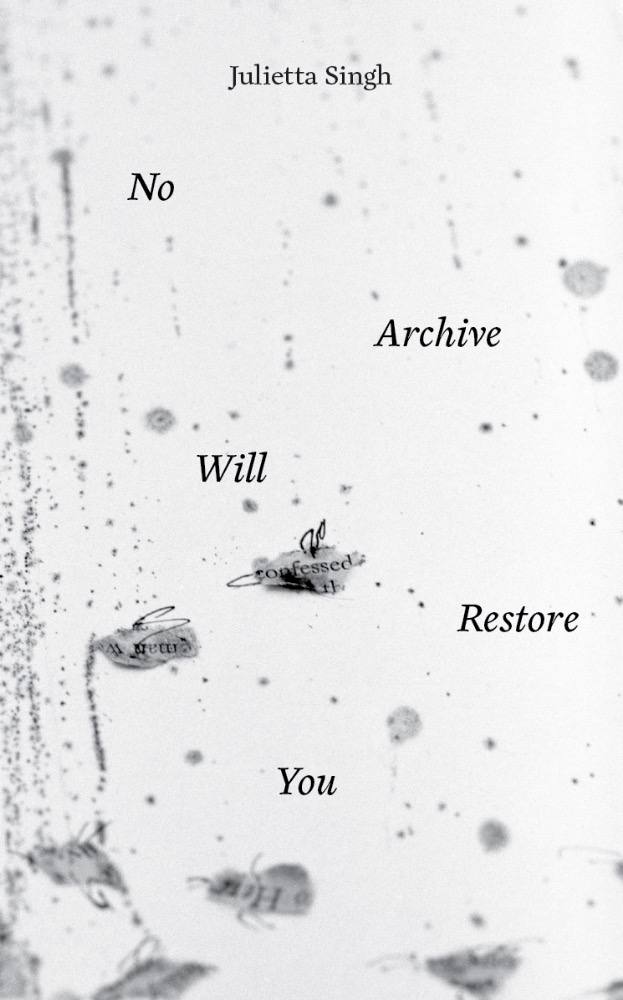
The short text is an exceedingly rich meditation on archives and archiving, speaking to the radical potential inherent in loosening our understanding of what an archive can be. Singh opens the text with Antonio Gramsci’s notion of the infinity of traces that make up each person: traces of history sedimented within us, and historical events that have formed who we are today, for which there is no inventory. In other words, we are made up of traces that are not always immediately legible to us, let alone organised or structured in any systematic way. Gramsci follows this with an invitation to compile an inventory in order to begin to understand ourselves. Singh, it seems, pushes against the possibility of such an inventory, asking instead whether we can simply sit with the traces rather than attempt to organise them; she resists impulses to categorise and systematise history in ways that entrench colonial modes of knowledge. In this sense, she also addresses how many of us feel seduced by the archive: ‘If only we could stumble upon the right archive, the secrets that no one else had yet discovered, we might still be one of the chosen ones. The archive was an opaque hope, yet it kept slipping away as though it didn’t want to found, plundered, excavated,’ (Singh 22). The book is primarily interested in this tension: our need for the ‘correct’ archive and its continuous slipping away. I am reminded here of Mersal’s conclusion that to know Enayat never meant knowing everything there is about her and her life, but rather to commune with her in some way, to engage in a kind of conversation.
This impulse appears in Singh’s writing too, especially in relation to the body. In a sense, her meditation is a conversation between her and her body, particularly in light of illness and the pain that comes with it. In her experimental writing, she moves us away from a stable, located archive, instead writing about the body as an ‘impossible deteriorating archive’ — messy, illegitimate, insufficient, excessive, sometimes even ‘monstrous’ (27). Yet to think of the body as an archive is also to be hopeful, a way of pushing against the strictures of reason. This addresses conceptualisations of the body as a key site of meaning-making and theorising, and as entangled with the mind rather than separate from it. Work in Indigenous Studies speaks to this understanding, which is found in many places around the world (Million 2009).
We are made up of traces that are not always immediately legible to us
Made up of time and matter, the body is always becoming and unbecoming, and always in relation to other bodies:
‘There is an archival crisis already looming here, because the body’s surface is ultimately not stable ground upon which to build an archive. Molecularly we spread into the “outside” world; our bodies as porous. The feminist formulations of the body insist on our vital entanglements with the outside world. We are not bounded, contained subjects, but ones filled up with foreign feelings and vibes that linger and circulate in space, that enter us as we move through our lives’ (Singh 30-31).
The non-boundedness of this kind of archive is a tempting invitation to those of us interested in conceptualising the archive as something in flux, rather than fixed or static. Elsewhere, Singh writes that our bodies ‘leak’ truths all the time, in that they reveal things we cannot conceal or prevent. For instance, gestures or bodily reactions that show what we really feel about something, or our body revealing that we may be in pain, or ill (Singh 30). Here, we see another kind of archive emerge, the opposite of boxes neatly stacked in a fluorescent-lit room. Because our bodies are never stable, on any level, they are an archive defined by fluidity and transformation. In order for us to study and understand them, they cannot be fixed in place. The body is an archive, Singh says, but it is also an archivist: ‘it gathers its own materials. Control over the assemblage I am turns out to be pure fantasy’ (32). I am reminded here of the moment Mersal gives up on Enayat’s box of belongings, understanding that she would have to come to know her in a different way. The relinquishing of control is perhaps one of the more difficult acts of dealing with archives; we are trained and taught to see archives as something we can mine for stories, the raw data for narratives we might already have in mind. This is pure fantasy, Singh reminds us.
As someone with a chronic health condition, I found Singh’s writing on the body archive and pain especially resonant. For Singh, pain is famously difficult to capture in words, even in poetry — it ‘fails to capture the pain of pain, its illegible core’ (61). While pain destroys our capacity for language, the body still has its own forms of communicating it. To hear or understand the specific forms of communication our bodies have, a different kind of listening is needed. In this sense, the body is an archive that needs to be listened to, rather than seen. This listening is still not an individual practice, though: pain, though felt intimately, is political, cultural, and historical. One way Singh explores this is through the question of racism, and how racism and colonialism produce embodied experiences of pain and trauma in a whole host of ways. As such, something we feel to be internal is connected to political and historical violence and inequality, and is part of why thinking of the body as an archive is tied to anticolonial and anti-racist understandings of the world (Million 2013).
The body archive is not separate or discrete. As an archive that moves through the world, it is both affected by others while constantly leaving traces everywhere and with everyone. Here again, we see the body as both archive and archivist. Where does the body start and end? And how do we archive something that is constantly changing?
The body is an archive that needs to be listened to, rather than seen
Like Traces of Enayat, No Archive Will Restore You also raises the question of ghosts. Singh is interested in traces that appear to disappear, for instance, memories that immediately become part of our unconscious, which Freud called ‘permanent memory-traces’ (97). These traces may constitute the origin of who we are, yet we can never really access them: the unconscious is ‘the most evasive archive of all, yet it is pulsing right there inside you’ (Singh 97). For Mersal, Enayat’s ghost appears as a guide; for Singh, ghosts instead gesture towards what we need to know, but can’t reach. In both instances, the haunting signifies a tense relationship with knowing: our desire and compulsion to know everything on the one hand, and the evasive nature of the world that prevents this on the other. For me, Singh’s archival experiment takes us on a different journey to Mersal’s: one marked by unknowing what we think an archive can be, but more importantly, questioning why we desire archives so desperately.
~
Iman Mersal and Julietta Singh approach the question of the archive in different ways, but both give us ways of engaging history that do not reproduce the static, fixed, organised, and disciplined nature of many institutional archives. The archive can be fragmented, dispersed, embodied, and felt; it often comprises things we don’t automatically even identify as ‘archives’. Both Mersal’s and Singh’s texts are a reminder that to engage with archives is less about finding out everything there is to know about something, and more about communing with the past. I read these books as experiments because they propose just that: that we experiment with what ‘archive’ means. To stretch a term beyond its conventional meaning is also to see entire alternate or new worlds and histories come into view, including those within ourselves.
Works Cited
Gordon, Avery F. Ghostly Matters: Haunting and the Sociological Imagination. U of Minnesota P, 2008.
Mersal, Iman. Traces of Enayat. And Other Stories, 2023.
Million, Dian. ‘Felt Theory: An Indigenous Feminist Approach to Affect and History.’ Wíčazo Ša Review, vol. 24, no. 2, Fall 2009, pp. 53–76. https://doi.org/10.1353/wic.0.0043
Million, Dian. Therapeutic Nations: Healing in an Age of Indigenous Human Rights. U of Arizona P, 2013.
Shilliam, Robbie. The Black Pacific: Anti-Colonial Struggles and Oceanic Connections. Bloomsbury Academic, 2015.
Singh, Julietta. No Archive Will Restore You. Punctum Books, 2018.
Stoler, Ann Laura. ‘Colonial Archives and the Arts of Governance.’ Archival Science, vol. 2, 2002, pp. 87–109. https://doi.org/10.1007/BF02435632
Trouillot, Michel-Rolph. Silencing the Past: Power and the Production of History. Beacon Press, 1995.


What shapes do solidarities take in these strange times we are living in? How can we find and forge solidarities when faced with genocides, human rights violations, and inexplicable injustices daily? Can storytelling play a role in liberation?
