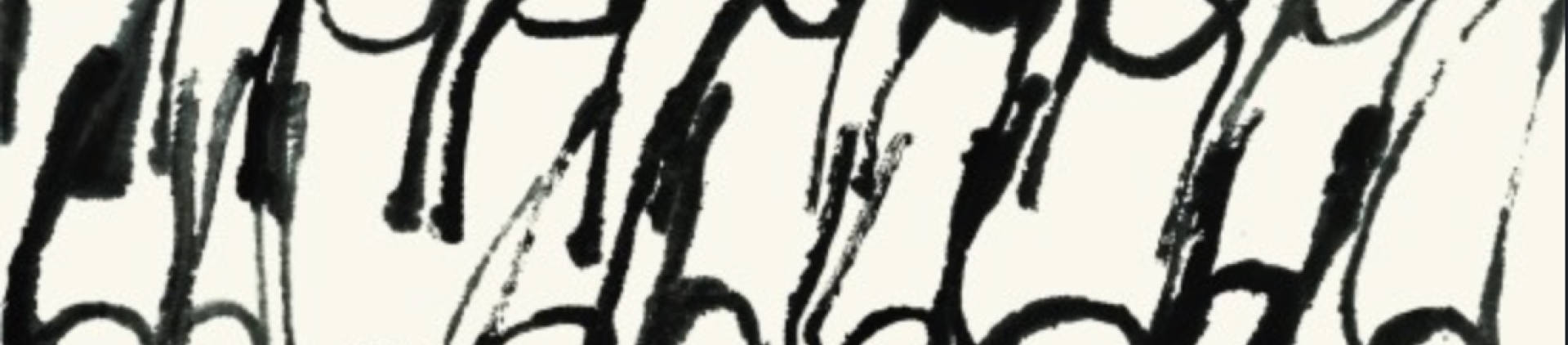
제. 타오르는 삶 [Burnt Offering] by SJ Kim
Braiding in readings of Don Mee Choi and Kim Hyesoon, this creative essay by SJ Kim reflects on translatability, Korean history, storytelling, patriarchy and femininity, and empire, through the performance piece Burnt Offering, performed by the 99ArtCompany in London last year.
In Translation is a Mode=Translation is an Anti-neocolonial Mode (2020), Don Mee Choi writes, ‘I come from a land where we are taught that the US saved us from Commies and that North Korea is our enemy. I come from a land of neocolonial fratricide. I come from such twoness. I speak as a twin’.
영혼에 울림을 주는 춤 is translated.
The translation is imprecise, as it must be, and what is easily understood is too restful.
The ritual takes place on and off the page.
Two sisters enter. Their hair is long and dark, bound with white cloth. Their uniform is in pale, neutral colors, passingly reminiscent of undyed 삼베 — that dying art, but recognisably too utilitarian for the material to actually be so. Later, the sisters will don what appear to be mining hats.
For now, the sisters kneel and pick up a stick of charcoal each from the centre. The sisters clasp their free hands together. This is an act of grounding. Their conviction stirs the air. They make gestures in turns: one sister stretching to trace a curve, almost a circle, almost, while the other gives and holds, anchoring as her sister, her sister shifts, steady as her sister draws as many strokes as smudges. The sisters work in tandem, their lines often intersecting, inexact.
How do we read such gestures — is the critic’s question.
Sometimes, while one sister repeats a curve or a line, tracing the act again and again, the other stares into the distance. She is turned away from the audience, or she looks right through – seeing something I cannot – and listening.
When the sisters rise and separate and work their way along a sharp white edge, aligning heel to toe to heel to toe, I dream of a life outcast, dancing upon a blade. I long for such a life of leaping into the air and landing on the ground, and in that span traversing the shoreline of life and death, returning to the space of the offering with the body housing a god, or a second soul.
Which is the more impressive feat — is the critic’s question.
My father taught me that art in Korean cultural history was the domain of beggars, charlatans, shamans, a realm of desperation. Our sad laughable little history is in the rhythm he says, but it is a rhythm across borders, a rhythm of every song. We gave the rhythm name, we wrote the incantation.
쿵 짝짝
쿵 짝짝
The rhythm can be sold as a happy love song, the way a decidedly ordinary man teaches a decidedly extraordinary woman how to move herself through a difficult door. I dwell in the space of the extraordinary woman’s surprise when confronted with a woman in love with another woman. This space is shaped by the extraordinary woman’s very American, Wow. W-o-w, she says, again and again, and I can see how her mouth moves, practiced, precise. Her mouth performs no translation, then. There is only imitation, base and acquiescent. In this space, I sit with a flare of irritation that cannot be snuffed by the simple truth that all representation holds real danger for real people.
To whom does citation belong — is the critic’s question.
Kim Hyesoon and Don Mee Choi taught me that storytelling is rightfully the realm of the feminine. And how this makes it all the more maddening that once the art was brought down from high upon the mountains, out from the groves of forests, over high walls with heavy gates, broken forth from barricades of bodies in the need to know and daring to be exposed – once the jingling of coins turned to the bitter rot of paper that is fire, paper that is flower, paper that is weapon – men laid savage claim.
여자의 몸은 어떻게 다루나?
여자의 마음은 무엇인가?
In <파묘> (2024), a young and powerful woman must learn how to serve the living without profit. She must learn this from an older and wiser man. She must learn to serve in a way that takes some part of her from her, the quiet end of the spectacle dwelling on her brokenness – through the eyes of another man, a younger man who loves her most – through him we feel the weight of her uncertainty, the depth of mourning for her irretrievable once self.
Burnt Offering makes no spectacle.
The translation is humble, as it must be, and what is easily understood is too full of grace.
In the post-performance discussion, another East Asian woman in the audience asks about the space of the feminine this work holds. Her question is in English. The answers come from the artists in Korean. A dedicated translator is present, and I am drawn to the gentleness of her deft handling, the earnestness with which she pauses for breath, laughs softly at the rapid tasking of her self. In this space, feelings are alchemised: transmuted, transformed, dissipated beyond, beyond. I understand why the answer posed to the question asked is both, as the artists speak to, a common question — and also one I feel is difficult to enter.
What is invoked, what is the lasting image — these are the critic’s questions.
The sisters don what I think look like miners’ hats. I have never seen a miner’s hat in real life. I have never met a miner.
But I have heard my father’s stories about the mineral wealth of our land. I have tasted his bitterness about the still largely untapped North, how it never had to be this way. For my next trick – America said – and two soldiers set forth with their compasses and drew over a map.
It is a difficult door to enter: how the space of the feminine could ever hold what a father knows, the way a father is not easily impressed with stories about iron rods in the mountains when a father has seen a man walking ahead of him step on a landmine, when a father had to talk the other man into stillness for hours, hours of sweating through their uniforms and watching for dawn.
When the sisters strap on the miners’ hats and wade sweetly out into the dark of the audience, it is the first time in a long time I long for the light to be held to my face, my full face looked upon with an open curiosity. But I am seated much further back, and this means I wonder if I am alone in marveling at how much when the light comes to dwell no longer on a human face but on the body of the 가야금, the 거문고, these bodies appear to be more of sinew and bone than ours, and how they are in the possession of the swell of a belly that is uncomplicatedly beautiful, how reassuring these carcasses are. When I remain, I will be beautiful, too.
I am used to now, after giving lectures on my interest in cultural studies and creative practice, receiving questions about Buddhism from a white person. Never about Catholicism, the mode in which I was more forcefully taught to pray.
So, as far as I can recall, prayer has always worked this way. This is the body. This is the blood. I can put whatever I want into a prayer and be forgiven for it.
A Korea must exist without America. We must work it so. The empire must grow an even hazier memory, London only ever a small if sometimes loving stage.
So, my gaze does not dwell on the shadowy flower, on the burnt remains of a working drawn in fire. There is some scent that reaches me from some immeasurable distance, but this is not what remains.
What remains is the slender silhouette with a long braid over a shoulder brought to a focus that I feel not as a singular point, but as a fuller sense, in the way fever can be experienced poetically on the page, without concrete pain — I have lived a good life.
In that moment, I do not feel the heaviness of my own body — that pressing tenderness comes only upon reflection.
The critic must reason that the slender body works differently here. The hold of the slender body is safe here, adoring, and prayerful. The slender body is here to serve, and only serve, see how the slender body serves. Just look upon the sisters’ darkened to absence feet, which are no more here, but elsewhere, worked off. To pray is to sweat, to pray is to sweat and ash and sister.
I want to stay in the moment. I am able to stay in the moment. Here, I stay.
In closing, four miners’ hats are laid out along the border between artists and audience with a singing bowl and its wand in the center. The artists are unburdened now, but it is the audience’s turn to look upon the ensemble in the light with some kind of wonder: there they are, two other dancers who stepped in and out as more shadowy sisters, and two musicians dressed in black who endured dutifully in the dark with little more than candlelight throughout.
Of the objects, I remember best the brass bowl, the brass bowl.
With works that profoundly touch me, I feel a desperate desire to hold as much of it as I can in my mind, exact, intact, preserved. But here I feel no such compulsion, only that desire to better understand fever, to hold fever in some softer and surer place, unalone. A singular, cyclical sound resounds, still.
The artists are sweaty from the labor, the unending labor of our charge, our toil for all time to protect what is frail, what we have been shown can be easily broken from us. Frail is the hope of a mother cradling her cheek against a daughter’s and whispering to her of how the sun has risen, again.
I have never known such a gentle mother, but again, this comes only upon reflection, that unending longing for a woman to move through the world as something other than a mother.
Who is the offering for (and why in heavens/on earth is it burnt) — is the critic’s question.
And where is my ungentle mother?
I follow my mother into a cave.
The structure does not go deep, but the darkness is weighty, the walls competent though weeping openly in parts and lined with moss. There is just enough space to raise an altar where fruit and meat will rot quickly and wine will sour come distant birdsong. For now, there is a single fat white candle. If you could really see just how bright the flame is when my mother lights it, you would believe in her power, too.
My mother squats before the light and clasps her hands together, the length of her fingers parallel to the ground. I watch her movements and not the shadow on the wall and can still make out just fine: wolf, goat, fox, hound, ox, pig — rabbit, rabbit.
I have witnessed, largely from the fringes – off the page – how religion can prey on immigrant communities, how rites can damn families by damning individuals first, how readily prayer can replace other words that need to be spoken aloud.
Dancing for the Devil (2024) doesn’t so much expose a Korean American man who became a cult leader primarily for wealth and to sexually abuse women, as much as it tries to expose the way women are altered by trauma. The scene I find I cannot view beyond holds two sisters kneeling across from one another, with a low table between them. One sister escaped the cult sooner than the other. The sister who remained, devoted herself further in order to save, at the very least, the soul of the sister lost to her. Their drinks are half empty. They have been there for some time when the audience becomes privy to their conversation.
One sister says to another — I am a dysfunctional sister.
I don’t know what it means to care about a child.
She cries — Look at me.
How can you put that burden on me?
I either show up or I kill myself.
The critic possesses the capacity to look away and the critic’s eye is easily distracted, as it must be. I imagine a mother and daughter in a cave and write the beginning of their story instead. I can only return upon reflection, and when I return, I am even more convinced than before — and so, I long for much more than before.
Jang Hyerim of 99Artcompany speaks of the difficulty of enacting Burnt Offering, how the work felt like it could kill her and her collaborators. Jang and the other performers would motivate one another by saying — Let’s die on the stage, then.
I understand when rage is tempered by gratitude and a desire to serve, it must be named something else. And so, 제. 타오르는 삶 is made a burnt offering.
But I have seen the smouldering. I am ready for some spitting now, no mercy, some kind of secretion that will leave no shelter of our bodies.
The offering is not for you. The offering is for baby, for teeth, for child, for beauty, for this, for ah, for oh, for the thinning of lips without teeth touching, or touching them together if the want is there, the offering is moving the mouth in many other ways, pushing air out, drawing air in, pushing air out, offer now, offer how, offer why — the offering is I, I.
Burnt Offering by the 99Artcompany was performed on 25 May, 2024 at The Place as part of A Festival of Korean Dance 2024. The company is led by the choreographer and artistic director, Jang Hyerim, dancing alongside Jang Seoyi, Lee Gowoon, and Lee Sookyung with musicians Hwang Gina and Lee Hwayoung performing on stage. Further credits include Hwang and Ju Bora as music directors, Lee Johee as writer, and Chae Min as dramaturg. A post-show discussion was translated by Rho Seh Hyun.
WORKS CITED
Choi, Don Mee. Translation is a Mode=Translation is an Anti-neocolonial Mode. Ugly Duckling Press, 2020.
Dancing for the Devil: The 7M TikTok Cult, dir. by Derek Doneen. Netflix, 2024.
Exhuma, dir. by Jang Jae-hyun. Showbox, 2024.
Extraordinary Attorney Woo, dir. by Yoo In-shik. Netflix, 2022.
Kim, Hyesoon. I’m OK, I’m Pig! Bloodaxe Books, 2014.
Image: Se-Ok Suh, Dancing People, 1989 via WikiArt


Our spring issue explores the concept of the periphery from various perspectives. Edited by our former Deputy Editor, Durre Shahwar, this issue includes writing on the climate, body, justice, migration, translation, illustration, and much more. It also features the 2024 Queen Mary Wasafiri New Writing Prize winners; a lead feature on Centring Justice by Professor Sunny Singh; interviews with Don Mee Choi and Claudette Johnson; and a review essay on Urdu literature in translation.
