Wasafiri at Large: Ecological Awakening in the Novels of Contemporary Turkish Women Writers
Wasafiri works with Editors at Large across South East Asia and Aotearoa New Zealand, and the Middle East. During their tenure, each Editor at Large writes a piece reflecting on an aspect of their literary locality. In this piece, Şermin Sezer-Toraman reflects on how contemporary Turkish women writers, through works blending magical realism, ecocriticism, and the spectre of the recent pandemic, address the interconnectedness of nature and women's oppression.
I have always been a lover of books. In 2006, I decided to pursue my postgraduate studies in English Literature after graduating from the English Language Teaching programme, not because I was particularly interested in English literature, but because my postgraduate studies had to be relevant to my bachelor’s degree. During my postgraduate studies, being quite busy with meeting deadlines and reading what was on the syllabi, I almost lost contact with contemporary Turkish literature. Meanwhile, Wasafiri was always a great source of study, as I was particularly focusing on postcolonial and diasporic literatures. When Wasafiri asked us Editors-at-Large to write about our own region’s literature, I felt excited at the chance to critically observe the latest tendencies in modern Turkish literature.
After surveying the works published in Türkiye in recent years, I wanted to focus on women writers, since their work would speak to my positionality. My research demonstrated that many Turkish women writers focus on the relationship between nature and human beings in their works. Since patriarchal society dominates nature and women alike, it is not surprising to see that women writers have an interest in nature, as eco-critics suggest. In the post-industrial era, nature is abused and exploited, and has lost its holy grandeur. Therefore, ecofeminism has emerged as a theoretical framework that links the deterioration of the environment with the oppression of women. Contemporary Turkish women writers may or may not have this theoretical agenda in their mind when writing, but ecological unease is evident in their works. As a woman and feminist academic, I enjoy tracing women’s experiences as represented in literature. Accordingly, I will focus on how Turkish women writers respond to the deterioration of nature in the modern world. To this end, I will introduce three novels: Zamansız (Timeless) by Latife Tekin, Aç Koynunu Ben Geldim (Open Your Embrace, Here I Am) by Aslı Tohumcu, and Yarın Yok (No Tomorrow)[i] by Ayşe Kulin.
To start with, Timeless by Latife Tekin raises ecological concerns similar to those in her previous novels. It is a love story between an Eel and a Weasel, two animals dwelling in the same lake. Their idyllic relationship is interrupted by the introduction of a bag thrown into the lake by the mysterious Woman in White. What is inside the bag generates a series of events, including Weasel's act of throwing the bag back into the lake and Eel's subsequent abandonment of him. The love story unfolds in a pastoral setting, dominated by sounds of nature. Set in an ambiguous time and space, it becomes a novel of all times. While the narrative, which adopts magical realism, expands the boundaries of dominant prose with poetry, music, and the sounds of nature, the novel clearly expresses a desire to ‘[b]uild language for an unknowable intimacy’ (Tekin 36). This language is poetic and evocative. Instead of weaving the story with an abundance of words, Tekin meshes it through images, which are highly suggestive. In this sense, going beyond the limits of traditional representation, she creates a unique language of her own, which challenges dominant modes of representation. She uses a non-logocentric language, turning the novel into a critique of anthropocentricism. Eel and Weasel as new and unfamiliar subjects can be seen as the result of detachment from mainstream thought and lifestyles. As the novel is open to transformation, so too are the processes of knowledge and knowledge production. I would also like to point out that this novel was written during the COVID-19 pandemic. In a time when everyone was confined to their homes, the writer traces a love relationship that is open to transformation and metamorphosis in the fictional world. If we reflect on our own experiences of the COVID-19 pandemic, we can remember that we lost our agency by abiding to the rules of WHO and governments. This loss of agency blurs the differences between the human and non-human, which finds its representation in Timeless.
Open Your Embrace, Here I Am by Aslı Tohumcu shares similarities with Timeless in the sense that they both employ magical realism, raise ecological questions, and problematise the concepts of time and space. This unique love story begins with a dream by a dagger maker, Kançıkarmaz Memet, who forges two magical daggers destined for a special couple. These daggers incite strange occurrences when a spell cast by Memet’s wife goes wrong, turning the novel into a surreal love story, anchored by two daggers — one of which is crafted with earth and the other with fire. The story then focuses on Rüya and Mutlu, the owners of the daggers, as they embark on a journey to find each other. Set against the backdrop of a clash between nature and humanity, or perhaps a longing to rebuild this relationship, the novel delves into the life of a girl named Rüya, who was deserted by her parents and raised by a crow named Mürşide, in the grave of a woman named Cavidan. It also follows the life of Mutlu, a man who believes in the power of words and spends his time recording words that are disappearing while he is away from his homeland. Before they can find each other, Mutlu is forced to live in places where he longs for his mother tongue, and Rüya faces many risks, such as the danger of being killed by a voyeur who wants to possess her dagger. Their love story unfolds in a blur of myth and reality, creating a sense of wonder. While the story emphasises the timeless nature of love, it also throws in unexpected mundane details, like Mutlu’s references to Jung, herbs, alcoholic drinks, marzipan, and Tante Rosa, a Sevgi Soysal novel, that disrupt the fairy-tale effect. When Rüya and Mutlu are united, they represent different personalities. While Mutlu has a more scientific mind, Rüya, on the other hand, loves to wander in dream worlds fostered by natural images. They respect each other’s choices and boundaries, believing in everyone's right to live as they wish. However, the tone of the novel favours nature over culture, as the story progresses predominantly through natural images.
Likewise, Ayşe Kulin's latest novel No Tomorrow transcends realistic representation, finding itself in sci-fi while presenting a captivating story set in a dystopian future, oscillating between the past and the present. The novel obviously highlights contemporary human beings’ faults against nature and their probable fatal consequences. The protagonist, Mira, is a scientist who lives in a world of high technology where wars are a matter of the past and people enjoy equal rights. Despite these ideal conditions, Mira feels a deep unhappiness, directing the readers to question the meaning of happiness in a world where everything is carefully and strictly planned, restricting human agency and freedom — a lack of passion or ambition leaves the human subject with a sense of emptiness. Mira’s life becomes more colourful when she is left with no choice but to contact one of her ancestors, who is supposed to know how the Tayro virus – a virus threatening humanity – was created in a laboratory. In this quest, Mira rediscovers who she is. Her communication with people from the past illuminates important historical events in recent Turkish history, addressing current issues such as social justice, gender equality, and ecological awareness, while showcasing another woman’s work that questions the flaws of contemporary human beings. For example, the Tayro virus shares common characteristics with the Coronavirus, having deadly effects on children, the elderly, and people with chronic diseases, resonating with our recent experiences. Kulin also refers to nature activism in Türkiye. While the novel might appear to be merely sci-fi at first glance, it raises philosophical questions and invites the reader to learn from the mistakes of the past in order to build a better future.
To conclude, in contemporary Turkish women writers’ works, there is a tendency to go beyond realistic representations, which is accompanied by concerns about ecology, highlighting how women’s place in patriarchal society might have caused an empathetic relationship between women and nature. By addressing ecological concerns in their novels, contemporary Turkish women writers contribute to a broader cultural conversation about environmental sustainability and social justice. Their works offer valuable insights, challenge dominant narratives, and inspire readers to be more engaged with the issues of our time. They all offer a critique of patriarchal and industrial structures that ignore wrongdoings against nature and women. The language Turkish women writers use also problematises the values of contemporary human beings. Now that the pandemic is behind us, we must think about the questions it brought into our lives. Human anxiety finds its expression in novels, serving as a warning to humanity to treat nature with ecological consciousness rather than anthropocentric hubris.
Works Cited:
Kulin, Ayşe. Yarın Yok. Everest Yayinlari, 2023.
Tekin, Latife. Zamansız. Can Yayınları, 2022.
Tohumcu, Aslı. Aç Koynunu Ben Geldim. İletişim Yayınları, 2023.
[i] These novels have not been translated into English yet. I have translated the Turkish titles into English. Aç Koynunu Ben Geldim has metaphorical meaning, and it is hard to directly translate it. Direct translation is Open Your Bosom, Here I Am. To 'open one’s bosom' may denote a physical action for the non-Turkish reader, but in this novel, it takes on an emotional meaning. Here, the word ‘bosom’ represents abstract concepts such as a person's inner world, heart, or a safe haven. Therefore, the phrase ‘open your bosom’ conveys a meaning similar to ‘open your heart to me, trust me.’
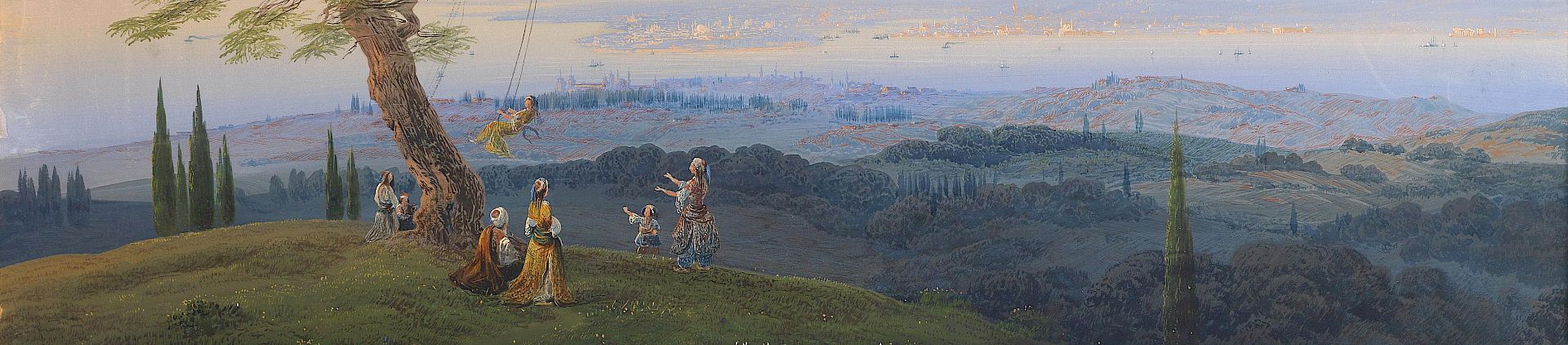
Image: Evening pleasures outside the gates of Constantinople by Carlo Bossoli, 1841, 39 x 60 cm, tempera on paper via Wikimedia Commons

