
Evenings in Diaspora by Sylvia Alajaji
In this life writing excerpt from Wasafiri 120: Armenia(n)s – Elevation, Sylvia Alajaji explores the emotional, historical, and cultural nuances of Armenian diasporic existence, interweaving personal memories with collective ongoing struggles, and drawing on music as a medium of cultural preservation and identity.
You can read and download the full piece for free during the month of December, or read it in the print issue of Wasafiri 120: Armenia(n)s – Elevation, now available to purchase.
deep in your eyes
keep
the invisible
— Krikor Beledian, ‘Unpeopled Language’
They bombed our neighbourhood. We can’t reach your grandparents. Get ready for school.
Mornings in diaspora can be excruciating. You wake up and the news comes trickling in. You realise that while you slept, your other world writhed in pain. As you slept, your other world – the one that holds your heart in a vice – was destroyed. And you slept. You slept.
Good morning, there was an explosion. Good morning, they bombed the airport. Good morning, there was an earthquake. Good morning, we lost Artsakh.
You wipe your tears. Get dressed. Go to class. Go to work. Swallow the rage. Swallow the grief. You go through the motions. You’re a shell. You pretend. As the day goes on and the needs of this life take over, it becomes easier, and eventually you split into two. This life here, so far away from there, becomes not so much a distraction but a self existing in parallel – in counterpoint, to borrow from Edward Said – with the part of yourself that is still, always, over there (186). You await the evening, when your other world is deep in its sleep and the news begins to slow.
In the day, the predetermined structures and patterns of life in the West keep the overlap of the contrapuntal selves at bay. It is often in the evenings when the parallel voices of this contrapuntal existence can begin to commingle in a harmonic language recognisable to only a few. It is often in the evenings, while our other world rests, when the day’s accumulated residues can be attended to, and the contradictions and incommensurable aspects of diasporic existence given form. They are not always pretty, these forms. The residues that collect are not always the things that give way to those quintessential scenes of diasporic existence: overflowing tables of food, joyous dancing, communities of makeshift cousins, aunts, uncles, and grandparents talking laughing singing against the backdrop of the night sky, bringing together this home and that home pari passu. ‘Psyche time’, as Gillian Rose terms the night, can also be a time of reckoning, as you realise amidst the din of the polyphony that surrounds you, that the home that became your refuge is the one that stands by as your other writhes; and, perhaps most painful of all, that the only way in which you can speak your pain so that it’s understood is in a language that will never give you the words that you so desperately need (70).
But I get ahead of myself. In the evenings, there is music.
֎
Sylvia, did you see this? (Ignore) Sylvia, this is baba. Did mama send this to you? (Ignore) Hi Sylvia! I just came across this video and thought you would love it. (Delete) #Komitas #Shushi #ArtsakhStrong
I began receiving messages about the video early in the day on 12 October 2020. I had already seen it before the messages began to arrive. Well, okay, I had seen maybe five seconds of it, but enough that I knew I could bear no more than that. By then, it had been fifteen days since the beginning of the attack on the historically Armenian region of Artsakh (Nagorno-Karabakh) that Azerbaijan had long been vying to control. It had been sixty-nine days since the explosion in Beirut – the largest non-nuclear explosion in history – that had brought it to its knees. Mornings brought an onslaught of barely bearable news, laid stark by the light of day.
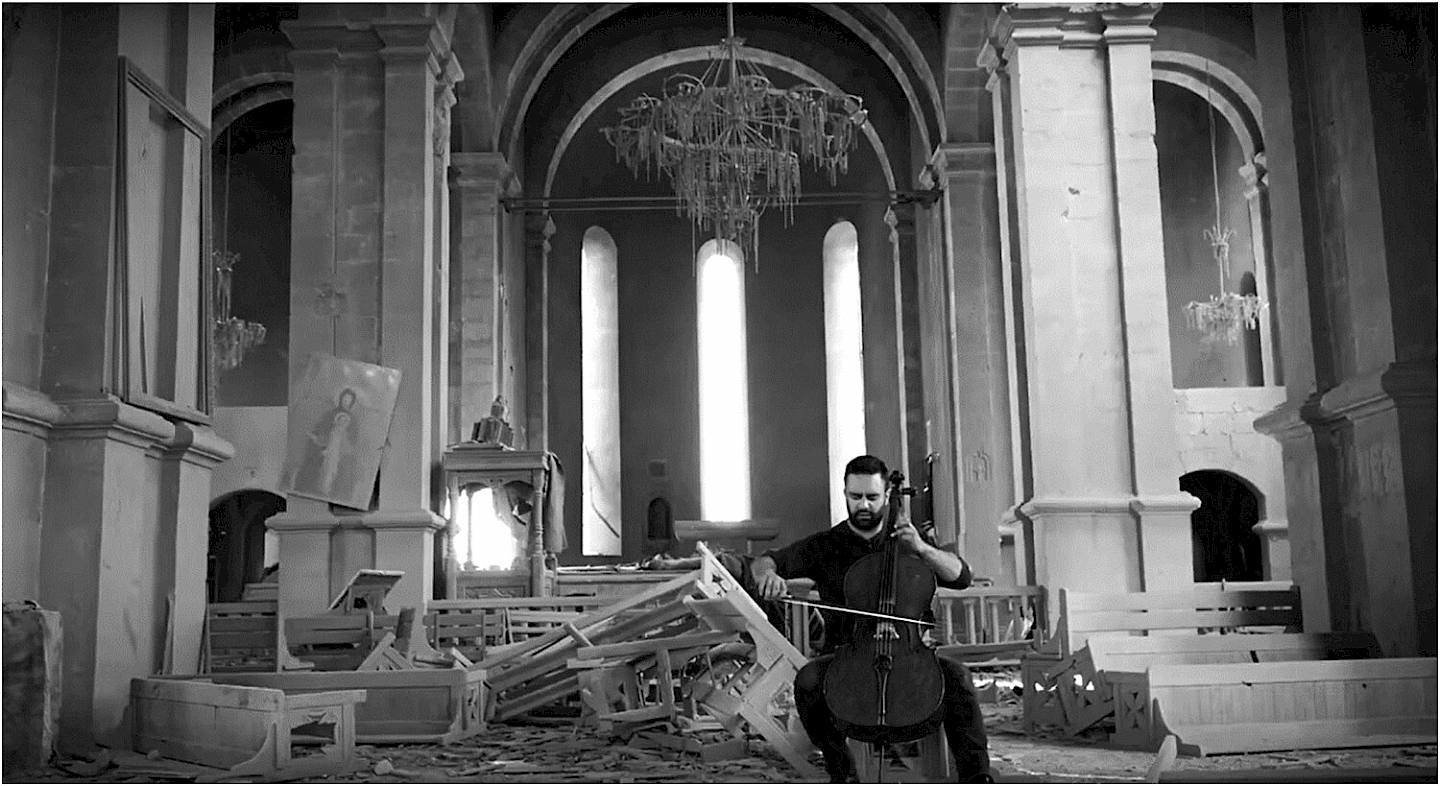
Sevak Avanesyan performing Komitas in the Holy Saviour Ghazanchetsots Cathedral in Shushi, October 2020. Credit: Screenshot with the musician's permission
The video was of a performance of ‘Gṛung’ [Groong/Kroonk], perhaps the most iconic and recognisable song to Armenians the world over. It was being played by the Belgian-Armenian cellist Sevak Avanesyan in the ruins of the Ghazanchetsots Cathedral in the soon-to-be captured city of Shushi (Shusha). Once one of the largest Armenian churches in the world, Ghazanchetsots was destroyed during the Shushi massacre of 1920, rebuilt in the 1980s, turned into an Azerbaijani armoury in 1988 amidst the expulsion of Armenians from Shushi during the First Nagorno-Karabakh War, reclaimed by Armenians during the city’s recapture in 1992, and then hit by shelling only days before Avanesyan’s defiant performance. Less than one month later, Shushi, the ‘beating heart’ of Artsakh, would fall. Almost three years later, in September 2023, there would be another attack, a surrender, and Artsakh would be gone.
The song’s lyrics, versions of which date from the seventeenth century, are an exile’s lament:
Կռո՛ւնկ, ուստի՞ կուգաս, ծառա եմ ձայնիդ,
Կռո՛ւնկ, մեր աշխարհեն խապրիկ մը չունի՞ս ․․.
․․․ Ինձ պատասխան չտվիր, ելար, գնացիր,
Կռո՛ւնկ, մեր աշխարհեն գնա՛, հեռացի՛ր:
Gṛung, usdi gukas? Dzaṛay em tsaynit
Gṛung, mer ashkharēn khabrig mě ch‘unis?
… Indz badaskhan, ch‘dvir, yelar knatsir.
Gṛung, mer ashkharēn kna, heṛatsir.
Crane, whence do you come? I am a servant to your voice.
Crane, from our land, have you any news?
… You gave me no answer, you left.
Crane, leave our land, go away.
It is a song ever-relevant, a palimpsest of Armenian exile and pain. For while there is a land today called Armenia, there are also Armenians from lands outside that land. The stories of the Armenians who lived in the remnants of the once vast kingdom consist of a series of mass displacements; Armenians were there, until they were not. From the late nineteenth-century massacres and 1915 genocide of more than one million Armenians in the Ottoman Empire to the late twentieth-century pogroms and ethnic cleansing campaigns of Armenians in Nagorno-Karabakh, these are stories of incomprehensible loss and survival, and of a desperate yearning for something no longer there ...


From poetry and fiction to newly released book reviews, art, and interviews – cover to cover – our 2024 winter special issue, Wasafiri 120: Armenia(n)s – Elevation, guest co-edited by Tatevik Ayvazyan and Naneh V Hovhannisyan, shines a light on modern Armenian identities and experiences. Alongside personal stories of love, loss, and memory, the volume speaks to current global issues – displacement, fragmentation, and conflict — all with eloquence, and all, ultimately, for elevation. This is your jukebox issue of contemporary Armenian writing, with varied content for varied tastes.
