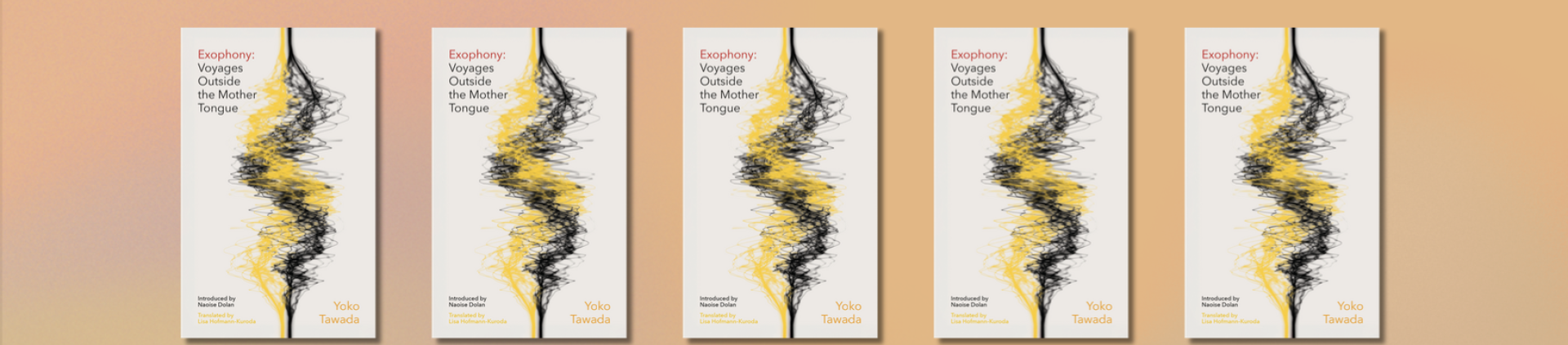
Extract – Exophony: Adventures Outside the Mother Tongue by Yoko Tawada
In this exclusive extract, Yoko Tawada – translated by Lisa Hofmann-Kuroda – considers the place of categorisation in literature. Her own writing is housed variously under ’Japanese Literature‘, ’Women's Literature‘, and ’Literature of Colour‘, among others. Here, Tawada breaks down these artificial boundaries to see the words beneath.
Gainesville: World Literature, Reconsidered
In the spring of 2002, I gave a lecture at The University of Florida in Gainesville. Afterward, someone asked me what I thought about the distinction between 'Japanese literature' and 'world literature.' The person who asked the question seemed to have some familiarity with Japan, where this is a common way of categorising books. I never thought anything of it when I lived there, but it now struck me as odd. After all, separating 'Japanese literature' from 'world literature' implies that Japan is not a part of the world — that 'the world' is something outside of Japan.
This is not quite how things are done in Germany. For example, my Dictionary of Modern German Literature categorises its entries 'German-language literature' and 'foreign-language literature.' Not 'Japan' and 'the world' but 'German language' and 'foreign language.' Using 'German literature' would have excluded writers from Austria and Switzerland, as well as Turkish and Czech writers who write in German. This still posed a problem for me, however, since I write in both German and Japanese. When I asked the editor of the dictionary which category I should be listed under, they said they supposed I should be listed under both. All borders exist in order to be crossed.
Recently, an anthology of Japanese literature was published in Russia. There were two volumes in this anthology. One was titled OH ('him' in Russian) which contained only works by male authors, and the other OHA ('her') which contained only works by female authors. This is another way to categorise literature, one that Japanese bookstores often use as well. It reminds me of my student days at the University of Hamburg, when the idea of 'women’s writing' was being fiercely debated. But the Russian anthology of Japanese literature wasn’t forwarding any kind of theory of gender and writing. It was more akin to how a department store divides their clothing into 'men’s' and 'women’s' sections. Recently there was a series published in China called New Works by Chinese and Japanese Women Writers. It would have been interesting if the series had completely rejected national categories in favor of gender, but all they did was add the qualifier 'Japan' to 'woman.'
The whole academic debate about women’s literature being different from men’s literature and gender being different from biological sex eventually led to the conclusion that even works by male authors could fall under the category of 'women’s literature.' (At that point we had decided that all our favorite authors were women, be they Kleist or anyone else.) But just when we thought we had gotten to the bottom of things, people began to argue that the question of 'biological sex' couldn’t be completely ignored either. Eventually I came to the conclusion that while both sex and gender were part of the equation, in neither case did it delimit what an author could write.
In Germany, there is yet another category called 'immigrant literature,' which I am sometimes included in because I have written books in German. In interviews, I’m often asked how I feel about being called an immigrant writer, and whether it bothers me to be defined that way. In Japan, interviewers sometimes ask how I feel about being referred to as a joryu sakka — a woman writer. Nowadays the more common term is josei sakka, but I wonder if the 'ryu' in joryu is a more appropriate description of gender, since the character means flow, current, or stream in addition to style or mode. The 'sei' in josei means sex, indicating a set of characteristics you were born with, but 'ryu' describes doing something in a particular way or method. A method is not permanent. There is no need to stick with it. You can wash it away any time you like. Maybe one person is taught that a 'woman' is a particular kind of thing, and that is how they happen to be going about it, but another person might decide that that mode of womanhood is uninteresting and choose a different one. In that sense, perhaps when we use the term joryu bungaku, or women’s literature, what we’re describing is writing by a person who is existing in a womanly 'mode' or 'way.' To use the term josei bungaku implies some innate characteristic I was born with, which doesn’t seem right. The term takes itself far too seriously.
In North America, it’s common to foreground the issue of race in a way that’s less common in Germany. Once, I was invited to a literary festival in Canada, and was surprised to find myself listed in their program under 'Literature of Color.' At first I thought it was describing my work as colourful, but apparently it was referring to literature written by people of colour. These included writers of African and Asian descent, and I was asked to speak as a writer from this category. It made sense in the North American context, where social problems stem from the divisions between white people and people of colour, but it maps less neatly onto the German context. Foreigners in Germany who are targeted by neo-Nazis include Russian returnees, Polish, Jewish, Italian, and Spanish people, as well as people from the former Yugoslavia. All of them are technically white. Of course there are also incidents in which African, Turkish, and Vietnamese people are attacked too, but still, the stark division between white people and people of color does not make as much sense in the German context.
There are more unique ways of categorising literature. A few years ago, there was a multiday literary festival in Berlin whose theme was 'sex.' The first day was about 'Heterosexual Literature,' the second was about 'Homosexual Literature,' the third on 'Fetishes and Sadomasochism,' and the fourth was simply called 'Other.' I was invited to read on the fourth night, probably because I am an animist who experiences objects, trees, and letters as erotic. On the night before the festival, someone called the venue and asked: 'What kinds of things do people in the "Other" category do?'
Weimar: Small Languages, Big Languages
In 1999, I went to Weimar for the 250th anniversary of Goethe’s birth. They invited me to be part of a panel on the concept of 'world literature,' which Goethe came up with, and asked me to talk about what I thought world literature meant in the twenty-first century. The first thing that came to mind was translated literature. I wasn’t interested in thinking about world literature as opposed to national literatures, but I was interested in the way words change when they cross national borders. So I talked about how world literature might be understood as translated literature, since the only way we can access 'world literature' at all is through translation. Translation is often thought of as a necessary evil. And although the question of translation had rarely been considered in relation to literature more broadly, I decided to proceed from the idea that world literature was first and foremost translated literature.
Durs Grünbein and Ingo Schulze, both young German writers, were on the panel, as well as Ben Okri and Yang Lian, from Nigeria and China, both of whom live in London.
Ben Okri said that he couldn’t count the number of times people had asked him: 'Isn’t it impossible to depict the real Africa in English? Shouldn’t you be writing in your local language instead?' I agreed that that was a strange question. English is a language that constantly absorbs different elements into itself, and besides, there are many different Englishes. The whole premise of the question suggests that English can only describe things that happen in England. You can’t decide in advance what any particular language is suited to describing. Besides, there is no such thing as 'the real Africa' — there are infinite ways of experiencing Africa, grasping it, and expressing it. It would be ridiculous to ask which authors are depicting the 'real' Germany, and the fact that people simply look at a developing country and immediately think there is some 'objective' reality there to be described is absurd. The words we use and the things we describe have infinite faces. And of course, there are many faces that have yet to be discovered.
But I sensed that the question directed at Ben Okri, which includes a tacit criticism of African writers who write in English, also implies something else: that he should be 'saving' the minor languages on the verge of extinction. In other words, the writer is made to bear the role of an ambulance, rushing to rescue endangered languages. Languages disappearing or being forgotten is certainly not a new phenomenon, but only in the last century or so has there been a concerted effort to put them on life support and try to save them. As English continues to spread throughout the world and Europe tries to create a unified identity for itself through the creation of a single currency, there is also a growing countermovement to save minor languages. In some regions of Switzerland, Rhaeto-Romance is now taught in schools, and can even be heard on the radio.
Poets are often seen as an important vehicle for protecting these minor languages. You cannot really say that a language is 'living' if no poetry is written in it. The fewer number of speakers there are of a given language, the greater the proportion of poets. It is difficult to say whether that is because a dying language tends to convert more speakers into poets, or because the government offers more support for poets writing in those languages. The Sorbian language spoken in the Bautzen district of eastern Germany is a good example of this. There are at most 3,000 Sorbian speakers in the district, although most of them also speak German as well, and I have met three poets who write poetry in Sorbian. Proportionally speaking, that would be like America having 280,000 poets. In East Germany, the Sorbian language received direct support from the government — perhaps because it would reflect well on East Germany if they showed that Slavic minority languages were respected.
The proportion of poets who speak a minor language as their mother tongue is also unexpectedly high, and the same applies to readers of poetry. The German poet Hans Magnus Enzensberger once wrote that on average, a book of poetry sells about 2,000 copies, whether it is published in Croatian or English. The population of the United States is sixty times bigger than that of Croatia. Which tells us that, proportionally speaking, poetry in Croatia sells incredibly well.
However, since few people can read literature written in minor languages, most of the time it ends up getting translated into languages that more people can read. At which point, the vocabulary of the language that is dying out — its rhythms of thought, its way of telling stories, its images and myths — seeks refuge in the major language, becoming dislocated, disoriented, and unsettled. But nothing could be more stimulating to literature than this. Which is why translated literature becomes a vehicle for the transformation of major languages.
When writers who speak a minor language as their mother tongue begin to write in English or another major language, it causes a shift to occur in the major language. And this is not limited to language in the narrow sense of the term. The specific angle from which one regards history, the sensory systems that capture magical things, all of this enters into the language of literature. People from smaller communities have an easier time avoiding the danger of regarding history from the vantage point of the victors. At the same time, magic often manifests itself in minor languages in different ways, due to temporal and qualitative lags stemming from smaller communities’ pace of industrialization.
Yang Lian, the Chinese writer based in London, had the opposite stance to Ben Okri’s: He had no desire whatsoever to write in English. He said he couldn’t stand the kind of flat English used in immigrant literature in England or the United States. Of course, Chinese is not a minor language. When Yang Lian reads aloud in Chinese, the words pour out of him like a torrent. Perhaps it is no coincidence that the next time I saw him was near Niagara Falls. The sheer volume of water was immense. There was something incredibly strong in the current. He told me that one of his favorite poets was Qu Yuan. Later I went back and read 'Heavenly Questions' and was fascinated by the rhythm of his thought. How could anyone ever render this in English, I thought. If this is what poetry meant to Yang Lian, I can only imagine how ridiculous it would sound to him for someone to suggest that he write in English. But I think it would be fascinating if the voice of Qu Yuan were to make its way into English and change the current and flow of it from within.
An extract from Exophony: Adventures Outside the Mother Tongue by Yoko Tawada, translated by Lisa Hofmann-Kuroda. The book, with a foreword by Naoise Dolan, is published by Dialogue Books.


