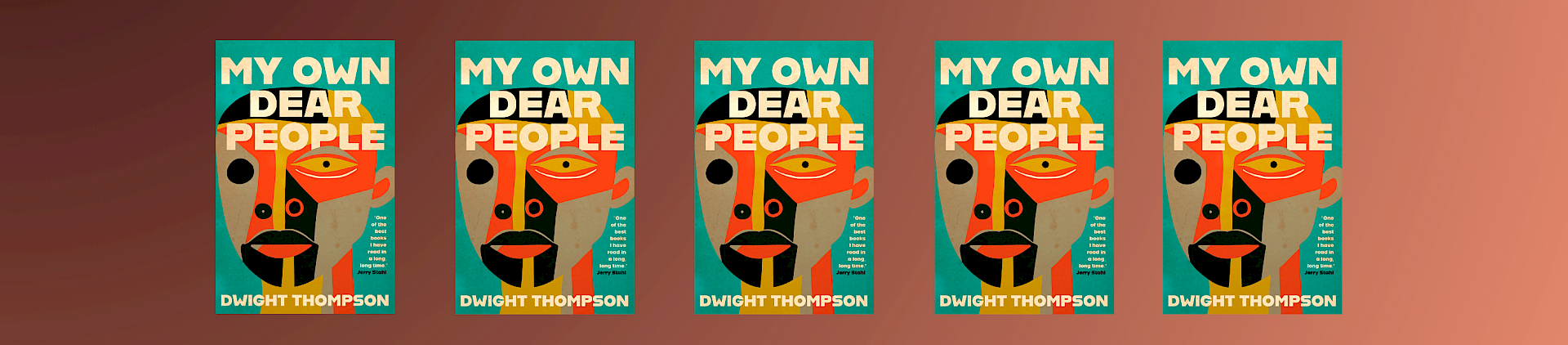
Extract: My Own Dear People by Dwight Thompson
Read an extract from My Own Dear People, the forthcoming novel by Jamaican writer Dwight Thompson, accompanied by a special introduction from the author. The story follows a young man named Nyjah Messado upon his return to Montego Bay – a city that is a vitrine for foreign tourists, yet pockmarked with danger for its local residents. Nyjah is haunted by the memory of witnessing an immense act of cruelty at the elite boys' school he once attended. In MoBay, he meets a young woman named Andrene and is forced to reckon with his own masculinity and actions in a society frequently hostile to women and queer communities.
Nyjah and Montego Bay: An Introduction by Dwight Thompson
In my preparatory notes for this text, I wrote '... the novel needs to explore the sources of the proclivities to abuse, the space for predatoriness and the often seemingly motiveless instances of cruelty particularly towards women and sexual minorities.' I needed to introduce a female character at the beginning of the book – someone au courant with the latest social trends in Montego Bay – as the protagonist Nyjah had been away from his hometown for three years. So, before she was established as Nyjah’s love interest, Andrene – or Dreenie – was in my head as a Virgilian guide back into the Inferno that Nyjah had only temporarily managed to escape physically.
The rape of a teacher trainee in Nyjah’s younger years is at the heart of the story, as are the factors that led to it, and the various modes of gay sexualities present in the novel. Nyjah rightly feels guilt as a do-nothing witness, and he has been carrying this guilt all these years he’s been away from MoBay. But he gets an opportunity to meaningfully reenter his former life when, on his way back to the world he’d abandoned, he encounters and befriends Dreenie. She affords him a glimpse of the shifting attitudes he’s about to experience through her eyes first. Dreenie is a strong, independent young woman who thrives on her entrepreneurial instincts and surprises Nyjah with her confident sexuality. She’s not as passive as the girls Nyjah remembers from before he went away to college in Kingston, even though she’s just as sly and cunning. But he’s able to appreciate these aspects of her personality as she gives as good as she gets.
Dreenie doesn’t pretend to be superior even though she is obviously streetwise. She values Nyjah’s education and his ‘right’ as a man to lead her, but only if he values her as a person and doesn’t objectify her. She quickly realises he’s been duped by the schools he’s applied to for work because the social landscape has changed in Montego Bay, and Nigerians are running ‘patty shop’ schools to exploit new college grads and vulnerable students. Nyjah is smart enough to value Dreenie’s experience and advice, so he sees her in a new light, though his sexual desire for her remains intact.
Dreenie welcomes and enjoys Nyjah’s frustration because, again, as his makeshift Virgilian guide, she relishes the opportunity to open his eyes on a journey back to his roots. Her role is also a bit Faustian, similar to Derek Walcott’s story Ti-Jean and His Brothers, where the Devil takes three brothers on a journey to challenge their worth as human beings. The brothers – Gros-Jean, Mi-Jean, and Ti-Jean – confront the Devil in a Caribbean fable designed to test their human emotions, specifically anger. The Devil, posing as a planter, threatens to eat any brother who gets angry, promising rewards if they stay calm. Mi-Jean, the second brother, tries to outwit the Devil by relying on his intellect, but his arrogance causes him to fail the challenge. Ti-Jean, the youngest, uses humility, wisdom, and wit. He listens to nature (Frog), mocks the Devil, and eventually makes the Devil angry, winning the challenge.
Ti-Jean wins by outwitting the Devil and making him feel human emotion. Nyjah, at the beginning of the novel, is at the Mi-Jean stage, still relying on his intellect to survive the cruel world he was raised in. Dreenie, by challenging his humanity, enables him to understand that he needs to recalibrate his approach through thorough self-examination, in order to reach a point in his personal development where he can exercise his full humanity and not be afraid of the fallout. She catalyses his courage to do the right thing, not only by her, but by everyone he has wronged, and to begin the long, arduous journey of taking full accountability for his actions.
Montego Bay, with its seductiveness as a resort city, is the perfect place for Nyjah to sate his carnal desires, especially as someone returning with a college degree and prospects. But he’s given a fresh reminder of his moral responsibilities before he even gets there. And this alliance with Andrene will foment the changes he has been too cowardly to make without agitation.
It was the whole ridiculous plight of wanting to write that set the flame alight even before I got home. I was on the bus dreaming I was the second coming of George Lamming, just as dashing, just as handsome in his BBC Caribbean Voices days, and just as talented, filling the airwaves with his mellifluous Bajan baritone. Well, maybe not as talented, but close, because Lamming was damn talented, the closest thing to what I’d ever consider Caribbean genius, and to be even half that good would have been its own reward. I smirked and looked out the window at vendors with plastic bags of roasted and sugarboiled peanuts strung to wires stacked high on their heads. That’s the true size of Lamming’s creative intelligence, I mused, still smiling. That’s the measure of the man’s nous — a brain so big it continues to grow outside his head and as tall as a peanut vendor’s stack.
I was so amused with my thoughts, I laughed out loud. 'Nutsy!' I yelled from the window, then whistled and fished my wallet from my shorts. 'Bring me a bag!'
The vendor approached with an unhurried walk. The girl sitting beside me regarded me with her eyes slanted. A thin little thing. I sized her up. Waistline twenty-nine, bust a C cup. A face about 8.5. She wore a pink blouse and jeans skirt and white slippers. Her heels were cracked. A slum girl on her way back to Montego Bay after partying in Kingston all weekend, I surmised, or if she has bags in the luggage compartment, probably a seller from the clothes arcade, returning home with cheap wares bought at Cross Roads and garment factories. She was a dougla. I could see she prided herself on her long lustrous ponytail that flowed to her back, and I had this weird fleeting attachment to it like I could feel its silkiness wrapped in my hands. I liked these types: young, coarse, abrasive, and cute.
'Hey,' I said, my eyes lingering on her just long enough.
'Hi,' she answered, smiling. Her breath might have been shot out of a cannon, it was that strong with the reek of Green Apple wine. I saw she had a hand on the bottle in her Perry Ellis handbag, slipping it out every now and then for a sip. A drunk? I was intrigued.
'Why don’t we get to know each other, since we’ll probably both be sitting here for the next hour.'
She sneered and scratched the back of her hair. 'I know all I need fe know ’bout yuh.'
'Don’t be too quick to judge.'
She turned and gave me her full attention. 'You’re a college bwoy. I hear it in yuh voice. I fuck enough of dem at Negril ATI to know when I meet one.'
She had bleached her whole face to a smooth starchy consistency, like a young mango, except for the backs of her ears that still showed her dark-brown complexion. A clothes vendor. Yes. A young entrepreneur who goes to Kingston to haggle and for debauch, trades of the very same nature. I’d been away from MoBay for three years but I could still tell what I was up against. Her perfume was faint, like a baby’s sweet colicky breath. St James girls could be so easy at times, so uncomplicated, that they could feel like a nuisance, and if you started treating them as such, cheating on them or occasionally hitting them or embarrassing them in public, they became desperate — desperate, that is, to prove their worth. Montegonian men knew exactly how to handle them. And they liked to be handled. If a Montegonian girl ever called you 'quiet' or 'kind' or, worse, a 'gentleman,' you were as good as dead; at the very least you were a laughingstock. It was like an obituary you couldn’t recover from without acting a proper fool. That is, to raise yourself from the dead with a personality transplant.
She was sizing me up with furtive glances and coy little giggles, like a child licking a jelly spoon. She saw that I had noticed her black ears and designer bag and cracked heels. But her attitude was still like, Yes, now that you know who I am and I know who you are, what yuh goin’ do, bwoy? It was the sort of challenge I relished, that was won or lost more by what was not said than what was. It was about mood, action, a quiet turbulence that had to exist between both parties where the air between you vibrates and your heart palpitates and flies to your throat and the heady fear of dying, the fear of falling, is the sweet relief of surrendering to someone who reads you perfectly without fulsome talk, because sweet words often spoil everything for us Montegonians.
I took her hand and studied her nails. They were jewelled, and the pink and purple nail polish was chipped at the base. She laughed and snatched her hand away. 'But wha’ppen to dis bwoy though?' When I stared at her, her smile melted. She got nervous. She wet her lips and looked ahead and said in an off-kilter yelp that startled everyone, 'Driver, turn up de music nuh, mek people enjoy demself in de damn bus. None ah we goin’ funeral, enuh.'
People cackled in soft murmurs and pointed at her with pushed-up lips because they knew it was the behaviour of a girl made skittish by someone’s hungry attention. The driver obliged and turned up the volume. 'One heartbeat at a time ...'
Smokey Robinson crooned. She snapped her fingers and sang along.
'Me love oldies bad,' she said without looking at me.
'Then yuh my type of gyal,' I replied. 'Nutten I love more than an oldies session at Pier One on Fridays.'
She widened her eyes. 'How long now yuh live a Kingston? Oldies Nite move to Wednesdays donkey years back. Friday Nite is Passa Passa now.'
'Well, you’ll just have to bring me up to speed then. What’s yuh name?'
She still sang with Smokey to give the impression that we weren’t talking earnestly to each other. She didn’t want people witnessing how easily she was crumbling. 'Andrene, but dem call me Dreenie. What’s yours?'
'Nyjah ... Nyjah Messado.'
She said quietly, with an inflection to suggest deference, 'What yuh want me call yuh?'
'Nyjah.'
My Own Dear People by Dwight Thompson is published by Cassava Republic Press on 19 May 2026.

