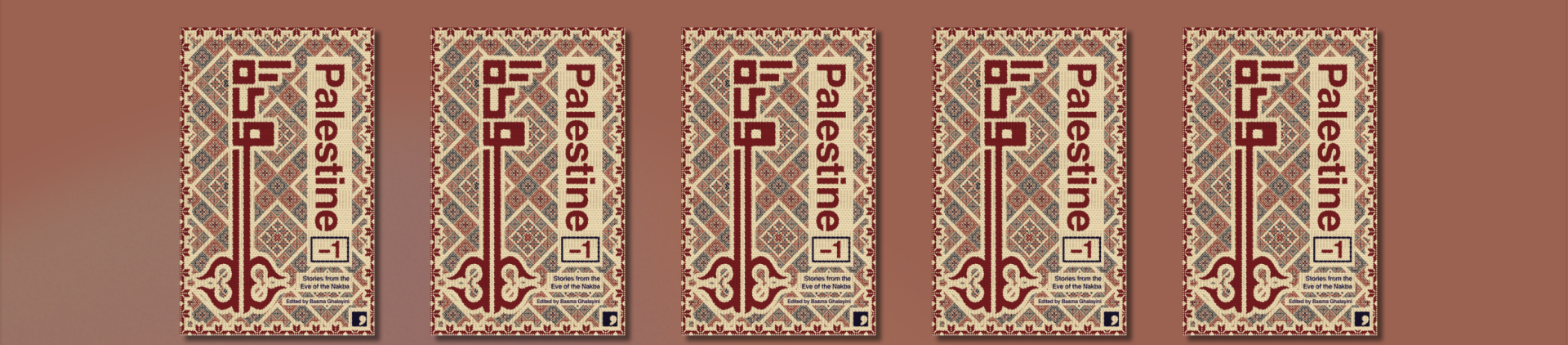
Extract: Palestine -1: Stories from the Eve of the Nakba
Read an exclusive extract from the newly-published anthology, Palestine - 1: Stories from the Eve of the Nakba, a collection of Palestinian writing using literary devices typically associated with the horror genre, edited by Basma Ghalayini. Titled 'I Swear, This All Happened', this magical realist short story by Liana Badr is set in a girls' boarding school in Jerusalem. It is translated by Maisa Almanasreh.
To Hanan and Maysara and Aline and Jihad and Lutfiya, and to all those who were there.
My friend Farida, during our secondary years in boarding school in Jerusalem, once told me there exists a mirror version of each of us. Whilst we live above the ground, our double, which is called the ‘Qareen’, lives below it. Farida said that it’s difficult to know anything for certain, except that we do not only exist in one form, and that we have to acknowledge this parallel existence below the earth. Her grandmother had told her this: whilst we’re happy going about our lives above the ground, another identical version of us carries on at the same time beneath it. It wasn’t a particularly easy topic to digest, so I tried not to dwell on it too much.
I hid my fear and trembling eyelids from Farida, as I tried to picture this identical image of every living human being. Was it possible for the above-ground version of ourselves to ever clash with the below-ground version? Would our human faces look just as beautiful in this underworld, or would they appear distorted? Do our features appear in the same way ‘down there’ as they do ‘up here’? And who, I wondered, has ever seen both at the same time?
Every morning, Madam Subhiye stood before us with her silver hair and her military posture, scolding us for our laziness when it came to studying English vocabulary, and our minds for always wandering far from our class assignments. We worried that our teacher, Madam Subhiye, might discover that we were only pretending to be dedicated students concerned solely with the pursuit of knowledge. We were paranoid that she would see how distracted we really were by gossip about the teachers, love stories from novels or Indian films – which we very occasionally got to watch – or with our own crushes on film stars or the boys who sometimes passed by our schoolyard fences. All these whispered conversations took place quietly away from class, while during lessons, we stared intently at the floor, terrified that she might discover these preoccupations.
I never revealed the dread that overcame me after hearing Farida talk about this double-existence, because I was always competing with Farida to be top of the class. We were rivals at the end of each term, racing to see who would read the greatest number of library books each week. Would it be me, or her?
So, night after night, I quietly contemplated what Farida had said, searching for evidence of this strange phenomenon. What would be the point of having this Qareen – this spiritual double of ourselves – living in the underworld? I was gripped by the thought that this double could control every move I made. According to what I could glean, this Qareen mirrored all our thoughts and actions, tracking every move with utmost precision. That, to me, sounded dangerous. What if it made a mistake? (Some of the girls reassured me that it could not act independently.) But still, especially if it looked and sounded exactly like us, and shared the same moods and everything that was inherent to us, wouldn’t it be dangerous if, for some reason, it did something wrong? Farida reassured me again that these underworld creatures, our spiritual doubles, had no will of their own, and that they only followed us and did what we do. So long as we did nothing bad, she said, there was nothing to fear, nothing they could do wrong.
Still, after dinner, I had to pretend to have a cold, when I started to tremble at the thought of my Qareena sitting at the hairdressers where my mother always took me in the school holidays. Would my Qareena also cut her hair ‘á la garçonne’ — as my mother used to say admiringly, to raise my morale and compensate for the hideousness of my unruly, black hair, that refused to meet the customary standards for beauty. Even during the hardest times, my mother, who had graduated from the Rosary Sisters’ High School, never changed her opinion, always echoing that of my auntie’s (her sister’s), that my hair wasn’t suited to be long like the other girls in our family, because it was too thick and impossible to tie neatly into a braid or ponytail.
My mother would say ‘á la garçonne’ with pride, as if she were offering me a fine piece of cake, to entice me into accepting this boy cut and spare everyone at home the trouble of having to drag a comb every day through hair so tangled it resembled a dense bird’s nest. My mother’s alleged admiration for this boy cut was just her attempt to assuage my disappointment about not having silky, straight hair like my sisters. Did my Qareena have the same hair as me, causing the same discomfort and misery to everyone around her?
Farida and I were standing on the basketball court, having finished our daily chores. The sunset cast its red glow on the large stone building next to our school that housed foreign pilgrims, known locally as ‘The Colony’, separated from our school only by a fence.
I asked Farida again, just to be sure: ‘Seriously, is there really a Qareen for each of us living in the underworld?’
Her golden hair came loose from her braid and tumbled messily over her forehead, as she answered: ‘Of course, it’s true. Honestly! Parents just don’t tell their children, so they don’t get in a panic about it. Otherwise, they’d have to make them drink water from the "bowl of nerves" all the time. Only us orphans, who’ve lost our parents, know about it. That’s why all the adults around us only want us to be calm and good.’
This was one of Farida’s attempts to imply that I was on a similar path to orphanhood as her, and that soon she wouldn’t be the only one with no family around. Over the years, the other girls often alluded to the fact that we never saw any of Farida’s family, except for one brother who dropped her off at the start of each school year, who she never talked about.
She also never mentioned her late father’s family, or her mother, who was of Armenian origin and had fled from a distant homeland that had shown her no mercy. So, Farida couldn’t help sharing, tenderly but clearly, that she felt I was walking the same path to orphanhood as her. After all, the school we attended was a kind of orphanage, and there are many types of orphans in the world.
It was clear to us that having a seriously ill parent meant orphanhood was a natural possibility, so the orphanhood I was experiencing was only partially complete, not fully formed. My mother was so ill that we, the youngest of her children, couldn’t understand the extent of it. This is why my family had sent me and my youngest sister to this school — to relieve my mother of the burden of having to care for so many children.
In the evening, we continued our conversations while embroidering in the hobby room, to earn Miss Marta’s praise. After dinner, we helped clear the tables, hoping to earn extra points from the Qareena we each supposedly had. We kept this a secret just between the two of us, until the incident with Imtiyaz the following month brought all these conversations back into our lives, making us wonder again if it was in fact possible to see our Qareena’a, the way Imtiyaz had seen her djinni.
Imtiyaz had a warm complexion that seemed to glow each time her eyes lit up with laughter. She was a dark-skinned twelve-year-old, on the shorter side, who always dragged herself sluggishly as if she cared about nothing in this life. Perhaps it was because she had never known anyone to call family or be called family by. Her sole talent, or ‘distinction’, seemed to be her ability to smuggle out extra loaves of bread, despite the strict school rules that bread was only to be eaten in the dining hall and during the three designated meal times.
She was favoured by Umm Mahmoud, the head cook who had fled the village of Deir Yassin after the massacre. Umm Mahmoud’s left eye had been damaged by a shard from a grenade that exploded right beside her while she was being chased by Zionist militias under a hail of bullets, along with other villagers. They used to say that Imtiyaz was found as an infant, tucked into a stone nook behind Bab Al-Amud, the grand Damascus Gate, one of the main gates in Jerusalem’s old city wall.
Eyewitnesses later said that Imtiyaz’s sister had been carrying her as they fled from the snipers of the Irgun and Stern Gangs, who had stormed their home and killed both her parents and her grandmother. They said the sister had then handed baby Imtiyaz to an elderly woman who was crawling on her hands and knees under the pine trees beside the road to Jerusalem, searching for a lost sandal. After that, the sister had been forced to run back and look for her youngest brother, who, in the chaos, had disappeared between the legs of the fleeing crowds. The old woman never saw the little girl’s sister again; she too was lost to the crowds.
This was the reason why the headmistress, who adopted the child, named her Imtiyaz, meaning ‘distinction,’ hoping that good fortune would see her grow into someone special like her name. When she was young, Imtiyaz stammered, unable to answer when asked about her name. Perhaps that’s why Umm Mahmoud, as head cook, always gave her as much bread as she wanted, no questions asked. She even slipped her the soft, warm, fluffy loaves, fresh from the oven, that were reserved for the teachers who boarded at the school.
For us, getting our hands on fresh bread felt like a rare privilege; we hated the food we normally got — always the same preserved tomato-paste stews over bulgur, lentils, or dry white beans, and nothing but bone broth to go with it, if anything.
The headmistress committed all her resources to rescuing the orphans who were left behind, scattered through the old streets of Jerusalem after the Zionists had raided their towns and villages. As a result, she couldn’t afford to give us anything but the bare basics. We loved her, nonetheless. Between us, we always whispered about how the grown-ups admired her determination and her tireless work in collecting donations from Jerusalemite families to keep us fed — which is why she too strictly forbade wasting bread.
But it was tough being hungry all the time.
The smell of fresh bread drew us to the back door of the kitchen, where we hovered near the vent, even though the cold draft and pigeon droppings that rained down from above made it a miserable spot to stand. We waited there for Imtiyaz to come out with her stash of bread that she got from Umm Mahmoud, so she could share it with us whenever hunger struck just before dinner time.
I still wonder if there was some kind of connection between the warm scent of bread and the strange thing that happened next with Imtiyaz. We had never noticed the name of Imtiyaz’s room until the bizarre night when the djinni appeared. Each of the bedrooms upstairs in that large stone building was named after a historic Palestinian town or city from which the families, both children and their parents, had all been expelled. The names made it easier for us to remember which room belonged to whom. Mine, for instance, was named ‘Yaffa’ and had a small balcony overlooking the Orient House, later called Bet El-Sharq. From that balcony, on summer nights, my friends and I could hear an orchestra as Jerusalemite families danced.
Imtiyaz’s room, on the other hand, was on the western side and faced The Colony — that sombre hotel that always seemed quiet, despite being full of European pilgrims visiting ‘the holy land’.
One morning, a great uproar broke out among the girls as they shared the news that a djinni had spent the night standing by Imtiyaz’s bed, whispering the whole night through in a voice so low it went unnoticed by the others in the room. Before long, however, other girls from ‘Tabaria’ room, where Imtiyaz slept, started confessing to hearing murmurs, though none but Imtiyaz actually saw the djinni.
We all crowded around Imtiyaz before the morning bell rang but she told us to come back after the classes had ended. When we did, the older girls kept interrupting, making it impossible for us to understand exactly what the conversation with the djinni had been about. Whenever she started speaking, the girls who shared a room with her would intervene, showing off how much they also knew about what happened.
We believed the djinni was real. In fact, there was an old laundry room up on the roof, and everyone knew it was home to a yellow-horned snake and a djinni of its own, who appeared and then retreated on a whim. And although they said he was harmless, he was also unpredictable, which was why we never dared to go up there alone, always going in groups to do our laundry.
So no, we didn’t find the story far-fetched. A djinni has the power to choose who it speaks to and who it wants to scorch with its fire if it doesn’t want them there.
Day after day, we circled around Imtiyaz, trying to get a better understanding of what her conversation with the djinni had been about, and wondering if it was the same djinni as the one from the laundry-room. Meanwhile, the older girls smirked at our questions, refusing to answer them like it was some private joke.
According to Imtiyaz, the djinni told her that it was tired of being alone, with no family or neighbours. But now, being among the girls, it felt part of the family; so, it clipped its long, claw-like fingernails to make sure no one scratched themselves if they came too close.
It was strange how gentle this djinni was. Despite its enormous size – its head scraping on the high ceiling – it stood quietly by Imtiyaz’s bed, waking her softly to talk to her, always kind, never harsh. So tender, in fact, that every girl secretly longed to get to know it. Except for me, of course. I was ashamed by my own cowardice; I was too superstitious to even say the word ‘djinni’, saying the phrase ‘in the name of God, the most Gracious, the most Merciful’ instead.
But Imtiyaz also had proof. Even the school nurses needed to question her about the large red marks that appeared on her skin — all of us had seen them. Her extremities were covered in blood-red spots, which she said came from the djinni’s presence, the heat it gave off, raising the temperature of the room, even in the bitter winter cold.
Amid all this confusion, my spirits were lifted by a beautiful, surreal dream I had around the same time. A winged, ivory horse came to visit me. It stood on the open rooftop in front of the laundry room. In my dream, we became friends, and I stroked its soft mane and thanked it for the radiant rainbow colours that shimmered and reflected off its coat. It strutted proudly on the bare floor looking like the Buraq Horse that artists draw in New Year calendars. Then it took off, its colours changing from sparkling silver to a sun-like glow, soaring over the rooftop, and leaving behind the clothesline and remaining pieces of laundry the older girls had yet to take down.
How I regretted not knowing if the djinni returned after that or disappeared forever. Not because it left, but because I had to leave the school. After my mother died, my family pulled me out of the school so I could care for my younger sisters back at home. My responsibilities multiplied as, all of a sudden, I was expected to cook, do the laundry, study and help my sisters. Time became so precious, I couldn’t spare a moment even to pay my old school a passing visit.
Occasionally, I’d hear news that Imtiyaz was still defying her teachers and getting in trouble for refusing to do her homework. Whenever she did, she would be barred from spending the evenings with the other girls in the art room, where they embroidered, drew, and wove straw baskets.
As for the djinni? I lost all contact with anyone who could tell me what was happening in my absence.
Then came the war.
Excerpt from Palestine - 1: Stories from the Eve of the Nakba. Available to buy here from Comma Press.


