Extract: The Palace on the Higher Hill by Karim Kattan
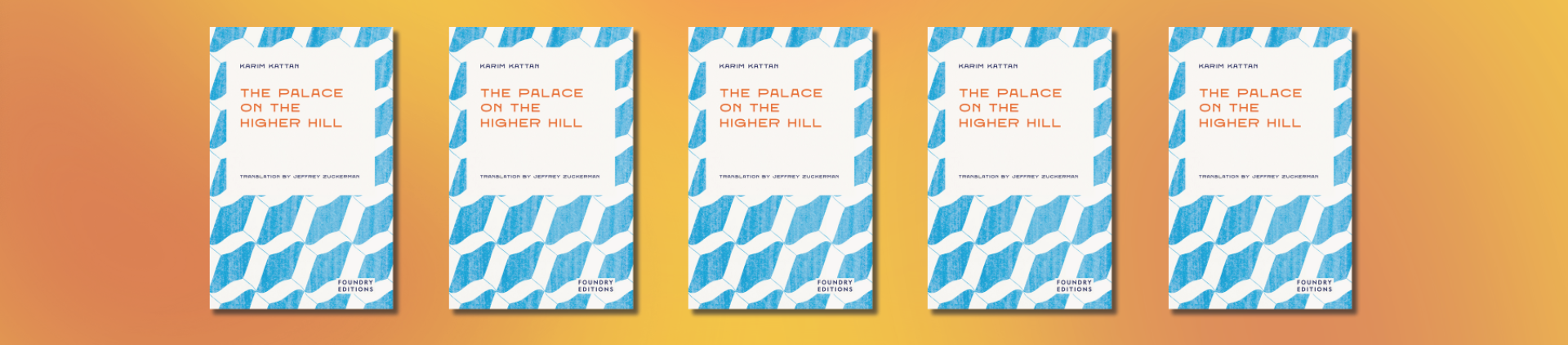
Read an extract from The Palace on the Higher Hill, the first English-language translation from award-winning Palestinian author Karim Kattan. Translated by Jeffrey Zuckerman, this novel introduces readers to a magical and somewhat sinister Palestine through a haunted family, whose narrative mirrors the history of their people and nation.
I’d left Jabalayn behind. I’d torn out my roots as thoroughly as I could, and set them ablaze. No, that’s not true, all this about roots, that’s bullshit. What roots? What I have are hooks sunk deep in my neck to keep me in place. When I try to move, they yank at my skin and I bleed.
After the blaze, I’d been dragged from boarding school to boarding school in Europe. Such is the privilege of the rich: they send their children not to prison but to the mountains. All the while, in Jabalayn, everyone was dropping like flies. Our sprawling family tree shrivelled up at terrifying speed. Old age, metastatic cancers, heart attacks: every member of my family snuffed out, one by one. Humiliating deaths, too, without the least bit of fight, not a single martyr. Measly illnesses. My teenage mind devised a theory that some divine entity, clearly baleful, yet exquisitely mannered, had deemed us reprehensible, filthy, disgraceful, and, rather than show its hand so openly by smiting us all at once, preferred to obliterate us little by little through organ failure. In a notebook, I jotted down the names, dates, places, and causes of death for the whole dynasty. At that moment, for so many of them, they ceased to be cold shadows and became individuals. Just look at this small sampling:
Edward, heart attack, Miami (USA)
Henri, lung cancer, Khartoum (Sudan)
Margot, Alzheimer’s?, London (UK)
Edward (2), heart attack, Jabalayn
Victoria, suicide?, Jabalayn
Manya, pancreatic cancer, Benghazi (Libya)
Henry (≠ Henri), brain cancer, Jabalayn
Juana, mysterious circumstances, New Orleans (USA)
Antoine, throat cancer, Beirut (Lebanon)
George, heart attack, Jabalayn
Elisabeth, heart attack, Jabalayn
Madeleine, heart attack, Jabalayn
Marguerite, heart attack, Jabalayn
I was waiting my turn. When Tante Jeannette died, not long after I left, I was convinced I was next. There was an implacable divine logic to it. It was the maid who came back from holiday only to find Jeanette with her tortoiseshell glasses on her head, her stern face unmoving, sitting in the same chair I had you, you the stranger, sit in when you came. I wonder if she’d begun to rot in this chair. She’d certainly rotted enough while she was alive. So I staked out this very rot in myself, too; every morning, I checked my pulse, took my temperature, did breathing exercises to make sure my lungs still worked. In the evenings, I repeated the ritual: pulse, temperature, breathing exercises. Any variation at all, any irregularity would confirm my impending death.
And yet I’m still here. This cruel god seems to have had his fill of punishment; my family is finally purified. Or I’m not even worth the hassle. On my worst days, I wonder if he’s decided that it’s a far better punishment to leave me here, alone. ‘That’ll teach you,’ someone up there must have decided. Or maybe not even that: what uncalled-for torture that would be, to leave me abandoned thus like an unfortunate lizard. The last-of, the last-to.
I’d never contemplated a return to my native land. I was happy where I was, in this European country that’s a bit unreal the way all European countries tend to be, and then there was you, and I had no friends or family in this distant land, remote, slowly vanishing into the mist. I figured it was best to do my mourning before the fact. Then, who knows, I could say, ‘Come on, let’s live in Palestine, shall we, in Jabalayn? You’ll see, it’s nice, there’s nothing there. I have a big house. You’ll laugh, the house is really something, everyone calls it “the palace” and it sprawls out over a huge hill that looks like an Amazon warrior. My great-grandfather So-and-So was the one to start building it in the twenties, he wanted a palace but it was really his son, my grandfather Ibrahim, the famous Abu Ayub, who made the house into the ghastly misshapen creature it is now. Oh, you’ll love it, George, you don’t know the particular fantasy that Palestinian men have. So-and-So had a huge house built on the highest hill of Jabalayn. “There are two hills in this village? Well, we’ll go for the higher one.” And up there, where it really isn’t that practicable to live, So-and-So built his dream, a huge birthday cake in stone. When they came by cab, our guests told the driver that they were going to Qasr al-Jabalayn, the palace on the two hills.’
So-and-So … I’m sorry, I really am, I don’t remember his name any more, but I’ll tell you this: he had seven kids, five girls and two boys, one being Ibrahim, and they all lived together in the same house and so did their own children. I can’t remember all their names. And it was when this great-grandfather whose name I’ve forgotten died, and Ibrahim stepped into the limelight, that this family’s history became capital-H History.
I never personally knew this famous Ibrahim. He died in the early eighties at a very advanced age and after a very admirable life, leaving behind Nawal, who followed him soon after, and his three adult children: Jeannette, my mother, and Ayub. Some of his sisters got married, and trapped their husbands in the shadows of the palace on the higher hill. The earliest years of my life were spent in the women’s dark quarters where, in the afternoons, some would sit down to knit scarves and caps for ghost children while others would gather like flies in the kitchen. And the men would stay in the drawing room for hours, not talking. Even now I wonder what these men did so as not to talk: were they in deep meditation? Or did they just not have anything to talk about, apart from an occasional dumb joke, the odd bit of hare-brained political analysis? In any case, they were all cold to me, apart from Ayub. I hated them and I do think they felt the same about me. When you were here, could you smell the lingering odour of rot and ruin that not even bleach could cover up?
Ibrahim: we called him, deferentially, Abu Ayub. ‘Father of Ayub’, just as Nawal is Imm Ayub, ‘Mother of Ayub’. This is how men and their wives are known, by the first name of their oldest son. Now, because I’ve been living in these depths for ages and ages, I feel like I know Abu Ayub inside and out. Here I am, alone, in his house, a hideaway teetering on some rock and on the edge of a cliff, trapped in my palace on the higher hill. Whenever I think about leaving, since I do still think about it, the whispers resurface wiswiswis and drown out my brain. At night, I see life go on in the distance; down there, while the sunset drains away the day’s colour, the settlements’ lights twinkle with the confidence of the victorious. On this side, Old Jihad’s restaurant is no longer aglow. My imagination, left to its own devices, dreams that it shines on like a lighthouse in the darkness, illuminating the dark ocean all around. The restaurant was abandoned after the fire. Rats run between the tables, snakes wedge themselves comfortably in the scarlet cabinets, hyenas have already chewed through the cushions’ fabric. Part of the ceiling must have caved in. The restaurant’s lights are only in my head. Down there, far off, the settlements’ lights taunt me: there are so many, they’re having family dinners, maybe they’ll come out after for a night-time stroll, it’s so nice out right now, it’s early spring, the end of winter, how should I know, and they don’t even realise that in the dark hills facing them, I alone watch them, envy them, hate them.
***
Just among ourselves, we called the village al-Bizayn, the two boobs. And the house was the palace on the bigger boob. ‘Ourselves’ meaning Joséphine, Ayub, and me.
***
The elder son, Ibrahim’s big brother — I don’t remember his name. A poor guy who went crazy at thirty and committed suicide. One night, he hanged himself from one of the almond trees. They found him at dawn, shrouded in the scent of flowers, swaying gently in the wind. His body was reddening with the dawn light. (In the house’s hallways, the cold shadows murmured, whenever I was in my room for too long or away at Joséphine’s too long, that I was no different from him.) After that, Ibrahim became the man of the house. That had to be a real blow for him, having grown up thinking he would have it easy, no family responsibilities, that was his big brother’s problem, and then boom, without even a second to mourn his brother, to learn or make sense of things, he was thrust into his place at the helm.
He did a good job of it, I have to say. Who would have thought: the baby of the family, the spoiled baby, who preferred soft cushions and sweet wine, the one with the soft skin of a fresh-faced child, the fine traits of a Christian icon, the limp wrists of a pampered scion, the one who spent his early adulthood waltzing from European capital to European capital; who would have thought, the one everyone expected to become an antiques dealer in Vienna, that one, in fact, had an obscene, diabolical business sense. All through my childhood I was told and told about Ibrahim’s brilliance: apparently they called him pasha in Tripoli and Istanbul, lord in Manchester and Lausanne. Jeannette bored me to tears rattling off all his honorifics, and all the heads of state and other kings and princes who had come and stayed at the palace on the higher hill (yes, yes, in Jabalayn where you were, George, you slept in the same bed that Ethiopian princesses once did). One prince, she said, had even come with a procession of elephants that climbed up the hill.
Ibrahim had plenty of dealings and the house had metamorphosed accordingly; as his wealth multiplied, so the house ballooned. His dealings in Qatar paid for the conservatory at the back of the house. Nowadays, it’s just a dilapidated structure overrun by brambles, but back then, oh, there had been three gardeners and every plant in the world within. Ibrahim loved flowers. His dealings in Chile made the back garden possible. After a stint in Italy where he travelled with the man Nawal only ever called ‘that priest’, the two syllables spat out with barely veiled disdain, Ibrahim decided that the house could use some pretty columns and that’s why, on the terrace, you have a colonnade of utterly useless Roman pillars in marble.
Each drawing room – there are six, can you believe it, six? – was a universe unto itself. There was a vaguely ancient Greek room; just the thought of it makes me blush. So many ridiculous frescoes of banquets, paintings of the Acropolis … how on earth could he have looked at that and thought, ‘Yes, yes, that’s a wonderful idea!’ There was the Jaffa room and its famous paintings depicting, across three walls, the history of the land, and, on the fourth, the sea.
The Paris room I’ll let you imagine for yourself. There was a drawing room that he called Alexandria, and then there was the Arcadia room, which I’d only ever seen in tatters but where naive depictions of shepherds and shepherdesses can still be made out, lying on the banks of pastel-hued rivers, under apple trees, kissing or playing the flute. Why he’d left it to moulder, I never dared to ask. Nawal often told me, ‘If you don’t count Paris, he’s recreated the Mediterranean here.’ I hadn’t realised the Mediterranean could be so ugly. And then there was his office. His study – he affected that English word – which he’d had erected behind the greenhouse (a fanciful configuration that nobody had ever questioned) and which not a soul, not even after his death, was to enter.
Extract taken from The Palace on the Higher Hill by Karim Kattan, trans. Jeffrey Zuckerman (Foundry Editions, 02 April 2025).

