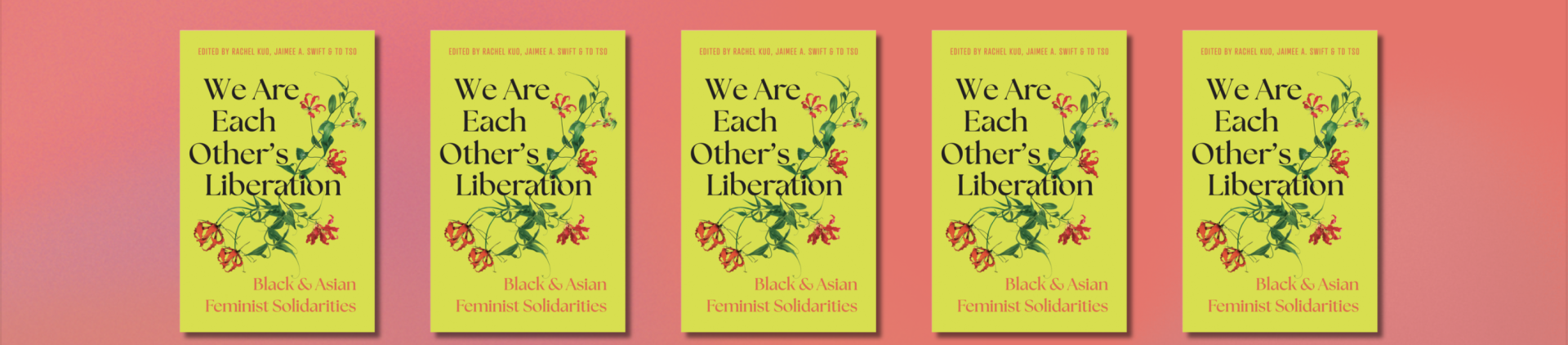
Extract – We Are Each Other's Liberation: Black and Asian Feminist Solidarities
We're delighted to share an exclusive extract from the forthcoming collection, We Are Each Other's Liberation: Black and Asian Feminist Solidarities, edited by Rachel Kuo, Jaimee A. Swift, and TD Tso. This extract is from an interview by Swift with Beverley Bryan and Stella Dadzie – founding members of the socialist and activist group, Organisation of Women of Asian and African Descent – on the joys and difficulties of political organising across race, class, and gender.
'We’re Here Because You Were There': On the Organisation of Women of Asian and African Descent
As founding members of the Organisation of Women of Asian and African Descent (OWAAD), a socialist and activist national umbrella organisation that emerged as part of the Black British civil rights movement, Beverley Bryan and Stella Dadzie have contributed much to our understanding of radical Black and Asian feminist organising transnationally.1 Founded in 1978 in London, OWAAD was formed in response to patriarchal, male-dominated leadership of the African Students Union (ASU) and other local Black activist organisations.2 While Black women were a part of ASU and other antiracist organisations, they felt their concerns were overlooked and they were tired of being treated as 'minute-takers, typists, and coffee-makers but hardly ever as political and intellectual equals.'3
OWAAD was formed as an 'independent, autonomous, national organisation of Black women.'4 Although the original name of the group was the Organisation of Women of Africa and African Descent, upon realising the common struggles among Black and Asian women living in Britain, they changed the name to the Organisation of Women of Asian and African Descent. One of OWAAD’s major accomplishments was its first national Black women’s conference in March 1979. Held in Brixton, the conference had two hundred attendees and is considered to be the inception of the Black women’s movement in the country. OWAAD organised around several key issues, such as immigration and deportation, children’s rights in schools, and anti-Black discrimination and policing. Bryan, Dadzie, and members of OWAAD also joined the campaign to end the SUS (stop-and-frisk) laws in England and Wales used against Black youth, whom police could arrest on suspicion they were about to commit a crime. Moreover, OWAAD campaigned and protested for reproductive rights, particularly against the testing of Depo-Provera, a contraceptive drug, on Black, Asian, and other marginalised women. OWAAD also published the newsletter FOWAAD!
While OWAAD disbanded in 1983, Bryan and Dadzie continued in their trailblazing activism. I spoke with Bryan and Dadzie in February 2022 about why they started OWAAD, their thoughts on the successes and lessons learned while organising cross-racially, and the state of solidarity.
Jaimee A. Swift: Given the incredible work you both have done, I am curious to know about your journeys into organising.
Beverley Bryan: My journey to activism started in my early teens with experiences of what I call casual brutal racism in high school. My parents were the true Windrush generation because they came to Britain in the early fifties and lived in South London.5 They were supposed to go back to Jamaica in five years, but that didn’t happen, as it doesn’t happen for many migrants because oftentimes economic plans don’t work out. My parents sent for me and my two sisters. I went to school in South London, in Battersea. It was called a secondary modern. I experienced racism, especially from white working-class girls because it was a girls’ school. That early experience made me realise I was from another place, even though we were supposed to be welcomed in this country because of our British citizenship. With that, there was a sense of, 'This isn’t fair, this isn’t right.'
That sense that these things weren’t right also came from the fact that I was quite religious, especially when I was about thirteen or fourteen years old. You know the words of the Sermon on the Mount, that we should love each other? At that time, I was reading a lot and the person that affected me most was James Baldwin. There were two sides of Baldwin: the religious side that came out in Go Tell It on the Mountain but also the sense of being a young person growing up in a hostile environment that I saw reflected in The Fire Next Time. Those readings had an impact on me. It was also during the mid-sixties and onwards, we were looking at what was happening in America. We weren’t just looking at Baldwin — it was also Martin Luther King Jr., Malcolm X, and the Black Power movement.
We had this sense we needed to do more to assert ourselves. We took on the slogans of 'Black is beautiful' and 'Black Power'. We started with owning that we were special, but we had to do something with that specialness. What that meant for me was to join an organisation. The first organisation I joined was a consciousness raising group, the Black Arts Workshop, where we worked with the West Indian Students’ Union. We studied Black literature, Black poetry, Black arts, and Black drama, acted it out, and took it to youth groups in London. The Black Arts Workshop was the way we empowered ourselves. By the time I was eighteen, I decided I wanted to be a teacher. Eventually, I did become a teacher, and I wanted to work somewhere where I felt I would be making a difference. I went to Brixton, and I went to Brixton because my parents had lived there, and I knew it was a Black community. That’s where I met up again with Olive [Morris].6
Olive and I had gone to the same secondary school together. I met up with her during my first months of teaching and she told me about an experience where she had been beaten up by police after being dragged to Brixton Police Station. Because of that experience, she joined the Black Panther Movement.7 When I heard about what she was doing, I thought, 'This is good work.' Because the Black Arts Workshop was mostly involved in consciousness raising, I thought if there was an organisation that was defending people who were attacked, then I wanted to be a part of that as well. From there, I was in the Panthers for about three years. When the Panthers disintegrated about three years after I joined, we took some of those ideas in those campaigns and started the [Brixton] Black Women’s Group (BWG).8
Stella Dadzie: The difference for me was that I am of Anglo Ghanaian parentage. I was born to an unmarried mother in the fifties. When people asked me where my activism began, I realised it began subliminally because right through my childhood, I was witnessing or experiencing racism, sexism, and class issues. We lived in poverty when I was a child, well, when I was returned to my mother anyway. When I came to know my father’s family, I was about twelve or thirteen years old. I started travelling to Ghana quite regularly. I think that gave me a good grounding, and a good sense of my African identity. My father was involved in the independence struggle in Ghana. There was a lot of talk around the family table of [Kwame] Nkrumah and Pan-Africanism. I was very conscious of the liberation struggles that were being fought on the African continent at that time.
When I went to Germany, I was studying languages, and I was very isolated. There were no other Black women. Later, I came into contact with African students and African refugees, in particular Eritreans who had taken up arms in Eritrea and ended up in Germany. That experience radicalised me because I became aware of how imperialism worked. I began to connect what was happening in Africa with civil rights struggles in the United States. I was also listening to some of the messages coming out of the women’s liberation movement, which was very embryonic at the time. Fast forward, I came back to England. I was keen to get involved in some way, and I got involved with some radical journals. One was called The Black Liberator, which looked at issues in Britain and across the African diaspora. The other one was the African Red Family, a cadre-developing project analysing what was going on in Africa. Like a lot of women, we were marginalised. We were the minute takers, coffeemakers, and we were often the people who fed ideas to some man who would then stand on his soapbox and speak our truth. That isolation meant that I was drawn to other Black women who shared similar experiences and concerns.
In my fourth year at university, I got involved in the African Students Union. It was through that group that I came to know Olive and other women like Beverley in the Brixton Black Women’s Group. I was also teaching at the time. The glaring inequalities in the classroom quickly drew my attention to organisations and groups that were lobbying women around what is now called 'decolonising' the curriculum.
My roots were similar in that those influences – the civil rights movement, Pan-Africanism, the anti-apartheid struggle in South Africa, women’s liberation – all of those things were going on at the time. I have to say that to some extent what was happening in the women’s movement did not interest me quite as much because it was characterized as a middle-class white women’s activity that involved a lot of navel gazing, hatred of men, and that did not really coalesce with the aspirations that I had, which were about race and class equality, as well as gender issues.
BB: Black people in the United Kingdom, we come from different experiences because Britain was an imperial power. We had the slogan 'We’re here because you were there.' To me, that summed up imperialism and colonialism. We all came from different places because of what was done in our individual countries. The Windrush generation is an example of this. They didn’t come to Britain simply because they wanted to; they came to Britain because their countries were destroyed. It is because of this past history we could talk of common experiences in the United Kingdom. It is also important to say that it is not just Britain; many European countries have similar history. And we can even extend that internationalist perspective when we come to talk about our Afro-Asian unity.
1 Excerpts from this introduction were originally published at Black Women Radicals, Jaimee Swift, 'On the Power of Stella Dadzie: A Radical Pioneer of the Black Women’s Movement in Britain,' Black Women Radicals, May 24, 2020.
2 Stella Dadzie, interview by Samenua Sesher, Respect Due, Museum of Colour.
3 Organisation of Women of Asian and African Descent, 'OWAAD Draft Constitution', 1978.
4 OWAAD, 'OWAAD Draft Constitution.'
5 The Windrush generation was a mass-migration movement of predominantly Black communities across the British Empire who arrived in the United Kingdom between 1948 and 1971. According to BBC.com, those of the Windrush generation “were encouraged to move to the UK to help with post-War labor shortages and rebuild its battered economy.” See Adina Campbell, “Who Were the Windrush Generation and What Is Windrush Day?” BBC, updated June 19, 2024
6 Olive Morris (June 26, 1952–July 12, 1979) was a Jamaican-born British political activist and feminist leader who was active in the British civil rights movement and the feminist and squatters’ movements. A member of the British Black Panther Movement, she also was a founding member of the Brixton Black Women’s Group (BBWG). Also a founding member of OWAAD, Morris traveled to China in 1977, and she documented her travels to the country in her report, 'A Sister’s Visit to China!' which was printed in the BBWG’s newsletter SpeakOut! See Olive Morris, 'A Sister’s Visit to China!' SpeakOut! Brixton Black Women’s Group, 1977.
7 Inspired by the Black Panther Party (BPP) and the Black Power movement in the United States, the Black Panther Movement (later the Black Workers Movement) was founded in Notting Hill, London, in 1968. Formed to address racial discrimination, prejudice, and police brutality enacted against Caribbean, African, and South Asian communities, the group, while influenced by the BPP, was not officially affiliated with the organisation; however, the BBPM became the first Panther organisation outside of the United States, 'adopting the Panthers’ symbols of military jackets, berets, and raised fists.' See Diane Pien, 'British Black Panther Party (1968–1973)', BlackPast.org, July 2, 2018.
8 'The Brixton Black Women’s Group (BBWG), which existed from 1973 until 1985, identified itself as a socialist feminist organisation, and was one of the first Black women’s groups to be established in the UK. The aim of the BBWG was to create a distinct space where women of African and Asian descent could meet to focus on political, social, and cultural issues as they affected Black women. BBWG published its own newsletter, Speak Out!, which kept alive the debate about the relevance of feminism to Black politics and provided a Black women’s perspective on immigration, housing, health and culture.' Milo Miller, SpeakOut! The Brixton Black Women’s Group (New York: Verso, 2023).
We Are Each Other's Liberation: Black and Asian Feminist Solidarities is published in the UK in Hardback on 14 October, 2025 by Haymarket Books. Buy it via our Bookshop.org page.


