Finding Comfort in the Loneliness of Others: Beata Umubyeyi Mairesse and Reading Across Cultures
Beata Umubyeyi Mairesse is a prolific Rwandan writer critically acclaimed in the French-speaking world. Her poems, short stories, novels, and testimony, rich with East African culture and world-spanning intertextuality, make a significant contribution to the literature on witnessing genocide in Rwanda and beyond.
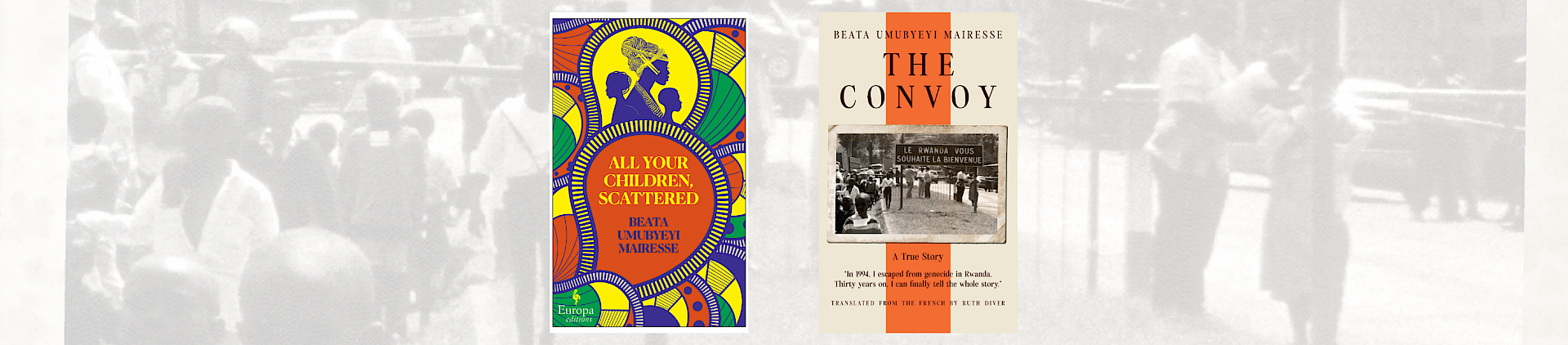
So far, her work has been little discussed in the English-speaking world, but this is at last beginning to change. Her first novel, Tous tes enfants dispersés, was translated by Alison Anderson as All Your Children, Scattered for Europa Editions in 2023, and her recent testimony, Le convoi, was translated by Ruth Diver as The Convoy for Open Borders Press in 2025. Awarded the Society of Authors Scott Moncrieff Prize in February 2026, Judge Shumona Sinha called it ‘delicate, dashing and heart-wrenching’, and said it ‘interrogates the very definition of personal memory and writing.’
King’s College London academic and Wasafiri Associate Editor Zoë Norridge met with Umubyeyi Mairesse in March 2025 when she was in London to launch The Convoy. The full interview, which explores Umubyeyi Mairesse’s turn to testimony after working with fiction for most of her career, is published in print in Wasafiri 125.
This interview provides a taste of some of the additional material from that wide-ranging conversation that we couldn’t fit into print. Here, they discuss the books Umubyeyi Mairesse was reading in Rwanda in the 1980s before the genocide against the Tutsi began, her literary influences after she moved to France in 1994, and the role of writing today at a time of heightened conflict.
Zoë Norridge: Your recent testimony, The Convoy, explores your search for media imagery of you crossing the Rwanda-Burundi border into safety during the genocide against the Tutsi in June 1994. You reflect on your experiences hiding with your mother in Rwanda, your journey out of the country, and the fate of both the humanitarian workers who helped you and the other children who were in your rescue convoy. In the opening chapters you also stress the importance of other writers for making sense of your past. You explain that it was through reading the work of Holocaust survivors that you found the words to recount your own story. Had you read any Holocaust literature when you were still in Rwanda before 1994? Other survivors have told me they were reading a book by Martin Gray …
Beata Umubyeyi Mairesse: Ah! A lot of Rwandans will tell you about Gray’s book Au nom de tous les miens (For Those I Loved). Yes. There was the book, and a film of the book, circulating in Rwanda in the 1980s. I remember my mother and I went to see the film at a screening organised one evening by the Extension universitaire (university outreach) library at the University of Rwanda in Butare. It had a profound effect on us.
ZN: It’s haunting to think of audiences in Rwanda watching that film, just years before they themselves would experience genocide. When did you first engage with Holocaust literature?
BUM: I’d been aware of the Holocaust since my teenage years. I remember reading a book about a concentration camp that I found in the library — Le camp des femmes: Ravensbruck. It is a collection of women’s testimony and was much too old for me: I was maybe fourteen. I was stunned by what I understood of the stories.
ZN: This is when you were living in Butare …
BUM: Yes, there were two libraries in Butare. One belonged to the university, and one belonged to the Centre culturel français (French cultural centre, or CCF). I used to borrow books every week from the CCF. I started off with French and Belgian comic books, then children's novels (la bibliothèque rose et verte), but pretty soon I moved on to the adult section. There wasn't much to do in Butare and, as an only child, reading was my main extracurricular activity. I went to the university during the summer holidays, when the CCF was closed. There, the books were for older readers. I was a strange teenager. My mother said that once I told her I would like to be a Jew or a Native American. She asked me why, and I said because they suffered so much. I related to their stories. What books can do …
ZN: What books can do … in terms of cross-cultural identification? How were you connecting with these experiences of Holocaust survivors and Native Americans?
BUM: Perhaps my experience as a mixed-race child raised by my single Black mother gave me a sense of strangeness from an early age. Because of my skin colour, Rwandans confined me to a White identity that I knew little about. I received a scholarship to study at a private international school, alongside children of expatriates and members of the Rwandan upper class and there, too, due to my modest background, I did not really feel like I belonged. No doubt this created a feeling of loneliness in me from an early age. So, I guess with my reading, I tried to find comfort in the loneliness of others, elsewhere ...
ZN: Do you ever feel constricted by the weight of this writing about the past?
BUM: No, not at all. I still read these books today. They are more necessary than ever! I like to quote James Baldwin, who once said: ‘You think your pain and your heartbreak are unprecedented in the history of the world, but then you read.’
ZN: In The Convoy you write that you were reading Leo Tolstoy’s War and Peace when you were in hiding …
BUM: Yes, and I never read it again! We had Volume 1 but not Volume 2. I think I only read it because I had already reread the other handful of books we had at home. I didn't understand much about these stories of princesses and Russian officers, I had only a vague idea of who Napoleon was ... But as I read, the fear of death that lurked all around our hiding place faded a little. I also had this book by Christine Arnothy, J’ai quinze ans et je ne veux pas mourir (I am Fifteen and I Don’t Want to Die). It’s about a 15-year-old child hiding with her family during the siege of Budapest in 1945. I don't know how this book – or War and Peace – ended up in our house. I came across Arnothy's account again seven or eight years ago at a sale of old books organised by the library in Bordeaux. Even before reading the title, I immediately recognised the cover of the paperback: barbed wire and an incongruous yellow flower. I bought it but didn't dare read it again. I remember the story – she was a Hungarian girl, my age, hiding in a damp cellar – and the sense of identification I felt when, a few days after reading the book, I too had to take refuge in a cellar in Butare.
I think I only read these books because I had already re-read the other books we had at home. We didn’t have many books, but my mother was a reader. She was the one who gave me a taste for reading.
ZN: She was also borrowing books to read from the library?
BUM: Yes. There were so many books in the library. I spent a lot of time there. The French cultural centre was in the building just opposite the flat where we lived, in the centre of Butare. I only had to cross the street to get there. It was one of the few places my mother let me go on my own at a fairly early age. When I close my eyes, I can almost remember where everything was: the wooden armchairs, the children's section, and the dozen or so large shelves in the adult section, the librarian's desk with his stamp for marking the date on the little card taped to the end of each book ...
ZN: Were you reading mostly African or European literature?
BUM: Mostly European.
ZN: And literature in Kinyarwanda? Perhaps from the university library? I know they were teaching literature in Kinyarwanda at the time …
BUM: As I was in a French-speaking school following the Belgian system, we were only set French or Belgian authors to read, mainly classics from the ninetheenth and twentieth centuries. My mother and my cousins, who had been educated in the Rwandan system, had some access to Rwandan oral tradition and post-independence French African literature by Camara Laye, Senghor, and others. But I had none at all. Very few Rwandan authors had published in French. At that point there was just Saverio Nayigiziki, Alexis Kagame, Cyprien Rugamba …
ZN: I’m imagining that Rwandan culture was alive for you in different ways growing up. Through oral literature perhaps, or other art forms?
BUM: Rwanda is a country rich in oral poetry, passed down through the generations. But the art of beautiful speech can also be found (even today) in major life events, such as weddings and other ceremonies that everyone can attend. From childhood, I was struck by the many proverbs that peppered the adults’ conversations, and their ability to sum up a destiny or a philosophy in a single metaphorical sentence. When I wrote my first collection, I introduced each story with a proverb, and they can also be found in my novels. I’ve since seen other survivors draw on the richness and complexity of our language in their books. The title of that collection – Ejo – a word that in Kinyarwanda means both yesterday and tomorrow, has been used by many other Rwandan artists in their work since. In terms of the oral tradition, radio plays were also very popular in the 1980s. I wrote a short story on this very subject: ‘Béatrice – Coup d’État Classique’.
I love bridging gaps between the English-speaking and French-speaking worlds
ZN: What influence did reading all of this European literature have on the ways in which you perceived the world? Did it shape how you understood the unfolding genocide around you?
BUM: I think that when the genocide began, I felt a sense of identification with the stories I had read about the Second World War, at least at first, an almost romantic way of experiencing those early days. Then the violence took over, and I no longer had the luxury of thinking about anything other than our survival from one moment to the next.
ZN: Your first novel, Tous tes enfants dispersés (All Your Children, Scattered), opens with an epigraph featuring three quotations: one from Holocaust survivor Georges Perec’s W, or the Memory of Childhood, a Rwandan proverb, and one from South African-born Motswana writer Bessie Head’s A Question of Power. I particularly love this last quotation: ‘As she fell asleep, she placed one soft hand over her land. It was a gesture of belonging.’ After all her struggles with apartheid violence, mental health, and exile, the main protagonist, Elizabeth, finally finds some kind of rest. Why did you choose these three quotations?
BUM: Perec survived the Holocaust in hiding in France. What I particularly like about W – which alternates between Perec's own autobiographical account and a fictional dystopia about the island of W – is the movement between imaginative writing and memory, which I think is also at the heart of both my fiction and non-fiction work. And like the child in W, the character of Blanche, who resembles me, found a kind of comforting kinship in books. As for Bessie Head, I read her later in life, in my thirties. I recognised myself in her story of a mixed-race woman with a shameful birth. Her novel, A Question of Power, had a profound effect on me. I too have longed for what her character expresses at the end of the book — a visceral need to belong somewhere, despite rejection and madness.
ZN: I know that African writers are important to you in your work. When did you first encounter African literature?
BUM: I was first introduced to African literature when I was a student in France. I was at Sciences Po Lille, and one of my teachers was from Cameroon. She knew I liked reading and suggested I join her book club for African and Caribbean literature. I’d never read a Black writer before that – before my twenties – and all of a sudden I was introduced to Toni Morrison, James Baldwin, Alain Mabanckou … and Caribbean writers like Patrick Chamoiseau, Aimé Césaire, Maryse Condé ...
It was really important for me. When I lived in Rwanda, people called me White. When I arrived in France, all of a sudden, I became Black. But I didn’t know what it meant to be seen as Black by the White gaze. It’s through those African, African American, and Caribbean literatures that I connected with the Black experience in Western countries.
ZN: These writers are also extraordinary stylists — masters of craft. I’m thinking of Morrison and the way she navigates memory through language, structure and characterisation, Césaire and the incisive linguistic precision of his poetry in his critique of colonialism and racism … Were you beginning to write at university, and did their writing have an influence on you?
BUM: No, I only started writing after I turned thirty. But I never stopped reading literature by those francophone, and increasingly also anglophone, writers. So much so that I started a book club in Bordeaux, which I have been running for over ten years now. It gives me great pleasure to introduce African and Caribbean authors to French audiences who know little about them. I had the members of my club read Abdulrazak Gurnah's works long before he won the Nobel Prize. A few years ago, I took part in a literary festival in Accra, Ghana. I met the author Nana Darkoa Sekyiamah and on my return, I convinced a French publisher to translate her first book into French. It is coming out this March, and we will be welcoming her to Bordeaux in April. I love bridging gaps between the English-speaking and French-speaking worlds.
ZN: Who are the writers inspiring you now?
BUM: Nadine Gordimer, Dinaw Mengestu, Binyawanga Wainaina, Zadie Smith, Jamaica Kincaid, Abdulrazak Gurnah …
ZN: And are there Rwandan writers who you particularly appreciate?
BUM: I am friends with writers of my generation who, like me, are of mixed race and therefore live between two cultures. Dominique Celis, whose first novel, Ainsi pleurent nos hommes, gives an unvarnished account of Rwanda today. And Gaël Faye, whose second novel, Jacaranda, takes up many of the themes I addressed in All Your Children, Scattered: intergenerational transmission of memory, silence within families, and, above all, a story of jacaranda trees cut down ... Both Dominique and Gaël grew up outside Rwanda and did not experience the genocide, but chose to live in Kigali over the last decade and are keen observers of the new country.
As a genocide survivor, I feel deeply affected by current events
I am also close to survivors who have written either fiction, such as Vénuste Kayimahe (who lives in Rwanda), or testimonies, such as César Murangira (who lives in Switzerland), and Marie-Josée Gicali (who lives in Canada). Some survivors who were not writers have had bad experiences with Western journalists who were supposed to co-write their books. That is why, together with Marie-Josée and three other compatriots, I’ve spent the last two years supporting survivors in their writing and publishing projects so that they do not find themselves dispossessed of their voices.
ZN: I’m fascinated by this project. In my own work recently, I’ve been looking at the importance of survivor control over the editing and circulation of their stories. For example, with 100 Days, 100 Stories – a collection edited by filmmaker and survivor Jo Ingabire Moys that I associate-edited – voice, accuracy, consent, and editorial sign-off were very important to us. How do you support these survivors in writing their own stories?
BUM: Many Tutsi survivors want to publish their stories but don’t know how to write a book. They aren’t writers, and often aren’t avid readers, so they don’t know where to start or get discouraged very quickly after writing just a few pages. We’ve set up regular video calls to bring together those living in France and in Quebec. We shared our experiences of writing and publishing with them and addressed their concerns. We arranged for them to meet an African writer and a Franco-Rwandan publisher so they could ask them questions; we also set up a book club where they read accounts written by survivors of other genocides and drew inspiration from those writings. Last but not least, each participant was paired with two coaches who proofread the different sections they had written, provided constructive feedback, and encouraged them to persevere. One participant was unable to write himself. He had had a very bad experience with a French journalist who had somewhat appropriated his story, so we found him another writer to work with and made sure that this time his voice was respected.
ZN: Have any of the children who were rescued at the same time as you read The Convoy, and been in touch to find out more?
BUM: I gave my book to the children I could find. Some read it, others did not, because they are not keen readers. But they all thanked me, saying that this story of their rescue was an important legacy that they would pass onto their children. Since then, it has inspired others to write their own stories, and I am helping them in this process. I’m also working on a documentary film to reach all those who do not read. The film will allow me not only to show the images that the book talks about, but also to recount all the incredible reunions all over the world that the book has made possible in the two years since it was published. It is a story that continues to be written.
Apart from literature written by Jewish, Tutsi, Gazan, and other genocide survivors, I generally recommend reading works by social scientists
ZN: When we first spoke in March 2025, we were worried about the ongoing conflict in the Eastern Democratic Republic of Congo, the war in Ukraine, and the genocides in Sudan and Gaza. These are still ongoing, and there is also war in the Middle East. What role do you see for yourself as a survivor who is also a writer in these polarised times?
BUM: As a genocide survivor, I feel deeply affected by current events. When I go to speak at schools and universities, for example, I don’t just talk about Rwanda. Young people ask me about the genocide in Gaza, and we discuss it. I also make sure to talk to them about the past, because there are fewer and fewer survivors of the Armenian or Jewish genocides, for example.
And then, as a survivor and a citizen, I try as much as possible to show solidarity. Together with a friend from Bordeaux who is originally from the West Bank, and a Palestinian writer friend from Paris, we have set up a project to invite artists from Gaza who are refugees in France, to enable them to make their voices heard in Bordeaux; we already have two events planned for July and November. As for Sudan, in the same vein, I am organising, with my book club and a Bordeaux-based organisation, an evening event with the writer Abdelaziz Baraka Sakin in May to raise awareness amongst the French public of a history about which they know almost nothing.
ZN: At King’s, my current third-year undergraduate course on ‘Testimony: The Holocaust and Rwanda’ is completely full. Students have come with so much concern for what is going on in the world, and so many questions about how they can understand genocide, survival, and rebuilding in the aftermath of genocide. Which books would you recommend to young people trying to understand more about genocide today?
BUM: Apart from literature written by Jewish, Tutsi, Gazan, and other genocide survivors, I generally recommend reading works by social scientists. For example, I am thinking of the works of Hélène Dumas on Rwanda, Anouche Kunth on Armenia, or the recent books by Didier Fassin or Jean-Pierre Filiu on the genocide in Gaza.
ZN: All the texts we’ve spoken about are, to varying degrees, marked by trauma and legacies of violence. Do you also turn to reading and writing for comfort?
BUM: Yes, of course. That's why my books aren't just about violence and trauma. They also contain stories of love, sensuality, tenderness, and sometimes, humour. That's where comfort lies. And then there's poetry, both the poetry I read – Audre Lorde, Andrée Chedid, Jackie Kay – and the poetry I write. It's a precious place where I put the tiny wonders of my life as a woman, a fighter, a mother, and a lover.
Read the full interview with Beata Umubyeyi Mairesse in print in Wasafiri 125


Edited by our Deputy Editor, Vamika Sinha, Wasafiri 125 explores 'Living in the Melancholony'. The term 'melancholony' is used by artist Abdul Halik Azeez to describe a place that 'constructs itself for and through the eyes of the white westerner'. This issue applies the term, more broadly, to not only the structures, but the affect, of living under a colonial, racial capitalist gaze and legacy.
