Hidden in the Paradigm: The Poetry of Jay Wright
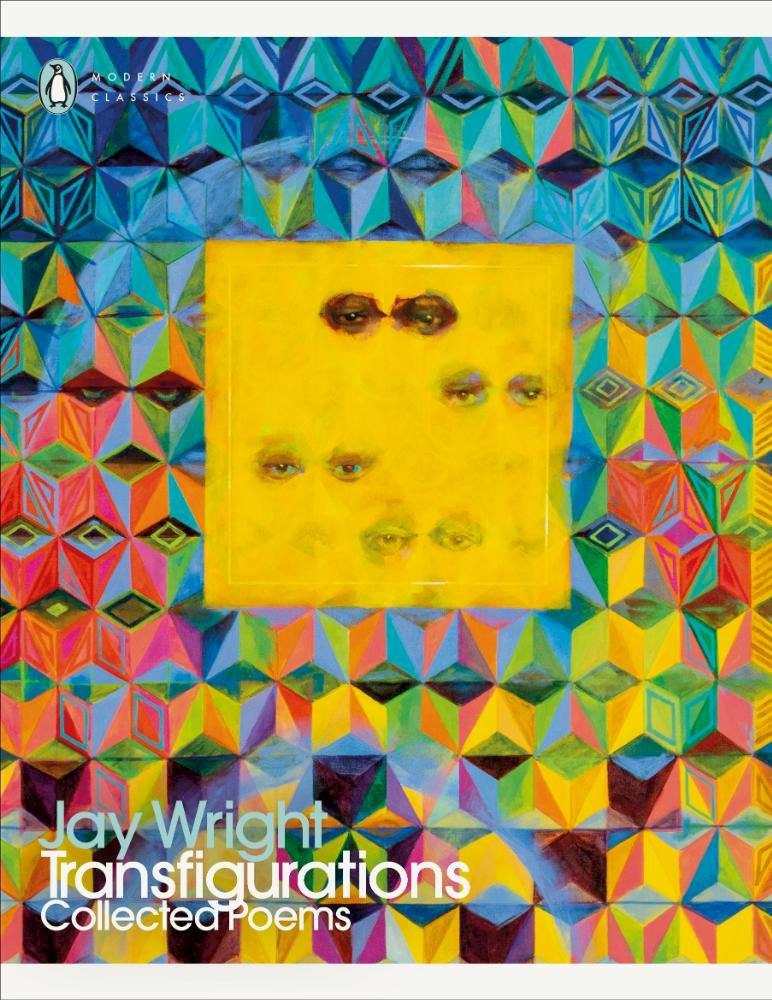
On 24 November 2025, Jay Bernard, Oluwaseun Olayiwola, and Dante Micheaux came together at the Judith E Wilson Studio at Cambridge University to discuss Transfigurations: Collected Poems (Penguin Classics, 2025) by the legendary American poet, playwright, and polymath, Jay Wright.
Originally published in 2000 by Louisiana State University Press, and now published in the UK as a Penguin Modern Classic, Transfigurations brings together all eight of Wright’s twentieth century poetry collections in one volume. Wright has since gone on to publish nine more books of poetry, the latest of which, Párodos, will be published in May 2026 by Flood Editions in Chicago. Transfigurations has been described as ‘a rare monumental, sensuous force unlike anything else on either side of the Atlantic’ (Ishion Hutchinson) containing ‘an indelible music’ (John Keene), and ‘a deep engagement with spiritual knowledge and myth’ (Rebecca Tamás).
Over the decades Wright has had many advocates: Robert Hayden, Elizabeth Alexander, Carl Phillips, and Henry Louis Gates Jr, to name a few. Chief amongst them was Harold Bloom, who named Wright ‘one of the handful of major American poets that we have alive among us’. And yet, despite Wright’s long list of admirers, he has struggled to receive the same level of critical attention as his contemporaries. Often described as ‘allusive’ and ‘difficult’ (John Hollander), Wright has perhaps suffered from the scale of his own ambitious writing, with only a handful of scholars such as Isidore Okpewho, Steven Meyer, Matthew Goulish, Will Daddario, Vera Kutzinski and, of course, Bloom, providing deeper insight into his work.
Inspired to expand the pool of critical (and popular) reception to Wright’s poetry, Bernard, Olayiwola, and Micheaux discussed everything from Wright’s figuration of the body to his formal concerns. Wright was unable to travel to the UK, so in order to bring him into the room, the session began with an audio recording of him reading his poem ‘Meta-A and the A of Absolutes’ at the Library of Congress in 1976. Each participant also read one poem from Transfigurations which, for reasons of length, are omitted here.
This conversation has been edited for length and clarity.
Oluwaseun Olayiwola
I have always wanted to ask —
who speaks, who moves and who returns
when the I is hidden in the paradigm
— 'The Measure’
Of course, this reads rather ars poetical — as Jay Wright’s legacy, even as a much-garlanded poet, can at times feel shrouded. In many ways it feels as if Jay Wright is an 'I ... hidden in the paradigm' of the larger American poetic landscape and context.
Earlier today, I went to look for his name in African American Poetry: 250 Years of Struggle & Song that was released in 2020, and it was absent. (I cannot purport to know why that is the case and the reasons could be myriad, but it feels like something worthy of note.)
It’s likely naïve of me to think of Jay as having written this to ‘make a statement’ about himself. Jay Wright’s work is, as many critics denote, philosophically dense, but it strikes me that this is a common remark levied at poets whose work does not have the easily readable attributes of apprehension. His first collection, The Homecoming Singer, abounds with actual place names: Madison County, Queens, New York, Nashville TN, Harvard; actual days and times like Wednesdays and Thursdays, locations where people congregate like prayer meetings, charity hospitals. There’s a realism in The Homecoming Singer.
For example, these lines from ‘First Principle’, a poem where the speaker is on the verge of approaching his father, who stands in front of him:
'I see my father
standing in the half-moon
that the ancient lamp
throws on the street.
There’s broken glass
scattered on the sidewalks
like sugared diamonds,
all around him.'
And as the speaker approaches his father, the probability of argument, the fated clash of dad and son boils:
'And I’m walking, now,
prepared to argue with that man,
who has his foot on the tattered shirt.
I hear it coming from me like a text,
my biblical, righteous rhetoric:
how can I tell you
the absolute rightness
of being in this fire?'
David Kalstone, in his review of The Homecoming Singer for The New York Times, called Wright’s concerns in this first collection 'the traditional stuff of novels — scorn for the deceptions of Christianity, elsewhere for the social norms that tap and trap black vitality.'
This seems to me partially accurate, and only partial because that was the only text Kalstone had on record to base his remarks on. He ends the review wondering where Wright will go next, stating the importance of watching the then-young poet’s next steps.
As Kalstone also remarked, the gerund of 'homecoming' is important as it denotes the continued movement, the texture of always approaching home yet never having arrived.
But the same poet who articulates his own ‘biblical, righteous rhetoric’, as though to acknowledge its place within the heart of his speech (which according to ‘Meta-A and the A of Absolutes’ says that ‘speech is fact and the fact is true’), in my view, goes on to register in his poems his own gargantuan philosophy.
I want to be clear. I don’t think Wright’s project is to replace the language of Christianity that he himself grew up with — but the centrality, possession, and dominance of the monotheist God of Christian ideology is vitiated. ‘I resist the image of God’, one speaker says at the beginning of the poem, ‘Continuing City: Spirit and Body’, part of a trio of poems called ‘Harmony’s Trio’.
There is another way in which this hierarchy is vitiated, and brings me to the topic of surrounding Wright’s work that actually interests me the most, which is the flagrant, repetitive, and (I do not mean this derogatorily), expansive way in which Jay Wright figures the body.
I am sure I am not as well-read as the two poets next to me, but before reading Jay Wright, I could not point to a Black, straight man who plays with his own body in his poems to the degree that Wright does.
Here is just a sampling of lines:
'We work,
with the body’s changing firmness,
to repair the constancy of things.'
*
'How can this body last,
If it must come?'
*
'Redeemed, I keep
longing’s mark on my body.'
*
'Surgical,
you could part my body
along earth’s axes; spirit me
among your father’s oaths and altars.'
*
And some from the end of the poem I just read:
'I am good when I learn the world
Through the touch of my present body.'
And
'I am good when I hear the changes in my body …'
I hope you do not find it callous or crass of me to bring up Wright’s identity as a Black straight man when thinking of the radicality of his linguistic vision. Even he himself, who may be listening, may balk at this notion, and in fact, I too find myself squeamish when my work is spoken about in this way. The word ‘body’ occurs roughly 374 times across Transfigurations, with the only nouns that occur more frequently than body being ‘light’, the pronoun ‘her’, and the word ‘love’.
Another quote:
'What is our intention but the fire
within us,
or the description of a body
clarified by wind?'
Fire, if you’ll remember from The Homecoming Singer, had the quality of ‘absolute rightness’, yet in Explications/Interpretations, a book that was published thirteen years later, fire is postulated as being an intention. Here, too, we have the ‘body/clarified by wind’.
I don’t think I am being too far-fetched either with this focus on the physiological. There’s a poem simply called ‘The Body’ broken into four parts: Man, Woman, Man’s Soul, and Woman’s Soul (which feels reminiscent of Walt Whitman’s Songs), followed by a poem called ‘Twenty Two Tremblings on the Postulant’ which has the subtitle (Improvisations Surrounding the Body) where, yes, we start with Arm, Forearm, and the Shoulder Blade, the Mouth, and then, without ceremony, travel to the parts of the body straight — men are known to love talking about, to love exploring: their tibia, their lower jaw, their anus. Here, the curves and crevices of the body are used as organising structure — the formal argument perhaps that the body can contain more than just flesh and bone (another one of Wright’s repeated words).
It calls to mind the ‘philosophically inclined subset of body-smeared literature’ Wayne Koestenbaum uses to describe the work of French critic and novelist Hervé Guibert. Wright’s work is body-smeared, whereas Guibert is smeared with blood, pus, and shit, even. Wright’s philosophically inclined body-smear is more an abstraction — the eternal and inescapable smear of experience on the body, represented by age, and if we’re lucky, wisdom.
This is in The Double Invention of Komo:
'Now, by the light’s fall,
I assemble an aggregation
of fact, and appoint
the body’s wisdom to its place.'
*
I want to end this with a couple lines from ‘What is Good’, from Dimensions of History:
'Luminous breath,
teach me compassion for this
my complex body'
Why does this matter to me? It isn’t unfair of me to say the body and the insistent articulation of the body as core to the writer’s project is a ‘feminised’ category — we champion Wright’s other contemporaries as having forged these grounds (think of the insistence of the body by other poets during that time period, such as Sharon Olds).
Compassion towards the complex body; compassion towards the complexity of other languages; compassion towards the romantic and loved other; compassion for the self subjected to and reinstantiating the ideologies one is born into; but also the compassion to understand they need not always define you; the compassion to produce a body of work that others one day may find. To bring identity into it again, I think men of all racial-sexual identities should be listening. With this book now being published in the UK, I hope the English are listening. And ever since I was encouraged to look more closely at Jay Wright's work, I have been listening.
Dante Micheaux
Transfigurations is a book of such spiritual and aesthetic largesse that it is hard to say anything about it without saying the whole of oneself. From the point of view of a concept that, in its composition, revealed itself over time.
In the first of their contemplative dialogues, the Otolith Collective engaged the instrumentalist Shabaka Hutchings and discussed the notion of timelessness, particularly as it relates to a piece of music by John Coltrane, entitled ‘To Be’ from his 1967 album, Expression. Hutchings posits that the various shifts in tone in the piece create distinct dimensions, and that the layering of these dimensions imbue the music with a certain timelessness. The curator and theorist Anjalika Sagar qualifies Hutchings's theory by what she describes as the ‘thickening of time’. These are useful terms upon entering the poetry of Jay Wright, such that the theatre historiographer Will Daddario might incorporate into his own theory what he calls ‘qualitative viscosity’, and an acute necessity for the poems collected in Transfigurations.
For the first decade of the new millennium, Transfigurations was second only to the Bible in my reading and has since surpassed even that holy book. I initially read Transfigurations as a traditional volume of collected poetry, that is, a compendium of several distinct collections, but the searing audacity of Wright’s vision came into focus with the publication of a book called The Guide Signs, which he published seven years after Transfigurations. That book implied that the two volumes – which, by my count, encompass ten different collections of poetry – can be read as a whole or experienced as a single movement. If that is the case, then the key is to be found, which helped this reader to ‘uncover the weave’, as Wright has historically said of his poetic project; and that key is the poem, ‘Inscrutability’.
The poem’s declaration that this must be said –
'I am provoked by the state of things
…
Determined,
I begin again to parse my body’s needs.
I ask if the world is real enough
to measure my intention.'
– is important to focus on. If ‘the world is real enough to measure my intention’. It unlocks the notion that the I – in whatever guise Wright chooses to convey it – is not a foil for the poet himself, but a possession of a body/mind, in order to examine its culture, time and perspective on both. Not dissimilar to the activity of the alien in Robert Hayden’s American Journal.
‘Inscrutability’ first appeared in Explications/Interpretations in 1984, which bears a significant dedication to Robert Hayden, as well as to Harold Bloom. Hayden, in bestowing the imprimatur of the de facto poet laureate of the United States on Wright, and by inviting him to read at the Library of Congress, marked Wright as a credible poet of ambition. ‘Inscrutability’ is full of associations, provocations, ‘sign and countersign’; the speaker is phasic, moving in and out of the lyric and also in and out of bodies — ‘bird’, ‘fox’, ‘a fallen verb’. Foreshadowing Wright’s deployment of the Dogon’s Komo, the speaker twins himself with the bird that titles all his voiceless provocations. ‘Inscrutability’ is a signpost of how the poet’s discipline becomes itself a formal element of composition, of what Daddario has described as ‘Wright’s commitment to sitting dynamically in the fullness of the present moment’. The poem resists enslavement, metaphorically, and the idea of culture as singular, while simultaneously emancipating the poet as a practitioner by citing the ages of liberation from the quality of being actual.
I point all of that out because what Seun was describing as Wright’s allegiance to the body, or talking about his body, is in fact a kind of technique that he uses to inhabit an ‘I’, allowing that ‘I’ to explore whatever is in the 'I' in its own time and own place. It goes back to what I think the Otolith Collective and Shabaka Hutchings were discussing when they were talking about dimensionality. And it’s no coincidence that Wright is an admirer of the Guyanese novelist Wilson Harris. In Harris’s own fiction, he deploys the same technique. Harris’s first novel, The Palace and the Peacock, is narrated in the first person, and then three quarters of the way through, the narrator dies and so no longer speaking to us, the reader. But the narrator begins to inhabit another character, who also does not speak to us; that character converses with the other characters, and we see through that character’s eyes with who and what he is interacting. I find this a useful observation to access the poems in Transfigurations, or the entire poem that is this book, with all of its speakers and dynamics. This particular poem, ‘Inscrutability’, in a book that is entitled Explications/Interpretations, is a way for Wright to communicate to the reader what his poetic intentions are. When he asks if the world is ‘real enough’ to measure his intention, it matters little because he can inhabit whatever world he wishes.
I want to share a few things that Wright has himself said. In Dimensions from History, which Jay [Bernard] will read a poem from later, Wright says that the ‘search in these Americas for a breaking of the vessels, for a redefinition of personality and for new areas of creative experience is a just definition of the task my poem undertakes’. I started by saying that he is a great poet of ambition; he is working within a canon of writers that probably began with Aimé Cesaire and Leopold Senghor, certainly Wilson Harris who wrote a little poetry, and certainly the poet Christopher Okigbo. Seun pointed out a reviewer of Wright’s first book describing him as ‘philosophical’: while it may be true that that word gets bandied about to describe poems that are not readily accessible to the ‘average’ reader, Wright actually is a philosophical poet, in that he is a long-time reader and student of philosophers, both of the European tradition but also from twentieth-century African philosophy. It is from these latter philosophers that he has found the formal elements of his own work. He identifies a kind of triad in what he would argue is every poet’s task, or at least every poet worth reading’s task. Wright describes this process as ‘separation, transition and integration’, and he says that that is the work that poems of ambition take on. The speaker separates themselves from a source, then changes, then integrates back into the original source. That is not unlike the process of weaving something.
There is an anecdote, which Wright shared in the early 1980s, that is often repeated in circles of his admirers, that is apt here: a young listener approaches Wright after a reading and says ‘your poetry encompasses so many things. How did you weave them all together?’ Wright responds: ‘They are already woven together, I’m just trying to uncover the weave’. Think about separation — the yarns that get separated and hung on a loom (the warp and the weft), experience a transition via the shuttle, and become an integrated fabric. This is what Wright says that poetry that is meaningful to our cultural production and sustainability does for us. And there are other areas I would mention in which he finds value. But his work is about the human as an entity that is collected together, regardless of what differences might be ascribed to individuals.
Wright has written, ‘I take the total comprehension of human experience, given the poet’s intellectual, geographical, social, historical and emotional grounds to be a necessary aspiration’. There is emphasis on the ‘intellectual apprehension of the processes of creating poetry and the insistence upon the creative and imaginative functions of the intellect in comprehending experience’. Because experience is the thing that is produced from the task of creating a poem. It is using one’s imagination to create an experience, and that experience is shared with a reader. When you read a poem from Transfigurations in which you experience the speaker as an ‘I’, you are the ‘I’ — the ‘I’ is inhabiting a source that you are, not a disembodied third person who is the poet trying to make you understand what he/she/they think. You are the ‘I’ inhabiting the experience of the poem. For example, in ‘Inscrutability’, the ‘I’ who is in the boat with the shell that is a bell — you are the ‘I’ in the boat, listening to those sounds, experiencing those sensations. The ‘I’ in the poem morphs from being the person in the boat, to the bird who is delivering the message, to the bird that shifts into these other entities. Wright also encourages ‘a world view which sees experience and knowledge as cumulative, the cosmos as creatively and harmonically ordered, the social and physical world as a unitary system of infinite complexity and correspondences'.
So, those are the concerns in Transfigurations, and ‘Inscrutability’ allows one to see underneath the experiences of the poems therein. This has oriented me in reading Wright. When I read The Homecoming Singer (he also published an early chapbook entitled Death As History), I thought ‘this is my experience’, this is closely related to my own culture and my ancestral history as a person of African descent, born and raised in the US. Then I approach the subsequent books and have no idea what is happening until I come to ‘Inscrutability’. Then, I realise that Wright had to work out this inhabiting of his own autobiography, so that others could inhabit it and experience what that culture is, and to move into other various cultures; as The Homecoming Singer progresses, one sees other cultures begin to be woven into the poems.
I will end by reading a wonderful poem called ‘Ecstasy, Bird and Oak’:
Ecstasy, Bird and Oak
And the bird knew me by sunrise,
and had my spirit dicing to chastise
itself. I arise
and light the oak.
Now in that light I recover
my dream’s white sheen, entry I discover
when I uncover
what yóu invoke.
Someone has me in his night eye.
I have come to a temple stone to lie
near the sharpest cry
love can evoke.
You hear and interrupt my flight,
foretell my healing, measure my delight
in the brief twilight
that you provoke.
I must enter my dream, devise
its downfall, and then learn to improvise
my death, realize
my spirit’s yoke.
Death, say, is the dance the lover
becomes, ecstatic reason to cover
the body, hover
near a white oak.
I have slept in beds to deny
the womb that seats me, though I justify
the thing I defy
and try to cloak.
The bird, at sunrise, sees starlight
as white as the song by which I invite
the first acolyte
home to the oak.
Jay Bernard
I will try to address something that I think is always in the room when Jay Wright’s work comes up, and that is ‘What’s at stake’? Why is it that this poet seems to be the world’s best poet, and yet is constantly missed? What is that? There’s something odd to me about this. I noticed as you were both reading that we’ve all gravitated towards the same poems — I’ve ‘starred’ many of the same lines that you have, so how is it possible that there’s something clearly recognisable in his work and yet he’s a poet who’s continuously defined as ‘difficult’ and ‘impenetrable’? What is going on there?
I came across Jay Wright via Harold Bloom about fifteen years ago, and the feeling of bewilderment didn’t leave me for a really long time. But now I’m a different sort of reader. For one, I know that most people don’t know most things; second, even if they do, they might not be the best communicators of that knowledge; third, I’ve learned that you can learn anything from anyone, and you can see how people work, how they think, if you observe the world as it appears, rather than as you want it to be. This third point is how I now approach Wright. His scholarliness, his abstraction, used to leave me feeling odd, and strangely shut out, and embarrassed at my lack of knowledge. Now, I consider not knowing an essential part of the reading experience. I don’t grasp for anything; I let the poems be. And the more I read, the more his images make sense. I allow my own idiosyncratic understandings to emerge and to be doubled or extinguished by what I discover to be correct or historical or factual. I think this is key to an enjoyment of Wright, because suddenly there are moments of lucidity where a clear, strong voice breaks into ordinary speech or something like it, and I hear a dilemma articulated with a clarity I’ve not heard before. Is it making sense or am I making it make sense? Have I gone so far down the wormhole that it’s starting to appear as sense? Or am I, in my anxiety, trying to scoop the jus from a charred bird? Is there some part of me that wants very badly for Wright’s promise to be fulfilled?
My approach to reading Wright yielded two ideas that I find compelling. The first is the idea of reception. His work is full of ghosts, full of disembodied narrators, and so, seemingly, is his audience. Wright’s reliance on Dogon and Bambara cosmologies is well-known and structures the eight books in Transfigurations, as well as other cosmologies from Aztecs and Mayans and others. Chief among these ideas is that at the point of creation, symbols precede the physical world. Before there is anything, there is a sign.
Second, the body has a double, and the reason for this, as the writer Isidore Okpewho says, is that if we lose any part of ourselves along the way, that lost part can be replaced. These two ideas have brought his work to life such that I understand, if not the elusive totality of his work, at least some of his spirit that animates it. Wright’s combination of European, New World, and African spirituality is an attempt to weave together something coherent that can be accepted, understood, and even act as a guiding star for those of us whose histories and lineages have been wiped out. And I do mean those.
At one point in his introduction to Wright’s work, Harold Bloom, one of his chief advocates, says in his somewhat characteristic and plaintive way: ‘Jay Wright speaks for me’. And it’s true. Both are mystics and spiritualists – one a critic, one a poet – and both of their practices are devoted to the associative, the obscure, the esoteric, the occult, the ancient, and the ambiguous. Wright’s near total refusal to explain himself, to ease up, to modernise his poetic sensibility does, after a while, render some old questions anew. Old questions of representation become a question of representing what exactly? I think Bloom’s sense of being spoken for points towards a world in which one’s spiritual inclinations in literature come once again to the fore. More than that, it points to the idea that we, or someone, or Wright perhaps, will have forged a new cosmology – a new cosmogony for any modern spiritualist who seeks it – which, to paraphrase Wynter, removes our cosmological projections from people, and places them once again among the stars.
The other question that arises from Wright’s work is how to repair what has been done. The idea of the double here comes into its own. Wright constantly repeats words in near proximity. For example, in ‘The Dead’, where ‘still’ as motionlessness is twinned with ‘still’ as persistence:
'Still, the dead go rootless,
without names,
without altar pots'
followed by,
'yet he moves still
in the shape of the Sigui,
moves still
when we stumble in drink,
the living dead.'
All senses are stripped of their properties. The heart stripped of love, the body stripped of its own beginning, ending finally with the return of the senses, the return of:
'a sign,
that moves your world still.'
This poem from Second Conversations with Ogotemmêli – with the Dogon elder who narrated these people’s spiritual ideas to the French anthropologist Marcel Griaule – is part of a sequence in which ideas are very slowly revealed over time and conversation, and then we see them surface across Wright’s works. We draw an unconscious thread between them. A later poem, such as ‘Twenty-Two Tremblings of the Postulant (Improvisations Surrounding the Body)’, brings us a disembodied body at once anatomically accurate, where there are in fact eight bones in the wrist, yet rendered strange:
'Between
the hand and these long bones,
eight bones,
as small as covenant stones,'
The physical body is a kind of analogue of the divine — a god’s delicate disguise, whose imprint in the world is both humanity and divinity. Ideas like these, I let them be. I read Wright’s work as though it belonged to me already. In many ways, the figures that appear: the fox, the smith, the god, are no different to the rosy-fingered dawn, or the ox-eyed lady Hera. Why are Wright’s repetitions not mnemonics, reminders of the future to come? Why are they any stranger than the Greek or Roman or Hindu or Jewish cosmologies, cosmogonies, and myths? When I asked myself these questions, I found that Wright’s work opened up to me, and touched on a particular ambivalence I feel in both wanting the world to be different and resenting the way poetry is so often reductively shoehorned into a sort of role it simply cannot fulfil — whilst ignoring the very obvious job that it does. Wright, working in a different time, was canny to that, and throughout Transfigurations not only communicates the knowledge of the Dogon as best as he can, but recognises the yearning spirit who longs for the consoling repair of their double, who wishes it was possible to do all of this again. We hear of ‘quarrels’ he writes in Soul and Substance (his 2023 book of essays), 'sense them within ourselves, prepare for what we must think of as a necessary exile.' We become confused. How can anyone accomplish such an exile? Where does one go that is not the world?
JB: It’s been really good hearing you both talk about this because I feel like there are very few occasions to discuss the work and the poetry. Are there any questions? I’m aware that when we talk about a poet [like Wright], we can sometimes miss the obvious.
Audience question 1: You mentioned various writers who’d been an influence on Wright, but are there particular writers who you see as being particularly influenced by him?
DM: I hope that I am. I wish that more were. I often give younger poets to Wright who I think are working to the same level of ambition as he is, and there aren’t many. Some of them are younger, and some of them are poets who you would assume he’s read already. I know he is controversial in [the UK] but Toby Martinez de las Rivas is one such poet. I gifted Wright his first book and he thought what most people thought reading which is that Martinez de las Rivas is an incredible poet, of great ambition working to uncover some things that have been covered about the history of this island. I think there are some younger African poets who are working in a similar vein to the kinds of things that Christopher Okigbo and Wole Soyinka were doing — they might not know Wright just yet but aspire to work in the same vein.
JB: I think that leads onto a question that I had, which is what has been Wright’s reception in Africa? Has there been much of a treatment of the ways he’s dealt with these cosmologies; has anyone examined that deeply? One of the guiding essays for me was from a writer called Isidore Okpewho …
DM: Because of Okigbo’s affiliation with Cambridge University Press, Isidore, who wrote about early Wright, was also interested in Okigbo and came here [to Cambridge] talk about that, and to explore Okigbo’s working in the vein of T S Eliot. I think there is some correspondence between them [Wright and Isidore], though I can’t be sure. But there is an affiliation with this particular geography, where these African poets were discussed in an academic way.
I cannot answer the first question. If anyone knows, it would be great to hear, but I think due to the kind of stigmatisation toward – and ignorance about – the African continent, academics, certainly Western academics, have not studied the reception of a particular writer in Africa. They study the reception of their own writers and writers that come into the English language. But I would be interested to know about Reception Studies on the African continent. With Wright – a poet who is not well-read in his own country – and given the publishing industry … his books were given a limited run, they were not reprinted. And the economic situation: I doubt that there’s been a large reception on the African continent. If anyone could say anything about that, it [would be] Wole Soyinka, who is Wright’s direct peer. They are both the same age and I know that they were reading one another, but it would be interesting to ask him. By the 1980s, Soyinka had come to international prominence and Wright was two or three books in. Again, the poems outside of the books weren’t published widely either.
JB: You said something, Seun, that I thought was really interesting, which is that he’s this African American man, male, straight etc, and I thought to myself, it’s interesting because that has not conferred on him any recognition. There’s something funny in this moment in particular about a poet who is so clearly doing all of these movements and gestures and manoeuvres ... I think about the way a writer like Fanon, for example, is just eaten up everywhere, for good reason. This is not a critique of him, it’s just interesting. Or even Césaire, or Glissant, who is currently the art world favourite. I always wonder what is the thing that projects some of these writers into this position and not others? Because Glissant is extremely difficult and pretty dense as well, and so is Sylvia Wynter, and she’s also the darling [of the art world]. So why is it that Jay Wright suffers from this seeming impenetrability; what’s the difference between him and all of the other very difficult people?
OO: I wonder if it’s because he is a poet, and if we put him in the philosophy section that would change how people approach it. Perhaps [this book] has the double alienation of being by a poet and it’s poetry, though Glissant wrote poetry and philosophy and is well regarded in both. But I hazard to say that his philosophy is more known than his poetry. I’m really interested in what you were saying about the sections in Elaine’s Book that reads,
'And the triumph of empiricism is jeopardized by the surprising truth
that our sense data are primarily symbols.'
It's coming back to this idea of the body, and the sensations that we have to take in through the body – which is this multifarious alchemical process of turning it into electricity – and then perception, and that level of work is ideally what we’re bringing to every poem. I’m someone who can stay with a poem for a bit, even if I’m being spun around. With Wright, I found myself saying ‘What?! What does this mean?’ I kept having to tell myself to take the language into your body, don’t take it into your head — what sense is it? Is it the ear, the nose? The normal sensory faculties I would say were supposed to help me read the poems were frustrated, but in a positive way. This is why I come back to the quote [from Elaine’s Book], that our sense data are primarily symbols, which I take to mean him saying that the normal ways which you would read my work, you’re not going to find.
I was also quite interested in the words that we were using: 'intention', 'complexity', of course the words 'body' and 'light'. And I was asking myself, do we need to graph the words? I copied the text [Transfigurations] and put it into an online generator that would show me which words were used the most frequently — that’s how I came to the words 'body', 'light', 'love', and 'water'. Is this something we need to map out to see what are the most pressing ideas? I’d love to hear more about that quote you picked out [from ‘Inscrutability’] of ‘is the world real enough to measure my intention?’. When I hear that, it feels like a creation myth, a presupposition, and a god who declared ‘let there be light’. It feels like a moment before the Big Bang. What faculties or techniques or strategies do we have to devise that feel like they come from this moment, before there is matter to be able to understand this? The thing is, it’s still language, it’s not invisible latencies, it’s words that we share. This is all to say I’m perplexed …
DM: It’s a colonial question. The answer to why not Jay Wright and [why] these other writers is because the two writers you named are Francophone writers, and there is a difference in the ways in which Francophone culture engages with text that is supportive of the intellectual. America provides a totally anti-intellectual society. It is difficult to break that. It is also colonial regarding ‘complexity’, because Wright isn’t saying one doesn’t have what it takes to get into these poems; what he implies is that the reader has not been educated in a particular kind of cosmology and/or given any of the terms needed for comprehension. Wright has read and researched to understand something of the given system of value, and attempts to share that experience with his readers. It is difficult to us because we only have the system that we have been given. We have to go outside of that system to understand other systems — and that is true of any culture. Imagine, for example, if there were no such thing as translation and one could not get a text in one’s own language, and could only face the text; and imagine if it was an ideogrammatic language. Those are the kinds of things that Wright’s poetry, when we talk about politics etc being important is doing. It is, or certainly was, radical practice. And he was doing this long before Toni Morrison wrote her Playing In the Dark!
JB: It’s interesting because in tiny, little writing – and I felt cheeky writing it – I wrote ‘does Jay Wright need a translator’? I know it’s a playful question because one of his critics says ‘Is he even writing in English?’ I think it was a really interesting diss, but also an insight …
DM: Does Pound need a translator?
JB: Exactly! So what is it that needs translating?
Audience question 2: You were talking earlier about intellectual styles and writing being more welcome in Francophone culture than perhaps in contemporary American poetry. It struck me that if we were to forge an old crumbling typescript of this and hand it to some British critics, saying ‘we found T.S Eliot’s long lost fifth quartet, it’s this poem called Inscrutability’, it’s no more difficult and mysterious than Eliot’s writing in Four Quartets. That style of writing may be currently unfashionable, but I don’t think that British readers would find it very strange or unusual. I wonder if that’s just a flavour that’s lacking in contemporary writing?
DM: Wright certainly addresses it in his essay about Black ritual. I will share a quote with you because the context is similar, though he is not talking specifically about the register of the language, but about the ways in which Black writing in his time (this essay was published in the 1980s) is relegated to a kind of performativity. Again, as a Black American living in the UK, I see the British poetry scene as totally segregated and only now we are beginning to see more than one Black writer at Faber who’s not Derek Walcott. How long did that take? How long has Faber been around? How long has, for example, Black Power – the movement for the equality of Black people or people of colour – been around, and the major publisher of poetry has been resistant until maybe five years ago? Wright explains that ‘the attentive Black American poet has been able to see creative dimensions in myth and formal possibilities in ritual’. Then he goes on to say that ‘ritual song or chant is poetry of a special kind in that poetry is song of a special kind. One does not comfortably become the other but both, written or not, must be spoken. We have to make this distinction and assert so much because too much has been made of contemporary Black poetry’s oral character as opposed to Homer, Chaucer, Dante, Milton, Goethe, Shakespeare, one wonders what the troubadours and Garcia Lorca and his friends were doing in those gardens and cafes.’
JB: You make a really excellent point, Dante, when you say that the ‘I’ is a vehicle in the poetry, and that it is, in fact, ‘you’, and that he explores all of these ideas with the ‘I’. Wright does something which I think is frowned upon technically in contemporary poetry, which is that he concretises abstract nouns. But if you rethink the concept of the ‘I’, suddenly those concretisations become spaces of exploration, ideas rendered anew. That is an intellectual move. So, I thank you for that, and I thank you both and everyone for coming.
Journey to the Place of Ghosts
Wölbe dich, Welt:
Wenn die Totenmuschel heranschwimmt,
will es hier läuten.
Vault over, world:
when the seashell of death washes up
there will be a knelling.
— Paul Celan, Stimmen (Voices)
Death knocks all night at my door.
The soul answers,
and runs from the water in my throat.
Water will sustain me when I climb
the steep hill
that leads to a now familiar place.
I began, even as a child, to learn water’s order,
and, as I grew intact, the feel of its warmth
in a new sponge, of its weight in a virgin towel.
I have earned my wine in another’s misery,
when rum bathed a sealed throat
and cast its seal on the ground.
I will be bound, to the one who leads me away,
by the ornaments on my wrists, the gold dust
in my ears, below my eye and tied to my
loincloth in a leather pouch.
They dress me now in my best cloth,
and fold my hands, adorned with silk,
against my left cheek.
Gold lies with me on my left side.
Gold has become the color of distance,
and of your sorrow.
Sorrow lies, red clay on my brow.
Red pepper caresses my temples.
I am adorned in the russet-brown message
the soul brings from its coming-to-be.
There is a silken despair in my body
that grief shakes from it,
a cat’s voice, controlled by palm wine
and a widow’s passion.
It is time to feed the soul
—a hen, eggs, mashed yams—
and encourage the thirst resting
near the right hand I see before me.
Always I think of death.
I cannot eat.
I walk in sadness, and I die.
Yet life is the invocation sealed in the coffin,
and will walk through our wall,
passing and passing and passing,
until it is set down,
to be lifted from this body’s habitation.
I now assume the widow’s pot,
the lamp that will lead me through solitude,
to the edge of my husband’s journey.
I hold three stones upon my head,
darkness I will release when I run
from the dead,
with my eyes turned away
toward another light.
This is the day of rising.
A hut sits in the bush, sheltered by summe,
standing on four forked ends.
We have prepared for the soul’s feast
with pestle, mortar, a strainer, three
hearthstones, a new pot and new spoon.
Someone has stripped the hut’s body
and dressed it with the edowa.
Now, when the wine speaks
and the fire has lifted its voice,
the dead will be clothed in hair,
the signs of our grief.
Sun closes down on an intensity of ghosts.
It is time to close the path.
It is time for the snail’s pace
of coming again into life,
with the world swept clean,
the crying done,
and our ordinary garments decent in the dead one’s eyes.
Cover image: José Clemente Orozco


