No Less Wonderful: Woman in Pursuit of Freedom by Mistale Taylor
In this vulnerable piece of life writing teeming with a distinct sense of voice, Mistale Taylor writes about her epilepsy and how each episode leaves her finding her way back to herself. Woven through past instances of her seizures are musings on the language, art, treatment, and wording around being an epileptic woman — 'for the past fourteen years, part of me has been trying to assign something meaningful to the condition.'
This piece was shortlisted for the 2025 Queen Mary Wasafiri New Writing Prize.
‘Do you remember when your birthday is?’ asked the paramedic.
I knew birthdays were a thing. I knew there were months. What is a month? Surely I could name just one month. World crashing down.
‘Um … I don’t know?’ I said with a hopeless smile, trying to suggest I was normal, hiding my amnesia. It tasted like blood.
‘You had a big seizure and bit your tongue badly. We will take you to the university hospital.’
‘No! Please no. I’m fine.’ I knew I didn’t want to go, but I also couldn’t picture a hospital. I let them strap me down.
Later, aching and uneasy, I could hardly stay awake under the synthetic medical lights. Mol had been sitting there for hours, days, minutes, texting people and looking at me. Since we were ingloriously assigned the same orientation group on day one of university, Mol and I had been bosom pals. It was a friendship of coincidence and love. Mol brought me a broodje kaas (my translation: little bread cheese) that I didn’t eat because of blood mouth. We labelled it a weird one-off, and she said I shouldn’t drink so much. I came to study at the ancient Dutch student town Utrecht precisely to drink so much, so this instruction threatened my slap-happy student life. We cycled back to the quad, lay in the cool sun, and continued pretending to be hippies.
Six weeks later, I seized again and was unceremoniously declared Epileptic. Did I have divine powers or was I demonically possessed? I settled on divine apathetic possession. Divine sounded special. I could be a-pathetic: outside of being pathetic and sick. The possession would be something I owned, rather than the state of being controlled by a demon. These words would let everyone know I was pinky healthy as I sang and slopped cheap beer on the floor.
Until the Hippocratic Corpus, the Ancient Greeks called epilepsy the sacred disease. But it’s not ‘sacred’, and when people cling onto those hallowed words, they’re trying to make it sacred like the cows in India. But it’s sacred like cows in the Netherlands producing pesticide dairy to hormone the Dutches into tall youths. Not of the Gods, but of the Body.
One such tall, pesticide youth, Dr Olierook (Oil Smoke), welcomed me with a snarl. She translated directly from Dutch aanval and called a seizure an ‘attack’, which was too violent. Back then, I preferred a ‘fall’ from vallende ziekte (the falling sickness, as in English). After some more falls, Oil Smoke ordered an electroencephalogram or, affectionately, an EEG. Mol walked me along the cold corridors of the neurology department and smoked cigs outside while I had the EEG, a computerised tomography scan and a magnetic resonance imaging scan. Every gram and scan came back neuro-okay, but I kept falling, and Oil Smoke kept tapping her computer keys without looking at us.
Now I had to open a new box of languages: the big fits, my ones, used to be called grand mal (big badly, in my own translation) but are now called tonic clonic. Tonic clonic implies '80s dance move, which isn’t inaccurate. When I’m writhing around, I am in status epilepticus. When I’m whining like a child afterwards, it’s the post-ictal phase. Several months after that first exchange with the paramedic, I had indubitably become a person with epilepsy, a PwE, an epileptic, someone living with epilepsy, a heretic, an idiot, some heretic epileptic idiot half-drowning, half-living with epilepsy.
Oil Smoke cleared her throat and prescribed carbamazepine. Side effects include: sleepiness, vomiting, nausea, dry mouth, headaches, and weight gain. I got these horrors all, minus vomiting and dry mouth. But I also got more seizures. She imposed more carbamazepine. Maybe this could save me! I almost fell asleep in the pumpkin soup at my own graduation dinner.
‘Someone having a full on epileptic seizure,’ I typed, with trepidation, hesitation, into the search bar. I saw a lady howl and collapse, writhe forwards and backwards and and and, after four seconds, I had to switch it off. Never again. I have only literature, art, and Mol to tell me how terrifying it looks.1 Religion insists on the wonderful and the sacred, as the Italian school ex-voto ‘woman in the grip of an epilepsy episode’ shows below.

This here naked woman is having an induced convulsion, from Eadweard Muybridge’s Animal Locomotion series — tonic clonic dance move embodied.

And these women with ‘hysterical epilepsy, hallucinations, anguish’, photographed by Paul Regnard in 1876, look as peaceful as me in post-ictal phase.


But I didn’t want anyone to see me in status epilepticus, yoghurt spilt on the floor. I was Mistale, casually skipping class to share funnies on the quad.
Whenever I awaken from an episode, someone is there, looking worried, frowning, saying my name, telling me I had a seizure. And every time, I’ve lost, I’m to blame. It’s another failed exam when you expected to top the class, it’s not getting to say bye to someone you loved, it’s the forgotten passport on the aeroplane, it’s the long Dutch nee (nay). Unlike me in real life, post-ictal Mistale eventually gets defensive and spikes up. Once, she was so frustrated with the hospital (or self?) she tried to rip out her cannula of intravenous fluids. Post-ictal Mistale has all the assertiveness pre-ictal Mistale desires. Or post-ictal Mistale has all the stubbornness pre-ictal Mistale carefully conceals under smiles and submission.
‘This should not keep happening, you need to do something about it,’ Mol implored Oil Smoke. She repeated it in sturdy Dutch for emphasis. I looked at the laminate floor, squeezed my thumb, and felt guilty about Mol being my carer and spokeswoman.
The hospital gave me a new neurologist. Dr Huisman (House Man) welcomed me with a wide smile and brown curls. Mol decided she fancied him and eagerly came to every appointment. We didn’t mention that she would have come to every appointment anyway. Turns out the carbamazepain was exacerbating my condition, and I was rushed onto different meds. Could have kissed Dr House Man. Could have murdered Old Smoke. She just stole some years of my best.
*
I moved to Amsterdam to continue the Dutchy jaunt and, even though the new meds felt better, something was still faulty.
The fire brigade hoisted me over my balcony because I couldn’t move and kept seizing. This was the worst locomotion yet. All I remember from that time is seeing a canal from high on high. Mol told me afterwards that they had cut me out of my urine clothes in the ambulance. She had seen me more than naked.
Later later – I don’t know when, but once I was no longer cerebrally extinguished – Dr House Man leant in and spoke resolutely, handsomely: ‘We are going to do a sleep-deprived EEG scan, oké? We need to pinpoint the trigger. Twenty-four hours no sleep, stay here overnight, you can use the computers, then we do the EEG.’
‘Yes, sir,’ I thought, noticing his lazy eye for the first time.
It was summer when I sloped along to my EEG and fell asleep six times during the scan. I’d never stayed awake for twenty-four hours before. They glued neon noodle nodes to my head and flashed lights and sounds at me. ‘Look at the light, Madame, and stop closing your eyes.’ They were trying to make me seize. I didn’t seize, but there were some squiggles where there shouldn’t have been squiggles on the brain printout, so we had a conclusion. Finally. Juvenile myoclonic epilepsy triggered by sleep deprivation, which causes my precious neurons to overfire. JME. Jay em ee. Jamie. I waved this conclusion around; it was my comfort, my direction.
When Dr House Man opened his mouth to explain the side effects of the new new meds, ‘No,’ I said, ‘I’d rather not know in case this has a nocebo effect on me.’ I was much better at navigating meds by then. Together, we would save the world! Pill X/Pill Y/Pill Z and a combination of these cocktails. For the two-week crossover period – my Fortnight of Rescue Poison – I would be on a full dose of the original pills and, slowly, incrementally, a full dose of the new pills. After maximum pillage, I would reduce the first one until I ended up on, eg only Pill Z.
I noticed the meds were used to treat bipolar disorder.
‘Does this mean I won’t ever become depressed?’ I asked, with hope.
‘That’s not how this medication works,’ he said with a big full stop.
The meds were also a mood stabiliser.
‘Will I ever feel again?’
I had tried to find evidence that the pills, like the pills my friends ingested when Richie Hawtin was DJing and the sky was on fire, made you high. Maybe I could be an ethical dealer of my own pills? Maybe it was cool because I was, like, perma-high? Alas, no evidence was found. While all my friends tried methamphetamines and gamma-hydroxybutyrate, there was I, clutching my anticonvulsants and phenyltriazine.
There is a beauty in epilepsy in all the art it inspires and the words it inspires. German scientists conducted a qualitative exploration of descriptions used to verbalise seizure sensations. This was to better understand the subjective experience of people with epilepsy. Curiously, epilepsy in aristocratic German is sometimes Böses Wesen (wicked creature; also something kinky in the manner of ‘oh you wicked creature, you,’ translated by my dear Freund). The German science creatures found three main categories of description: (1) perception, nature, and battle metaphors; (2) body and emotions; and (3) moments difficult to describe.2 I’m in (3) difficult to describe because I knew nothing before, nothing during, slowly slowly something after. I don’t get that holy aura most others experience to warn me of a fall — a smell of burning or seeing stars. I get no visions and revisions, no feeling of memory/rememory, no beauty, no bliss. At least you got to have something dreamy and otherworldly, Dostoyevsky. Sometimes, sometimes, some times, I feel ‘fittish’: a bit shaky, a bit fragile — like a shuddering frangipani that has been trampled on, so some of the white of its petals has turned translucent or grey and is shaking, there, in the wind. But the actual fit? No memory, no feeling.
‘For the next medication we try, you’re going to have to go off the contraceptive pill,’ Dr House Man said with zero flirt. After six years of The Pill, and four years of The Other Pills too, I was happy to have one pill fewer to ingest daily. What a wicked transformation! I grew more sinewy, tiny, elated, healthful, less tears, more spots, no more bosom, much more blood and lining. Back to my self: hysterical of brain, hysterical of womb. Hysterical of cerebrum, hysterical of cervix.
Now it’s just me and my two meds, four pills, 750 mg of A and 150 mg of B, every twelve hours.
Look at this glorious tangle of numbers.
These days, I have an unprovoked grand mal once in a blue year. After every time, I would wonder whether my brain – which had stopped breathing for a while – had become unclever. I had always been a clever one, and now my brain was choking itself, slowly, over years. And every time I clung onto my Official Accomplishments, like buoys in a sea of decaying synapses. Now, I realise both that the elastic brain fixes itself and that I trust my brain again.
Sometimes I may tick the box of disabled or person living with a disability or disorder or chronic condition. I get to have expensive health insurance and don’t get to drive or scuba dive. But I don’t want to be told I’ve a disability and that it’s a protected category and everyone should be careful with me and not say the wrong words with me. I don’t want to read literature about the stigma – oh! The stigma – woe! The stigma.3 I read stigma is the biggest sociopsychological burden for someone with epilepsy.4 Being told you’re constantly stigmatised is a scrap burdensome. Being told one may not say ‘brainstorming’ because it offends the likes of me is a sociopsychological laugh. That’s condescending, not offending. I don’t want to be a ‘PwE’; I want to be Mistale. Footnote, footnote, footnote, apathetic epileptic.
And here, and for the past fourteen years, part of me has been trying to assign something meaningful to the condition. A reach for epilepsy in art, science, and religion, in celebrity, has been an attempt to glorify it. Or rather, glorify the condition for myself while always downplaying it for my friends.
However, I realise it’s just me, living with a thing, that I remember upon waking and before sleeping, like bowel movements or deep breathing. Just because I have epilepsy, I don’t automatically have insight, or more or better insight, than the other human next to me just being. It doesn’t make me more enlightened. And in my unenlightened, everyday, prose-bound possession, I have found a freedom.
Endnotes
1 It does look terrifying, as only ‘a very public display of your private anguish’ could, (described by Colin Grant in A Smell of Burning: A Memoir of Epilepsy, on p. 6).
2 A beautiful piece where scientists have considered the humanities: ‘“What is this strange sensation?” A qualitative exploration of metaphors used to verbalise hard-to-describe experiences by people with epilepsy’ in Epilepsy & Behavior by Bronnec, Altenmüller, Fuchs, Lahmann, Schulze-Bonhage, and Bauer.
3 Louise Fein’s title begs too much pity: ‘On the Historical Stigmatization and Persistent Vilification of Epilepsy in Literature’ in Literary Hub.
4 Peter Wolf contemplates ‘Has stigma changed? The image of epilepsy in literature. An essay', in Epilepsy & Behavior.
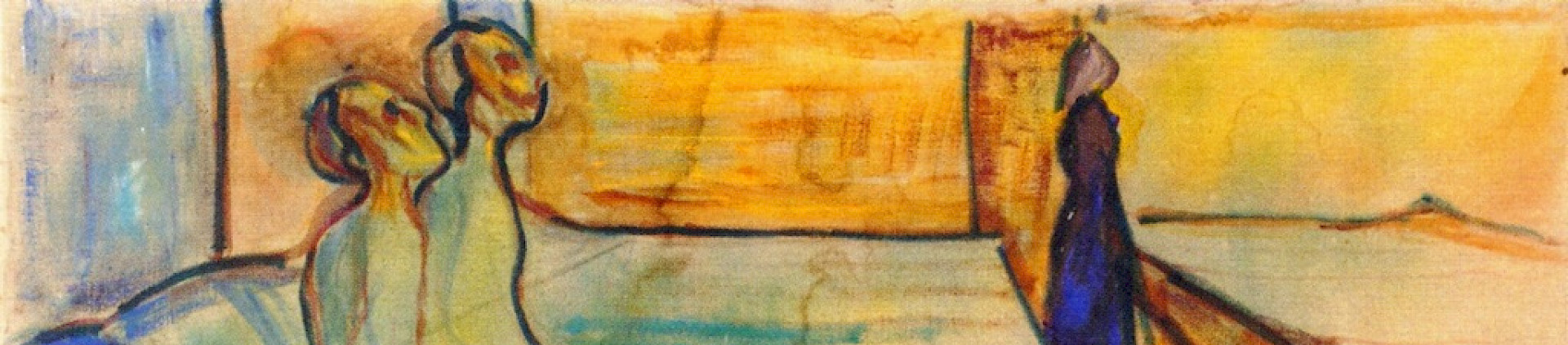
Cover image: Hospital Ward by Edvard Munch

