On Naming Storms and People by Jaden Morton
In this moving short story by Jaden Morton, a young person grows up in rural Norfolk with their family, slowly casting off the alienating binds of boyhood towards a different gender and identity, the eroding coastline an ever-present part of their narrative.
This piece was shortlisted for the 2025 Queen Mary Wasafiri New Writing Prize.
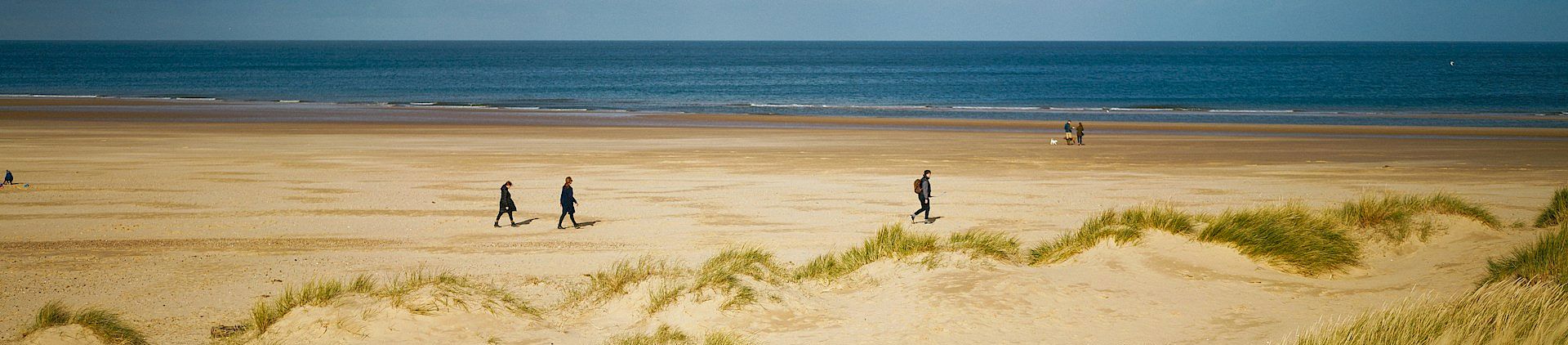
The Norfolk sky is a low-hanging dome. The clouds, slightly out of focus, carry rain like old shopping bags. As a child, I walked the coastline with my parents. The prehistoric cliffside of Hunstanton had three distinct layers of rock. The first layer was a deep red and stood taller than our two-storey farmhouse. Above the red, a story of orange bleeding into another of white. Parts of the white rock broke off from the cliffs and lined the shoreline with bone-clean boulders as they collapsed into the sand. As a child, I climbed them. I would poke my small hands into the voids and feel the ambient temperature drop several degrees. If I was too carelessly hopping from boulder to boulder, Mum would call out from the safety of the flat sand. Watch your feet, little monkey, her voice dissolved into the wind, Little lost caverns.
As I grew up, the rock formation changed from playground to meeting place. My school friends and I would cycle to the beach after school to smoke, drink, and talk about the girls we fancied. They pitched each other the kind of life they would have after school, unphased by any sense of limitation. Their desires were unrelatable to me, but the wanting was infectious. On the wet sand tossing fist-sized rocks into the sea, they held an incorruptible will for more, and I was with them thinking, yes, more.
They were kind boys, who noticed that I was changing in ways they were not, and said nothing. My hair grew long and I grew distant, until they eventually stopped inviting me to the beach. The memory of that time shifts like a coastline; perhaps it was me who stopped replying to their invitations, and my distance wasn’t as subtle as I thought. I sometimes catch myself wondering if my retraction was more painful for them than I realised. I carried my resentment towards their rejection to university, where I would get drunk in small living rooms and talk unkindly of their optimism, I called them naïve little boys, opaque, ignorant.
In the months before I left for university, those beaches drew in dead whales. Beneath the shadows of sand dunes, they lay on the flat sand as if possessed by stillness. To count time in beachings is to say I left home seventeen dead whales ago. I searched local news websites to keep track of the strandings, looking for patterns in their arrival. Wondering why they had been drawn to my black hole of a hometown. Whales have a heritage of ancient knowledge, like a microchip of knowing installed into them; when working properly it should guide them safely through the ocean. I searched the university’s online database for academic articles, wanting to know if the fault was in the confusion of warming currents, or in the whales themselves. In a fit of desperation, I emailed a lecturer specialising in local marine biology.
On the increasingly rare occasions that I did go home: Dad’s eyes had sunk further into their sockets, yellowed from decades of pints after work and pints on the weekend. He would stand with his arms folded in the doorway in a sweaty work shirt and grey slacks as I walked up our pebbled drive with my heels sinking into the mud beneath the stones. He scanned my clothes, earrings, or shoes as though it were his duty to take offence.
The house was a detached, pebble-dashed farmhouse with windows set deep into the walls.
The maroon paint used on the frames was prone to splintering, so every few years Dad would repaint them. Mum held the ladder, watching him nervously as he climbed to the first floor. He was overconfident as he slapped paint into the frames. Mum reminded him to slow down, and he pretended he couldn’t hear. One year, during strong winds, Mum implored him to come down as she pinned her weight to the feet of the ladder. Her voice was lost in both the wind and his arrogance, and the bucket spun off its hook and came crashing down. Maroon paint poured to the ground, coating her in the thick paint. I came back from school to the sound of her cursing Dad from the shower as she scrubbed her arms in the bathroom. I laughed when he told me that she had looked like something from a slasher movie, and she sent me to my bedroom.
In 1986 a motorway snaked its way around the house. The owner before us worked high up in the planning agency and managed to protect it from demolition. A ring of pine trees was planted around the perimeter to block the sound of engines, but the noise pierced the leaves regardless. In '96, powerlines. The skeletal giants towered over the house like the inky outline of a cathedral. Every summer a naive family of wrens would abandon the moors to sit on the lines with the pigeons and the crows, before eventually seeing sense and turning back. Then a roundabout and a small garage, followed by a second roundabout and a Little Chef. A McDonalds and a Spar, then the Little Chef disappeared, and a Premier Inn took its place. When the wetlands flooded in 2001, we spent two weeks there while the house dried out.
On the west gable there was a modern brick extension where the original kitchen was torn away during a storm in the late 1990s. My parents went wild and forked out for a skylight on the slanted roof, which was really something back then. The house was built to withstand the ruthless demands of open farmland, braced for winds that carry salty air across the channel. These winds build momentum over the Fenland, slipping through the tall grass of the moors until reaching the richer soils of central Norfolk, where farms like ours used to harvest wheat and grain in the spring. The house was not built for freak summer storms.
The eye passed directly over the farm, peeled the walls off the old cattle shed, and sent them hurtling towards the house. Storage boxes, bikes, and old playsets battered the east wall until it collapsed in on itself. When we saw the damage in the daylight, the house looked as though it had taken a deep breath and had forgotten to exhale. I was too young to remember anything with clarity, only the rubble and the sagging wall. There are half-formed memories of being dragged from my bed and driven to Uncle Graham’s, and my Mum scouring the rubble for our cat, Gretel. The fallout of the thing always seems to punch harder than the thing itself. Mum couldn’t sleep without pressing the windows tight and testing every handle, Dad would frown up at every gloomy sky and check the weather on Ceefax with religious dedication. Gretel survived but died three months later of old age. We held a modest cat funeral in the garden, and I remember feeling small under the powerlines.
Dad’s 60th came just weeks after the GRA was repealed. The unsigned documents were in my bag next to his birthday card. I carried his present, aware of the sweat soaking into the wrapping paper. My heels buckled on the pebbled drive as Dad stood in the doorway with his arms crossed. Mum pottered behind him in the hallway, clearing the shoe rack to make room for my sandals.
The hallway was covered in photographs, they cascaded from the first floor landing to the front door. Neat gold fames held the image of days out on Heacham beach, butterfly hunting on the Moorlands with my cousins, and crab fishing out at Wells. There was a photo of me from every school year in ascending order, slowly evolving in my school uniform, a blue and gold tie and stiff woolly blazer. In the first few photos, I am soft in the face, my hair cropped short, brown curls cut tight against my temples. Further up the staircase I have a fuller jaw and the shadow of hair on my upper lip. In year 10 I had a cold sore burning the side of my mouth, in year 11 the nose ring, and in year 13 a covert touch of mascara.
A reluctant boyhood chronicled up the staircase, framed against the textured wallpaper. As I walk down the landing, the boy in front of me liquidates, reinvents until my graduation photo emerges. Growing my hair unleashed a wild curl. Beach waves, Mum said, referencing one of her Woman’s Weekly magazines, it was the only way she knew how to approach my unfamiliar new identity. Beach waves lovely.
There were photos of me as a baby too, chubby cheeks and closed eyes resting on Mum’s shoulder. Her hair reached down to her waist.
Mum pushed a mug of tea into my hands, asked about my journey. Any delays? Is my Railcard still valid? Do I need cash for a new one? How’s work? Have I done my tax return properly? Do I need help with it? She can always help with things like that, you know. How are my housemates? Do they eat meat, stay up late, bring strangers over, and smoke electric cigarettes late into the night?
'Do you mean vapes, Mum? No, they don’t.' This is one of many half-truths that make up our conversations.
She then began running through the weddings and subsequent procreation of her friend's sons and daughters. Dad slouched in his lounger and glared at my skirt. He sat up when Mum asked about the lads from boys’ grammar, and since I hadn't actually spoken to any of them in years, I reeled off some updates I’d seen on Facebook. Recalling the new jobs in London, the new girlfriends, the spontaneous relocations to Australia. I only had basic details, scraps of information of the boys from my expired life as a young man. None of them had actualised the dreams they’d proclaimed on the beach, but they’d done enough to make dad nod his head in approval. I placed his present on the coffee table and took the card and the documents from my bag, making sure the card was on top. Mum was halfway through a story about her last trip to Dunelm Mill when I lifted the wallet of unsigned documents onto my lap and waited for her to finish. She trailed off with an unsteady voice. She knew what this was, what I wanted from her. Dad folded his legs and turned away from us both, pressing his weight into the leather arm of the recliner.
I began. 'So, I’m here for Dad’s birthday, obviously. Well, I know it was a couple of weeks ago but this was the only weekend I could get off work.'
Dad didn’t look up from his phone as he scrolled his newsfeeds. He spoke into his phone, as though the presenters would turn away from the busy work of reporting and reply to him sympathetically. 'Yet, he only stays for one evening.'
He. A wren takes off from the parapet, dives headfirst into the dry earth.
'I’ve got some documents I need you to sign. I’m changing my name. I know you aren’t exactly comfortable with this, but I really need to take this step.'
'Comfortable?' Dad snapped. Sickened, he kicked open his legs and lifted from the chair.
'I get it, promise I get it. But I just really need this.'
How are names chosen? Do they exist only in paperwork and bureaucracy? I think names are discovered, realised as we become the archaeologists of our own bodies. I think names reveal themselves to us in the dirt.
'Your poor mother.' Shaking his head, retreating to the kitchen with a cigarette, letting the partition door slam shut behind him.
Once he’s gone, there is no sound but the tapping of a crow’s claws on the pebbles outside.
Mum moved from behind Dad’s chair to sit beside me and turned her legs towards mine so that we were face to face. She sat close and folded her hands into mine, rolled the flat pad of her thumb over the lines of my palm, and drew slow circles into a pressure point. Somewhere far away, a hawk cried Baby into the afternoon sky.
'So what will your new name be?'
'Remember the storm, the one that took out the kitchen?'
'Genevieve.'
'Yes, but Genie mostly. That’s what my friends call me back home.'
'You are home. Aren’t you?'
'I’m home home.'
'I see.' Her voice was quietly resigned. 'You’ve got to say it twice just to convince yourself it’s really true.' She looked at me as though she had forgotten who I was and both of our hands trembled.
'Please just sign the form, Mum.'
The wren dives into a body of water, sees itself in freefall, then disappears. She turned once more to the plastic wallet, opened the flap, and inspected the documents. Lifting her glasses to the bridge of her nose, she read through the forms diligently, nodding to herself, sifting through the legal jargon with a downturned brow. The GRA repeal gave her a power over me that she resented as much as I did. A new law in which it was declared at least one person of sound mind who signed your original birth certificate must approve the distribution of the new one. This was the only way to change your name. A cruel bureaucracy that left those of us lucky enough to have parents around to sign, completely at their mercy.
'Let me go get a pen.'
Dad was at the end of the garden kicking around a McDonald’s bag that had drifted from the motorway. He stood with his rounded shoulders facing the house. His cigarette smoke floated up to the powerlines and dissolved into the grey sky. I grew up watching him simmer this way, his temper was an unpredictable wasp in waiting. My parents’ fights were always defined by his one-sided rage. We learned to gauge his mood by the sound of his car tires pushing away the pebbles on the drive. Light, barely audible ripples, then we were in the clear. A louder gush of stones, something like the crashing of waves against a concrete promenade, then we prepared ourselves for the worst of him.
The anger carried in with the stench of his work shoes, as he kicked them off and let them roll across the hallway. Mum would be stirring a stew or finishing up some extra accounting business she’d picked up from savvy clients, who knew they could pay her pennies for good work. If she was working (domestic), he’d comment that the food was bland, and if she was working (capital), he’d look for errors in her calculations and then brew himself into a bloodier rage when he was proven wrong. That was when the worse fights would happen, when she was smarter, had more wit, or dared to let her mind bear its teeth. His riotous temper would send lampshades flying into plasterboard and see curtains torn from their railings. This rage would drive his flailing body out into the garden, towards the surrounding fields. His wailing disturbed the birds nesting in the soil, and – at once – thousands of them would erupt into the sky in protest. They loathed him.
Mum returned with her pen, but instead of sitting down to sign the forms, she slammed it onto the coffee table and held out her hand.
'Come with me.'
I was hesitant, there was an unrecognisable wildness to her. I let her pull me through the front door and up the driveway. We started running across the pebbles, heading for the motorway until she took a sharp right into the bushes of the neighbouring field. She gripped my hand as we disappeared into the shadowy hedgerow. Twigs snapped out of our way as we crashed over dried leaves and mole hills, and the worms burrowed deeper into the earth to make way for us. Then the grey daylight returned, the afternoon sky purpled, dense with bruised clouds and, as ever, dominated by the black powerlines.
An indulgent inhalation, we filled our lungs. On the exhale, we released two bellowing screams esoteric in pitch. The dome cracked open. Thousands of bleating, flapping shadows concealed the clouds, and tore the daylight from the fields as though it had been a cotton tablecloth all along. A chorus of wing beats pounded the earth, whipped at my cheeks and my hair. The birds rioted my new name into being. Our bodies rumbled, nothing inside me was still.
Cover image: Phil Hearing on Unsplash

