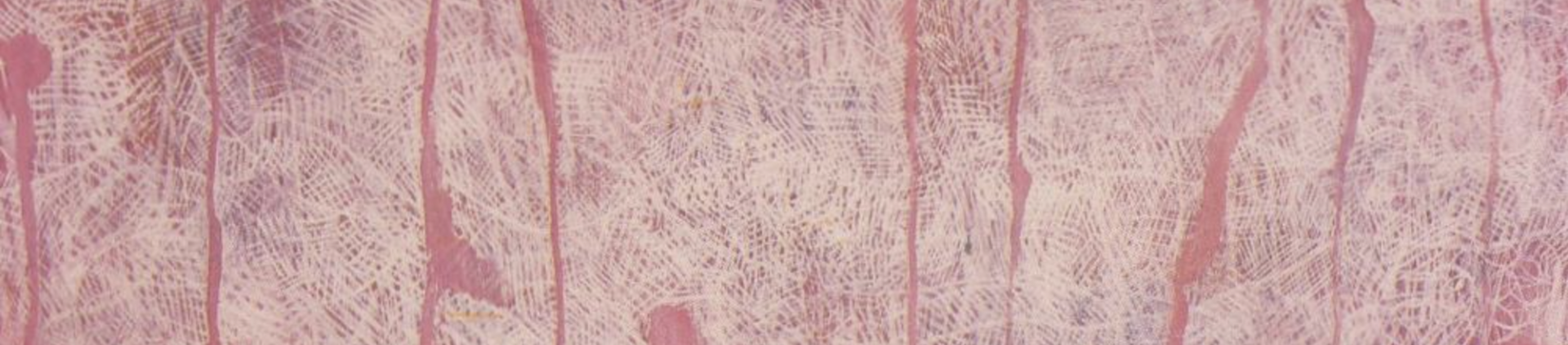
(Abstract) by Bin Xuan Phai
On (Mis)Translation and the Vein of Resistance by Khairani Barokka
Using the term 'amuk' as her starting point, Khairani Barokka roots out the violences in colonial mistranslation, weaving in disability justice and personal experience in this extract from Wasafiri 123.
Download the full piece for free during the month of September 2025 only, or read Wasafiri 123 in print, available to preorder now.
Each word contains, as I write in the book amuk, ‘linguistic cosmologies — how stars move and imprint upon the body’ (15), imbued with how our bodyminds change as the word hits us read, spoken, written, signed, heard, or felt. Connecting our selves with lineage, heritage, understandings, both our own and others. Each translation of each word is a refracting of these cosmologies; when indigenous understandings of feeling and language are flattened, when translation is disrespected as a task in which meaning is twisted without real care for communities of origin – as it so often still is in the Western world – it is to hold a constellation of histories without tenderness.
The histories of a single word taught me this, as it continues to teach. It reveals whole rainforests of a word’s usage, narratives of violence and resistance attached to it forming veins in leaves and the sinew of roots from person to person, family to family, passed down, across populations.
amuk is a poetry book, and in its entirety is my translation of this single titular word — meaning ‘rage’ or ‘to rage’ in Indonesian and Malay, and the origins of ‘running amuck’ and ‘amok’ in English. As someone bilingual in and translating between Indonesian and English, and acutely aware of colonial histories and etymologies, I’d always been drawn to a juxtaposition of different translations for the word: a juxtaposition of violent (ie colonial) and non-violent forms of translation.
It is a work in two parts. The first section is one long poem entitled ‘amuk’, that is the text from a performance lecture (originally commissioned by the University of Edinburgh’s Climate Futures Initiative). The second part is a series of ‘prayer poems’. These two sides, rage and prayer, are revealed to be part of the same amuk ethos, and one and the same themselves.
An excerpt from the long poem:
the refusal of indonesian
and various indigenous languages
to conform [to have conformed]
to temporal orthodoxy
is-was-will be the greatest of wisdoms
on the tips of our tongues and limbs
kept-keeping-will keep self-protecting
in the leaves (Barokka, amuk 16)
This self-protection in the leaves is where the vein of resistance lies. When I picture linguistic resistance, it is in the veins of leaves in the remaining rainforests, as extractive colonialism has always been a destruction of indigenous models of environmental justice.
As early as 1516, the Portuguese had adapted ‘amuk’ into ‘amuco’ or ‘amouco’, denoting ‘a frenzied Malay’ (Temple). As European colonialism took firm hold on South East Asian archipelagos, by the seventeenth century, the word ‘amuk’ had been translated into Dutch, Danish, and English as well. The reasons for this are deliberate and laced with violent intent.
[ ]
Wherever brackets appear in the book, I perform it as a deep and sudden gasp. I am deeply interested and invested in what lies between brackets, in what breathes in the gasp. I use brackets to denote a gasping repeatedly in this work, for when I think about colonial destruction past and present, it can overwhelm the system; it can cause the stirrings of a panic attack. When I experience a panic attack from anxiety, including existential indigenous anxiety, I gasp.
This gasp I understand as being part of a collectivity with regards to ‘health’ and ‘wellness’, the Muslim notion of the ummah as one body, my infinitesimally small gasp coming from thinking about, and feeling, the histories of millions, etymologies under threat, etymologies that doggedly persist, that regard my own soulbody (a term that is my translation from the Indonesian ‘jiwa raga’), that interpret the nuanced workings of my own soulbody for others, and for myself. Through a single word.
Here is where a definition of disability justice is prudent. Disability justice is a term first defined in English by queer crips of colour artist collective Sins Invalid, stemming from conversations c.2005 (Sins Invalid). It has ten principles, including ‘Leadership of those most impacted’, ‘Anti-capitalist politic’, and ‘Recognising wholeness’, ‘Collective access’, and ‘Collective liberation’. It has always been anti-colonial and anti-genocide.
Disability justice is in opposition to ‘disability rights’, a movement predicated on disabled citizens of a nation receiving their rights. But what if, as Leah Lakshmi Piepzna-Samarasinha writes in Care Work: Dreaming Disability Justice (2018):
'A rights frame work says that … civil rights legislation give disabled ‘citizens’ our rights: we simply state the law and get our needs met. Disability justice says: What if you’re disabled and undocumented? What if you think the settler colonial nation we live in is a farce and a hallucination? … What if the people giving you accommodations and access technology – or not – are not paid for by the state but part of your community?' (76)
In January 2025, I successfully attained ‘Indefinite Leave to Remain’ (ILR) status in the UK; in other words, I became a permanent resident. I’d lived in the UK for nine and a half years, and continue to, under an Indonesian passport. Despite being on competitive student visas and a Global Talent Visa that were difficult to obtain, I was not given any access to benefits as a disabled person who was not a citizen or a permanent resident. There is no comprehension for the UK government that someone could earn a competitive Visa for work in the arts, and also be disabled and ill.
To be here at all, I was required to suffer. To scrap for access and rest where I could, amidst a morass of access neglect, violence, and disbelief, to slowly find true belief and access intimacy and another family, far from home. It was only with ILR that I gained access to benefits for the first time; and it’s not as though gaining access to benefits on the surface means that you will receive them, or that the process of applying for and obtaining benefits on a regular basis wouldn’t be painful and dehumanising enough to deter you from applying, as my disabled British friends and colleagues can attest. After all, the United Nations deemed the UK a humanitarian crisis for disabled people years ago, due to the Conservative government’s austerity measures. That crisis has only intensified.
Read the full piece here, free to access and download for the month of September 2025 only.


Inside Wasafiri 123, you'll find interviews with Andre Bagoo and Christina Sharpe, a lead feature poem by Devika Rege, our 2024 Essay Prize winning articles, and much more. The issue also includes a special section – Tibet: In Focus – showcasing creative-critical commentary by a range of contemporary writers, translators, and artists.
