Publishing Commons: R T Samuel and Ruby Hembrom in Conversation
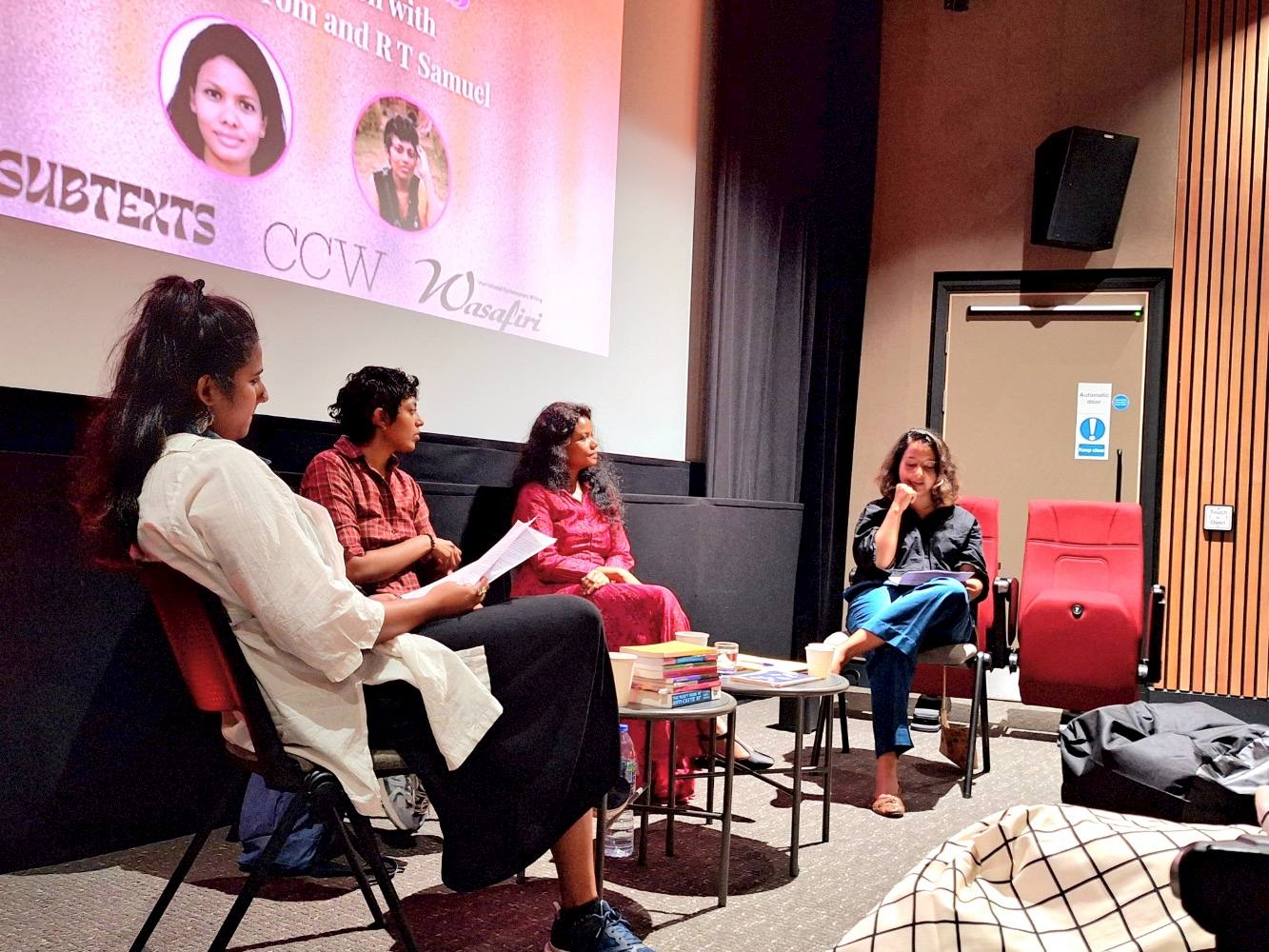
We held a live conversation on 30 June, 2025 with R T Samuel and Ruby Hembrom – editor and founder-director from Blaft Publications and adivaani, respectively – two indie publishers championing some of the most exciting and radical work in India's literary scene. The discussion was facilitated by Ananya Mishra, Lecturer in Global Race Studies at Queen Mary University of London, and Prerana Kumar, poet and former LAHP placement holder at Wasafiri. Together, they explored the contemporary publishing industry in India, anti-caste expression, science fiction, promoting Adivasi-Indigenous literary cultures, (re)forging the literary scene from what has been bottlenecked as the ‘periphery’ and 'ethnography', and more.
This conversation has been edited for length and clarity.
Ananya Mishra: Today is 30 June, which marks Hul Diwas, a day of revolution. Hul Diwas honours the 1855 rebellion led by Sidhu and Kanhu Murmu against upper caste and British land theft and exploitation. We have thus named this conversation ‘Publishing Commons’, quoting from Lionel Fogarty's Harvest Lingo. Fogarty – a Yugambeh poet born in Australia – has been creating solidarity among Dalit, Adivasi, and anti-caste poets, as well as First Nations Australians, through his poetry. In the ‘India Poems’ of Harvest Lingo, he offers a poetic five-pointer plan to envision and create such inter-indigenous coalitions, a plan that is not just interested in resisting but circumventing the colonial and casteist centre and its modes of expression altogether. Publishers adivaani and Blaft Publications have been doing the work of creating a ‘publishing commons’ in India for some time. How were these envisioned? What were their creations rooted in?
R T Samuel: Blaft Publications is an independent publishing house based in Chennai. In its fifteen years, it has published what the couple that runs it describes as 'wild' and 'wacky' books. They don’t pay much attention to commercial trends. They've put out zines, beautiful photobooks, and collections — such as the one for Tamil pulp fiction.
I feel like they're very different. They don't necessarily have an immediate political ethos; their publications are centred more around their taste. Some of the art is inspired – and actually painted – by Shyam, who does paintings for Tamil films. They also really like maths — they have a lot of short stories based on maths problems. Their writers are often people who have interned for them, like Mimi Mondal, the first Indian and Dalit author to get some of the biggest awards in science fiction.
Ruby Hembrom: Sometimes, things start when they’ve reached a tipping point. And that is the story of adivaani. My sisters and I were allowed to enter certain spaces – work or college – traditionally closed to us because we spoke English. I kept asking, where are our people? I decided to teach them English. Because, for Adivasis, this is a language where they can negotiate with the state — our constitution is written in English, you sign documents that are in English. Knowing it is a tool with which you can defend yourself. We are denied that tool because we don't know the language. But I realised that the books we were going to practise the English language with would have been written by others, and not featuring us.
Then, I attended a publishing course, knowing nothing about publishing. From among all the poets, authors, printers, illustrators, and publishers, I could not find one indigenous name. I had to do my own work and start a press. And I realised that we wrote in our native tongues, in borrowed scripts, and that was not considered good enough, which led to us being excluded. So I had to publish us in English. I called the press adivaani, from adi which means first, and vaani which means voices.
AM: Your work, then, comes from a place where it's saying, ‘Enough is enough, let me create this space.’ In the last ten years or so, since you have been working in this space, do you think there have been more conversations between publishers? And more collaboration between translators and writers who are not in mainstream publishing?
RTS: In the UK, a lot of major publishing houses have internship programmes so that diverse audiences can get their foot in the door. But in India, this isn’t the case. There is very little opportunity to get published. Publishers chase commercial numbers. The collaboration you’re talking about is not there.
RH: I agree. adivaani is in the margins, but I'm still part of the industry, and the only reason my work is known is because of them paying attention to their relatable English-speaking Adivasis. For instance, the Gandhi Foundation International Peace Award 2011 was given to two people who had done work for Adivasis. Adivasis, doing work for their own people, were not considered. One of the panellists said, 'How can we even give it to them? They don't even speak English.'
There is sensationalisation around me, the Adivasi ‘IT Girl’ who quits her job to go back to her roots. But I was never disconnected from my roots. There is an infantilising of our work. I would get invited to a lot of places, but they were interested in just me, in the story of how I did this. They would never ask about how they could get our books or how they are produced.
From among all the poets, authors, printers, illustrators, and publishers, I could not find one indigenous name. I had to do my own work and start a press.
AM: Maybe we can think about what could be aspired towards here.
RH: Presses specialising in anti-caste work who start publishing Adivasi books make you think, 'That should have been a book I should be doing.' Sometimes they inform us that they’re releasing something without providing any details until it gets published. How is that collaboration? These publishers often have large funding and are supported by research grants that don't come to us. Even then, their Adivasi or tribal publishing is from northeast India. That's also strategic, because they're English-speaking, so they can afford not to look at us, the non-English speaking peninsular Indian tribes. All this makes the validity of publishing houses like mine really suffer. It becomes difficult for us to keep existing and staying relevant.
Prerana Kumar: The tension created by the centre versus the margins manifests differently in the UK, because here literature identified as ‘brown’ gets racially marginalised, but that ‘brown’ categorisation is mostly caste-privileged and erases Dalit, Bahujan, and Adivasi identities. You've spoken about what it’s been like for you at events to have been boxed into 'marginalised literature’. How do you reckon with these tensions while producing the books that you do?
RTS: We did it almost in a tongue-in-cheek manner. Because it was Blaft, and because Priyanka Paul did the cover art for The Blaft Book of Anti-Caste SF, we knew that the book would be very consumable to a certain audience. It was very important for us to have Ambedkar displayed prominently to clearly show that we are anti-caste. We wanted to challenge consumers. Blaft also has tote bags that say 'anti-caste'. It's funny, because now it's becoming a sort of virtue-signalling object.
Dalit people are not the minority. They are – if not the majority – much bigger than the term ‘marginal’ would suggest. They are not represented in politics, in seats of power, or even in publishing. In India, Blaft’s audience, and literary audiences in general, are diverse. They are not all upper caste or Hindu or Hindi-speaking. Whereas abroad, I think it gets murky.
They can afford not to look at us
RH: We never really thought of the centre or the periphery around our work. We centred ourselves. Who would read the books was not really a consideration because our original challenges were just about creating manuscripts. After we started and somehow caught the media’s attention, my inbox was flooded with manuscripts — all of them from non-Adivasis. There was so much work by non-Adivasis on Adivasis, which proved that Adivasi material was commercially redundant. I said no to those inquiries. These are the kinds of negotiations with the centre, from the periphery.
PK: Speculative fiction has always harnessed imagination and world-building in very exciting ways, breaking open fascist and capitalist logics. For me, it's so surprising that this new Blaft anthology is the first of its kind in India. R T, I want to hear more about your interest in speculative fiction.
RTS: I started reading it when I was twelve, with CS Lewis and Tolkien. I was fortunate enough to have parents who read widely and to have access to a lot of libraries. I wanted dragons to be in space. There was an honest pleasure that I took in these books. Rakesh at Blaft and I put my obsessive, encyclopaedic knowledge into the anthology.
The work in this book might not all be categorised as speculative fiction. Rakesh and I were interested in the elasticity of the genre, and we wanted to reach out to established Dalit authors and commission works of speculative fiction from them.
I wanted, in this anthology project, for everyone to get paid and to have good, creative fun.
We never really thought of the centre or the periphery around our work. We centred ourselves.
AM: Ruby, in your article ‘Cohabiting a textualized world: Elbow room and Adivasi resurgence’, you mention the dilemma of transmitting, translating, and reproducing what's organic and breathing into a form that is, in many ways, limiting. When you were curating, how were you working with different languages and forms of Adivasi storytelling cultures?
RH: There was no process of selecting because we were not ambushed by manuscripts. There was creating and curating. We spoke to activists and family members of important figures in Adivasi movements to see if there was any material they left behind. If it was in a language that was not known to me, we got experts. The act of co-creation with authors was an important part of asserting ourselves in this literary landscape. There is now an archive for people who want to know who Adivasis are and what their writing is.
PK: Eve Tuck talks about how indigenous writers create work that suspends damage-centred narratives. Often, there is a tendency in the wider publishing industry to bottleneck marginalised experience and define it solely by memoiristic narratives of suffering. How do the writers you work with defy – or disregard – these expectations?
RTS: On our end, we anticipated a lot of horror fiction, which also falls under speculative fiction. It’s in the Hindu consciousness: the ‘monstrous’ is very often Adivasi, lower caste, or Dalit from the way they’re described, from body shape to facial features and skin colour. That is what is the ‘horrific’ to the Hindu imagination. We constructed the book by reaching out to older authors and looking through old out-of-print magazines. We commissioned pieces. I knew that there would be a lot of alternate histories, time-travelling, parallel universes, and horror — which turned the gaze back to what is horrific to Dalit and Adivasi people, for instance.
RH: People expect Adivasi writers to write only about Adivasi issues, which means suffering and pain. They do not recognise that there is this huge spectrum of what Adivasi knowledge or cultures are. We have songs, music, and texts that talk about everything. But people do not expect us to have an opinion on what's happening in the world. There's romance, folk tales, and fantasy. There's a lot of speculative fiction in our folktales. With that, I would say it's important to acknowledge the suffering and pain articulated in the publishing — but there's so much more to us.
The ‘monstrous’ is very often Adivasi, lower caste, or Dalit from the way they’re described ... That is what is the ‘horrific’ to the Hindu imagination.
AM: What are you excited about now? Can you tell us about your new projects?
RTS: This is not necessarily about my own work, but I hope the speculative fiction genre expands in India. I hope people give authors bigger opportunities. When we announced our fundraiser, some big publishers announced – just a month or two after it – that they’re doing a speculative fiction anthology. So hopefully, within those anthologies, there will be a diversity of authors. Back home, I’m seeing a few Ambedkarite and anti-casteists in conversation with each other. I do feel that with the kind of work that we're putting out and the way we're speaking to each other, we'll see the fruits of that maybe ten or twenty years from now. But I'm really excited about being part of the dialogue.
RH: What excites me is the life the books take. That’s not something you can know. There's no way to really tell what will happen to the books — it's such a struggle to get them out,and only a few independent bookstores keep our books in circulation. The reach has been so limited. But I will only stay with the small, independent establishments that actually support work like ours.
It's beautiful to see the life your work takes on. Many of our books are being taught in universities abroad in English language departments. That always surprises me, because people in India don't know about our work. I was sent an email recently about the new parliament that's being built in India. They're building a parliamentary museum, and they want two images from our book on the Santal Rebellion.
I have not produced a new book in seven years. There are books in the pre-press and pre-printing stages. But then it's super interesting to know how people are still seeking our work. This is what I wanted to do. This, I think, is a form of translation for me — a transmission and transmuting of words and text that come alive in this fascinating way.
This event was held in collaboration with Queen Mary’s Centre for Contemporary Writing (CCW) and Subtexts.
Cover image: Limits of Identity by Nalini Malani


