The Trying Space by Divya Ghelani
The first piece in our new Writing the Self, Writing Berlin series – led by our CHASE intern Divya Ghelani – is a personal essay by Divya, reflecting on her entwined experiences of producing both a novel and a baby via IVF while living in Berlin. She explores how this time transformed her ideas of anxiety, perseverance, and the act of creation.
‘Why don’t you give IVF a go?’
We were on our usual walk in a pretty, local graveyard in Mitte. It was spring, during Berlin’s second COVID-19 lockdown. All the flowers were in blossom — daffodils jutted out of the side of gravestones, jaunty and strange. Amid conversations about the novels we were writing, I told my friend that my husband and I were still trying for a baby. COVID had made everything feel compressed: time, self, desires. I was 39 years old and one year into marriage. Two close family members had gently suggested IVF to me already. I knew how much they cared for me, yet I couldn’t help but feel intruded upon. Something about that walk in the graveyard, however, started to turn my mind.
About a decade ago, I had trusted my husband’s desire to move to Berlin, joking with new friends that I was a ‘love migrant’. He had known the city in his twenties, and though I was a stranger to it and its language, I agreed it could be a great place for us. We liked that, compared to London, Hong Kong, or New York, Berlin felt more hospitable and affordable to artists and creatives, where we could also find others with like-minded politics.
Several weeks after the graveyard conversation, my husband and I found ourselves navigating the labyrinthine German bureaucratic and health systems, in the hopes of figuring out how much IVF would cost. As two, independent English-speaking writers, we didn’t have a large disposable income or much of a clue about the tangle of health and administrative-specific German words related to IVF. We relied on the Internet and international chat groups, as well as translation apps, which involved photographing the pages of dense German text that would dictate our future. It was all so frustrating that I started to wonder why we'd chosen Berlin at all.
I reminded myself that we were the lucky ones. As a heterosexual married couple with statutory health insurance, we were offered partial cost coverage on the medical procedure — something same-sex and unmarried individuals undergoing IVF are not offered. That said, the discount would cease as soon as I turned forty, after which neither the state nor my health insurance company would want to encourage me towards making a baby. This not only worried me, but it also made me feel old. That outdated term ‘geriatric mother’ kept floating about in my head like a taunt, butting against a more spirited and youthful self-image. I felt anger at every structure that created and perpetuated disapproval for a forty-plus woman trying to have children; at the same time, I also felt solidarity with the many same-sex couples who wished for a child yet were denied fertility treatment assistance from health insurance companies or forced to jump extra hurdles, oftentimes trying for a baby out of their own pockets entirely.
My first box of IVF medicine arrived via a delivery man in late summer, like some mundane parcel from Amazon. I felt unnerved by this. My husband and I unpacked it together, dazed by the sheer number of syringes and chemicals. At one of the many, many appointments at the IVF centre in Mitte, which were frequently for blood tests, the female paediatrician said, ‘We’ll make you a nice birthday cake!’ as she walked me to the door. She made a bulging pregnancy gesture with her hands. 'The ingredients are needles and chemicals,’ she smiled, ‘but cake is cake.’ That evening, when speaking to my husband, I recalled her words with a feeling of warmth. ‘I’m fine,’ I told him. ‘It’s going to be fine.'
'We’ll be like Sid and Nancy! It’s rock and roll,' I joked. 'I just can't decide if I should inject it into my thigh or ask you to do it.'
In the weeks before the first needle even punctured my skin, I was quietly kicking myself. Why had I waited so long to make such real, life-affirming decisions with someone I loved? And why had I taken over a decade to finish my novel – writing one and a half whole, new novel drafts in between – just because I lacked the confidence to believe in myself and the story I wanted to tell first? Publishing a novel would have made me feel like a ‘a real person in the world’ — successful on my own terms. If I was able to be someone that confident, I thought, I would then be able to take huge life decisions like starting a family. Instead, I swung between striving and failing, in a constant state of unknown. It made me feel underwater, too scared to swim up for air.
'We’ll be like Sid and Nancy! It’s rock and roll,' I joked. 'I just can't decide if I should inject it into my thigh or ask you to do it.'
The unknown is perennially scary. Days into my first set of injections, I got addicted to some awful political thriller series on Netflix, which I roped my husband into watching with me. Looking back, it was clearly a form of dissociation, but one I felt I needed to cope with how the hormones were infiltrating my body. I had never taken so many drugs before, avoiding even paracetamol where possible. IVF made me feel like a giant medical experiment — sensitive, vulnerable, and more prone to anxiety and mood swings. I wanted to numb myself because I felt out of control, self-conscious, and sometimes despairing.
Amid daily injections, novel-writing, and brainless TV nights, I mentioned to a friend at my co-working space one day that I was trying for a baby via IVF.
‘It hasn’t worked the natural way for us,’ I confessed.
‘What's natural?’ she said kindly. ‘It’s so cool. You’re making a baby the sci-fi way!’
Sci-fi or not, the first round was unsuccessful. I didn’t expect it to hit me so hard. Earlier on, I had made a secret pact with myself: to be A-okay, even thrive, without a child if it didn’t happen. After all, I was an artist — creating was my raison d’être. I would continue painting my colours onto the world and creating on my terms regardless. My husband (himself a novelist) had agreed with me that it was best to be open about the procedure with friends. But this presented the added problem of having to tell them when the first round failed. Sometimes at night, I thought of a friend for whom it had worked the first time around, with even ‘lower quality eggs’ than mine. I felt I was unloved by the universe, unchosen somehow. At the same time, I experienced enormous guilt about comparing my eggs with those of someone I cared for, who was only deeply glad that IVF had worked for her.
The IVF egg retrieval process had yielded three ‘good’ eggs for me, so we had two more frozen embryos left. The minor retrieval operation had taken place on a red leather chair, followed by a white bed. I had gone under general anaesthesia for the first time in my life. The process from there was more strange than painful. It had become so tangled up with my dreams, regrets, future imaginings ... all that preparation and injecting and hoping and filling in an insane number of German language forms via Google Translate, only to find that the baby that was meant to happen through the second embryo implantation, hadn't. I felt like such a fuckup. A lot of money was gone. We did have some more savings, but still. I kept wondering where in life I had gone wrong.
A few months later, we tried again. It was around this time of the second IVF round that I stopped talking to many friends in Berlin, like a flower closing in on itself. I just didn’t have the energy, especially if they required my emotional support. Through the hormonal volatility, I simply spoke to my husband, my family, an excellent therapist, and two childhood friends. It was around then that I slowly began to rebuild a daily writing practice, wading deeper into writing my first novel, this time with the support of an Arts Council England Developing Your Creative Practice grant that my agent helped me obtain. What had once seemed like an insurmountable feat was becoming a gradual shelter, shielding me from the strangeness and unpredictability of the world beyond. I looked forward to approaching my novel because no matter how difficult the rewrites and plot issues sometimes seemed, they were at least problems I could solve. After years of only allowing myself to half-believe that I could write a work of fiction in the way I wanted, I now focused just on the doing — placing one sentence after the other.
This isn’t to say I felt alright. At night, I often wished I had been more like one of those organised, professional women who harvested and froze their eggs before the age of 35. I went on the ‘Google Benders’ my husband had warned me against, obsessing over what to eat, what vitamins to take. Though much of it was spiralling, it did lead me to acupuncture, a holistic practice that two scientific studies suggested might help me on my journey by regulating blood flow, reducing tension, and regulating my hormones.
I looked forward to approaching my novel because no matter how difficult the rewrites and plot issues sometimes seemed, they were at least problems I could solve.
‘You really want more needles?’ my husband asked.
‘They’re not the same,’ I assured him, adding, ‘It could be good for your stress levels too.’
After the first visit to the acupuncture clinic, I found myself making breakthroughs in my novel. Dissolving into the characters and storyline, I became more relaxed at my desk. At each session, the acupuncturist patiently spoke to me for an hour, time I couldn’t imagine receiving from other healthcare professionals. We talked about my confusion about whether to exercise beyond the gentle yoga I was already doing. When we had been trying naturally, my husband and I would play frisbee by the Berlin Wall, which is situated just a couple of minutes from our flat. It was light-hearted and fun, but now I was scared to exercise too vigorously in case it messed with the IVF process. Still, my body seemed to want to move more.
The acupuncturist told me to put my anxieties aside and just listen to my body, approaching fitness as a medium of energy and life-force, rather than depletion. I downloaded a fun LA celebrity-endorsed fitness app and began working out every morning as part of my pre-novel morning routine. My moods were still up and down due to the chemical hormones, and I was often emotionally frazzled by all the wishing and hoping, but the online class could be hilarious, asking me to make sounds and move my body freely to encourage emotional release. The architecture of my novel – its foundation and arc – was becoming more solid and clearer to me too, transforming into a book I felt I could finish. I sent a new draft of Night School to my encouraging and editorially sharp agent.
Progressing with the novel I once felt I could not complete was also opening me up to thinking creatively about the business of making a baby. When my husband read a book called Spirit Babies: How to Communicate with the Child You're Meant to Have by Walter Makichen and suggested we should make an altar to our unborn baby, I said, ‘Why not?’ Normally, I’d have laughed it off as ‘wishy washy’ and ‘woo woo’. Though we had only budgeted for two rounds of IVF, if we weren’t all in at this point, why bother? We created our makeshift altar by covering our living room coffee table with photos of people we loved, symbols we wished to share, cards from friends, photographs of nieces and nephews, and supportive messages we’d received because we had been open about undergoing the IVF process. Each morning while exercising, I watched the altar grow and change. When the first leaves of autumn fell, my husband brought some in, alongside a few acorns, and placed them inside a shell from a beach he loved. It was beautiful.
Throughout this time, I spoke weekly to a therapist, a practice that became so formative that it feels near-impossible to write about now. Initially, I was glad to find a therapist of colour, who I felt understood the complexities of moving and living between cultures. Then it was eye-opening to learn that these cross-cultural issues were not actually part of the core of my problems. My therapist was male – which I had been wary of at first – yet it became healing for me to discover how we could collaborate so wonderfully. As a result of therapy, my daily writing loosened up. Emotionally, I started to feel more like I was wearing a warm, comfortable jumper at my writing desk, one I could take risks and create in, as opposed to a sharp suit, as if permanently interviewing myself for the job of Author. Some of my crippling perfectionism broke away, helping to soothe the IVF process.
Once, while discussing the classic, corrosive ‘Is it good enough?’ anxiety of writing creatively, my therapist referred me to existential philosophy. For the Danish philosopher Søren Kierkegaard, anxiety was essential to the creative process because it involved destroying the status quo and old, harmful patterns, overlaying them with newer, original forms or ways to live — a means of actualising possibilities. ‘[Anxiety] is altogether different from fear and similar concepts that refer to something definite,’ Kierkegaard wrote in The Concept of Anxiety, ‘whereas anxiety is freedom’s actuality as the possibility of possibility.’ He famously compared anxiety to the dizziness of freedom, noting that it is not just something humans must free themselves from, but an emotion they must learn to understand if they are to grow. Having lived with anxiety throughout his life, Kierkegaard’s exploration of it was as much a philosophical endeavour as an analysis of self.
Emotionally, I started to feel more like I was wearing a warm, comfortable jumper at my writing desk, one I could take risks and create in, as opposed to a sharp suit, as if permanently interviewing myself for the job of Author.
Sometimes, when I was experiencing that Kierkegaardian dizziness or doubt, I wondered if trying and trying to finish my book or make a baby via IVF meant it was unnatural, that it was not to be. Other times, I wondered if both were the most natural things in the world; they aligned with my heart’s desire to create. In creating was that beautiful, inherently human wish: to always try — despite ambivalence, despite suffering.
When the second round of IVF failed, I was shocked. I had been eating healthily, growing emotionally, exercising routinely, taking my vitamins, getting acupuncture, trying tapping therapy (an Emotional Freedom Technique), building an altar, staying positive, making time for joy – joking about with my partner, watching The Office – and exploring Kierkegaard in therapy. My book was beginning to flow, too. This was genuine headway after so many years of effort, of trying. But there was no baby. ‘No’, again. To make matters worse, our two rounds of budgeted-for IVFs were done. If we wanted another go, we would need a new strategy financially. When I confided in my family, my amazing sister immediately wired me the money for a third round. ‘What’s money for, unless for times like this?’ she said. I felt renewed. It was a magical feeling, like a blessing; it warmed me from the inside out. I was deeply grateful to feel so loved and supported in another attempt, in trying again.
During the third IVF round, I found myself reflecting on the concepts of hope and courage. I ordered The Courage to Create by Rollo May; its title seemed to name my exact problem. May writes of courage as a foundational virtue, onto which other values are layered. He writes too about the etymology of the word, which originates from the Old French corage, meaning ‘heart’, and asserts that courage is ontological. It doesn’t just mean the absence of fear, but the capacity to act despite it, in order ‘to make being and becoming possible' — similar to Kierkegaard’s thoughts on anxiety.
I didn’t manage to read May’s own book on the subject, The Meaning of Anxiety, but I did wade into a new birthday present from an artist friend, entitled The Gifts of Imperfection by Brené Brown, as well as a popular TED talk by Elizabeth Gilbert, called Your Elusive Creative Genius. It wasn’t my usual reading list (in my experience, self-help content never helped for too long; I’d just forget about the learnings as soon as I finished them), but this time, I didn’t care. I was hungry to unravel the crazy knots life had created in me, and I needed more blueprints, guides, and ideas.
I finished my novel Night School in late summer of 2024. Primarily set in Leicester, England, the closest city to the town I grew up in (though I started writing it in Hong Kong and finished it in Berlin), it’s about the devastating consequences when the boundaries between teacher and pupil are abused, as well as female friendship, defying the Western literary canon, and the transformational power of finding one’s creative voice. I could not have completed it if I hadn’t gone through all this — all of the trying.
Trying is as much about hope and heart as it is about anxiety, self-consciousness, and vulnerability. My experiences have led me to think of hope as an active thing: like putting one word after the other in a novel you want to write out of your heart, but don’t yet know how. Or like repeatedly injecting yourself with needles or jamming your legs in stirrups in some clinical room because you dream of a baby. Or doing aerobics in front of a screen on an app, because you intuit therapy alone won’t release the old traumas trapped within your body.
In creating was that beautiful, inherently human wish: to always try — despite ambivalence, despite suffering.
Perhaps the fraught space of attempting something meaningful, of trying, could even be welcome. It helped me reach beyond what I knew, into the unknown, and return with more knowledge about myself and about life. I’m in the trying space whenever I create something new, an act that inherently involves risk, or has an edge to it. If there is no risk, is it worth creating at all? Staying in this space is never very comfortable — until I completely forget I’m there, having disappeared into the task. I feel the rewards, even if the world doesn’t always see them.
Our baby was born on my husband’s and my wedding anniversary in 2022, his arrival a lesson that nothing works out as one expects. Instead of the natural birth I had dreamed of, I had a chemical induction — 24 hour-labour, laughing gas, painkillers, an epidural, followed by an unexpected C-section because of a drop in my baby’s heart rate. I remember shaking so violently after they cut me up, shouting to the doctors that I had pneumonia. Soon after the C-section, my baby was rushed to another hospital due to an infection. The separation meant my milk didn’t come in properly in weeks one, two, three, four, or five. I still remember the breast pump machine they wheeled in for me, how it seemed like a crazy painful toy, and how little milk it produced. I felt so bad, as if everything from IVF to breastfeeding had been unnatural for me, that it was my fault for living as I did.
Through caring for my baby in what felt like genuinely desperate times, I realised that I was still learning what it means to see hope as a verb. When the midwife first handed him over from behind the operation screen, he was all cleaned up, as if the stork had freshly delivered him in a white blanket. This was lovely, of course, but it also hid the messiness of creation — important parts of the process that were discarded, like the temporary organ of the placenta, which we took home and later buried in a forest. Our child was just as I had imagined him to be, as if I had dreamed him up in my head that very day in the IVF clinic, while looking at his embryo picture. Still, when the midwife passed him to me to make skin-to-skin contact, I did not feel that first rush of love I’d been taught to expect. But I knew love would be there, ready to access as I began to heal. In those hours of exhausted unknown after the surgery, I kept faith, caring in whatever way I could, watching with gladness as my husband loved him instead.
It is this extra effort – the trying space – that is a form of love. Love was not just feeding my baby my milk for nutrition; it was the way I held him as I tried. It would have been the way I held myself if IVF had never worked out, the way I would have held onto my partner, too, and all my other hopes and dreams, still.
My novel is still out on submission, meaning I don’t know whether this story I crafted for years, this gift, will ever make its way into the world. It is yet another period of hoping amidst the unknown, even though I have already done my heart’s work. I am now in the process of writing another novel (officially my second, but technically my fourth). There are times when I experience the anxiety of the trying space all over again. But I think I’m handling those moments better, aiming to understand and value them for what they can do, and how they can help me reach beyond myself, sometimes returning with jewels.
My toddler teaches me more about the trying space every day. In his young life, each day presents new things to figure out, to learn, to become aware of. He has fear, but no fear. The other day, while playing football in the playground, he fell over. He seemed distressed, so I rushed towards him. But he just got up, rubbing his head, and said ‘Owa!’, before kicking the ball again.
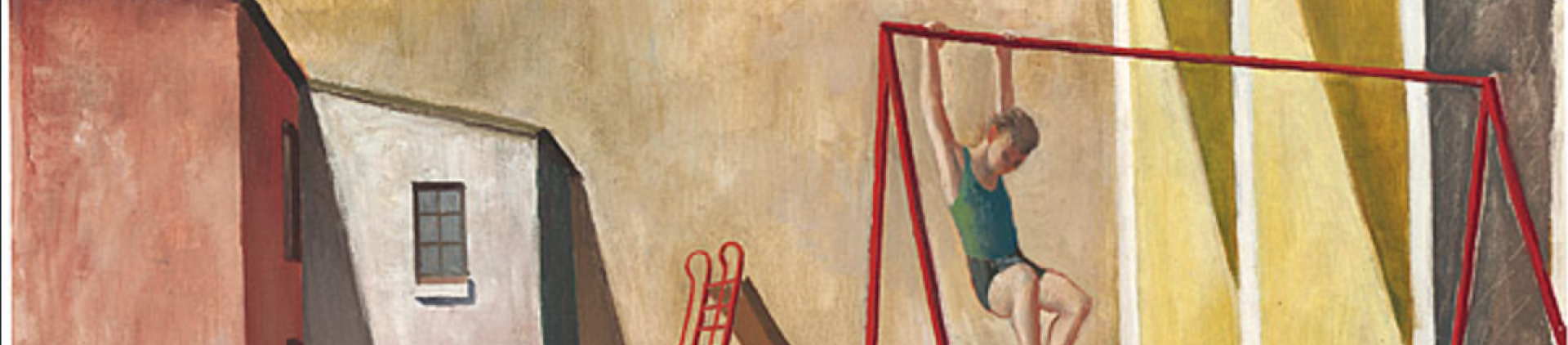
Image: Playground (Children Playing) by Jeffrey Smart

