Two Poems by SK Grout
Based between the UK and New Zealand, SK Grout offers two poems which unearth everyday lyricisms, memories, and migrations amid wider concerns on environmental and climate care.
Wild Talk
I go on listening how hard it is to find kudzu you’ve worked diligently
to explain this plant without the use of senses only imagination
eventually I make the connection jagged green plastic pieces that lie underneath takeaway sushi kudzu
you want to make gin and tonic substitute gin for sake a long circuitous story I attend carefully you’ve visited every
North London Asian grocery store as far as your bicycle can take you looking
for a tiny plant to grow and nurture
later you’ll never see my surprise when scrolling through social media I see a photo posted as poetry prompt wild kudzu
growing in a swampy state somewhere in America Woah! Kudzu!
As if to manifest through discovery I have pulled a version from the ether
I cannot travel there and back
to pluck you some only stare wistfully through my phone at the megalithic green
I think good thoughts
hoping a little of this magic
lingers and
kudzu makes its way to you
We can tell where a humpback whale has travelled from the themes in its song
And what is my whale song?
‘Poi E’ and the lost singing
of pīwakawaka as they flit
from flower to flower
in my grandparents’ garden
in Whangaparāoa, Bay of Whales.
When I was five, my parents took me
to the remnants of a whaling station
just north at Whangamumu.
The walking distance from our parked
Datsun to the harbour was as long as
this memory is eroding.
The remaining historic structures include vats
or tanks that held whale oil, the slipway
on the beach front, and an old boiler. My mother
remembers iron pots lingering in the sand.
And what was my whale song then?
The doting light of summer, my English
grandmother’s returned hands, impossible
impatience of a gobstopper.
The base operated throughout the 1800s
to the early 1900s. Aotearoa was officially renamed
New Zealand from 1840. The records
state that a fair annual catch in the late 1800s
was 16 to 20 whales. Records did not exist
before then. The most important stories passed
between blood and lips and ancestors.
Bay of boisterous wind, bay of valiant warrior.
The land will remember.
One of my father’s last whale songs
is watching the film Boy together
at the Hibiscus Coast Cinema. The dance
break at the end is a crossover between
the Pātea Māori Club and Michael Jackson.
I can still see him laughing and laughing
and laughing.
Whangamumu Harbour was chosen
as it coincided with a section
of the humpbacks’ route,
where men could stand within the sea
flaunting nets, bludgeoning their prey.
The station stopped culling because of an oil
spill during WW2 which diverted the whales.
What song did they sing then? The terror is
over. The terror has begun.
Parts of this poem have been sourced from the website of Department of Conservation Te Papa Atawhai about Whangamumu Whaling Station and the New Scientist article ‘We can tell where a whale has travelled from the themes in its song’ (4 September, 2019).
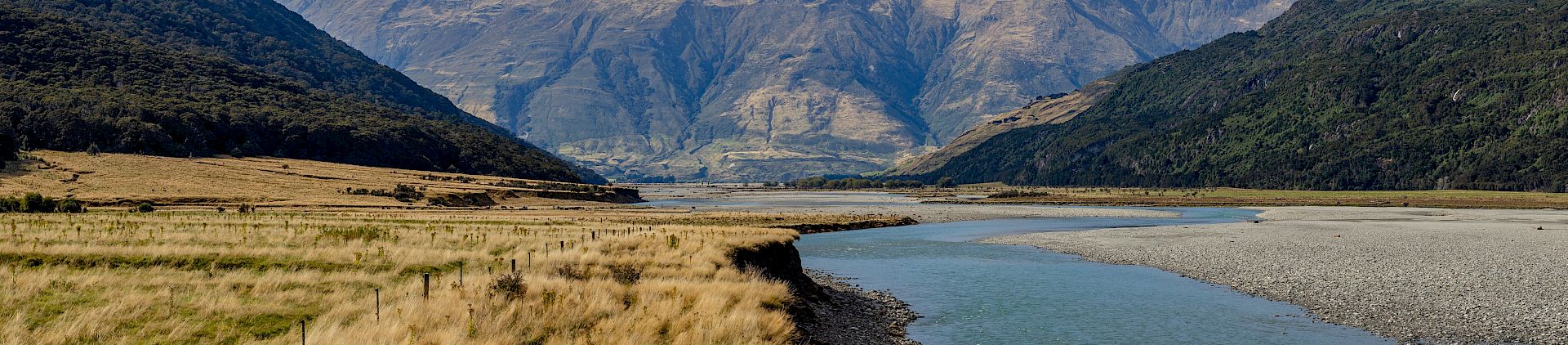
Image: Wilkin River close to its confluence with Makarora River, Otago, New Zealand via Wikimedia Commons

