Unfinished (Inacabada) by Ariel Florencia Richards, trans. by Beth Hickling-Moore
In this moving fiction by Ariel Florencia Richards, a young woman reflects on the 'cumulative' silence surrounding her transition, and its cold, creeping impact on her relationship with her mother. While contained in the liminal space of an aeroplane above the Andes, the protagonist's mind drifts from the alienation of her Christian childhood to the present. Translated from Chilean Spanish by Beth Hickling-Moore.
Supported by a grant from the Open Society Foundations.
Before the plane took off, M had already fallen asleep. Arms folded, head leaning on the window, and mouth open, snoring softly. Juana, in the next seat along, was feeling restless, holding a book between her legs. The young woman had asked for the aisle seat because her hormone blockers were diuretic, so she needed to use the bathroom all the time. Though she had never peed standing in her life, her bladder now swelled non-stop. She had to sit on the toilet for minutes at a time to expel all the water via an audible stream gushing impatiently from between her legs. M didn’t know. Juana had tried to tell her about the hormone replacement therapy, but she didn’t want – or couldn’t bring herself – to listen. She didn’t want to know anything about the transition. The young woman sometimes thought that the problem was her own: perhaps she hadn’t found the right moment to talk about it, or perhaps she wasn’t expressing herself well enough. It was just that, when she tried to explain things, she felt like words weren’t enough.
How was it possible to feel like this? Juana loved the woman sleeping next to her and wanted to share what was going on, not just because it was the truth, but also because it was amazing. As the plane started taxiing along the asphalt, she looked at M slumped, placid and sweet, her mouth half-open, and envied her capacity for self-abandonment. Above all in the knowledge that they would spend five whole days together in a foreign city, avoiding talking about her transition. She had asked her mother to come with her to a visual studies conference where she was going to present a few developments in her research. When they had invited her to give the talk, she had written M’s name in the space for her plus one and used some money meant for her investigations to buy the extra ticket. She wanted to talk to her. To explain how she was feeling, what was going on. To break the silence that had seized hold of them since she’d started on the hormones.
Juana believed that, on a trip together, they could rebuild a sense of mutual trust and be able to talk. But once on board the plane, she wasn’t so sure. Instead of opening her book, she thought about how M’s two tiny hands were squeezed into impenetrable fists, observing the tension that made the veins in her neck pop. Her brow was furrowed and there was so much friction in her jaw that you could almost hear it. On the screen in front of her she saw herself, stiff, holding her breath. Rigid. Stuck steadfastly to the seat. When the wheels of the plane lifted from the asphalt, the young woman exhaled deeply and considered the possibility that this obstinate silence growing between the two of them wasn’t acting alone. She, too, was probably the author of this parenthesis. So, almost involuntarily, she let a word escape. Mum. Though she took hold of her hand, the woman by her side didn’t move a muscle.
Behind this word came others that had been waiting perhaps too long to be uttered. Juana felt like they were building up inside her and were starting to weigh heavy, holding her back from naturally unfurling and moving towards where she wanted to go. Because around them hung a paralysing fear. Fear of being misunderstood, of being rejected, of being thought crazy. Saying them meant, also, beginning. And beginning was a way of leaving behind what was no longer hers. If she was honest with herself, facing this shedding was also a letting go of a possessive, masculine dimension. As the city and the airport they had taken off from drew further into the distance, Juana felt as if there was no turning back, admiring the lightness with which this whole structure of metallic materials made its way through the sky. This trip would be the end of her past self, and she would have to, however she could, say goodbye.
As a girl she already knew. She always had. She had learned to stay silent about her identity. First it was at home, when she saw her parents’ confusion when she wanted to look and dress like a girl. Then in school, when she turned ten and, along with her classmates, began preparing for First Confession. At her school – a Jesuit institution dedicated to instilling ‘leaders with spiritual education’ – they were told that they were already old enough to be aware of these evil doings stopping them being happy, and so they would receive a sacrament which would show them the healing power of God. One afternoon, a tall, bespectacled priest came into the classroom and, pacing with his hands behind his back, began to explain what – among all the actions that he listed – counted as sins they must confess. The father’s lap of the room, weaving between their seats, seemed more like lurking. And Juana was drawn in by this. More than forgiveness, she was interested in the magical idea that, upon uttering a few words, an action’s effect would fade away. Like a counterspell.
At ten years old, she saw herself from the outside as a pale and timid little boy. And it was true that she didn’t talk about herself to anyone. She played alone and at breaktime would wander around, hugging and leaning against the columns that held up the school’s national flags while her classmates played football. Although she got good grades, she was easily distracted in class. Whenever she got the chance, she stopped taking notes, flipped her books over, and drew all over the back pages. With a couple of strokes, she would always make the same woman appear, drawn in profile, who she then went about adorning with different dresses, hairstyles, and makeup. This woman looked like the actresses she liked, yes, and her mum too, but she was – more than anything – a reflection.
Juana and M shared certain features: the hollows around their eyes, their pale skin, and a permanent listlessness. Both were timid and were wont to grow detached easily; they had the same way of propping their heads in their palms, gazing at something beyond their field of vision. Their fingers were equally long and their faces in profile very similar. But they never talked about their physical similarities, nor did they respond when other people brought them up, because this allowed for the dangerous possibility that they would have to talk about the things they didn’t talk about.
The daughter remembers that, after those long days preparing for her First Confession, she started feeling a watchful gaze upon her. This curious, ever-attentive eye was at once the pacing priest’s, Christ’s, her mum’s, and her own, and lay in the wings, watching her in every single decision she made. Although the father insisted, during his rounds of the classroom, on a forgiving, benevolent God, Juana felt his presence as that of an outsider. And she thought that, through confession, it would be possible to rid herself of Him. So, when the moment arrived, she strode determinedly to the far end of the chapel, crossed herself, and asked the priest to forgive her for saying nothing. The priest took her by the hand and assured her that God forgave all mistakes, but that saying nothing wasn’t lying and, therefore, it wasn’t a sin. Juana was going to insist that she was hiding something important, but the father winked at her and whispered in her ear, slurring his words, that she should pray wholeheartedly so as to become an affectionate and sensitive man.
The young woman gulped down saliva and stretched out her legs, which barely fit between the plane’s cabin seats. She stretched her arms up and, with the tip of an index finger, turned on the reading light above her. She opened the book between her knees and read a passage in which the protagonist, a woman who had just buried her son, came to the Ancient Egypt room of a large museum and found herself before the statue of a goddess chiselled to protect Tutankhamun’s intestines. The statue had slim, extended arms as if ‘they conjured up the darkness into which the Pharaoh was entering.’ After giving this description, the author seemed moved: ‘I have the disquieting feeling that a language buried in my darkest depths is running through me.’ For Juana, the idea of an encrypted message in her body eased her own difficulty in telling M what was going on. She sighed. They still had seven hours of the flight to go.
Some months ago, she had been granted funding to conduct some research about unfinished artworks in Chile for the centre for artistic documentation where she worked. She was absorbed in studying pieces that hadn’t been finished: creations that had been abandoned for some reason. It was about discarded work as well as pauses that revealed a half-finished creative process. For Juana, these awaiting artworks were in some way suspended in time. Her objects of study broke the linearity of artistic production, proposing an imbalance in expectations.
During the weeks leading up to the trip, she had spent a lot of time observing and analysing a marble sculpture, artist unknown, that had appeared in the basement of the Chilean Museum of Fine Arts. Its catalogue description stated that it was unfinished, but Juana suspected that there was something deliberate about it. In the piece you could distinguish a human figure, apparently genderless, partially chiselled, within the natural form of a stone pulled from a quarry. And for her, in this intermediate dimension, appeared the possibility of a truth that wasn’t visible, at least not straight away. You could make out an inconclusive end. ‘Obscure beauty of existences. Only illuminated by words. Prisoners of themselves and undone by time,’ said the book’s protagonist as she left the Egyptian museum.
Before getting on the plane, the young woman had taken a moment to pack the bag she would take with her on the trip. Standing before her wardrobe, she considered including items she’d never worn in front of her mum: dresses. She chose a couple she thought suited her and, she thought, she could wear if it was cold in New York. She laid them out on the bed carefully, affectionately stroking a hand down their lengths, admiring them. Although she’d already started the hormone blockers, which reduced her natural testosterone production, there were still no visible changes. Juana still looked – on the outside – like M’s eldest son. But when she put on these dresses, she felt like she was squeezing into another layer, soft and longed for, which enveloped her and reflected her from the inside.
The week before the flight there had been a debate on TV where the presidential candidates had shared their manifestos. During his turn, one of the candidates – the eldest – had called for a minute’s silence to remember a woman who had died when the police responded violently to a protest. From her bed, Juana saw how the candidate raised his fist in the air and asked for ‘a minute in her honour'. Six seconds passed before one of the journalists on the panel thanked him for his participation and passed on to the next candidate. This interruption affected the young woman, and the event caused a small social media commotion that night. Juana read that minutes of silence were intended to symbolically suspend the world spinning on its axis. Someone on Twitter said: ‘The flux of existence is paused momentarily to bear witness to the pain suffered,’ and another stated, ‘In our country, there has never been a minute’s silence.’
‘Mum,’ Juana said to M, shaking her a little in her seat. ‘Did you see the debate the other night?’
But M didn’t wake up. Her mother worked as a Spanish language teacher in a girl’s secondary school and was about to retire. She was a demanding and caring teacher. She believed the only tool that could bridge the social divide was education and had wound up teaching students to read and write with the same harshness – and sweetness – as with her own daughters. In fact, Juana and her sister were often jealous of the attention that M’s students received.
Juana had inherited her love of reading from her mother, and before her transition they would often read the same books and talk about them. Both women were methodical, diligent readers. Both carried pocket diaries where they took notes and filled their calendars. M wrote with loose, slanted handwriting, while Juana’s was small, narrow, and jagged. The daughter, just like her mother, had a natural capacity for writing in perfectly straight lines, though afterwards she was often incapable of deciphering what her own annotations said. Both of them laughed about it.
Seen from the outside, they were clearly mother and daughter. Although M was small and Juana tall, each struggled to prove they were comfortable in their own bodies, even though neither of them were. They both wore their hair short: M’s messy and Juana’s bleached and combed into a centre parting, like a choirboy. They looked alike. Both had a long, pronounced nose, with sunken eyes and small mouths. M’s expression was softer and she liked to go about with her face half-washed, while Juana, with harsher features, traced around her eyes with thick black liner. But behind both of their faces they shared the same tired gaze. Though they had similar tastes when it came to men, Juana didn’t think her father had been particularly handsome, while M declared that she had been attracted to him physically. Both had a laugh that was suppressed inwards; they blushed easily and if they felt uncomfortable, both would bring their palms to that blind spot behind their ears. Like it was a place of refuge.
Although they had enjoyed talking in the past, the start of her transition had affected their relationship. M had retreated and Juana felt that when she insisted, it was all the more damaging. There was an uncomfortable silence around the truce they’d instinctively agreed on to avoid the subject. Beyond the silence, Juana felt sad. She understood that M was hurt by seeing her eldest son disappear, but for her, transitioning was the only way of not dying. Despite barely talking about anything that wasn’t strictly necessary anymore, the daughter kept believing that she and her mother communicated in a way that went beyond the verbal: a silent language that, if it still existed, she had to get back. Because the world would come back. As always, through the medium of words.
They were flying over the Andes when they lost cabin pressure and a sense of distress rippled amongst the passengers. Beyond M’s profile, which was immutable, Juana saw a snow-capped peak. The young woman thought it eloquent to talk about giving someone ‘the cold shoulder’ as a way to say you were ignoring them. And she liked that people ‘broke the ice’ when they started talking again. As a girl, she had understood that silence was the kind of response that could be seen as a punishment. One summer, on holiday in Aysén with her mother, the relationship between cold and silence had grown especially clear to her. Swaddled in windbreakers and wellington boots, they had climbed up a hanging glacier together. One that had been there for centuries, only changing its shape. This ice suspended between two rocks was a geological clock marking a time that seemed to be otherworldly, one of mourning. The enormous blizzard that flurried around them lived out a cycle of slower-than-slow thawing, imperceptible to any human. Yet it had a crack. The glacier was dying and a stream of ice water spurted from its base, its splashes soaking them wet through. Juana remembered seeing her mum before this blizzard, looking at her out of the corner of her eye from the other side of the boat, as if she was guessing at the potency she held inside her: her own crack.
When had she known for the first time? The daughter believed that the beginning was linked to the shame which had emerged in her childhood. Every time she showed her true self in front of others, it provoked surprise, discomfort and, ultimately, pain. Above all in those closest to her: her parents. The spontaneous expressions of femininity from their eldest son exposed something they didn’t want to talk about. Not within their marriage, nor within their family, nor outside of it. Not with anyone. So, from a young age, Juana learnt to keep quiet. It wasn’t a comfortable or conspiratorial silence, but rather a cumulative one. The more she experienced it, the more it grew. But all of her hiding places were spaces for decompressing. The bathroom, behind closed doors, along with its mirror, transformed into a kind of intersection. Here, looking at herself, she could check that, behind her pale boy exterior, she was still herself.
Around the time of her First Confession, she would go and ride her bike around in the afternoons, feeling like she could let the girl who she truly was come out. Sometimes she pedalled in a straight line down the same street until it got dark, and other times her routes drew intricate labyrinths through the landscapes around her house. On her bicycle she felt free and brave. Strong and light. Racing along, she could make out secret worlds hidden behind walls and railings in her barrio. Then she would pedal faster, the wind whipping her face, pushing her further and further. In doing so, she felt a stir of emotions which exasperated her sanity, her stability, and her obedience.
M mumbled something incomprehensible and adjusted herself in her seat. Juana had invited her mum to this conference because it had seemed like a good time to get together and talk. But now, seeing this woman sleeping beside her, she wondered whether she had trapped her, was backing her into a corner. A voice asked her amiably if she wanted something to eat. Juana looked up and shook her head.
‘And your mum?’ asked the flight attendant, nodding towards M, who was curled up underneath a blanket.
‘I can’t wake her up,’ said her daughter.
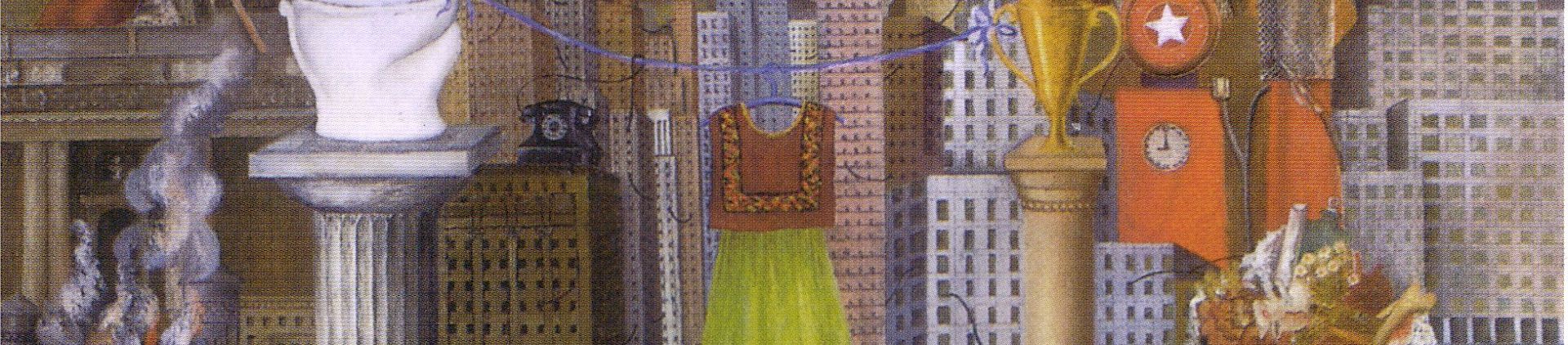
Cover image: My Dress Hangs There by Frida Kahlo


