Wasafiri Wonders: NoViolet Bulawayo
We spoke to the twice Booker-shortlisted Zimbabwean author, NoViolet Bulawayo – who recently won the Best of Caine Award – on her career trajectory, the force of literary prizes, writing life, and thoughts on the current African literary landscape.
NoViolet is the winner of the Best of Caine Award for her short story, 'Hitting Budapest', which won the Caine Prize for African Writing in 2011. You can read more about the award here.
Congratulations on recently winning the Best of Caine Award! Can you tell us a little about where you were in your career at the point of winning the Caine Prize originally in 2011? How did the win affect you then, and how has that changed now?
Thank you so much. In 2011, I was at the start of my writing career. I was a student in the MFA program at Cornell University, and 'Hitting Budapest' was one of my early published pieces. It already felt like a gift just being published, and so being shortlisted and then winning the Caine right after was amazing. The award opened doors in significant ways: it helped me get an agent (agents watched, and I assume still watch, the shortlist for emerging talent), and helped bring my work to a global audience. That season has since passed, and I’m now an established writer, but it still feels special to be part of a brilliant list of writers who’ve done, and continue to do, amazing work.
You’ve been honoured with a number of other titles, including being shortlisted for the Booker Prize twice! What do you think is the place for prizes and ‘best of’ lists in the literary ecosystem today?
I think prizes and lists can definitely boost, sometimes change, authors’ careers. They bring writers and their works to important conversations, connect them to wider readerships, and help sell books, which definitely helps authors, publishers, and booksellers alike. These are of real, material benefit, more so for writers outside of mainstream publishing — we know the real struggle to earn a living through writing. That said, the systems of selection are often undemocratic, meaning certain writers and books will get elevated over others, meaning we should constantly be working to make criteria for selection as fair as possible.
‘Hitting Budapest’ formed the opening chapter of your debut novel, We Need New Names. What was it about these characters or this story that made you feel you hadn’t quite finished with them?
We Need New Names didn’t grow out of 'Hitting Budapest' — it was vice versa. The story came out of what was already an ongoing novel project I was struggling with at the time. Although it arrived with its own shape and was originally imagined as a self-contained piece, it soon became clear that craft-wise, I’d stumbled on a better way of carrying a project that was otherwise proving a bit of challenge to maneuver for the density of its subject matter. The fluidity and clarity of the short story then was the main reason I finally made the call to take the work apart and rewrite it. It was definitely a plus that the characters were vibrant and carried an energy that could allow for a character-driven narrative to balance the heavy themes.
What does your writing routine or setup look like?
As busy as I am with teaching at the moment, I try to write whenever my schedule allows, which is a balancing act. I’m constantly writing in my head and jotting down notes, even my phone recorder is now in the mix, though I used to scoff at the idea! On non-teaching days, I hunker down and write as much as I can. In a perfect routine, of course, I’d be writing 24/7.
Are there any particular books, pieces of music, or conversations that have particularly impacted you as a writer?
I was just telling my cousin the other day that I missed Brenda Fassie, a writer who taught me a lot about storytelling, voice, presence, mood, and place. She’s one of the musicians I had on repeat when I was writing Glory, so I’m not surprised she made it into the novel, not just in the lyricism of certain sections. Here’s an excerpt:
'She is not prepared for the voice that jets from the relic with the force of a waterfall. It staggers her backward until she lands flat on the sofa, felled by the awesome force of the water, and she sits there, tholukuthi drowning in Brenda Fassie’s voice, drowning in the song “Memeza,” that is also a lamentation of an absent mother, drowning in the past, drowning in the present that is full of her mother’s absence, drowning in the future she knows will very much be a bloodied river of broken hopes, just like the ugly past. Tholukuthi the past. But she doesn’t sink, no. Because Brenda Fassie’s voice raises her to safety and places her on solid ground, rings and rings and doesn’t stop ringing until the goat realizes the voice is not com ing from the relic anymore, but from somewhere else, and that somewhere else is actually her own throat.'
What are your hopes for Zimbabwean, and more widely, African fiction, stories, and writing today? What would you like to see more or less of?
Part of my hopes have already come true — the past decade has seen such remarkable shifts in the African literary landscape, thanks in no small part to the intentional ecosystems that have centred African narratives on their own terms. From rejection of Western gatekeeping and stereotypes, to reimagining storytelling forms, to the growth of African publishing and sustaining platforms, to the strengthening of African writing communities across the world — all of these developments have led to robust growth, and I find it overwhelming in the best possible way. Wanting to see less of anything is unproductive, people should be free to write whatever they want. But what I’d love to see more of, however, is creative nonfiction and criticism to match the energy of what’s happening on the fiction front. And, of course, writers being able to make a living off their work.
What are you reading right now?
Prophet Song by Paul Lynch.
Media, Culture, and Decolonization by Wunpini Fatima Mohammed.
Forest of Noise by Mosab Abu Toha.
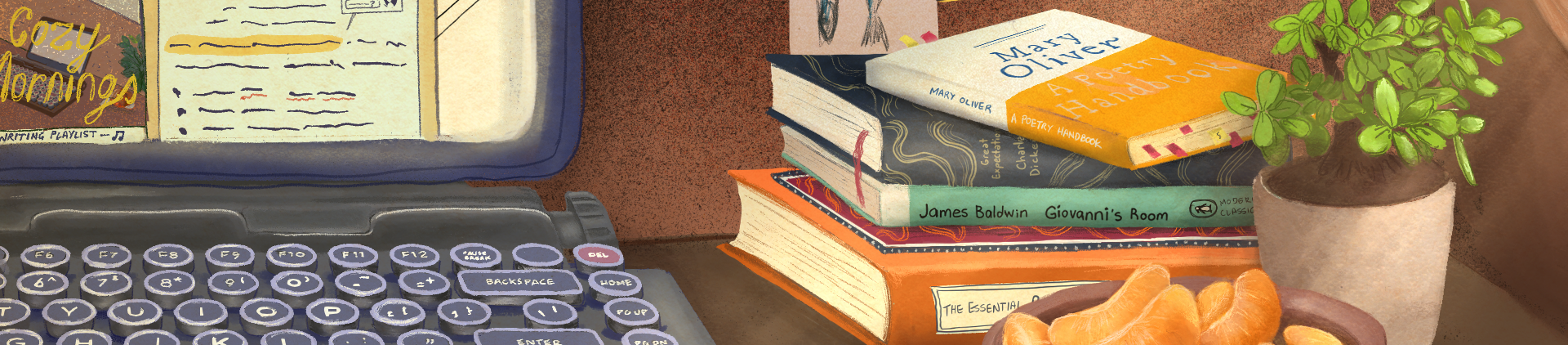
Cover image: Illustrated by Simone Khanyi Hadebe

