A Brief History of Creation and Eastern Cairo by Shady Lewis, trans. by Katharine Halls
Read an excerpt from Chapter One of Shady Lewis's third novel, A Brief History of Creation and Eastern Cairo (Dar Elain, 2021), translated by Katharine Halls. The novel is set in a modest middle-class neighbourhood of the titular city, and its story unfolds over the course of a single day, against the backdrop of real-life events that took place in the 1980s. In this chapter, the narrator introduces us to his home and family members.
Supported by a grant from the Open Society Foundations.
Chapter One
Our street had no name, but a number, and numbers are said to be meaningless, or at least abstractions of a much larger meaning. It would be false to assume, naturally, that the number 30 reflected any particular meaning in and of itself, but it was the number borne by our street, and that was enough to make it an abstraction of an infinite number of memories. Of course, memories have no value unless they are retold, and there is no meaning in retelling unless there is someone to listen, and no point listening unless the speaker and listener share a common language, or some mutual confidence in each other’s good intentions. This was Adam’s quandary, in the beginning: who to tell his stories to. And when the Lord brought unto him all living creatures, Adam gave names to them one by one: to all cattle, and to the fowl of the air, and to every beast of the field, as the Book says. It must have been an arduous task, and taken a long while, during which Adam remained alone, and only then once he had finished did God create a woman of his rib, to whom Adam also gave a name: Eve, because she was the mother of all living. And since the Lord allowed Adam to give all creatures their names in order to have dominion over them, then whosoever names a thing becomes its master.
There was nothing left to Eve but numbers – something the Book remains silent about, though it can be surmised quite clearly – and perhaps this was a stroke of luck for her and us both; she kept the secret of numbers to herself and said nothing in the open, probably out of wisdom or the avarice of the wronged that masks itself in humility.
And so, when God drove Adam and Eve out of the Garden, Satan corrupted creation: he strewed salt into the waters of the sea, so they became bitter brine, and he made fire which was once purer than light emit smoke that blinded the eyes; names lost their absolute authenticity, and words were no longer the things themselves as they had once been – Be, and it is – but became images that did not resemble the original in the least, merely tokens that we agree upon enough to be able to understand one another, just about, or at least so we think. Thus was the innocence of Paradise violated, and interpretation became indispensable and yet approximate, and the subject of permanent doubt, which brought with it the need for encyclopaedias and dictionaries and teachers and poets and clerics and police. And of course, thence came forth eloquence and falsehood as twins, and Adam lost his dominion over creatures and came to fear the beasts of the earth and they to fear him, and acrimony was born to the world.
As for Eve, after the Fall from Paradise, she kept her counsel, impelled by the fear of a person fooled twice and perhaps the hope of one day saving the sons of her belly. Thanks to her, numbers preserved their first innocence and remained neutral, externally at least, demanding no interpretation but a simple and direct mathematical logic that promises a return to the lost Eden or to a better world that humankind might one day create.
To the young boy I was then, my father was Adam and my mother was Eve, and Street 30 was my Garden of Eden, and then, as I later discovered, the narrow path between Heaven and Hell. In fact, our street really did stand on a line dividing two worlds. The neighbourhood, which was said to have been given to Nasser by a Swiss enterprise in the late 1950s, brought development to the desert of Ayn Shams and disrupted the natural border which for so long had been deliberately left to divide Heliopolis from Matariyya and its rural hinterland. Masakin Hilmiyya was a mixture of the two, or a buffer zone for the truce that held between them, or at the very least the threshold leading from one world into another altogether.
The little neighbourhood was divided into a network of straight, leafy streets of approximately the same length that intersected precisely and harmoniously to form repetitive city blocks with a small public garden at the meeting point of each four. For my father, this justified his claim to distant acquaintances that the simple two-up two-down in which we lived, with its back garden and concrete balcony, was in fact a villa. Sometimes my mother would shake her head, draw in her lips, and mutter peevishly, ‘Public housing is a villa now, is it?’
My father’s claims did not stop here. He would regularly repeat to us and to others, and indeed often to himself too, that we more or less lived in Heliopolis. ‘Heliopolis is only ten minutes from here, isn’t it?’ he’d ask, and if nobody responded, he’d answer his own question. ‘Of course it is. And Heliopolis is the nicest part of this whole area.’
Not infrequently, he’d find himself obliged to play his trump card, which he saved for difficult days, tough crowds, and the times when he even doubted himself. ‘Think about it,’ he’d say. ‘Heliopolis is originally Ayn Shams, and Ayn Shams is Heliopolis.’ He’d elaborate on this by peeling the name back to its origins, explaining to his listeners in a dignified manner bestowed upon him by the confidence of knowledge that ‘helio’ meant sun in Greek, while ‘polis’ meant city, and many people thought that Heliopolis meant ‘City of the Sun’, but they were mistaken, because ‘polis’ also meant police or government. And just as the eye was the guard of the body which kept watch over it, the police of the body so to speak, Heliopolis, like Ayn Shams, quite incontrovertibly – while accounting for some degree of etymological change, which was perfectly reasonable given it was several thousand years old – meant ‘Eye of the Sun’.
Usually the discussion would end here, not because the listeners were necessarily persuaded, but because they were so impressed with the effort and skill he’d put into his argument and could appreciate a game well played, even by an opponent. It was also unlikely that any of them would ever claim a knowledge of Greek or etymology equal to his. I always admired my father’s wily way with words, his curiosity about their origins, his ability to transform one word into another, the leaps he’d take from one language or era with the aim of nudging a word’s meaning ever so slightly or refashioning it altogether. My admiration nonetheless left me skeptical regarding names and their reliability, and relieved that our street at least was designated by a number, 30, which could not support any of his laborious manipulations or the embarrassing counter-thrusts that ensued.
‘Ten minutes from Heliopolis?’ my mother would snort from the kitchen. ‘Imbaba is ten minutes from Zamalek. Does that mean Imbaba’s in Zamalek?’
This comparative logic was clear and incontrovertible, but she wasn’t looking for an argument so much as entertaining the guests with a little display of conjugal bickering; performances like this, staged and superficial though they might be, were popular in family gatherings and soap operas alike.
Guests were always arriving unannounced, and my mother would have to rustle up some food on the spot, having quickly swapped her oil-spattered house robe for something presentable and swept her hair back into a bun with a couple of clips, a bun being the safest and easiest choice – not to mention the most elegant – when one was in a hurry. That’s how visitors used to appear in the past: there’d be a light knock at the door, and then the earth would disgorge them on the threshold. The state of high tension occasioned by their sudden arrival, and the clattering of pans in the kitchen, louder than firecrackers on a public holiday, were an essential part of the joy of hosting and a perpetual object of mildly feverish hope, most of all on sluggish Fridays when we would await visitors with meek apprehension.
‘A bald woman shows off her niece’s hair, Umm Sharif,’ the guest would quip, and my mother would half-feign a chuckle to signal her gratitude to him for joining the game. My father’s cousin Raga’i was his age and the closest to him of all his relatives, indeed more like a friend than a relative, which is probably why my mother did not think it inappropriate to make her little jokes in front of him and his wife, who always looked so fresh, her passive face untroubled by either worry or cheer.
Uncle Raga’i’s twice- or thrice-yearly visits were a source of great happiness for me. He was wealthier than any of our other relatives and would slip a five-pound note into my hands when he arrived, five pounds being a considerable sum at the time. The smell of the cigarettes he chain-smoked clung to him so forcefully it had become a part of his physical presence. It was as potent and refreshing as a slap in the face and it lingered around the house for a day or two after his departure, like a memory whose gradual ebb could be traced in both that scent and a faint sense of sadness and regret. I don’t know if I liked him because of the smell of cigarettes, or if I liked cigarettes because of him, because none of our other acquaintances had a smell like that overpowering presence and its power of persuasion. Another reason I liked him was the loveable Luxor dialect he had acquired after many long years of living there and now spoke like a native, its ‘g’ instead of ‘q’ and its languid vowels in the middle of words lending him an obscure halo of unaffectedness mixed with gentle manly vigour. It was especially well suited to his stories, which were eloquent in being so uneventful.
Noticing him putting aside his cigarette and placing it on the edge of the brass ashtray before him, then tapping gently with his right hand on the table, I sensed he was about to say something important, since he only abandoned his cigarette for the most urgent purposes or for one of the long gurgling laughs that shook his whole enormous frame as if it were dusting off some invisible ash left by the constant smouldering of cigarettes.
Uncle Raga’i leant toward his wife as if to speak to her, or to intimate that what he was about to say was to be said for her benefit. Tante Helena made no new expression signalling gratitude and contented herself with a silence more lethargic than it was dignified.
‘As it happens, something very strange indeed once happened to me in Imbaba.’
My mother bounded from the kitchen into the sitting room in a few nimble, childlike steps that seemed incongruous with her slightly squashed stature and rounded figure. Her entry was so sudden she surprised even herself, and stood rooted to the spot for a moment in the centre of the room before retreating hesitantly, dragging her feet across the tiles as if rubbing away some infraction she had committed by joining us. She returned to the hall she’d just come through and leaned her left shoulder against the wall, ready to listen to the guest’s curious anecdote from a distance, such that she could simultaneously be a part of our gathering and yet also outside it. This was the kind of minutely detailed manoeuvre, albeit with trivial consequences, that mothers had to calculate with utmost care. She was suspended between the kitchen and the sitting room as usual – or to be more accurate, in both places at once, all of which seemed fitting and natural for a woman who anticipated every rare opportunity to be joyful – while still clutching a knife in her right hand, which she’d placed on her hip, and half an onion in the other hand, her forehead sweating in evidence of the late summer heat and the roar of the gas beneath the saucepans on the hob.
‘I’m sorry, Umm Sharif,’ said Tante Helena, leaping suddenly from her seat. ‘Let me help. We can’t have you doing everything!’
Her voice was tinged with reproach, and she stretched out both arms toward my mother. But a slight inclination of my mother’s hand was enough to persuade the guest to sit down again and disperse the affected look of sympathy on her face. It was replaced by a look of submission, which in turn soon vanished too.
‘It’s no trouble at all, dear,’ said my mother. ‘It’s not every day we see you, after all.’
This familiar sentence, repeated dozens of times in the presence of guests, was followed by a gesture that invariably angered my father and caused me great embarrassment. Taking the long sleeve of her blouse, my mother would wipe it over her eyes and cheeks to mop up the mixture of sweat and onion tears she’d shed, then finish off with a long, loud sniff.
I’d heard Uncle Raga’i’s story before — at least twice from him on previous visits, and more than once from my father. It wasn’t just his amusing anecdote that was repeated on family get-togethers, because in a time when not a lot went on, there was a limited range of topics available for conversations with guests: complaints, recited off by heart, about what a hard life it was and how it was getting harder by the day; the odd memory from childhood or the good old days that would never return; a renewed lament for a relative eaten up by bedsores in the public health insurance hospital. Once they were covered, there was nothing for it but to return to the same old anecdotes, and to listen to them with the same amazement as the first time, along with the additional sense of reassurance and comfort brought by their reliable seasonal appearance.
‘Hang on, Raga’i,’ my father would say, clapping his hands in delight as he leapt from his seat. ‘I’ll just fetch the tape.’ He jogged up the stairs, headed for his bedroom, and, as I’d come to expect, my mother and Tante Helena exchanged an ever-so-slightly mocking glance. My father’s Toshiba cassette recorder was his favourite toy, and about the most extravagant luxury item a spendthrift low-ranking state employee could aspire to possess. Other homes had exchanged the black-and-white television sets for larger, colour ones. Some had even bought VCRs, and from time to time we’d receive invitations from acquaintances to spend the evening sitting around one of them. We’d watch films that we usually already knew or had perhaps even seen on TV, by chance, a few days earlier. But what made my father envious, and prompted him to purchase the tape recorder from a pay-in-instalments shop in six payments, each worth half his monthly salary, was the spectacular feature of home recording he had discovered: the ability to control time. To be able to defy nature and turn the dial of time back and forth, to rewind it over and over, stopping at any one point for as long as one liked or playing it slowly to enjoy it at leisure, or speeding it up to skip over what was of no interest and thereby economise a few moments of a life that was short enough already.
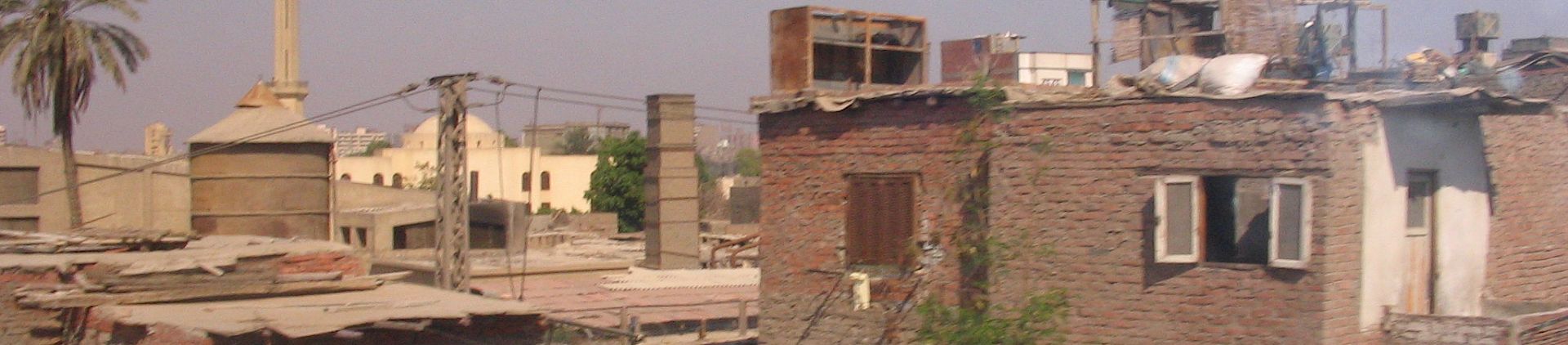
Cover image: Houses in Cairo via Wikimedia Commons


