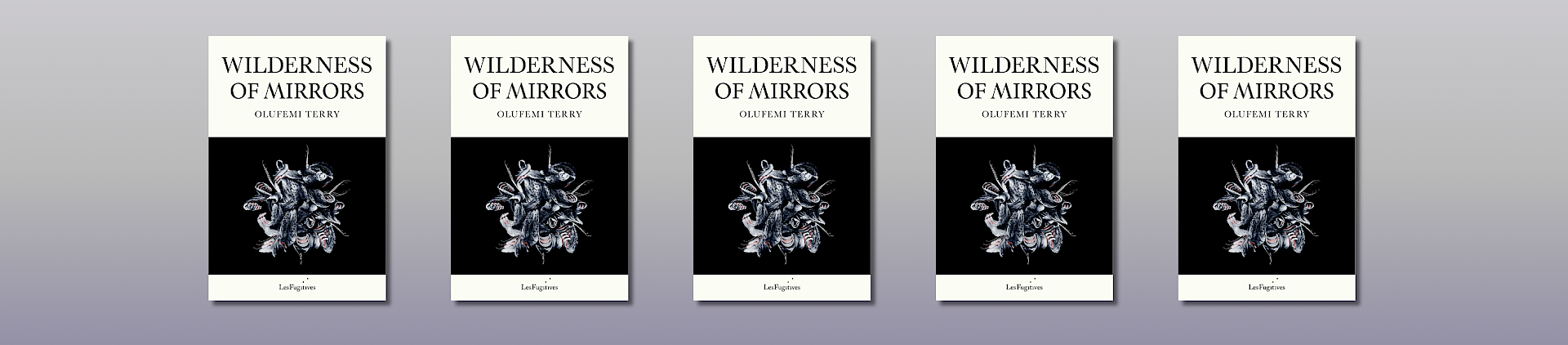
Extract: Wilderness of Mirrors by Olufemi Terry
Read an exclusive extract from Wilderness of Mirrors, the forthcoming debut by Caine Prize-winning author Olufemi Terry. The novel follows Emil, a young, wealthy Creole who pauses his medical studies to move to the fictional Stadmutter, South Africa. There, he experiences the whirlwinds of young adulthood within a post-apartheid, multiracial city with shifting class and cultural hierarchies.
To read further fiction and other genres of contemporary writing from across the African continent, check out our latest issue, Wasafiri 125.
The two of them stand exposed on the unlit pavement of a residential street. The next house is some way down the road, and Ekow’s silver car has already rounded a bend and moved out of view with its deceptive sidling velocity.
Out of Ekow’s presence, Tamsin is different, diffident, and she looks at Emil in expectation. The direction that suggests itself is downslope: follow the curve of the road to reach the shore. Tamsin lets out a sinusy grunt, perhaps a reaction to the tickle of powder in her throat, a sound so improbable Emil has to bite back amusement.
'This way.' He is pleased at sounding, feeling calm. Spooking Tamsin will only increase his own jumpiness. It is not yet eleven o’clock, is his guess. Tamsin rabbits her nose, another reflex against the cocaine, and falls in beside him. There are houses below, but these stand in darkness. Already he can hear the jostle of open water, and within a few minutes they arrive at a T-junction that gives onto the ocean road leading back toward the tourist strip. Here though there is no beach abutting the road. Beyond a narrow grass verge is sheer cliffside that falls into deep roiling water.
Either Ekow’s bearings are awry or he has played a malicious joke putting them out here. Crashing waves spit up sea spray, smearing their vision: the lights of the Kampsbaai bars and nightclubs are a Fata Morgana of bleared neon green, blue, red. The road is winding; he estimates that returning to Ayia Napa will require at least fifteen minutes of walking, and along a stretch of road empty of habitation.
Emil has hold of Tamsin’s forearm. Still, he is careful not to lengthen his stride and give an impression of hurrying her along. The pebbles of the murram track make for unsteady progress. And the track narrows where the cliff wall leans out over their heads, in one or two places nearly hangs over the road, towering and providing small comfort against the sensation of being exposed. No car has yet passed in either direction.
Tamsin wipes the spritz of sea mist from her forehead and eyelashes. 'What does Freudsniffer mean?' Emil asks. The water droplets are bitingly cold against cheek and top lip, reminding Emil of how far south they are in the world. Between Muttie and Antarctica is a void of sea and grinding ice. 'A private joke.' Tamsin sounds winded. 'Freud was very fond of cocaine.'
Freud? 'And what was Ekow saying about Chapman’s peak?'
'Oh, it’s one of his kicks, racing that car up and down Chapman’s nights with the headlights off. It’s his fetish. He takes the engine apart every few months and reassembles it. You know, my father grew up here before Kampsbaai was a real resort. It was scrub all the way up to the mountains and maybe five houses, barely a village.' Is Tamsin trying, in changing the subject, to reassure him? 'My grandma used to go over the ridge for groceries in her little Beetle.'
Sudden laughter on the air. The mumble of human voices. Emil is confused at first by the direction of it, and glances back over his shoulder before identifying its source up ahead. Male voices, high-spirited and talking over one another, not in English but in Creole argot. Jungen. And fast approaching, by the sound of it, but still out of view. He assumes he and Tamsin are also not yet visible.
'Hy dink hy schelm,' one boy tells his mates in a cracking voice. The guy thought he was clever. The first two jungen move into view from around an arc of the road just ahead; they are in close conversation, their heads leaned together, nearly touching. Another three are a few steps behind and one of these is the loud-voiced boy. How young they seem; and it is strange too that their carrying voices convey some haste, the impatience of the young, although they are not walking particularly fast. Where are they going? At this hour, it is unlikely taxi vans ply the ocean road south of Kampsbaai; nothing will go past here except private cars.
Emil catches Tamsin’s slippery-dry hand in his own and moves ahead of her on the path. He has experienced dread since the first sound of approaching voices, and not for himself. The next moments throng with sensation, leaving him no time to speak. An image flashes in his eye, real as life, but he knows it for a fever dream, aftershock perhaps of the iboga. Two prostrated forms, the larger, juddering one almost entirely obscuring a supine form beneath, a sprawl of pale wrists and long-toed feet bared and arching. Tamsin. The violator might be Emil or one of these jungen but it scarcely matters; he and they share a physical likeness that collapses distinction.
Just in the instant the two jungen in front reach Emil and Tamsin, there is the putter and snarl very close by of a revving motor. The first boy sees Emil—Tamsin is slightly behind him—only at the last moment. He starts and pulls up short, his eyes going very round. In that place hemmed in by road and cliff, he is close enough for Emil to smell five-rand menthol cigarettes on him, maybe the same brand Celeste smokes. He grunts as the hitch in his forward momentum fetches the next boy stumbling into his back.
'Hai,' calls a commanding voice, and a motorcycle rider swerves his machine up over the curb and onto the murram track, driving straight at Emil as if to run him over. Taken unawares on two sides, real fear flares in the faces of the jungen. The motorcyclist is bareheaded. Emil knows him. Bolling. 'Here you are,' he says, killing the engine. He straddles the immense motorbike easily. Emil lets go of Tamsin’s hand. As if there’s nothing extraordinary about meeting on an isolated stretch of road beyond the city.
'Why you run that kindtrike at us?' one boy jeers. His mates break out in nervous grins at the analogy — a child’s three-wheeler — but when Bolling looks at each of them, they don’t know what to do. The explosive arrival, the humped immensity of the motorcycle continues to unsettle them.
'Get on,' Bolling says, leaning the motorcycle to one side to ease Tamsin’s mounting. Her upper thigh is bared as she swings a leg across the pillion, but the anticipated catcalls do not materialise. The jungen shuffle their feet, seeming eager to be off but curious also to see how this encounter will turn out. Once Tamsin is astride, Bolling walks the motorcycle backward into the road and kicks the engine to life. Cutting the handlebars, he hauls the machine about in a tight arc. Emil gets up behind Tamsin on an old-fashioned wedge seat.
A brief ride. Within minutes, Bolling noses the machine up to the curb at Ayia Napa. The strip has quieted, a lull perhaps before the late-night crowd comes in. Two women sit nearby on a doorstep, forearms on knees; one of them, weeping, seems unable to stop. Her friend looks witheringly at the three of them and Bolling’s motorcycle.
'It was just kids back there,' Bolling tells Emil, gesturing over his shoulder. Emil has slid off the wedge seat. Tamsin seems in no rush to dismount and merely lifts her hand from Bolling’s shoulder. 'Nothing serious.' But what had Bolling seen? Feeling — wonder mingling with resentment — swells in Emil and he is unable to respond. With a glance of reproach toward Tamsin, he goes off down the strip. No one calls him back.
The motorcycle ride has dried the sea mist to a stiff salt mask on his cheeks and forehead. He walks as if he has a purpose other than getting his head clear. Six young girls stand in the road up ahead, a less frequented section of the corniche with its 7-Eleven and betting shop. Black girls. Each one has a pattern daubed on her forehead and throat in luminous paint. Stars or dots in a diamond formation, snaking lines. Twelve hands settle on hips in very grown-up fashion. A dance is commencing, a sight that distracts him from his anger by driving grievance toward new targets. These are children; the hour is late. And the costumes, brief string skirts and halter necks fastened tight over breasts that are mere nubs, sharpen their vulnerability. One or two of them are as young as eight years old.
But the children are not unchaperoned. The ensemble leader sits well back from the dancers, his shoulders braced against the darkened window of a shop. He begins striking the drum encircled by his thighs (like an opponent wrestled into submission). The drummer wears a kirtle of some haired fabric dyed to mimic the pelts of civets or brown hyenas. He raises a varying rhythm on the cowhide with the heels of his palm. Despite the precision of his beating, the man’s face has an unfocused look.
Emil has no yardstick to measure the children’s skill. For whom do they dance? Not pedestrians, who are very few in number here and are anyway preoccupied with their phones. Behind him though is a restaurant patio, six tables on a raised platform overlooking the bay with a cordon of wrought iron fencing. Every table is occupied. Nearest where Emil stands on the sidewalk, a couple’s table is laden with platters of shellfish and half-eaten slabs of what must be buffalo or eland steak. Game meat for the tourists.
But it is the diners themselves, florid, listless with drink, that absorb Emil. He is glaring, in fact, and wonders that they remain unaware of his eyes on them. They are American or British, certainly affluent, and yet he doubts they eat so richly at home as in Muttie. Exchanging dollars or sterling for rand favours the tourists immensely, and Emil suspects this is the reason the couple have ordered a meal too large to eat at one sitting, likely the dearest wine too. When the bill is presented, the satisfaction at how little it has all cost likely exceeds the savour of the lobster or springbok loin; it is this that will feature most vividly in the memory. The true source though of Emil’s loathing is the couple’s insensibility to the dancing children.
To the mumbling of the drum, the girls have formed two lines facing one another. The ones nearest him bend forward until they are on hands and feet, mimicking beasts. One by one, they roll to the tarmac and lie still. The dance might be retelling the cattle killing, the legend about a warlike people in the country’s southeast that very nearly achieved self-annihilation through a mass slaughter of their own herds.
This exclusive online excerpt from Wilderness of Mirrors by Olufemi Terry, (publishing in the UK on 19 March 2026) is reproduced with permission from Les Fugitives. All rights reserved.

