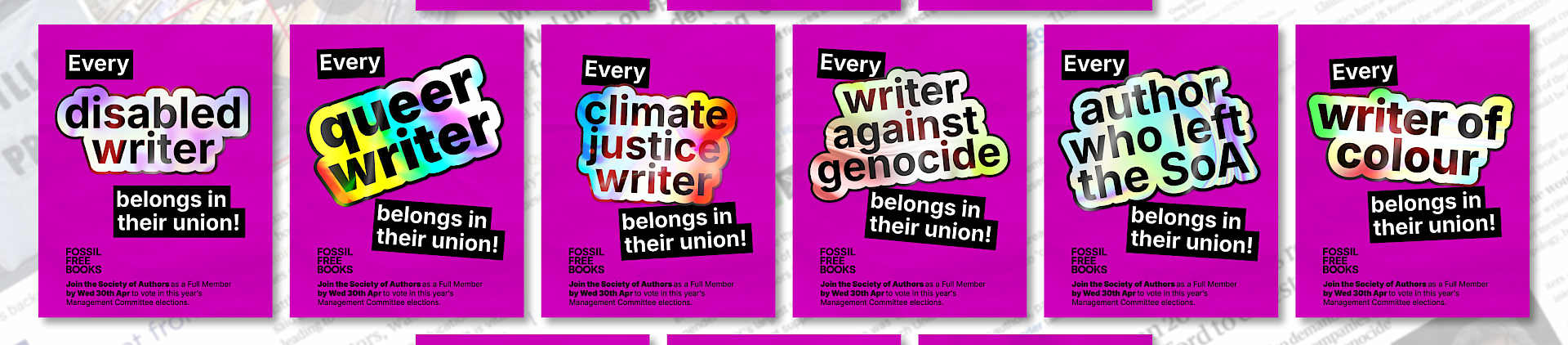
A Union of One’s Own: Fossil Free Books and the Society of Authors
Can a group of grassroots campaigners collaborate with a 140-year-old trade union that is resistant to change? In this essay, Martin Reed and Noreen Masud identify the tensions between grassroots activism and established union structures, discussing the challenges to labour activism in the creative industries. They specifically examine the Society of Authors, one of the UK’s largest trade unions for creators, from their perspectives as members of the bookworkers collective, Fossil Free Books.
When grassroots campaigns and trade unions work together, it’s usually a win-win. For workers, organising their grassroots campaigns through trade unions is a tried-and-tested way to use existing structures to make their voices heard — from solidarity campaigns like Lesbians and Gay Men Support the Miners (LGSM) during the 1984/5 Miners’ Strike, to recent specific issue groups like Extinction Rebellion (XR), Just Stop Oil, and Stand Up to Racism. Meanwhile, for trade unions, acting in solidarity with grassroots campaigns strengthens member engagement and retention, keeping the union relevant. It welcomes new groups of workers into the fold who might otherwise not have joined. And for everyone, the union affiliation can offer collective power, solidarity, and a safety net in the face of campaigning activities that often attract negative attention, whether in the workplace or more publicly.
In 2023, as our bookworkers’ collective Fossil Free Books (FFB) progressed its calls for books industry divestment from fossil fuels and refusal of complicity in genocide, union engagement became an inevitable next step. We had already seen the power in collaborating to advocate for positive change and the difference we could make simply by being in the room — how much more could FFB achieve with the backing of an established trade union? In high-profile actions targeting Baillie Gifford, the private equity sponsor (until 2024) of many of the UK’s literary festivals, FFB attracted a great deal of attention from the national press, the publishing industry, and on social media. Many of our organisers were vulnerable to high-profile personal attacks, not to mention potential risks to their careers. Organisers needed the collective power, solidarity, and safety net that a union could offer — if the union in question would provide them.
This essay identifies tensions between grassroots activism and established union structures, discussing the challenges to labour activism in the creative industries. Can a group of grassroots campaigners collaborate with a 140-year-old trade union that is resistant to change? Can they encourage it to evolve, live up to its potential, and become the representative union they need? And can we convince enough supporters to stay and work with us, not walk away?
Representation in a Precarious Industry
Many people are surprised to learn that unions exist in the book industry at all. (A trade union for poets and novelists? Really?) But few professional creators who work in publishing are happy with the status quo. You needn’t look hard to find writers concerned about declining advances and precarious contracts, or translators and visual artists discussing the threat of Artificial Intelligence (AI) to their livelihoods, and a drop in the amount of work they are offered as commissioners cut costs in the name of innovation. Meanwhile, celebrities receive disproportionately high advances for their (often ghostwritten) work.
More subtly, an ‘anti-woke’ toxicity has crept into the arts scene over the past few years. Formally, it takes the shape of changes to funding criteria, with a more cautious and 'apolitical' approach to deciding whose voices are platformed, heard, and amplified. Informally, it shows itself in a growing intolerance of workers who challenge the publishing status quo. In practice, an industry that, only a few years ago, published statements in support of Black Lives Matter and Ukraine, and adopted inclusive approaches to recruitment and publishing new voices, has now applied the brakes on its more progressive policies. Organisations that publicly condemned Russia’s invasion of Ukraine in 2022 remain silent on Israel’s genocide in Gaza. We at Fossil Free Books resist that shift in our industry.
FFB organisers include booksellers, agents, and publishers, but most of us are writers, illustrators, and translators — professions all covered by the Society of Authors (SoA), one of the UK’s largest trade unions for creators. Many of us have been associated with the SoA in one way or another for years: either as regular members, or working in the SoA’s many group committees, or even on the union’s Management Committee (the SoA’s board of directors), or as staff. Many are recipients of the union’s multitude of prizes and grants or have been commissioned as judges and assessors.
Since 2022, we have organised as workers on our own merit and managed to build mass support. We have staged actions at multiple festivals and held our own in meetings with festival management and representatives from Baillie Gifford. But as a collective with a horizontal structure run by time-short volunteers, we knew that the best way to consolidate and achieve lasting change would be by organising with the support of an existing union structure and resources. A trade union’s strength lies in the balance between its expertise in offering individual support and solidarity, the collective power it can wield when it mobilises its members, and its industry standing — a potent combination for campaigners. So, when FFB organisers sought to work within an established trade union, the SoA was the only logical option.
Much of what the SoA does is invaluable: ask any member who has requested its advisory team to vet a publishing contract. The grants and prizes it distributes are worth more than £500,000 every year (these rose into the millions in its emergency relief efforts when lockdowns in the early stages of the pandemic limited many authors’ capacity to work). Over the past decade, it has launched a range of partnerships and initiatives to reach beyond its middle-class, London-centric base to attract new members from a wide range of backgrounds. And with a tiny campaigns team, it has done a great deal to raise awareness and lobby the government and industry on the threats posed by AI to creative careers. Its staff care genuinely about improving the lives and livelihoods of SoA members and about modernising how the organisation works.
A trade union’s strength lies in the balance between its expertise in offering individual support and solidarity, the collective power it can wield when it mobilises its members, and its industry standing — a potent combination for campaigners.
But change at the SoA is slow. And, until now, it has tended to operate through contradictions of convenience. The SoA seems conflicted about whether to see itself as a trade union or more as a members’ club. Perhaps this dates back to the Union’s privileged roots, founded by members of the Savile Club in 1884. Or maybe it is because of an older demographic accounting for a large proportion of the Union’s membership. Or it’s because it operates in a sector whose workers are typically not unionised, meaning that traditional trade union notions of mass organising and empowering members as workers are somehow alien — instead viewing members more as users of a service. In any case, it has allowed the SoA to focus less on mass organising on specific issues (as distinct from lobbying and awareness-raising on those issues) and more on community and individual support. Even when the SoA sees itself as a trade union, it is often at pains to stress that it is a ‘special register body’, not a regular trade union. The actual difference is minimal and mainly administrative. Member engagement is encouraged, yes, but within strict limits.
That the SoA operates as though it sees itself not as its members, but as doing things for its members – prioritising service over engagement – is disempowering, in union terms.
Furthermore, the SoA positions itself as a partner to the publishing industry when it sees benefit for itself in the partnership and there are shared interests between creators, publishers, booksellers, and agents — such as government support for the creative industries or threats posed by AI to the current copyright regime. But there is a balance to be found between those shared interests and issues on which a union must represent its members alone. A trade union’s relationship with industry should rarely be cosy.
But, given that it has 12,500 members, strong industry connections, and deep corporate knowledge of publishing and the creative industries, the SoA’s potential to become more effective as a trade union is immense, if enough book workers organise with and within it.
Ambiguous Democracy
When, in late 2023, FFB organisers spoke with SoA leadership about calling an Extraordinary General Meeting (EGM) to allow members to vote on two motions, there was an expectation that the union’s democratic processes would be allowed to run their course. We put forward two motions for the EGM, which was eventually scheduled for 2 May 2024. The first motion called for the SoA to lobby for a responsible end to fossil fuel investment in the books industry, with the aim of giving FFB much-needed union support. The second motion called for the SoA to release a statement of solidarity on Palestine. At the time, the SoA was one of the few UK unions to remain silent about the Gaza genocide.
The Management Committee appeared to support the divestment resolution and, perhaps seeing some benefit in engaging members around specific topics, they even introduced a resolution of their own on AI.
But on the Palestine motion, they took an extraordinary approach. They could have debated the wording with us before putting it to members (as they did with the divestment motion). They could have even proposed a statement of their own to give members a choice. Or they could have just trusted their members to decide and vote with their conscience. They did none of these things. When the text of our motion was distributed to members, it was prefixed with a 700-word introduction from the Management Committee urging members to vote against it.
The wording was divisive. The format of the document was ambiguous. Many members weren’t sure what they were actually supposed to be voting on. It seemed designed to confuse the vote.
The divestment motion and the SoA’s own AI motion both passed with ease. The Palestine solidarity motion did not, although it was close, with 47% voting in favour.
The Cost of Leaving the Room
Had members been trusted to decide for themselves how to vote, without what felt like direct interference from the Management Committee, what happened in the days and months after the EGM might have been very different. Losing a fair vote is disappointing. Losing a vote that has been engineered to fail is something quite different. The SoA leadership had positioned itself squarely against FFB and, by implication, all those who held FFB’s position on Palestine and other matters.
After the EGM, hundreds of SoA members – including members of SoA committees and other longstanding members – resigned or allowed their memberships to lapse. Many sent detailed letters of complaint with their resignations, only to receive copy-pasted responses and the link to a page of ‘EGM questions and answers’ buried four levels deep on the SoA website, which did little to answer people’s concerns and nothing to allay their sense of alienation.
A trade union’s relationship with industry should rarely be cosy.
Most unions, if faced with an exodus of so many members, would be keen to understand what went wrong and seek to make changes to become more representative and relevant. But not only did the SoA leadership appear happy to watch members go, they doubled down on their position on the EGM, going to pains to distance themselves from FFB and its supporters in public statements in June and November 2024. Did the exodus fit a narrative that all these ex-members were activist outsiders and bad actors all along — not ordinary writers, artists, and translators seeking to make their industry better?
The lesson for us was simple. The SoA needed to change. But it was also clear that if members who wanted change left in protest, nothing could or would improve.
Change from Within
FFB spent months researching and reviewing our trade union options. Could we do better with a different trade union, such as the Writers’ Guild of Great Britain (WGGB) or the National Union of Journalists (NUJ)? Could we somehow form our own? There were indeed other options and other unions, but none that were realistic nor could accommodate the broad spectrum of creators making up the FFB community.
In a major meeting of FFB organisers in January 2025, we agreed by consensus to remain with the SoA — to work to change it from within and to encourage the many members who resigned to return and work together for change.
Since then, we have put a huge amount of resources and volunteer time into making that happen. We have supported candidates and members on several SoA committees. We backed the nominations of four progressive candidates who stood for election to the SoA’s Management Committee in 2025. And we have individually had many conversations with people within and without the SoA — discussing how change can happen and about the roles they can play.
There are signs that things might be starting to change, albeit slowly. We have worked to nurture a constructive face-to-face dialogue with the SoA’s management, to at least try and re-open lines of communication between the SoA and its members who felt let down by it. There are FFB supporters now serving on several SoA group committees, and last year saw the election of FFB organiser Polly Atkin to the SoA’s Management Committee.
Meanwhile, in 2025, two members of the Management Committee resigned: Helen Fields quit unannounced in July; Julia Williams quit publicly in November — both in protest at what they saw as the SoA’s lack of support for ‘cancelled’ and gender-critical writers. Fields had campaigned repeatedly on X against the Management Committee candidates FFB was supporting. Williams was elected to the Management Committee after taking part in an unsuccessful campaign by gender-critical members to oust Joanne Harris from her position as Chair of the board in 2022. Both had been vocal on social media against FFB and its supporters.
Losing a fair vote is disappointing. Losing a vote that has been engineered to fail is something quite different.
We can hope this may be the start of a progressive tonal shift, which might, over time, help to rebuild trust between FFB supporters and the SoA.
However, change does not happen overnight, and it’s never guaranteed. In 2025, it was a challenge to remain committed and focused, especially in the face of often surreal, even litigious, interactions with the SoA’s management about meetings we tried to organise, as well as other issues. And even while we worked to encourage people to join or re-join the SoA, the union triggered national press attention and another flurry of member resignations with its publication of a bizarre statement following the raid by Israeli security services on the Educational Bookshop in Jerusalem, and the arrests of its Palestinian owners, Mahmoud and Ahmad Muna, in February 2025. The statement managed to avoid any mention of Palestine, Israel, Jerusalem, the Munas, the name of the bookshop, or indeed any specifics whatsoever.
But we are in the room now. We have voices. And that is the first step to making change.
A Precedent for Reform
As you enter the lobby of the SoA offices in Holborn, there is a small, framed black-and-white photograph to the left of the reception desk, pinned to the wall beneath the building’s entry phone. Barely noticeable, dwarfed by bookshelves, signage, and office paraphernalia, it quietly commemorates a more progressive campaigning period in the union’s history.
Taken in the mid-1970s, it shows a group of placard-carrying authors protesting for the creation of a Public Lending Right (PLR) in UK law to pay authors when their books are borrowed from public libraries. What isn’t evident from the photograph is that not only did the SoA work to block the campaign, it also actively alienated and demonised its supporters. Sound familiar? What is happening today with FFB has happened before. Different authors, different issues — except the SoA now lauds those earlier activists and claims them as its own.
In 1972, a group of authors led by Brigid Brophy and Maureen Duffy, concerned about falling rates of author pay, petitioned the SoA’s Management Committee to lobby the Government for PLR. Despite the SoA’s claim to represent all UK authors, they said such work would be political and therefore not within their remit (again, a familiar, convenient retort). They invited Brophy to chair a PLR committee, on condition that the group withdraw a motion to debate PLR proposals at the SoA’s next AGM. Then they filled that committee with people whose sole aim was to block it.
Frustrated by these obstructive tactics, Brophy and Duffy founded the Writers’ Action Group (WAG): a collective with many parallels to Fossil Free Books. Like FFB, WAG was run by a small group of radical authors who saw the damage caused by the status quo. They too realised that the best vehicle to campaign from would be the SoA; WAG organisers encouraged authors to join the SoA, building support within its membership to challenge and change the organisation from within.
Of course, like FFB, they were publicly alienated, kept at arm’s length by the SoA’s Management Committee, and treated not as SoA members but as an external threat. Like FFB, they were pilloried in the national press, described by critics as ‘extremists’.
Their campaign came to a head at the SoA’s AGM in 1973. They proposed three motions in advance: one on PLR, one calling for four WAG members to be elected to the Management Committee, and another calling for the SoA’s unionisation. A fourth motion, proposed on the day in an attempted coup, called for the entire Management Committee to resign over their inaction on authors’ pay and the PLR issue.
All four votes were defeated, but the voting on PLR was extremely close. The SoA changed its approach.
It is unclear whether the Management Committee had a genuine change of heart or if growing support for WAG had triggered an instinct for self-preservation, but after the AGM the SoA invited Brophy and Duffy to restart the PLR committee. It wasn’t a capitulation as such — but they had now invited WAG into the room, this time with less obstruction, and they allowed the union to become a vehicle WAG could use to support their lobbying efforts.
Now, some fifty years later, FFB are working to similar aims — to be in that room, to be the voice for authors who, for too long, have not felt represented by their union, and to empower the SoA to become a genuine organising trade union, instead of functioning as an advice service cum members’ club.
As for WAG, after seven years of grassroots campaigning, they saw PLR signed into law and established what would become the Authors’ Licensing and Collecting Society (ALCS). Today, the British Library distributes over £6 million annually in PLR payments, while ALCS has paid out secondary royalties worth over £700 million since 1977 — £47 million in the year 2024/25. The SoA is one of their biggest cheerleaders. Not bad for a group of extremists.
Of course, FFB is not WAG by another name. We have different priorities and different struggles. And no doubt we’re half a century away from seeing any photographic celebrations of FFB pinned to the SoA office wall.
But we understand what’s possible when we mobilise together to challenge that how-we’ve-always-done-things mentality — conversation by conversation, vote by vote. If we can organise together, and make sure we stay in this powerful union space, even the slowest-to-evolve people and organisations might one day be unable to imagine their worlds without the positive change all of us advocated for.
This piece is supported by the Queen Mary Centre for Creative Collaboration.
For further reading, check out 'Solidarities Across Hyphenated Identities: Three Fossil Free Books Organisers in Conversation' with Yara Rodrigues Fowler, Jessica Gaitán Johannesson, and Andres N. Ordorica, available in Wasafiri 124 or online here.
Cover image courtesy of Martin Reed.


