
Building AWETHU: Organising around Climate Justice and Black Liberation
The AWETHU School of Organising is the first programme of its kind in the UK teaching young people effective methods for political and community organising, while centring Climate Justice and Black Liberation. In this piece, Jess Mally – who co-founded the organisation with Mikaela Loach in 2022 – dives into AWETHU’s origins, methods, and mission, as well as their own journey as an organiser, asserting that our hope and actions must be interconnected as much as our struggles are.
It was the autumn of 2022 when Mikaela Loach and I first started imagining what is now the AWETHU School of Organising. We both happened to be in New York at the same time: Mikaela was attending Climate Week where she infamously exclaimed that billionaires shouldn’t exist at Bill Gates' own event (if you haven’t seen it, pause here, watch, and then come back, it’s worth it!), and I was there attending meetings and delivering workshops exploring anti-racist practice. Mikaela had just completed and handed in their manuscript for It’s Not That Radical - Climate Action to Transform Our World, and our conversations celebrating this big milestone led us to discussing the urgent need for political education, community building, and organising theory in our organising spaces, ranging from climate to anti-racism advocacy and organising in the UK.
In 2022, and even more so now, it was clear to us that we were facing a polycrisis: the climate crisis and all its consequences, from the rise of fascism to the ongoing violence of racial capitalism on our communities – whether in the imperial core or on the peripheries – to, of course, the continual devastation of land. We, as well as many of our comrades, known and unknown, felt a sense of urgency and, for lack of a better word, a calling to play our part in meeting the moment beyond the work we had already done.
Mikaela and I have a history of organising in different capacities over the years, with various experiences in those spaces. A common denominator was that both of us had periods of burnout on our respective journeys and often faced racism in these areas. All in all, we felt that we had to learn too much the hard way: with little to no guidance or support, by trial and error (at times to the detriment of ourselves and others), and often as the ‘only ones’ — basically lacking the tools needed to organise in a sustainable and effective way. In our conversations that autumn, we kept coming up against the question of what we would’ve needed when we first started out on our organising journeys, in order to have achieved different outcomes for ourselves and our movements. What support, programme, or education would we have wanted when we began organising? What would have prepared us better for what was to come? What – certainly in my case – would’ve saved me years of disappearing from the active work of organising because of its immense toll?
The more we talked and imagined, the clearer it became: we wanted to offer a programme that would provide the next generation of organisers at least some of the things we didn’t have. From political education centring climate justice and Black liberation, to offering organising tools to better equip people as they embarked on organising in their communities, to, most importantly, a space where they could be amongst peers, building a community that would support them on their journeys going forward.
Centring Climate Justice is crucial to us, not only because of the magnitude of the climate crisis, but because we believe that those most affected by it should be at the forefront of developing solutions. This is not currently the case. The climate movement in the UK is overrepresented by white and middle-class people, even though the climate crisis disproportionately impacts Black communities, both in the UK and the Global South — a recent report showed that less than 1 in every 20 people working in the climate sector are ‘non-white’.
We wanted to offer a programme that would provide the next generation of organisers at least some of the things we didn’t have
The people organising for change – those with adequate access to the tools and language to tackle this crisis – are the ones building solutions and, therefore, our futures. We decided to start AWETHU to ensure the voices of young Black people, whose lives are both directly and indirectly impacted by the crisis as well as the systems that have caused it in the first place, are centred and heard going forward.
In my view, the climate crisis is the greatest crisis our world is facing in this moment. It affects all of us, albeit not (yet) in the same way. Just last year in 2025, we have seen devastating floods in Pakistan killing at least 1000 people, wildfires in LA costing at least 440 people their lives, and across East Africa alone, droughts and severe flooding killing at least hundreds, while continuing to affect millions. Many governments, especially in the Global North, are responding to the symptoms of this crisis (which include, among other things, displacement either directly caused by climate catastrophes or by one of the many ways the crisis impacts human security, leading to increased migration to Global North countries) without sufficient urgency. Instead, they resort to fascist tactics, creating environments hostile to migrants, scapegoating the ‘other’, and increasingly repressing dissent.
We fundamentally believe that to rise to this moment – to withstand fascism and to protect the earth and all beings who call her home from further collapse – we have to build people power.
At AWETHU, we believe that how we build this power is by organising our communities.
One thing that actively hinders people getting organised is a sort of hopelessness and defeatism, sadly seen in a lot of public discourse. News cycles and social media (as useful a tool as it can be) tend to nurture apathy or stir hopelessness in people. Some in the climate movement, as well as many who are only now beginning to feel the consequences of rising fascism, display a kind of doomsday attitude in their work, spreading messages of defeat whenever something doesn’t ‘work’ as intended, or whenever the powers that be do something ‘shocking’ that further suppresses our movements or puts the planet at risk.
We firmly reject this kind of defeatism. As Black people whose ancestors have survived fascism and the violence of racial capitalism in all its forms, we understand that hopelessness and giving up is a privilege we do not have. We know, to quote Mikaela, that ‘Hope is an active stance’. That hope comes when we organise, when we show up, when we care for each other, and when we collectively resist the powers that be.
Centring Climate Justice is crucial to us, not only because of the magnitude of the climate crisis, but because we believe that those most affected by it should be at the forefront of developing solutions.
This is why we are building AWETHU: to create a space for young Black people to gain the tools and support to act in the face of our current moment, to bring hope to their communities, and to organise them into effective movements.
Whilst we are certainly not the only group working towards equipping the next generation of organisers and activists, our firm stance on centring young Black people, and our political education offers focusing on climate justice, make us the first programme in the UK of its kind.
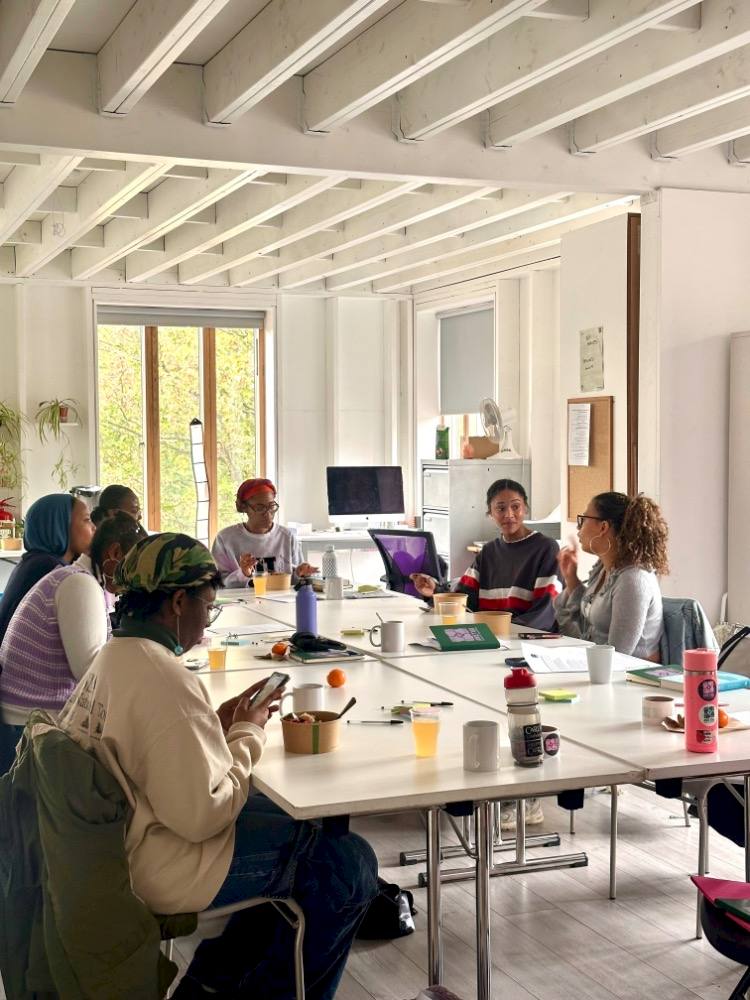
Currently, given our very limited resources, we run our programme once a year across eight Saturdays. Our hope is that as we continue to grow, we’ll be able to offer this eight-week programme multiple times a year and across the country, while additionally offering one-off workshops and courses both virtually and in person to support our movements in the UK and beyond.
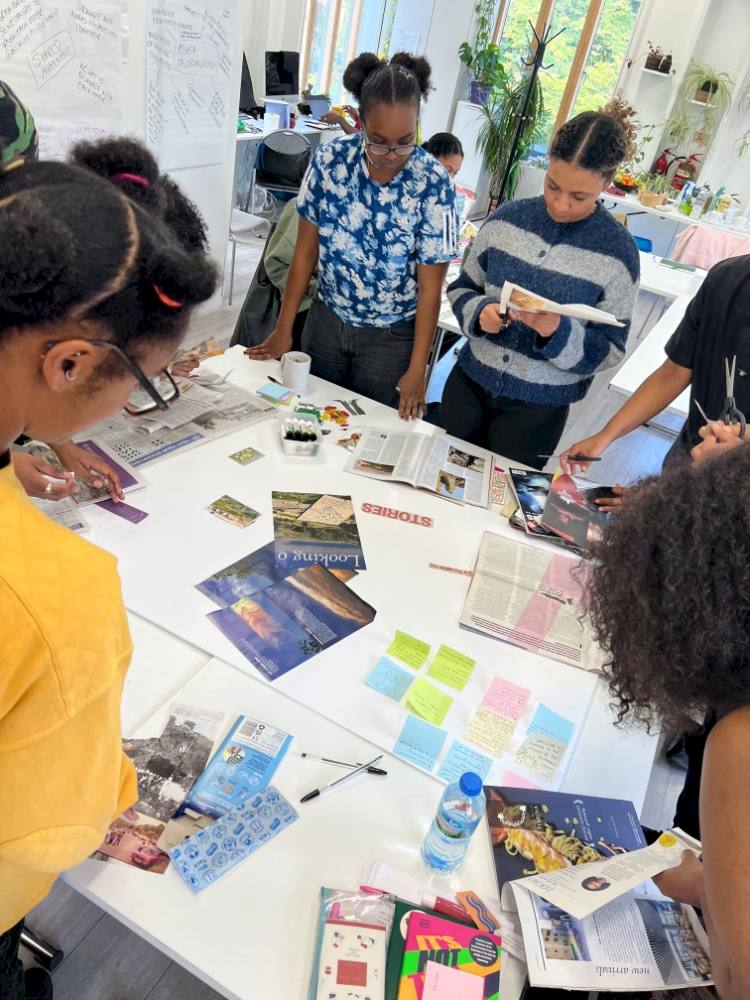
Our current programme seeks to equip young people (all between the ages of eighteen and twenty-four) with the things we didn’t get when we were their age. This includes providing physical space for community to form among like-minded people, offering the political education needed to meet this moment with conviction and clarity, and helping bring others on the journey too. Perhaps most importantly, we strive to equip them with tools for effective and strategic community organising. Our political education introduces our cohorts to works from the likes of Walter Rodney, Angela Davis, Aimée Cesaire, and many more, as well as works on organising like Hope in the Dark by Rebecca Solnit and – a text we typically begin with – We Will Not Cancel Us by adrienne maree brown. The organising tools range from power mapping tools (to help our young people understand how the issues they’re passionate about are upheld by various power structures), to practical ‘Starting From Scratch’ guides (helping them think about their meeting agendas and how to run effective meetings), and trainings like Gene Sharp’s ‘Spectrum of Allies’. We centre radical imagination, inviting young people to not only think about what needs dismantling, but actively imagining the futures they hope to build. This year, we introduced our cohort to Dr. Ruha Benjamin’s Imagination – A Manifesto to support this work.
The climate movement in the UK is overrepresented by white and middle-class people, even though the climate crisis disproportionately impacts Black communities
We centre community organising because we believe, in the words of Mikaela, that:
‘Organising is building the capacity for revolutionary change to be possible. It doesn’t necessarily mean making that change right now, but organising our communities so that when the conditions are right, revolutionary and transformational change is possible.’
Today, activism and organising are often synonymous with big marches or protests, posting lots on Instagram, or getting into keyboard wars with those of different persuasions than ourselves, even becoming career activists. Whilst all those methods can be valid and meaningful when engaged in strategically, at AWETHU we believe that we have much to learn from our forepeople about effective community organising.
It is intentional that we don’t usually learn about civil resistance movements or revolutions in school; when any social change movement is mentioned in a curriculum, at least in the UK, it often focuses on and exceptionalises a single hero who allegedly saved the day. From Malcolm X to Martin Luther King Jr., Nelson Mandela to Rosa Parks — those who control the curriculum, and therefore how we are taught historical narratives, invest in making us believe in superhuman saviours who emerge only once in a while. It is also not a coincidence that here in the UK, these saviour narratives are often about those who resisted elsewhere, rather than those who resisted here. They deliberately omit narratives about people building and reclaiming power together.
This couldn’t be further from the truth. If you take a moment to dive deeper into the histories of various civil resistance movements across the globe – including various struggles for Black liberation – any victory, any change, has come not by one or two heroes, but by communities getting organised and movements building people power.
As Black people whose ancestors have survived fascism and the violence of racial capitalism in all its forms, we understand that hopelessness and giving up is a privilege we do not have.
One person who has influenced us while building AWETHU is American civil rights activist, Ella Baker — we glean much from her work, pedagogy, and approach to community organising, summarised beautifully here in her own words:
‘The major job was getting people to understand that they had something within their power that they could use, and it could only be used if they understood what was happening and how group action could counter violence …’
The organising theory aspect of our programme subsequently consists of learning from past movements (including those that – contrary to what their absence from school curricula implies – happened here in the UK), exploring practical tools for engaging, organising, and activating our communities, and examining case studies of contemporaries who are currently organising for justice now. An example of the latter is the grassroots organisation, We The People Nigeria, whose founder, Ken Henshaw, is a good friend of AWETHU.
Activist and revolutionary Assata Shakur has said in her autobiography that ‘Theory without practice is just as incomplete as practice without theory. The two have to go together.’ Therefore, alongside organising theory, political education plays a huge role at AWETHU. And it goes beyond infographics and labels, beyond having ‘read the right books’, and is deeply linked to the lived experiences of the communities most affected by the polycrisis of our time. Such political education takes seriously the root causes of this crisis. It seeks to build futures free from those damaging systems, while appropriately addressing the material conditions of impacted communities.
Centring Climate Justice as an anchor point for our political education programme is imperative for us. Why? Because we believe that Climate Justice incorporates every struggle we as humanity, and certainly we as Black people, are facing all over the world.
For true Climate Justice to become a reality, we are not just talking about mitigating the immediate consequences of climate change and avoiding a temperature rise of 2°C (which looks inevitable unless things don’t change soon and radically). Climate justice requires all the systems of oppression which uphold structures enabling extractivism and exploitation of people and land to be dismantled. Climate Justice demands an end to the exploitation of child slave labor in the Congo; it demands an end to the slaughter and starvation of millions in Sudan; it demands an end to the genocide of Palestinians. A climate-just future doesn’t have room for billionaires or multinational corporations (wherever they’re from) with a monopoly on power and resources. It demands just distribution of resources (and reparations!). The very systems that have led us to this moment of climate crisis are intrinsically linked. In fact, they are predicated on the unequal stories of race that have evolved alongside, and in symbiosis with, capitalism over centuries.
Therefore – and this is where AWETHU’s two-pronged approach comes in – there can be no Climate Justice without Black Liberation. We recognise that we could also say that there can be no climate justice without – insert any harmed group here – liberation. However, in the spirit of the Combahee River Collective, on whose principles and in whose lineage we stand, we believe that: ‘If Black women were free, it would mean that everyone else would have to be free since our freedom would necessitate the destruction of all the systems of oppression.’
In our course, we support young people in unpacking how the issues they are passionate about are directly linked to climate-just futures. Not all of our alumni will go on to necessarily organise in climate spaces (although many do), and that is okay. We believe that whatever organising spaces they become a part of, and whatever cause(s) they commit themselves to, they will do so from a deep understanding of the interconnectedness of our struggles, thereby enriching the ever-growing tapestry of global Climate Justice work wherever they are. They will also, by more deeply grasping the climate crisis’ impact on their own communities, help shape more localised discourses on climate saliently — in their homes, friendship groups, workplaces, and so on. Again, borrowing from our foremothers in the Combahee River Collective's Statement, we believe that the consciousness-raising work of political education is a crucial fertiliser for the soil from which revolution will no doubt sprout.
Climate justice requires all the systems of oppression which uphold structures enabling extractivism and exploitation of people and land to be dismantled.
One activity we often get our students to do is to draw a problem tree from the cause they’re seeking to organise around. They chart the various systems causing the climate crisis (capitalism, whiteness, imperialism, to name a few), helping them see how their work towards liberation for their communities is in fact Climate Justice work, even if it doesn’t look like that at first glance.
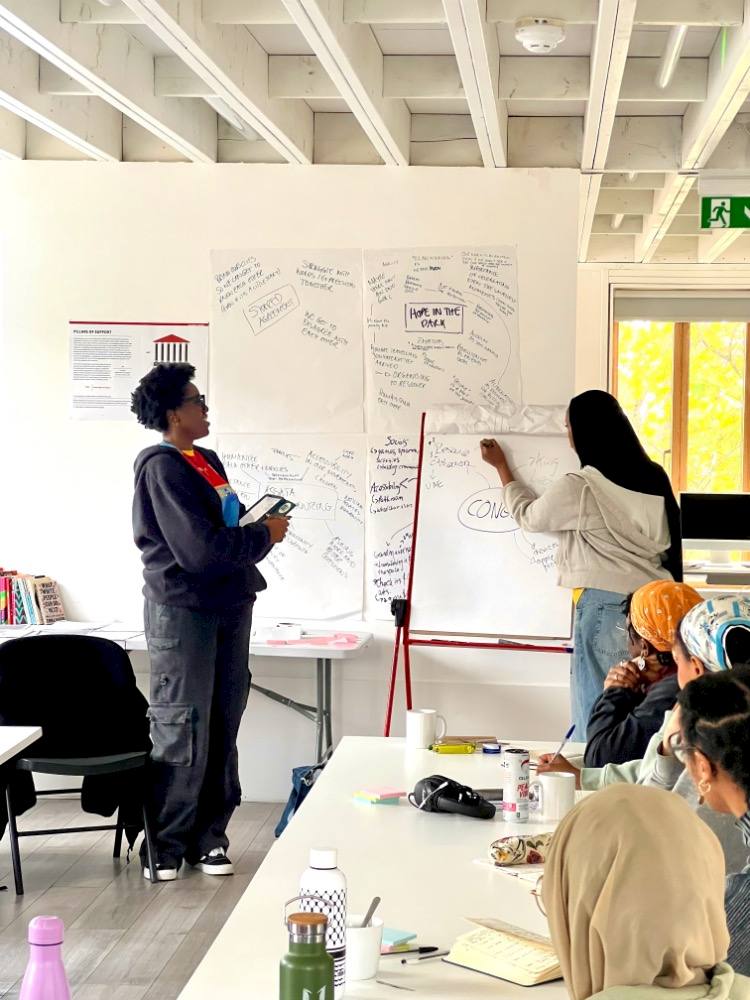
Given that we are abolitionists, the example we often invite students to consider is the desire to eradicate police presence in schools. A young person, having been affected by the presence of police during their time at school, might decide that they’d like to organise around this so more students may not have to experience the same thing. This doesn’t immediately spell out Climate Justice work. But it’s where connecting the dots begins. That young organiser might draw a link between policing and state violence in general. They might begin to see that policing in schools disproportionately harms Black and brown students and connect this to their experience(s) of racism and/or white supremacy. They might then learn that police presence isn’t the same in every school and that some schools, predominantly those in lower-income or working-class neighbourhoods (which correlate with higher numbers of Black and Global Majority students) are over-policed compared to those in other communities. From there, we would unpack that those are the same predominantly Black and Global Majority neighbourhoods that are disproportionately subject to the impact of pollution. As a result, the conditions that lead to a specific inequity in our society become clear: a society that relies on marginalising its working class (capitalist), and does its best to divide and conquer those within that category (racist) naturally also overpolices those communities.
By organising to get police out of schools, the young organiser will engage with the root issues of the problem, use their political education in their organising efforts, and hopefully organise in such a way that they’re not only getting police out of their particular school but contributing to the overall transformation of their community. Most importantly, they will be addressing the conditions that may have led to the police being there in the first place. Without this context, they might have only focused on getting police out of schools as the main issue in a vacuum, only tackling the symptom rather than the root. This could backfire, leading to frustration and ultimately not bringing about the transformation they hoped for.
It may seem counterintuitive when reading an essay like this, but I would like to invite you to pause here for a moment and consider what organising from this kind of perspective might mean for you. What is the issue that makes your blood boil? What is the cause you are most passionate about? What reality, if radically different tomorrow, would fill you with joy and anticipation? I guarantee that there will be a direct line, just like in the above example, between the pillars upholding the ongoing climate crisis and your cause. What might it look like to start thinking about it that way, to begin organising with this in mind? How might it help build solidarities between our wide-ranging movements and smaller locales?
This work of helping each other connect the dots (and I speak from experience when I say it remains a constant learning journey), of learning from each other and getting to the root of issues in our organising is why AWETHU exists. It’s why we have decided to build a school for organising that centres Climate Justice and Black Liberation, and it’s why we hope that you will join us and the millions of others everywhere who are ready to fight for our futures and transform our world.
This moment is a scary one. But we hope that, like us, you may take heart in the fact that many before us, and many right now, have resisted and won.
We know we are not alone; we know there are many who are organising with the inherent interconnectedness of our struggles at the forefront of their work. There are those who are building mutual aid networks and networks of solidarity among various causes and locales. People all over the world are increasingly organising to build an alternative future – a better world – and it is our greatest honour to play our part through AWETHU. Our hope is that the work we do inspires others to do the same, that we can equip our movements beyond our cohorts, and that our actions produce the hope and steadfastness required to rise to the challenge we all face together.
This piece is supported by the Queen Mary Centre for Creative Collaboration.
Cover image: Woman Shooting Cherry Blossoms by Yinka Shonibare
All other images courtesy of AWETHU School of Organising

