Airports, Immigration, and Spiders: On Writing My Debut Book 'Babylon, Albion' by Dalia Al-Dujaili
Dalia Al-Dujaili writes about the inspiration and research behind her debut, Babylon, Albion, a nature-memoir exploring identity through the land-based mythologies of Britain and Iraq and family memories of migration.
I’ve spent a very long time in airports. Passing through borders, travelling to and from the airport, living out of suitcases, waking up at the crack of dawn to catch an early flight or arriving at a strange rental in the dead of night. Airports are the farthest space from a forest. The air is stale and recycled, the light unnaturally sterile and bright — there is no sense of time inside. To me, airports feel like the least natural places in the world. And yet it is through these airports that I first started writing my debut book, Babylon, Albion, a nature-memoir exploring identity through the land-based mythologies of Britain and Iraq, and my family’s memories of migration.
Babylon, Albion is not about airports at all, quite the opposite. It is about our green spaces, shared land, the mythologies that emerge from soil and woodlands, and our identities – whether cultural, racial, or national. It is about decolonising our relationship to the natural world and our experiences in the outdoors. Yet airports are the spaces that have made the stories in my book possible. And it’s travelling through borders that has made me aware of why I needed to write them.
As a child of diaspora, I’ve never felt content or satisfied with the idea of a border. How could identity be contained to a single place? I contain multitudes inside of me – vastly differing landscapes, two languages that mingle oftentimes, and several conflicting cultures. The title of my book, Babylon, Albion, refers to two places – they were the first two words that came to my mind when writing, and have inspired the entirety of the work – the ancient Mesopotamian city of Babel, or Babylon, as mentioned in the Bible, and Albion, the ancient name for Britain. In Latin, ‘albus’ means ‘white’. As I chronicle in the book, the island supposedly got its name from invading Roman armies who, upon their sailing to Britain, first noticed the white cliffs of Dover. In British folklore, it was the giant hero Stormalong’s ship that grazed the side of the island, creating the chalky cliffs we see today.
Folklore and myth, above anything, have helped me feel much more connected to the British Isles than its colonial ideologies that are imposed on us as Brits (both with ancestral ties to the land and to the Global Majority diaspora in Britain). For many, Britain can be synonymous with empire — as it very much is for me. My family come from a place which was occupied by the British for decades, and later invaded and sanctioned by its army. But the term ‘Albion’ – though at times appropriated by ethnonationalists today – feels less referential to Britain as an empire and more to a place rich with necessary biodiversity, both in its landscape and its stories that ask us to steward the land.
I began the writing process for the book by reading a lot. Though the book might not seem particularly academic in weight or style, it is entirely undergirded by rigorous research, drawing from creative nonfiction essays, prayers and hymns, verses from the Quran, academic research, and memoirs. I wanted the process of writing this to teach me more about the similarities in the folklore and mythologies of Britain and Mesopotamia.
As a child of diaspora, I’ve never felt content or satisfied with the idea of a border.
The first books that inspired me, remaining cornerstones throughout the whole process, were Mary Oliver’s essay collection Upstream (2016), The Old Ways by Robert Macfarlane (2012) (obviously), and The Next Great Migration by Sonia Shah. Also, the work of Corinne Fowler at the National Trust and her book Green Unpleasant Land, which chronicles the British countryside’s relationship with empire and colonialism, served as a major influence. Fowler speaks to how the same places I grew up around in Surrey have often been steeped in traumatising colonial histories; to acknowledge the past is a gateway into accepting a new kind of British identity which could be restorative and creative instead, especially in regards to the climate crisis and global dialogues on social justice. This was an idea I found paramount to express in Babylon, Albion.
The words of the late Oliver, in particular, were my guiding light while writing: ‘the palace of knowledge is different from the palace of discovery.’ Just a few of her sentences have fuelled entire sections of Babylon, Albion, such as her essay on a spider, ‘Swoon’, where Oliver describes the process of a mother spider birthing babies from hundreds of eggs under her stairwell. ‘Swoon’ inspired the ‘Devotion’ section of my book, about the idea of being in a constant state of awe, praise and gratitude to the natural world, in the third chapter, ‘Paradise on Earth’. The section’s title was taken quite literally from Oliver’s most beloved quote, ‘Attention is the beginning of devotion.’
I first discovered ‘Swoon’ just after I had returned from a camping trip in Ulverston in the Lake District, where I found that – as I document in the book – my fear of spiders seemed to momentarily disappear. While in a tent, I saw little spiders crawling all over my legs, illuminated by candlelight. Yet instead of fear, I felt, for the first time, at peace with the spiders’ simple existence, rather than anxious about their unpredictability.
It was through the words of OIiver that I knew I did not want to write something journalistic for my first book, though this is what I am most accustomed to. Even in my journalism, I often find it hard to filter out subjectivity and passion from my articles (perhaps this is why I could never be a reporter). In Babylon, Albion, I found myself expressing something rather poetic, though I don’t consider myself a poet either. I found myself wanting to articulate ideas through beauty and mysticism about the natural world around me, in order to feel more connected to it.
Perhaps for the first time in my writing career, I became able to quite easily adhere to the deadlines I set for myself. I think that’s because I really loved writing this book; it felt like falling in love. You know that sweet, heady joy: they’re the first thing you think of when you wake up, the last thing you think of when you go to sleep, and then they’re the subject of your dreams. I thought about Babylon, Albion all the time. There was no end to the honeymoon period.
Folklore and myth, above anything, have helped me feel much more connected to the British Isles than its colonial ideologies ...
It feels like this book has come at the right time. The rise of the right-wing has greatly exacerbated anti-migrant discourse, not just in Britain but all over the Global North, from the United States to France and Germany. I was too young to vote on Brexit at the time, but, being the child of immigrants, I was not too young to notice its immediate effects on migrant discourse. Today, we see major riots almost monthly — from 2024’s Southport riots in the UK, to the more recent ICE raids in Los Angeles, and the violent riots in Northern Ireland two months ago. I hope Babylon, Albion can be an antidote to what are likely growingly common feelings of unbelonging and the anxieties we feel today. More people live outside their country of origin today than at any other time in history; we are the majority. The term ‘minority’ seems inadequate when referring to ourselves – as migrants or people of colour – because it disempowers us. Babylon, Albion is a gentle reminder, told through folklore and mythology, that migration is a return to nature.
Babylon, Albion is out now with Saqi Books.
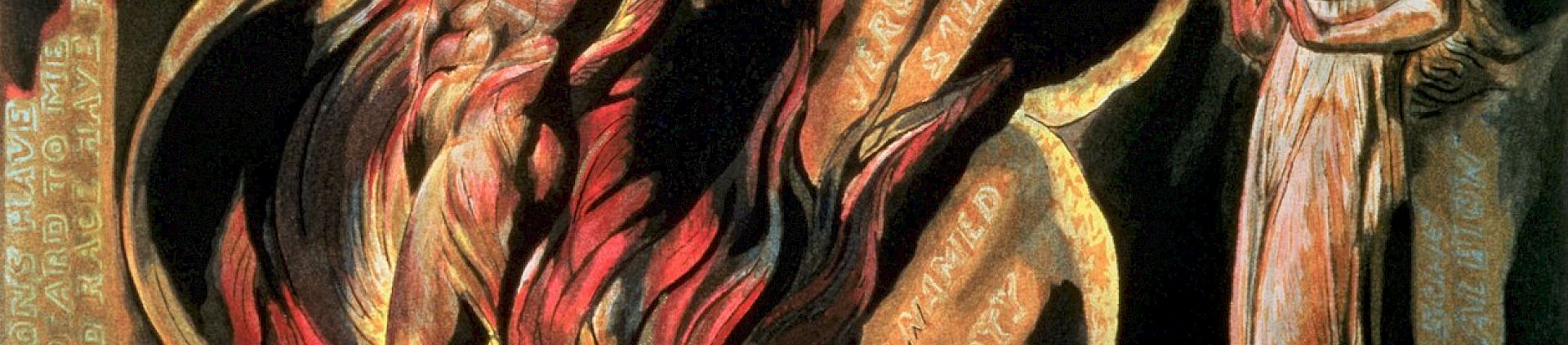
Image: The Emanation of the Giant Albion by William Blake

