The Weight of the Anecdote by Noreen Masud
'This is the problem with anecdotes: they are so ambiguously weighted. They might say nothing or they might say everything' — Life Writing judge for the 2025 Queen Mary Wasafiri New Writing Prize, Noreen Masud, talks about the value of the anecdote when writing about one's life.
The 2025 Prize is open for submissions until 30 June 2025. Submit here.
I tried three times to write about my strange life. The first time, I was fourteen. The things that made their way into my memoir A Flat Place (2023) – about flat landscapes and how they might supply a visual language for certain kinds of strange lives and experiences – were happening around me in real time, in my odd, frightening house in Pakistan. This teenage version was fiction; it was based around the haunting refrain from ‘Scarborough Fair’, which promises love just out of reach, if only you do one more impossible thing, step out just a little bit further off the precipice. I abandoned the book when real life became too painful to record, and the risk of the manuscript being found and read became too high. At the same time, I thought: it doesn’t matter, because there’s nothing really to write about. Nothing but incidents which mean nothing in themselves. That version was lost when I left Pakistan, two weeks before I turned sixteen.
I tried again at twenty-nine. I was all bones and agony. I wanted so desperately to be coherent and sharp and unblurred. I wrote and I wrote, in a summer too hot and bright, squinting at the screen; I couldn’t make myself lower the blind because I knew I would never want to raise it again. But the writing was all anecdotes. I couldn’t make the things I remembered add up to anything.
There is a passage about anecdotes that I often think about, from E. M. Forster’s novel Maurice (1971). Maurice and Clive are having a love affair. Clive comes to stay with Maurice’s family, after the stress of his bar exams. Maurice – his family’s only boy – is doted upon and spoiled by his mother and sisters. In this passage, they are all having dinner and chattering vacuously in the way that families do.
'[Maurice] was eating away placidly, too used to such table talk to see that it worried his friend. Between the courses he told an anecdote. He spoke slowly, stupidly, without attending to his words or taking the trouble to be interesting. Suddenly Clive cut in with ‘I say – I’m going to faint’, and fell off his chair' (Forster).
Not for a few chapters do we learn why Clive fainted. It turns out that he was so overcome by horror at how boring Maurice was that he physically lost consciousness. The passage sums up why I love Forster. His characters are often willing to have a truly appropriate reaction to things around them, to die or faint or scream at things that really we should all be fainting or screaming at. You may call them melodramatic. Nevertheless, just about once a week, someone or other tells me an anecdote so boring that I seriously worry I might faint. I fix my eyes on theirs and nod encouragingly, while the world goes blurry around me. Only the memory of Forster’s perfect summary keeps me upright. I remember his phrasing – ‘without taking the trouble to be interesting’. The solidarity sustains me.
But this is the problem with anecdotes: they are so ambiguously weighted. They might say nothing or they might say everything. The teller of anecdotes can never be sure which sort they’ve got on their hands. Sometimes they tell the anecdotes in order to find out, to gauge the audience’s reaction, so that they know what to think about what’s happened to them. Weight-wise, I found that my anecdotes from Pakistan were impossible to tell predictably. They grew or lurched or dissolved on the way out. I’d try to tell them briefly or lightly, as a joke, and that wasn’t the right thing: my listeners reacted with horror. Or I told other stories, ones which sat on my heart like rocks and kept my eyes open at night – taking a great deal of trouble to be interesting, I thought – and my audience just looked blankly back at me, as though I’d blown bubbles in their faces. In the telling, the light ones turned out to be weighty and the heavy ones seemed totally weightless and insubstantial. Why had I told them at all?
Perhaps I didn’t know how to tell stories, I thought. Indeed, this is a common problem if you’re not used to being listened to. You tell the anecdotes too fast, or you start apologising for the anecdote before you’ve reached the payoff. It’s terrible to be deferentially listened to, like Maurice, and it’s terrible not to be listened to at all. I was very worried that I might be boring enough to make someone faint.
In the telling, the light ones turned out to be weighty and the heavy ones seemed totally weightless and insubstantial. Why had I told them at all?
I still haven’t solved the problem of the anecdote: what it might mean or not mean, even whether to tell it at all. It’s easier not to talk than to talk; easier not to write than to write. But you have to do both. And, writing within the heat of history, before we can know what anything means, we only have anecdotes, to write and talk about.
When I finally wrote A Flat Place, I tried at least to pay attention as I told or wrote the small story. I don’t mean pay attention to the reader – readers get in your head – but to the story in all its aliveness. Nose into it all over again: snuffle vigorously through the anecdote for the truffles you missed last time, the last spark among the embers. If you find it falling into the same soft folds each time, fold it lengthways instead, and run your nail along the crease, hard. We say that we crave stories, but I think sometimes what we really crave is the experience of listening to someone fully listening to themselves.
Ultimately, it wasn’t until I’d told all the anecdotes in A Flat Place that I realised part of the point was for some of them to fail. For some of them to stand in for nothing; to bewilder; to be irreducible beyond themselves, like a flat landscape. Even to be boring, sometimes, and know it. Clive fainted because Maurice assumed he was automatically interesting. Find the right way to be boring, perhaps.
The 2025 Queen Mary Wasafiri New Writing Prize is open for submissions until 30 June. To have your work considered by Noreen Masud and the rest of our judging panel, submit here.
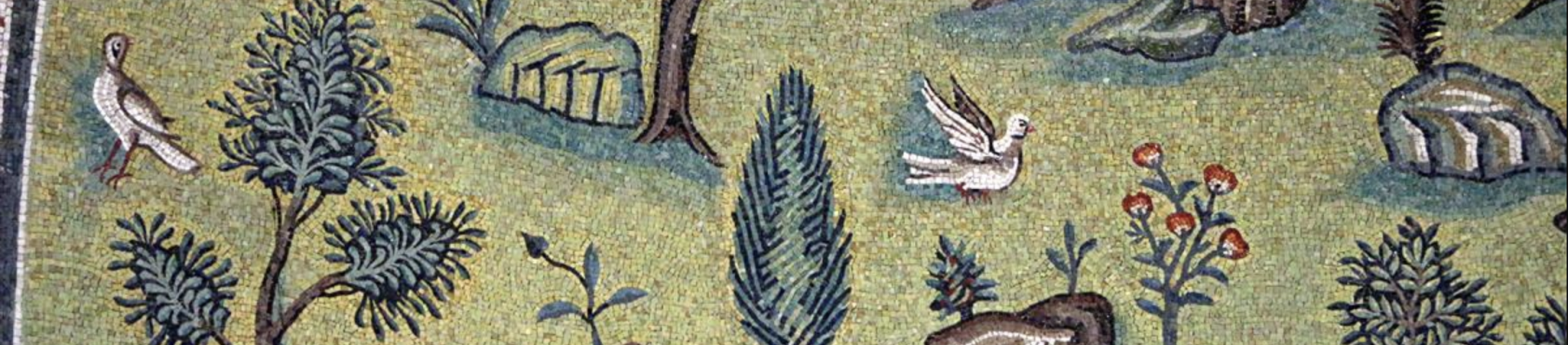
Image: Byzantine Mosaics, Apse Mosaic (detail), c.549

