Breathing Between Bubbles: A Leib-University in Exile
Yana Suchikova is the Vice-Rector for Research at a displaced Ukrainian university. In this piece of life writing from our latest Solidarities issue, she writes on the emotional and corporeal experiences of sustaining university teaching during war and occupation in Ukraine — with and without internet, in makeshift shelters, in simultaneous isolation and fragmented togetherness, while displaced and dispersed. Drawing on Boris Vian’s text L’Écume des jours and the 'foam' of their everydays – 'light, sparkling, but short-lived' – Suchikova considers the various 'bubbles' of locality, care, reprieve, freedom, and solidarity she and the students and members of their university create.
This is an extract from Wasafiri 127: Solidarities.
Download the full piece for free during November 2026.
When we descend into the shelter, the classroom contracts into breath. The ceiling drops by a few invisible centimetres, and metal chairs, once intended for long lectures, suddenly become stools for short remarks. Phone flashlights create craters of light on the walls, and each laptop becomes a small candle. We do not say ‘a class in a shelter’; we say that the class itself is the shelter. In it, we preserve our possibility to be together and to call things by their names.
Someone starts Zoom. Someone else boils water in a thermos powered by a power bank. Another holds a textbook on their knees; it smells of mould and damp from the fifth basement we have used this year. I ask, ‘Can you hear me?’ And from different cities, different rooms, and different hours, short sounds of confirmation reach me — like birds pressing the air with their wings.
I write this as the Vice-Rector for Research of a displaced Ukrainian university. Our city was occupied on the third day of the full-scale invasion. For some time, we lived under occupation.
Did the university still exist for us then? Yes, on a park bench a few dozen metres from the main building. That is where we ran it from. Entering the building was dangerous. About a week after the occupation began, the occupiers dragged out our rector with a bag over his head, at gunpoint. After that, the bench felt safer than the walls. There was no mobile connection, no internet. That was the densest bubble I can imagine: hostile silence all around and our microscopic membrane of pencil, paper, and memorised phone numbers.
Later, we relocated the university to Zaporizhzhia, the regional centre of our region — a city that lives on the frontline. Here, the sounds are different: instead of the muffled silence of occupation, there is the wail of sirens and the boom of explosions. But there is also freedom: to speak our own language; to communicate, to see and to be seen; to respond to our own names. Our community – our lecturers and students – is scattered across the world: across Ukraine, abroad, and in some cases, in Ukrainian territories that remain under occupation. We are a ‘University without walls’ (Suchikova, ‘University without Walls’; Lopatina et al; Suchikova and Tsybuliak).
In philosophy, a distinction is made between Körper, ‘the body we have’ (material, measurable), and Leib, ‘the body we are’ (experienced from within: rhythms, trust, habits) (Merleau-Ponty; Plessner; Husserl). For the university, Körper means buildings, equipment, budgets; Leib means shared practices of teaching and research, care, language, and memory.
It is usually assumed that Körper is primary: first there is a building, a classroom, equipment, and only then does the living body – Leib – ‘settle’ inside. This has been the philosophy of the university for centuries: no walls, no space; no space, no community. But the university without walls breaks this sequence. Here, Leib is primary — it is our selves, our practices, our shared breathing. Körper appears only episodically — when we gather at some location to hold an event or a seminar. No, that is not the entire university, only the part of it that at this moment takes form. Others join online, or create their own node in another city. And altogether, that is us.
In Boris Vian’s L’Écume des jours [Foam of the Daze], this is the foam of days: a fragile everyday that shimmers and then collapses, a space that reacts to our joys and losses — the room breathes with us. In Peter Sloterdijk Spheres III: Foams, it is a different kind of foam: a multiplicity of coexisting bubbles that touch at their edges but do not merge; between them lie membranes: simple rules of passage, channels of communication, small rituals through which we conduct air: trust, meaning, care. In this sense, the university without walls is not an address, but a way of breathing between bubbles: preserving Leib and adjusting membranes, even when Körper has disappeared or been wounded. For us, the calendar is a membrane. Not just a grid of numbers, but a thin skin through which shared air passes. Time zones converge there, and the multicoloured slots act like valves releasing pressure. We call it coordination. In truth, it is care: making sure no one suffocates in their own bubble, and no one gets lost in someone else’s.
The word ‘bubble’, to me, used to seem childish, even treacherous — as if it meant something frivolous. I avoided the word for a long time, until I began to see how our university has split into tiny spheres: laboratory groups, teaching families, diaspora rooms, co-working tables — each maintaining its own space, while remaining close to the others. We live in Sloterdijk’s foam. What matters are the interfaces: membranes not to divide, but to conduct — electricity, voice, trust.
There are days when space becomes like in Boris Vian’s pages: alive, responsive, fragile. The room quite literally breathes: when someone speaks of trauma, the wall seems to move closer; when we laugh, the bookshelf steps back by a finger, granting us a little more room. Objects are not neutral: an electric kettle is a mood, not an appliance; an extension cord is freedom of speech for the one whose laptop is dying; a co-working key card is a pass into belonging.
Our university even has its own ritual of care, the online psychological café ‘I Am Here’. Each person, at home, in front of a laptop, brews coffee. And three coach-psychologists lead group therapy. Through the image of coffee, we slowly work through our trauma, trying to climb out of the bubble of silence, learning to speak again. This drink holds us in a common circle, even when we are scattered across different cities and countries.
For Vian, the foam of days is light, sparkling, but short-lived. Ours is short as well: a quick cup of coffee between two air raids, a funny ‘meme of the day’ in the chat, a greeting from another city weighed down by the same fatigue. This foam is not about superficiality; it is about proof of life. We are learning not to be ashamed of joys that take up little space. They are our unit of measure ...
Read the full piece here, free to access during November 2026 only.
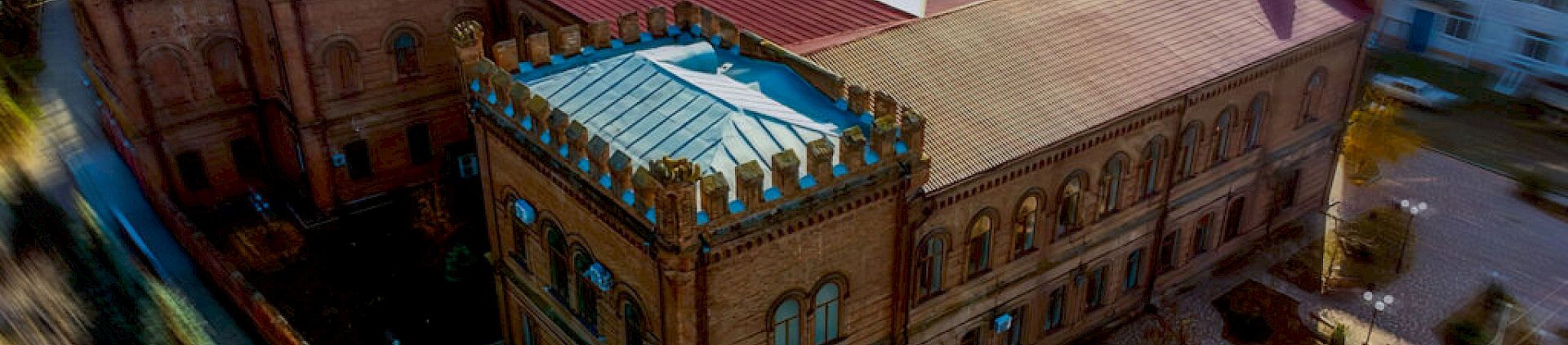
Cover image: Berdyansk State Pedagogical University


What shapes do solidarities take in these strange times we are living in? How can we find and forge solidarities when faced with genocides, human rights violations, and inexplicable injustices daily? Can storytelling play a role in liberation?
