Watching the Wall from Bada Zayed by Mohamed Shafeeq Karinkurayil
In the first extract from Wasafiri 122: The UAE Issue, Mohamed Shafeeq Karinkurayil remembers watching the Berlin Wall fall on his television in Abu Dhabi's Madinat Zayed township — a place he spent several years of his childhood in, following his father's immigration from Kerala.
You can download this full piece for free during the month of June 2025, or read Wasafiri 122: The UAE Issue in print, available to preorder now.
On 9 November 1989, the Berlin Wall fell. In the United Arab Emirates (UAE), the evening news the next day would have begun like any other day. There would be a long list of the dignitaries who were met by the leader of the nation, accompanied by a long video of them greeting and meeting in some palace. Since the news in the nation comprised almost solely of these meetings and greetings, one could see a lot of the international news. For many months, the visuals of the ecstatic and purposeful chipping at the wall would be replayed on TV. It was one of those evenings when I saw people chipping at a wall, beaming and celebrating on the TV that I asked my father what it was. That was Berlin, he said, and those people have brought down the wall that separated their country from the rest of their own. Perhaps it was those joyous faces that night – the clasping of human bodies as if at the end of a long adventure, and the palpable feeling of being in a momentous time – that made me long to see Berlin and not the cafés of Paris, or the streets of London, or the vast and high metropolises of the United States. That would happen twenty-three years later. Germany showed the way for the world. They were the ones to look up to. No one could beat them in technology or willpower (at other times, of course, one marvelled at the Japanese too). To certify how strong a lock was, the shopkeeper would say that even a German thief would not be able to break in.
The German nation would proclaim its strength in the football World Cup in less than a year. There was no dearth of heroes in that World Cup. The UAE was among the finalists. All the matches, and not just that of the UAE, were shown live on national television. During half-time they would show the speed and strength of shots in the game, all in green and black technology-themed graphics, which left us in awe of the superhumans on the field. In the group match against Germany, who would go on to become the champions, Adnan Talayani scored against the Germans. Yes, the world was a new and exciting one. A footballing hero was etched forever in the firmament. Later, Maradona would cry like a baby, and we would continue to be astonished by the birth pangs of that summer of 1990.
*
Madinat Zayed, or Bada Zayed as it was called then, was a township established in 1968. It was a desert town mostly clustered around one street, with some outlying clusters, separated by more than a hundred kilometres of desert from the capital Abu Dhabi. One of the major establishments in the township was the Al Dhafra Hospital compound, which began operations in 1982. It was in this hospital compound that my father worked, and we spent many years there, from the late 1980s to the mid-1990s. Surrounded by the desert on all sides – except for a powerhouse to the east – the compound walls kept the sand out during the desert winds. The hospital was located on a short stretch of road which connected Bada Zayed to Bainouna on the other end, a mostly native Bedouin settlement. Along the road were a few plots of farms manned by a lone Pakistani farmworker we often saw on our way to the school.
The icon of the town was the copper-coloured Arabic kava jug that was placed in a circle at the trijunction. On one side of the junction, the town consisted of two prominent buildings symmetrically placed on either side of the highway, containing grocery stores, fruit vendors, a restaurant, and more. Further in on the north-western side were Bedouin settlements, planned in grids, each bordered with roads on all sides. The southern side of the tri-junction was composed of a bus station on one side of the highway and small makeshift shops on the other, which were less prominently visible from the road. Here, there were butcher shops, tailoring shops, and a sizeable market of clothes, then called lailam (most probably from the Urdu word lelo, which means ‘take’). The road which led to Bainouna was the road going east from the tri-junction.
My father was among those who sought their luck in the Gulf in the wake of pioneering migrants from Kerala. My paternal grandparents worked the fields, some of which were their own. However, as was the case for all those enduring privation, even for those with relative wealth, the boys were expected to find their way in the world quite early on. They left the village, returning to it only twice or three times a year. My father sought the way of education. A school dropout in the third grade, he continued his education in the dars system. This typically meant staying away from home in a mosque with a handful of other students. The dars did not have a mess system, so mosques sought households who were willing to feed some or any of the students and ustads. The students earned some pocket money by attending special prayers on the occasion of deaths and remembrances. It was one such patron of the local dars of this seaside village in Thrissur, a place marked by the (to some, mythical) arrival of St Thomas in AD52, a node in the global network of pilgrimage and exile, where my father spent most of his teenage years. An entrepreneur with business interests in Kerala and the UAE arranged for a passport and visa for my father. On his instruction, it was the postman of that village who filled out the passport application form in English for my father, giving him a date of birth, as people kept a record of deaths (in the Hijri calendar) but hardly remembered births. Now he had to cross the ocean and come of age ...
Read the full piece here, free to access and download for the month of June 2025 only.
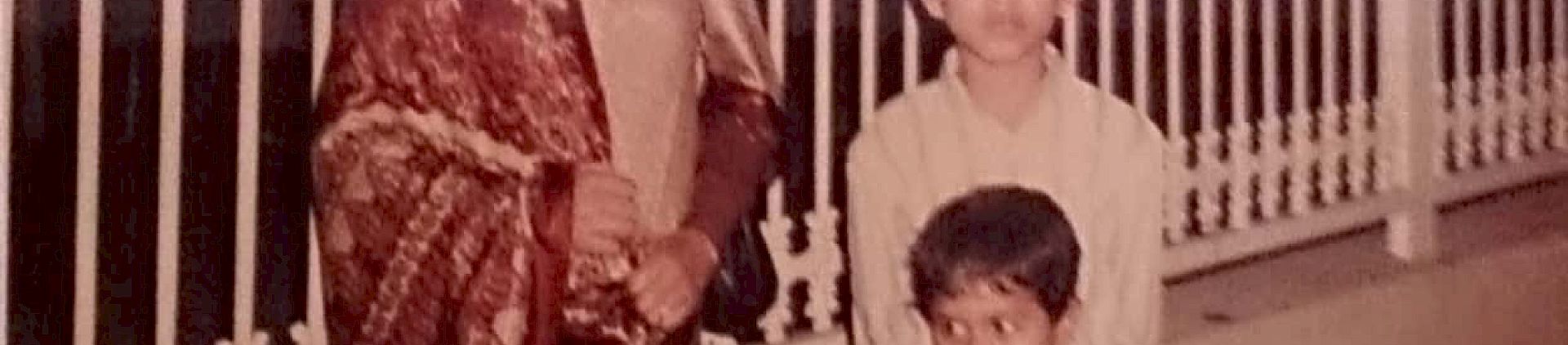
Cover photo: Author with mother and younger brother on a trip to Abu Dhabi, 1992. Courtesy of Mohamed Shafeeq Karinkurayil


Our summer special issue, guest co-edited by Laure Assaf and Deepak Unnikrishnan, explores the United Arab Emirates’ literary and creative scene — away from monolithic representations of the region. Its contributors are makers – of books, arts, texts, and community – with ties to the United Arab Emirates and/or the Gulf. They are brought into conversation across generations and disciplines, reflecting on what this place is for them, and what it does to them. They talk about risk, memory-making, taxis, and televised dreams — pushing the lines, or treading them carefully.
