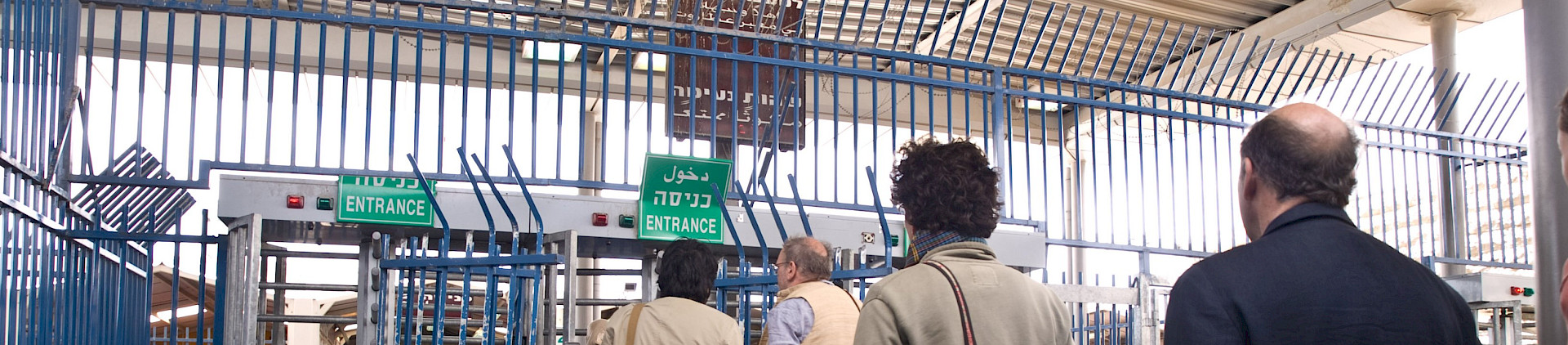
Checkpoints Now, Borders Later? Revisiting Checkpoint Aesthetics in Palestinian Life Writing
In this essay, Shatha Abd El Latif examines four works of Palestinian life writing: Suad Amiry’s Nothing to Lose but Your Life (2010), Raja Shehadeh’s Occupation Diaries (2013) and Palestinian Walks (2007), and Mourid Barghouti’s I Saw Ramallah (2000). Through her analysis of these texts between the diary and memoir forms, Abd El Latif argues that 'Palestinian life writing offers a critical archive through which the checkpoint can be understood not merely as a geographical site of restriction, but as a temporal and narrative structure that reorganises everyday experience.'
This piece is commissioned in tandem with Wasafiri 127: Solidarities.
Supported by a grant from the Open Society Foundations.
In the 2012 book Palestinian Film and Literature in Postcolonial Feminist Perspective, Anna Ball asks: ‘What might a uniquely Palestinian border-theory look like?’ (127). Her question comes from the assumption that the broad spectrum of Zionist settler-colonial borders is unorthodox, leading to a ‘distinctive aesthetic’ that has come to define the Palestine border narrative (Ball 127). What Ball describes here is a dialectic reading of border violence and intellectual imagination, emerging from the uneasy theoretical tension between Palestine, postcolonialism, and poststructuralism. As critical theory delineates borders as mobile and relational, there is an (often) celebratory concurrence of borders as sites of creative hybridity, political possibility, and even a transformative encounter (Ball 101). Such theoretical conventions, however, risk obscuring the particular material and historical conditions through which colonial borders in Palestine are produced. For Palestine, the border is not merely a liminal threshold that unsettles fixed identities and territorial divisions –– it is a traumatic site through which colonial violence is enacted upon bodies, landscapes, and everyday rhythms of life (Ball 112). As Ball discusses, Palestinian borders therefore demand a critical vocabulary capable of accounting for their unorthodox modus operandi. They are simultaneously technologies of enclosure and sites of creative production, as well as structures of dispossession; they are spaces from which acts of witnessing and narration emerge. This tension forms the foundation of what might constitute a uniquely Palestinian border theory: one that does not dismiss the creative possibilities generated by borders but situates them within the material realities of occupation, fragmentation, and enforced immobility (Ball 129-130).
The texts discussed here come from an unfolding geopolitical context that suggests a worldly turn in the material philosophy of global frontiers at large: an affliction toward border mania that locates borders as ‘fetishistic monuments’ of the nation-state fantasy (Washington 11). Older border scholarship – primarily attending to the US-Mexico border – considers borders as the pretext to lawfulness and nation-state sovereignty (Kristof 281). However, Louise Harrington contends that this reading is no longer sustainable. Scholarship has since moved toward theories of open (as in relational), mobile, and malleable borders (Harrington 218). In Palestine, this mobile border ethos is found in the central logic of the Israeli checkpoint and settler colonialism itself, where sovereignty is exercised through ‘unbounded territoriality […] by not delimiting boundaries, by not making clear the extent of sovereign authority’ (Hughes 217). Rather than producing a fixed territorial division, the checkpoint operates through an incomplete process of bordering, constantly negotiating, extending, and retracting the limits of Palestinian mobility (Diener and Hagen 37).
This connection exposes the intimate relationship between Israel’s geographic warfare and the ways in which it influences and shapes the daily lived experiences of Palestinians. More than merely signifying the presence of a border, the checkpoint also functions as a mechanism through which the border is continuously enacted. The checkpoint henceforth reveals the border not as a static line dividing two territories, but as a process through which space and time are continuously reorganised. This description of what a checkpoint is, what it is not, and what it might ultimately become endows it with a transient position in time and space before its eventual materialisation as a border. In this sense, the checkpoint becomes a privileged site through which to examine the unfinished and recursive nature of settler-colonial bordering.
Palestinian borders demand a critical vocabulary capable of accounting for their unorthodox modus operandi
This essay examines Suad Amiry’s Nothing to Lose but Your Life (2010), Raja Shehadeh’s Occupation Diaries (2013) and Palestinian Walks (2007), and Mourid Barghouti’s I Saw Ramallah (2000), four works of Palestinian life writing that engage with the spatial and temporal effects of occupation. Between the diary and memoir, these texts narrate encounters with checkpoints, borders, and restricted mobility as everyday experiences of violent geographies. Beginning from sites of crossing and return, they transform the border from a territorial structure into a literary site through which questions of movement, memory, and witnessing are negotiated. I read these works to explore the possibility of forging a new reading of settler-colonial borders as dynamic and continuously produced formations, while tracing the relationship between the poetics of diary and memoir and the distinctive qualities of a Palestinian border aesthetic. I argue that Palestinian life writing offers a critical archive through which the checkpoint can be understood not merely as a geographical site of restriction, but as a temporal and narrative structure that reorganises everyday experience. The diary and memoir, as forms embedded in the rhythms of ordinary life, reveal how the border extends beyond the moment of crossing and becomes absorbed into the temporal, corporeal, and emotional landscapes of Palestinian existence.
This argument does not claim, however, to represent all Palestinian life writing or all Palestinian experiences, therefore avoiding what Bart Moore-Gilbert warns could become the construction of an ‘abstract, transhistorical, Palestinian […] essence’ (‘Baleful Postcoloniality’, 52). Nor does this reading suggest that the aesthetic practices of border writing by Amiry, Shehadeh, and Barghouti encompass all Palestinian lived experiences of borders. The writers studied here emerge from comparable class positions, educational histories, and literary networks, and all three occupy an Anglophone archive of Palestinian life writing. Yet, precisely because of their positionalities, their works shed light on a crucial and surprisingly underexamined intersection within postcolonial border theory and life writing studies — that is, the relationship between the material transformations of Palestinian borders and the literary forms through which these transformations become legible as part of a literary aesthetic (Moore-Gilbert, ‘Baleful Postcoloniality’, 113; Ball 103).
When theorising ‘checkpoint narratology’, Susan S Lasner and Shlomith Rimmon-Kenan revise Mikhail Bakhtin’s chronotope, which describes how time and space fuse together in stories (‘the nexus of time and space’, that is, the ‘Ur-chronotope of the novel, the chronotope of the road, the locus of free movement’) (243). This is to suggest that, when the road turns into the roadblock, it compels narrative towards ‘find[ing] circuitous ways around conventional practices’ (Lasner and Rimmon-Kenan 246). This argumentation is not indicative, nor is it a claim, of a simple correspondence between occupation and narrative, however. Rather, it is a contextual reading, understood in the way of a ‘situated narratology’ (246). Here, the return to Bakhtin’s chronotope asks us to rethink the centrality of the chronical event in narrative progression. Otherwise, we are at the risk of an eclipsed account of how the obstruction of movement transforms the very conditions of narrative unfolding. Instead of advancing in a series of discrete events, narratives of occupation become organised around interruption, waiting, repetition, and suspended temporality.
Amiry, Shehadeh, and Barghouti channel the unorthodoxy of Zionist borders into their narratives of crossing and (im)mobility. Substantiating Ball’s reading of borders as sites of witness and creative production, the three authors produce critical and documentative literary accounts that chronicle eyewitness narratives as they negotiate and resist the checkpoint’s violent geography. The term ‘violent geographies’, (also referred to here as geographic warfare), corresponds to the ‘architecture of occupation’, in reference to Rafi Segal and Eyal Weizman’s spatial analysis of Israeli settler-colonialism (2003). Here, spatial violence is realised and understood in material terms, which are executed as a process rather than a fixed instance or time-bound event. The dictum of this violence is carcerality; it traps space and time within its own black hole of political subjectivities. These subjectivities are shaped and performed through an ‘artificial and imposed arrangement of interrupted or confined space’ and the ‘unsynchronized rhythms of disturbed time’ (Said 20). In this sense, the checkpoint’s site produces a ‘particular embodied [and literary] territorial experience’ through its ‘porous barriers’ (Tawil-Souri, ‘Qalandia’ 368). Here, this porosity manifests in narrative aesthetics as an engendered glitch. This glitch is sustained through what Tawil-Souri calls the ‘arbitrary management of this porosity’ by a high-tech laboratory that operates on the bodies of Palestinian crossers (‘Qalandia’ 368).
... narratives of occupation become organised around interruption, waiting, repetition, and suspended temporality
In the diaries of Amiry and Shehadeh, the checkpoint’s porosity reorders narrativised experiences of time and space. This produces a Palestinian border aesthetic of fragmentation that emerges from a preconceived link between checkpoint-time and life-time. The turning of the border machinery’s cogs is heard well before the checkpoint appears either on the textual or physical stage. Hence, the relationship between checkpoint-time and life-time suggests they are inextricable from each other. This relationship is greatly evidenced in the way the diary, as a subgenre, realises the surgical ‘temporal work’ that the checkpoint performs upon the narrative (Tawil-Souri, ‘Checkpoint Time’ 388).
In Nothing to Lose but Your Life and Occupation Diaries, Amiry and Shehadeh frame each diary entry with an exact record of time and location. Narrative is compartmentalised and fragmented into discrete textual units, resembling the fragments of the bordered landscape (Ball 121). Their diaries therefore become alternative sites locating their (im)mobility both physically and temporally, while pointing towards an embodied textual negotiation with settler-colonial carceral spatio-temporalities. This fragmentation is central to the practice of diary writing, allowing Amiry and Shehadeh to record what they witness and centralise their lived experiences of crossing. The framing of their narratives allows the authors to register the extent to which checkpoint temporality exercises fragmentary violence upon Palestinian bodies and geography. The diary then becomes an optimal vehicle for decoding the checkpoint’s temporal mechanisms and the narrative techniques they generate. Yet, as narrative moves through space, the grip of chronological time is loosened; a disjunction emerges between the printed word on the page, the footstep on the ground, and the temporality that binds them together. Narration, in other words, cheats time. As the checkpoint, entangled within the broader carceral geography of occupation, ‘underlies […], complicates, dismantles, reduces, or revises basic elements of narrative’, it exhausts conventional chronologies (Lanser and Rimmon-Kenan 246).
Occupation Diaries, for example, struggles to maintain a linear narrative and moves away from its documentative tone towards a more personal and reflective register. Amiry, however, intensifies the fragmentary form even further. Her diary suffers from multiple instances of narrational slippage, where the fragmented body of the diary itself becomes unable to capture the immediacy and extent of checkpoint violence. Amiry not only struggles to sustain linear narrative, shifting form and style as Shehadeh does, but also fails to maintain continuous prose. Monitoring her movements before and after crossing the Atara and Qalandia checkpoints, she uses ellipses to capture the rhythm: ‘Walk … Walk … Walk … Stride … Stride … Stride … A long and deep breath’ (Amiry 71). To Mishuana R Goeman, settler-colonial logic produces a ‘grammar of place’ where ‘the collapse of a progressive time-space continuum’ troubles new possibilities (238). This mode of border narration indexes what Genette terms a ‘descriptive pause’, a leakage in narrative time, where ‘some section[s] of narrative discourse correspond to a non-existent diegetic duration’ (93–94). Thus, while the act of physically crossing the checkpoint might last only seconds, within narrative time it occupies several pages, if not entire chapters.
In Palestinian Walks, Shehadeh’s forays unearth another fulcrum of checkpoint aesthetics. In the memoir, we witness the autobiographical subject pushed toward peripherality, which we might understand as a temporal spot engendered via the literal eradication of Palestinian lives from their homeland and a colonial culture of denial. In Saree Makdisi’s Tolerance is a Wasteland, the reconfiguration of Zionism’s culture of denial offers an invaluable insight to this conversation: ‘ ... space is being denied; that denial is then occluded first by the attempt to literally cover it up and then by other layers of denial, but mostly by the hyperbolic and absurdly theatricalized investment in a discourse of “tolerance”’ (17).
... the fragmented body of the diary itself becomes unable to capture the immediacy and extent of checkpoint violence
This discourse of tolerance is understood in spatial terms of ‘destruction and usurpation’, mobilised by the erasure of ways of belonging — an apex of ‘catastrophic injustice’ (Makdisi 17). It is difficult to move on from this point without attuning to the underlined subtext of catastrophe, exodus, and al-Nakba. (One could even argue that no aesthetics of checkpoint narratology can be understood separately from the continuous mass exodus of Palestinians in 1948). Of course, this ethos of tolerance is found in the chapter ‘Imagined Sarha’, Shehadeh’s penultimate foray in the memoir. He writes:
‘We had become temporary residents of Greater Israel, living on Israel’s sufferance subject to the most abusive treatment at the hands its young male and female soldiers controlling the checkpoints, who decided on a whim whether to keep us waiting for hours or to allow us passage. But worse than all this was that nagging feeling that our days in Palestine were numbered and on day we were going to be victims of another mass expulsion’ (Shehadeh 185).
This prophetic reading of mobility choregraphed around immobility, bordering on catastrophe time, reinforces the thesis that the subtext of exodus (the Nakba) is constantly recreated, relived, and anticipated at checkpoints or on bypass roads. The checkpoint is understood as a mobiliser of Shehadeh’s (im)mobility. In the passage above, Shehadeh adopts a cynical tone, weighed down by images of psycho-traumatic horror injected by the checkpoint and an even more dystopian prediction of an imminent exodus.
The phrase ‘living on Israel’s sufferance’ also carries spatially necrophiliac significations. To live on sufferance is to inhabit a geography in which Palestinian existence remains provisionally tolerated, while the conditions of that existence continually reproduce dispossession and death. The narrative is trapped within catastrophe time and space: catastrophe is not an event that has passed, but an enduring condition of habitation. The temporalities of sufferance consequently produce intolerable geographies, where everyday movement becomes precarious, signposted by a Kafkaesque depiction of ‘unpaved roads that had to be travelled in secret, mere tracks that went over rocks and took dangerous bends, damaging the cars that travelled them’ (Palestinian Walks, 185). Piled-up cars and people trapped in dystopic, grey, fenced checkpoints abound throughout Shehadeh’s memoir, much like Amiry’s and Barghouti’s checkpoint interventions. In other words, this carceral and asymmetric experience of time englobes checkpoint/life-time.
Yet, this is complicated by a dislocated temporality that shapes Shehadeh’s understanding of subjectivity as ‘temporary residency’ on the periphery of ‘modern’ time and citizenship (Palestinian Walks, 185). I invoke here Lanser and Rimmon-Kenan’s reading of ‘temporal dislocation’ in occupation narratives, a ‘change in temporal order’ with multifaceted implications in the narrative. Here, nonetheless, my reading performs a dislocation of the concept itself, preserving its core while expanding its interpretive application. To elaborate, Shehadeh invokes a third temporality that works to displace Palestinians in time and space and, by effect, reorders or even obliterates his subjective status and ability to map a united, congruent relation between time and space. Shehadeh’s meditation on the parasitic behaviour of the checkpoint typifies the scriptum of violence that continuously splinters Palestinian lives into ‘a series of waiting episodes’ (207).
This stretching of time and space – which creates an experience of immobility – hinders the experience of temporality as progressive and forward-moving. It performs what Julie Peteet describes as ‘geographies of risk and anticipation’ (99). As she argues, ‘mobility and space are mutually constitutive and relational: checkpoints facilitate Jewish Israeli mobility and constitution of space and curtail that of Palestinians. Mobility implies a meaningful act that occurs through, and is constitutive of, space and time’ (Peteet 100). Likewise, ‘“stealing time” captures the materiality of closure: a concrete, objectified sense of time, the actual minutes, hours, and days that accumulate while waiting... Palestinian time is a tangible material thing that can be granted or denied - or, as Palestinians see it, stolen’ (Peteet 134). Peteet thus provides theoretical language from which to understand Shehadeh. The checkpoint’s modus operandi creates a temporal (dis)order where waiting and conditional passage accumulate until a temporary checkpoint assumes the enduring political function of a border.
... catastrophe is not an event that has passed, but an enduring condition of habitation
In Mourid Barghouti’s I Saw Ramallah, the checkpoint comes closest to the border par excellence, with the Allenby Bridge separating the West Bank and Jordan. Yet the border in the text is not encountered at the moment of crossing but produced through a temporal accumulation of exile. It is here that genre ‘proper’ is best challenged and reconstituted. I Saw Ramallah, writes Anne Bernard, is ‘part memoir, part essay, and part prose poem’ (665). This hybridity, I argue, edges toward experimental stylistics that Barghouti uses to rid his autobiographical self from the shackles of orthodox national critique that has otherwise shaded a post-Nakba era of Palestinian writing (Bernard 670). Moreover, it forges the path for the border to unfold simultaneously as a material crossing, a remembered homeland/landscape, and an imagined return.
This formal instability mirrors the instability of the crossing itself: as the border exceeds the administrative function of the checkpoint, the memoir likewise exceeds the conventions of autobiography, repeatedly interrupting documentary narration with lyric meditation. The opening chapter, ‘The Bridge’, establishes this narratological principle before the crossing has properly begun:
‘It is very hot on the bridge. A drop of sweat slides from my forehead down to the frame of my spectacles, then the lens. A mist envelops what I see, what I expect, what I remember. The view here shimmers with scenes that span a lifetime; a lifetime spent trying to get here. Here I am, crossing the Jordan River. I hear the creak of the wood under my feet. On my left shoulder a small bag. I walk westward in a normal manner – or rather, a manner that appears normal. Behind me the world, ahead of me my world’ (Barghouti 1-5).
The crossing has scarcely begun, but the memoir has suspended its chronological movement. Before the checkpoint functions as a geopolitical obstruction, Barghouti encounters it through bodily sensation, memory, anticipation. and sound. The slipping drop of sweat, the misted spectacles, and the creaking wood delay narrative progression, suggesting that the border is first experienced corporeally before it is crossed geographically. Barghouti thus engages a different kind of evidence. Rather than documenting the checkpoint through factual accumulation, he locates its violence in the body's encounter with space, treating sweat, blurred vision, breath, and hesitant movement as embodied traces of border violence. The memoir therefore privileges the concrete experience of landscape over abstract symbolism, grounding its lyricism in the materiality of the crossing itself.
Formal instability mirrors the instability of the crossing itself
As the chapter unfolds, the prose repeatedly slips into poetic meditation – as in ‘a bridge that is no longer than a few meters of wood and thirty years of exile’ – collapsing physical distance into historical duration (Barghouti 13). The bridge exceeds its material dimensions, condensing decades of displacement within a seemingly ordinary site of passage. Likewise, Barghouti's insistence on proximity – ‘Do you see how close it is? How touchable? How real? I can hold it in my hand, like a handkerchief’ (9) – constructs the central paradox of the checkpoint-border: Palestine is physically near, sensorially available, yet politically inaccessible. We might call it a ‘geography of estrangement’. Even the memoir’s syntax begins to perform or mimic the choreography of the crossing. The oscillating between prose and lyric form, the breathless, sparse short clauses, and the slowing of narrative’s pace imitate the troubled and fractured rhythm of the subject’s movement at the checkpoint. Crossing narratives, then, begin before the material act of passing through a checkpoint. In I Saw Ramallah, the border is first traversed narratively, affectively, and corporeally before it is crossed geographically, revealing the checkpoint not as a temporary site of inspection but as a temporal process through which exile accumulates until the checkpoint itself assumes the political work of a border.
The Anglophone Palestinian diary and memoir forms have so far evinced a profound engagement with a broader border aesthetic, encoded through patterns of encounters with the checkpoint space. Amiry, Shehadeh, and Barghouti experiment with the sub-genres of life writing at both traditional and experimental thresholds. Nothing to Lose but Your Life, Occupation Diaries, and Palestinian Walks embrace the classic model of the diary and memoir, namely the episodic, immediate qualities of the diary and the autobiographical tone of the (political) memoir. In so doing, these texts also test the limits of the genres as ‘self-representation energized by trauma’ (Gilmore 16). Moore-Gilbert hails the diversity of genres in Palestinian life writing, arguing it is a symbol of ‘the variety of Palestinian identities constructed therein [of] political affiliation and (dis)location’ (Postcolonial Life Writing, 128). This reading reasserts Moore-Gilbert’s emphasis on the political and narrational urgency of Palestinian life writing, recognising the craft for its ability to redefine how border aesthetics might be understood within postcolonial literary studies.
If ‘borders are traces’ to be read, the checkpoint in Palestinian life writing emerges as a force that reorganises the literary text itself as a spatial object, leaving its traces in chronology, genre, syntax, and embodied narration (Harrington 222). Amiry, Shehadeh, and Barghouti complicate and challenge borders as territorial infrastructures or geopolitical demarcations. They demand that we reorder our engagement with the checkpoint around its material and temporal operations as aesthetic processes, operations which reshape the very forms through which life under settler colonialism becomes narratable. To conclude, the contemporary era of postcolonial literary language must not and could not be understood without the interventions of Palestinian life writing. It remains always in debt to the latter.
Works Cited
Amiry, Suad. Nothing to Lose but Your Life: An 18-Hour Journey with Murad. Doha: Bloomsbury Qatar Foundation Publishing, 2010.
Ball, Anna. Palestinian Literature and Film in Postcolonial Feminist Perspective. New York: Routledge, 2012.
Barghouti, Mourid. I Saw Ramallah. Translated by Ahdaf Soueif. Cairo: The American University in Cairo Press, 2000.
Bernard, Anna. ‘“Who would dare to make it into an abstraction”: Mourid Barghouti’s I Saw Ramallah’. Textual Practice, 21.4 (2007), pp. 665–686.
Gilmore, Leigh. The Limits of Autobiography: Trauma and Testimony. Ithaca, NY: Cornell University
Goeman, Mishuana R. ‘Disrupting a Settler-Colonial Grammar of Place: The Visual Memoir of Hulleah Tsinhnahjinnie’. In Theorizing Native Studies, edited by Audra Simpson and Andrea Smith, pp. 235–265. Durham, NC: Duke UP, 2014.
Lanser, Susan S., and Shlomith Rimmon-Kenan. ‘Narratology at the Checkpoint: The Politics and Poetics of Entanglement’. Narrative, 27.3 (2019), pp. 245–269.
Lindsey Moore, 'Ruins, Rifts and the Remainder: Palestinian Memoirs by Edward Said and Raja Shehadeh.' Postcolonial Studies 16, no. 1 (2013): 28–45.
Moore-Gilbert, Bart. Postcolonial Life-Writing: Culture, Politics, and Self-Representation. London: Routledge, 2009.
Moore-Gilbert, Bart. ‘“Baleful Postcoloniality” and Palestinian Women’s Life Writing’. Biography: An Interdisciplinary Quarterly, 36.1 (2013), pp. 51–70.
Peteet, Julie. Space and Mobility in Palestine. Indiana UP, 2017.
Said, Edward W., and Jean Mohr. After the Last Sky: Palestinian Lives. Columbia UP, 1999.
Segal, Rafi and Eyal Weizman. Civilian Occupation: The Politics of Israeli Architecture. Verso, 2003.
Shehadeh, Raja. Palestinian Walks: Notes on a Vanishing Landscape. London: Profile Books, 2007.
Shehadeh, Raja. Occupation Diaries. London: Profile Books, 2012.
Tawil-Souri, Helga. 'Checkpoint Time.' Qui Parle, vol. 26, no. 2, 2017, pp. 383–422,
Tawil-Souri, Helga. 'Qalandia Checkpoint as Space and Nonplace.' Space and Culture, vol. 14, no. 1, 2011, pp. 4–26.
Washington, John. The Case for Open Borders. Haymarket Books, 2023.
Whitlock, Gillian. Soft Weapons: Autobiography in Transit. Chicago: U of Chicago P, 2007.
Whitlock, Gillian. Postcolonial Life-Writing: Testimonial Transactions. Oxford: Oxford UP, 2015.
Cover image: Qalandiya checkpoint
