I Exist in Disappearance by Malak N Hijazi
Palestinian writer Malak N Hijazi's life writing piece reflects on growing up in Gaza — the realities of white phosphorus raining down on your school, watching the weight fall rapidly off your body, losing a childhood friend, noting the olive-coloured eyes of a soldier. Existing here means existing 'in disappearance', amid the systematic extermination of your people.
This piece was Highly Commended for the 2025 Queen Mary Wasafiri New Writing Prize.
The second term of fourth grade ended in May 2009. It was our final year at that school. We were all about to move to a new one for fifth grade. To mark the occasion, we tore our used notebooks into confetti and let the pages rain from the second-floor balcony like a paper storm. Our plastic rulers drummed against the blue iron railings – ta-ta-ta – a beat like a wedding zaffa. Our voices smashed the sky, wild and gleeful.
The carnival didn’t end the way we had hoped. Teachers scolded us. We were told we didn’t deserve to 'grow up' if we couldn’t respect the school that had been our home for four years. They made us gather the torn pages. We apologised. Then we left. No proper goodbye.
Looking back, I’m struck by how obscenely ordinary that moment tried to be — as if that classroom hadn’t been dissolving into ash just months earlier. As if we were still whole.
Five months before, our school had burned under white phosphorus bombs. Our classmate Asil was killed in an airstrike on her home while eating lunch with her siblings and mother.
Yet somehow, we returned.
We laughed at the journalists who came asking how we 'felt after the war', or funnier — asking for a message to the world. I remember saying something awkward like, My parents were scared too. It wasn’t just me. War terrifies us all.
Some of us memorised the names of unfamiliar news channels and their broadcast schedules, since electricity was unreliable, just to see ourselves famous on screens. Later, we understood why they were so interested. There was a photograph, widely shared, of our school as white phosphorus rained down on it.
They painted over the walls, replaced the windows. Counsellors came with coloured paper. They told us to close our eyes and 'search for something in the darkness'.
But we learned what not to draw. No fire. No blood. No memory. Nothing that made the sessions heavy with blah-blah talks. And to give ourselves mercy from adults, just a little bit. We drew suns tucked in the corners, clouds like candy, houses with chimneys. That way, they’d believe we were okay.
I once asked my friend Hiba, 'What did Asil’s face look like?' Had I already forgotten?
'She turned into a bird in janna,' Hiba replied, her eyes following a bird perched on the carob tree.
I didn’t answer. Asil didn’t get to fly. She had disappeared from the playground, the classroom bench, the spot where we played ropes. She was so good, I’d get jealous.
Summer came. That meant I’d forget everybody else and play with my friends from Al-Hara, our neighbourhood, instead. No more zebra-striped UNRWA uniforms. No more waking at six. I could sleep until ten or eleven without being scolded.
But it also meant being woken at eight by my father — not for school, but to fetch fava beans (foul) and falafel.
I’d grumble, then accept my fate. I’d wash my face and pull my hair into a ponytail. I'd turn my back to the mirror, forgetting I couldn’t see that way. So I'd pull my hair to the side, trying to tell if it had grown. I couldn’t.
I’d pick a plastic bowl – safer than glass – from the kitchen drawer. On the way to Al-Hindi, our local falafel shop, I’d see other children with bowls too. We’d tap coins against the bottoms like secret messages. After mine was filled, I'd carry the bowl with both hands, the falafel bag wrapped around my wrist, and walk like someone on a mission.
At home, I’d place the bowl on the table and rinse my hands in cold water. Then I’d sit, take a bite. And for a moment, the world would pause.
*
The only way to know it’s morning is when the light begins to leak in. Then comes the chaotic sound: the wail of an ambulance, followed by shouting from the water queue. 'I was here before you!' someone yells. I hear people drumming urgently on water pots. Morning no longer signals a new beginning. It’s just another round of the same shape of life.
I reach for the scrap of metal beside me. It is dead. No charge. I stare at the ceiling, imagining it collapsing. A hand reaches for mine — dust-covered, scraped. She is alive, it says. She is alive.
I wash my face once. Twice. A third time. As if I can cleanse what cannot be seen. I touch my arms, my ribs, my hair. I don’t look in the mirror — I already know I’ve lost too much weight. Clothes are a better measure, I tell myself. And yes, everything I wear feels like it could belong to someone else.
The books beside the bed gather dust. The one on top reads: La amlek illa al-masafat allati tub‘iduni by Abdulsalam bin Abdulali — All I own are the distances that keep me away.
I stare at it for a long moment and think: maybe that’s all I’ve ever owned — the miles between what I remember, what once was, and what remains.
I take five steps to the window. Outside, resting on the outdoor unit of an air conditioner used only twice in ten years, a plate holds stale bread and water. A bird flutters away. Only then do I realise: I exist.
Gaza stretches before me.
To the centre: tents patched together with tarpaulin, ropes, and crumbs of forgotten dreams. Rusted cars. Demolished fences. Balconies hanging like broken swings.
To the left: children selling firewood and scraps of paper, candies they cannot afford, dragging water buckets too large for their hands. They gather outside a former school, now a shelter.
To the right, a garden without a house. I used to mock my neighbours for being obsessed with their plants. Now they are gone — burned alive by a bombshell. Israeli tanks swallowed their home whole. Their bodies have merged with the soil beneath.
Love has a way of melting people into the things they cherish, I try to convince myself. Sometimes memory grows green instead of red. Yet still, I see the same cliché scene play out in my mind — but this time, their faces stare back at me, as fire reaches out with long, cruel hands, creeping slowly while they sit trapped in the corner, powerless to move or stop it.
I once tried to shrink grief by whispering to myself: throw your 'that’s all' memories into your rooms and shut the doors tightly. But memory leaks. It always returns. I carry all the yesterdays on my back. And the present slips through my fingers like silky water.
I look at the sky to feel the nothingness, but to me, clouds are time. And time waits for no one.
I feel myself dissolving. I close the glassless window, hold the arm of the couch. Try not to fall apart.
I wish genocide had stayed locked in textbooks, buried in useless humanitarian law. To erase people by design — that is what it is. They want me to disappear.
And I exist in disappearance.
My stomach growls. Acid climbs to my throat. But I have no appetite. My relationship with food has changed. Food has lost its metaphor. I no longer describe a book as delicious, or something as sweet.
Now I say: blood like bread. Grief like lentils. Mundane as a can of beans.
I eat whatever is in front of me — cold fava beans in a plastic pot, left from yesterday’s breakfast, or a bit of homemade duqqa in an old coffee can with a drizzle of olive oil. No drink for today. Sugar is too expensive, and there is no joy in sugarless tea.
The radio hums.
Israeli news, in Arabic. The announcer’s voice is smooth, masculine. It doesn’t ask how I feel during the war. It is full of mispronunciations. It speaks of current and future military operations. Of neutralised threats. Of us.
It speaks my language, but not to speak with me.
Terrorists. Saboteurs.
The tongue that once carried lullabies and bedtime stories no longer recognises me.
Do not ask how I process that. I do not. I sit and listen. All I hear is a murmur: you will not speak my language.
I fight back with words. Not this word. Not that tone. Not this hollow rhythm. My language rejects you.
Still, I keep listening.
*
Seeing soldiers with our own eyes was almost impossible. They flew in F-16s. I used to think there were people inside drones too, but my father told me drones strike on their own — they don’t need someone inside to press the button. I once asked him why some people were killed by airstrikes from F-16s while others were targeted by smaller drones. He said it depended on the soldier’s mood and how precise they wanted to be. That answer stuck with me. It felt like secret knowledge, and I repeated it proudly to my friends and to my cousin, Alaa.
That summer, rumours spread that Israel was planning another war.
Alaa and I were on the roof, playing with shawls, wrapping them over our shoulders like strapless dresses. We whispered, careful to keep our voices low — her father, my uncle, was asleep, and that meant voice blocking.
'They would name it Men’s Tears,' she said. 'Or Red Roses.'
'Red roses? Why?' I asked.
'Maybe because the blood is red.'
I pulled the brown shawl from her hand and said too loudly, 'That’s mine.' Then I froze, covered my mouth, and repeated it in a whisper — 'That’s mine.'
Then she asked, 'Do you think they’ll kill all the women and children so the men will cry?'
I looked at her. 'What you’re saying is ridiculous,' I said, but my voice shook. I didn’t believe my own certainty.
Alaa added, 'Israelis are cowards. If they didn’t have planes and weapons, we’d defeat them. If only we could meet them face to face, they’d be scared.'
I didn’t respond. I didn’t want to see a soldier with my own eyes. And I didn’t really believe there would be another war that summer. I had asked my dad, and he told me Gaza was too small of a threat to Israel. If they wanted to make us suffer, the siege was enough. No need to waste money on military operations. Somehow, that made sense to my little mind. And honestly, I preferred walking through a supermarket with empty snack shelves over hearing missiles and bombs.
*
We huddle — forty shivering bodies crammed into one small room. Eyes meet but see nothing. A red light flares before the bomb falls. If I see it, if I hear the blast, it means I was not the target.
I count the escapes. Too many.
Bullets slice through the tin shield, shattering glass in the blink of an eye. They twist through the air like the serpents before Moses — but no staff is cast. No miracle consumes them. Still, I am not the target.
Soldiers know people are inside their homes during military operations. But soldiers see only when they choose to. I no longer know who is more trapped — us behind these walls, or them behind their tanks.
The first time I saw a soldier, his olive eyes met mine. He held a gun in his hands and gum in his mouth. I imagined those hands could never hold a rose, a child, a lover’s waist. Then he said something made for souvenir mugs: 'War is war.'
That’s easy to say for someone who’s never had to live it.
I chewed my voice and swallowed it whole.
They expelled us on a cold winter night. The soldier was in a bad mood and didn’t allow us to take any source of light. I wore a shawl over my shoulder, trying to shield my frozen body from the biting air.
I left the house with bags on my back and their weight heavy beneath my eyes. The place no longer felt like home — except when the scars on its walls seemed to part like doors, and my heart slipped through them.
I saw the house my grandparents had fled in 1948. The uprooted olive tree had become an almond tree, just like the one my grandmother once planted. Beneath my feet lay their earth. I gathered what remained of their days, intertwined with mine.
You don’t understand grief until you’ve broken bread with your grandparents, sipped from their chipped cups.
I remember the margins I lived in – under beds, inside cupboards – more afraid of bombs than monsters.
This life wandered from place to place, searching for home, but losing breath before it ever arrived.
Now, I own nothing but distance.
Some days, I want to crush that distance like an insect in my hands.
Other days, I just want to survive it — walking back home, carrying a bowl of fava beans with both hands, a falafel bag wrapped tightly around my wrist. Birds lift from the ground when my feet touch the sidewalk.
The child within me will always be fighting you.
I exist …
I exist in disappearance.
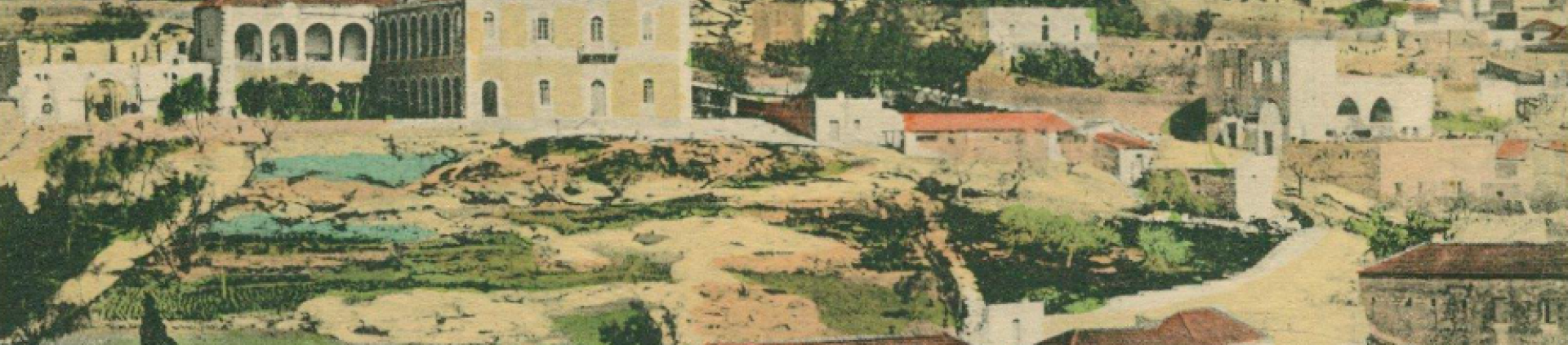
Cover image: Nazareth by Karimeh Abbud

