
Public Memory and the Politics of Fallism: Dan Hicks in conversation with Rahul Rao
In 2020, the Black Lives Matter movement incited a paradigm shift within the history of a specific form of aesthetic disruption: toppling public statues. Rahul Rao discusses his latest book on the subject, The Psychic Lives of Statues: Reckoning with the Rubble of Empire (Pluto Press, 2025), with Dan Hicks, curator, professor, and author of the book Every Monument Will Fall. Beginning from how statues are 'infused with libidinal desires', the pair explores incidences of recontextualising or removing monuments of colonial memory, Indocentrism as a lens on statue wars today, counter-monumentality, intergenerational disagreements on the left, and fallism – the student-led decolonial movement that first emerged in South Africa in 2015 – more widely.
This piece is commissioned in tandem with Wasafiri 127: Solidarities.
Supported by a grant from the Open Society Foundations.
Rahul Rao’s The Psychic Lives of Statues: Reckoning with the Rubble of Empire was published in spring 2025 with Pluto Press. In the book, Rahul explores the deeper structures of racism and the politics of ‘decolonisation’ that are interwoven with struggles over colonial statues and the broader questions of public memory. In doing so, Psychic Lives is a significant addition to the growing literature on the legacies of empire — in which what people used to call ‘postcolonialism’ is transformed into the study of the traces, fragments, and endurances of colonialism.
Rahul and I met up at a café in Berlin Mitte in October 2026, where I spoke to him at length about his important new book, the experience of writing and publishing it, his influences, and our hopes for the future. My own book Every Monument Will Fall: A Story of Remembering and Forgetting (Penguin, 2026) explores parallel questions, joining the dots between public memory, monumentality, and ancestral remains in museum collections.
Our conversation took us from Cape Town to Delhi, Oxford to Glasgow, from Minneapolis to Los Angeles, traversing the visual culture of memorialisation and the politics of forgetting in the context of enduring colonial legacies. We talked about libidinal politics, cultural Whiteness, Indocentrism, Fallism — and writing from the left in the publishing industry in the 2020s.
Dan Hicks: At the heart of The Psychic Lives of Statues is the idea of what you call ‘the psychic purchase that images, symbols and statues continue to have’, and how they can ‘index ongoing experiences of discrimination, dispossession and death’.
Could you begin by telling us more about your use of the word ‘psychic’?
Rahul Rao: One of the issues that I wanted to address in the book is a commonplace puzzlement about how apparently inanimate objects such as statues can arouse intense passions on the part of both those who want to topple them and those who want to preserve them. This led me to take seriously the idea that statues become infused with libidinal desires, which make them lively objects.
I take the everyday perception of statues as phallic objects as a point of departure, but suggest that this has to do with more than simply their shape or the fact that they disproportionately depict men in public space (which of course they do). Over time, I came to see statues as distinctive interventions in public space that draw our attention (when they do) because they embody a peculiar combination of aggression and vulnerability.
By ‘aggression’ I mean how, unlike other visual media, statues enter our sightlines without warning. In this respect, statues are quite unlike books, films, or art hanging in galleries or museums, all of which require a degree of viewer agency before they enter our consciousness. Statues, along with other forms of public art, and also commercial billboards and advertising, do not ask for permission to be seen.
I came to see statues as distinctive interventions in public space
And by ‘vulnerability’ I mean how the power of statues relies on their exposure to the public gaze, which also leaves them open to re-inscription, defacement, and destruction. In this way, statues can aggravate the sense of some part of culture or memory being under attack — particularly when activists are able to tell a persuasive story linking them to injustices in the present. At the same time, they can give us an opportunity to do something about them, providing a kind of stage or screen on which people can express those feelings.
While the psychic gives me an entry point into answering the question of what statues do in public life, I’ve also been interested in the relationship between the psychic and the material. In the book, I found myself reaching for W E B DuBois’s notion of the ‘public and psychological wage’ – an idea that he deploys in Black Reconstruction in America to explain how poor Whites in the Reconstruction era in the USA are affectively bound to Whiteness, and thus separated from the Black working class with whom they might otherwise have forged a class alliance against the White plantocracy. These ‘wages of Whiteness’, as they have come to be known – in other words, the psycho-social benefits of Whiteness – have been disbursed in an endless variety of forms.
The huge number of Confederate statues built in the American South at the end of the nineteenth century into the mid-twentieth century offer a striking example. Often erected at moments of labour unrest, they were built to avert the prospect of cross-racial class solidarity by giving the White working class a psychological boost without altering their class position. I argue that paying attention to the psychic purchase of images, symbols, and statues can help us to better understand how the material distribution of power in societies is entrenched or disrupted.
DH: The influence of Du Bois is clear in your book — especially his argument in the context of the American South about how Whiteness was ‘compensated’ by a ‘public and psychological wage’ that divided the working class. At the same time, you describe your argument as ‘an Indocentric view of a global conversation about race, caste and decolonisation in the aftermath of the British empire’. Can you say more about this ‘Indocentric’ view?
RR: In answering that question, let me begin not in India but in South Africa. My book has its origins in the Rhodes Must Fall movement that erupted in 2015, which successfully campaigned for the statue of the British imperialist Cecil Rhodes to be removed from the University of Cape Town’s campus. The protesters, who were largely students, staff, and university workers, saw the endurance of the statue and its colonial iconography in their university as a metaphor for the persistence of apartheid legacies more than two decades after the regime’s formal juridical end.
But I began writing the book in earnest in 2020 when, in the wake of the murder of George Floyd, Black Lives Matter activists and their allies in the United States and across the globe – including in the UK and the Caribbean – took aim at statues of figures associated with slavery and colonialism. Statues of figures like the Confederate general Robert E. Lee, the Conquistador Juan de Oñate, and the enslaver Edward Colston were removed as symbols of the institutional racism saturating public space and institutions in the Western world. In both these moments, the debates were rightly led by Black activists and writers whose long-running struggles against White supremacy seemed to have reached the sort of tipping point that allowed them to break through to White publics who had hitherto been oblivious or impervious to their demands. Yet it seemed to me that there was something missing in these conversations, which unfolded – quite literally – in Black and White.
I was drawn to Rhodes Must Fall in the first place because I had been a Rhodes Scholar selected from India to study at the University of Oxford in 2001. What were my responsibilities as a student and scholar from a former British colony who had benefitted from Rhodes’s bequest to the university, which was itself premised on enormous wealth extracted from other British colonies in southern Africa?
In 2016, a protest movement called Gandhi Must Fall broke out against the installation on the University of Ghana’s campus of a statue of Mahatma Gandhi. The protesters considered Gandhi to be racist, casteist, misogynist, and a symbol of Indian imperialism. I was intrigued by how, in the midst of a wave of antiracist iconoclasm, statues of one of the most iconic figures of mid-twentieth-century anticolonialism had now also come under attack.
In these quite different ways, Indianness seemed to re-emerge as a dangerously liminal category: neither Black nor White, and placed in colonial racial ontologies between Black and White. That liminality is exacerbated by how caste fractures Indianness in ways that have generated diametrically opposed forms of internationalist politics: Black-Dalit solidarities on the one hand, and Hindu dominant caste affiliations with White supremacy and Zionism on the other.
In these ways, Indianness seems to me to offer a fraught vantage point from which to say something different about the statue wars of our times — a place from which to think about the positionality of simultaneously being a victim, perpetrator, and beneficiary of the extraction of wealth under racial capitalism.
DH: Among the rich range of examples that you offer in the book, there is one notable contemporary Indian monument: the Statue of Unity, the world’s tallest statue, standing almost 600 feet tall in the Narmada Valley in the state of Gujarat. As you explain, it depicts the politician Sardar Patel (1875-1950), and was unveiled in 2018 — a project inaugurated by Prime Minister Narendra Modi. Tell us about how you read this remarkable statue.
RR: Observers of statue wars in the West and its settler colonial offshoots might be forgiven for viewing statues as a relic of the high noon of Victorian imperialism. In the book, I pay attention to the franticness of statue building in contemporary India as a way of suggesting that, far from being obsolete, statues remain a favoured method of claiming space and marking time for both elite and subaltern actors. The longest chapter in the book is an account of this immense monument — the Statue of Unity, or what I prefer to call the Statue of Impunity.
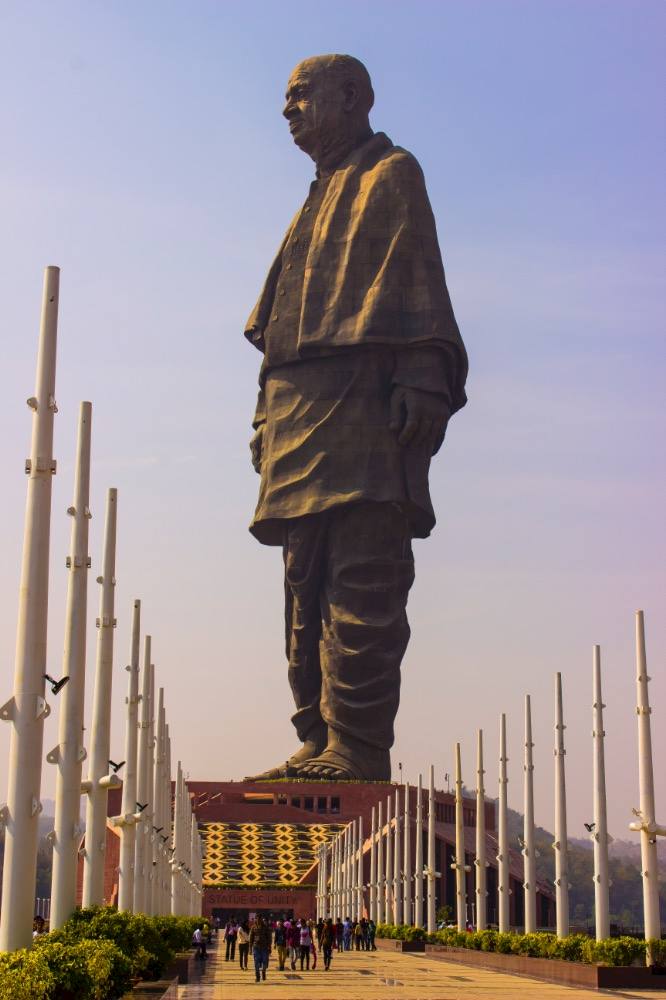
The statue memorialises Sardar Vallabhbhai Patel, the first Home Minister of India — a man who is lionised by the ruling Hindu Right today as an exemplar of the muscular nationalism that it espouses. This is mainly due to Patel’s historic role in cajoling and coercing hundreds of nominally independent kingdoms to join the new Indian state at the time of Independence from the British. But the statue is also about forgetting. It is erected at the site of the Sardar Sarovar Dam, one of the most controversial hydroelectric projects built anywhere in the world; it resulted in the displacement of more than a quarter of a million farmers and Indigenous Adivasi people. The spectacle of the statue engenders amnesia of these displacements. In paying homage to the might of the Indian developmentalist state, visitors are lulled into forgetting the immense sacrifices in land, labour, and environmental devastation that the dam exacts on a daily basis, even as its benefits are siphoned off to privileged caste and class groups.
The statue is also not just a statue: surrounded by vast theme parks, manicured gardens, hotels, and other tourist infrastructure, the location functions as a space for adventure, leisure, and nationalist pedagogy that somehow subliminally channels older drivers of religious pilgrimage to illuminate the production of contemporary fascism’s jouissance. That’s what I mean by the ‘Statue of Impunity’.
Statues remain a favoured method of claiming space and marking time for both elite and subaltern actors
DH: Many of the memorials you discuss are in the UK, especially in Scotland. You recount not only the sorry tale of how the statue of Cecil Rhodes still stands at Oriel College, Oxford, but also how plans announced for recontextualisation of the Macquarie Mausoleum at Gruline on the Isle of Mull were never followed through. General Lachlan Macquarie’s role – as governor of New South Wales from 1810 to 1821 – in the massacres of Aboriginal people in Australia is well known. You also talk about his role in slavery, and in the sacking of Seringapatam (Srirangapatna) in southern India in 1799, including the looting that happened in the wake of the defeat of Tipu Sultan, a history that I myself discuss in my forthcoming book World War Zero.
You argue that colonial memorials ‘will always be scars on the landscape whatever recontextualisation they may undergo’. Can you tell us more about the Scottish context in which the counterinsurgent rallying cry of ‘retain and explain’ has led to inaction, or even to the redisplay of memorials to colonial violence and dispossession?
RR: The most obvious current example is Glasgow’s George Square, which partly reopened to the public in September 2026 after a £20 million refurbishment. As well as repaving and tree planting, the square’s eleven bronze statues and the Sir Walter Scott Memorial have undergone restoration — including General Sir John Moore (famous for his roles in the violent repression of rebellion of enslaved people in St Lucia in 1796-97 and in putting down the Irish Rebellion of 1798), and Colin Campbell, Lord Clyde (involved in putting down the 1823 Demerara Rebellion, as well as the Indian Rebellion in 1857-58). There was a public consultation about whether these statues should be removed or replaced. But following campaigning by Robert Poll’s ‘Save Our Statues’ group, the statues have returned — now provided with QR codes for historical context. The result is a fudge. And if such contextualisation is the approach of a Scottish National Party-led city council, then what hope is there for other cities in the UK? It seems as if the policy of ‘retain and explain’ – championed by the right-wing politician Robert Jenrick, when he was Conservative Secretary of State for Housing, Communities and Local Government – has become the commonsense of our time.
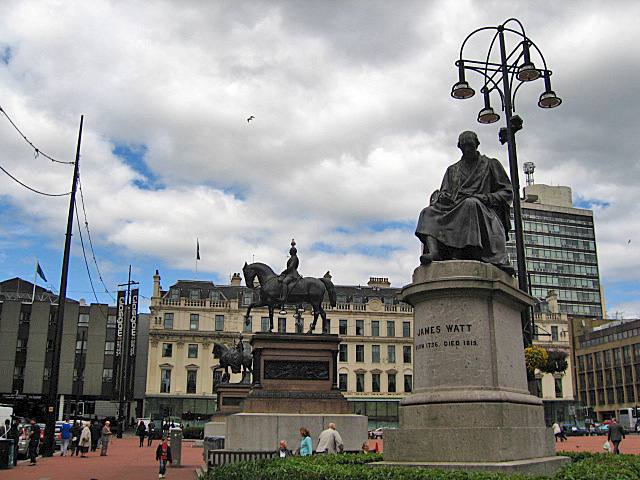
Historical context is certainly valuable, but it often does little to disrupt the aesthetic power of statues and the affective effects of monuments. Consider the number and scale of Confederate statues in the USA: it’s hard to imagine that a bit of contextualisation would help change things. In other words, re-contextualisation is not always adequate to the task of historic redress. It is rarely adequate when the aesthetics of the men resplendent on horseback, there to command and to be obeyed, are at such a different scale from the tiny plaque of text that nobody reads or a QR code no one notices. Crucially, reading the label or visiting an informational website is optional — the onlooker has to do the work, the onus is placed on the viewer. The challenge is how to reverse the burden of the necessary process of re-education.
So, sometimes aesthetic disruptions – like toppling – are a better answer. At the high point of ‘direct action’ statue removals in 2020 – Colston in Bristol was one example, but there were several in the USA as well – I was struck and moved by the scenes of crowds exulting in the bringing down of racist statues with their own hands and in what people did to the statues. Colston was drowned in the harbour as a reminder of the fate of the thousands of African people whom he enslaved; a statue of a Confederate soldier was strung up by the neck from a lamppost in Raleigh, North Carolina, to evoke the spectre of lynching; a protester knelt on the neck of a toppled Columbus statue in St Paul, Minnesota, in remembrance of how George Floyd had been killed in neighbouring Minneapolis. In all these different ways, protesters were honouring the sacrifices of their ancestors, non-violently enacting a desire for redress – and yes, perhaps even revenge – while forging a new sense of community on the ruins of the statue.
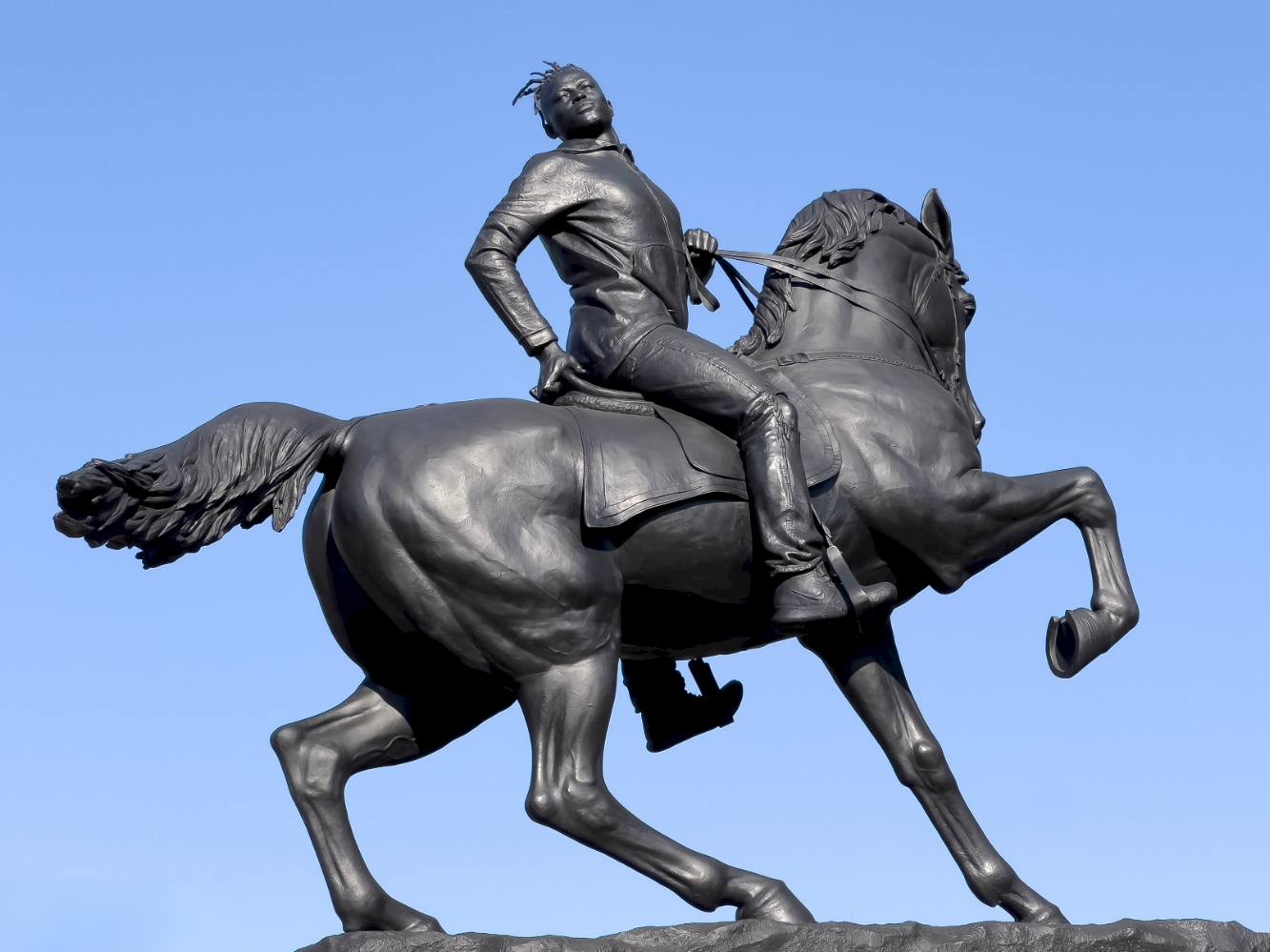
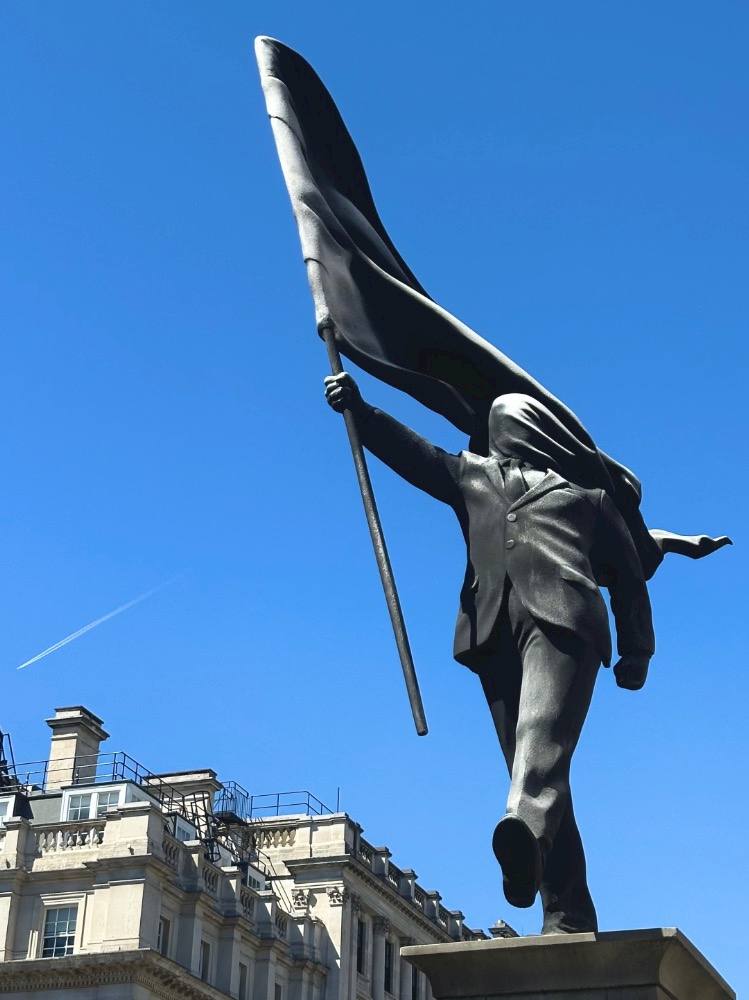
Counter-monumentality can offer another mode of aesthetic disruption. The Monuments exhibition at MOCA in Los Angeles in 2025-26 was one example of the potential for the aesthetics of statues to be reimagined. Kehinde Wiley’s ‘Rumors of War’ (2019) – a monumental bronze equestrian statue built in the style and on the scale of Confederate statues, but featuring a Black man with dreadlocks, dressed in jeans and sneakers – is another. Installed outside the Virginia Museum of Fine Arts, in close proximity to Monument Avenue, which was once crammed with Confederate statues, the work was intended as a direct response to those monstrosities. Interestingly, Banksy’s guerrilla statue of a man with a flag covering his face, ‘Blinded by the Flag’ – intended to draw attention to the blind patriotism engendered by the militaristic statues and war memorials around it in Waterloo Place – was immediately welcomed by Westminster City Council when it appeared in spring 2026. It seems to me like an example of how dissent will sometimes be co-opted by liberalism. Dissent can be exhibited as evidence of liberalism’s tolerance, thus limiting how subversive it is. I am grateful for the statue’s presence, but does it have any disruptive potential?
DH: Nonetheless, it is surely possible to transform and evolve memory culture in effective and positive ways? In Every Monument Will Fall, I point to the empty plinth left after the removal of the image of Edward Colston in Bristol — far better than what I see as the wholly unnecessary way in which the fallen statue takes up space at M-Shed, yet another monument to the enslaver, just this time indoors and laid on its side. And also to the installation, due in 2027, of Khaleb Brooks’s sculpture ‘The Wake’, with poems by Yrsa Daley-Ward, at West India Quay, outside the London Museum Docklands, where the statue of the enslaver Robert Milligan was removed two days after Colston fell in 2020. That seems to me an excellent example of how the memory culture can be flipped — in this case from the perpetrator to the survivors and the descendant community.
With these issues in mind, I want to probe what you say in the book about your disillusionment with older modes of decolonial struggle. Can you tell us more about your motivations for writing Psychic Lives, and how these seem to you now two years on from when you finished it?
RR: As I said, my original motivations were rooted in the Rhodes Must Fall movement. As a former Rhodes scholar, I was aware of the history of the scholarship, squeamish about receiving the money, and very ambivalent about the Rhodes Trust. I was hardly unique in this — those feelings were, and doubtless still are, shared by all those on the left who benefit from the Trust. The appearance of this movement on a global scale was transformative. It made it possible to articulate many of these misgivings in new ways. In 2020 it was clear that debates over monuments were important for both expressing and confronting racial tensions.
In part, the book is a celebration of disagreement within the left: an internal conversation of dissent which is crucial for progressive politics. In different ways, the Rhodes Must Fall and Gandhi Must Fall movements expressed the disenchantment of a younger generation with icons like Mandela and Gandhi, and also argued amongst themselves about how best to take the struggle forwards. These are painful, intergenerational conversations — about the inadequacies of older decolonisation and anti-apartheid movements and their failure to dismantle the legacies of colonialism and White supremacism. In the case of Gandhi, contemporary movements launch frontal attacks on his casteism, racism, and sexism. These movements show how younger generations of activists are against not only White supremacism and its remnants but also older modes of struggling against them.
Now, two years on from finishing the book and six years on from 2020, it feels like we’re living in a bookend of the 2020 moment, and that arguments with the far-right have become sharper and more pressing. Trump is back in power, and his administration has even seen the re-erection by the National Parks Service of statues removed in 2020, including a statue of the Confederate general Albert Pike in Washington DC and another of the enslaver Caesar Rodney in Wilmington, Delaware. At the same time, we are living through an unprecedented attack on Diversity Equality and Inclusion (DEI) initiatives in all their forms and reeling in the aftermath of Professor Jason Arday’s death — yet another example of a Black man killed by institutional racism. The re-erection of statues and the new attacks on DEI feel like a terrible echo of 2020.
DH: I have to say I am more hopeful. In writing Every Monument Will Fall, I learned about the long history of the fallism movement – how Rhodes fell in Zambia in 1964, in Zimbabwe in 1980, as well as in Cape Town in 2015 – just as the statue in Oxford will one day too. When I lived in Bristol in the late 1990s and early 2000s, it was my generation who failed to remove Colston the first time around, going through the formal process with English Heritage as it then was. Then a new generation came along and just took the thing down. So 2020 was more than just a moment; we just have to remember the history it was part of, and how that history is unfinished. Like restitution – and like the work of decolonisation, abolitionism and the civil rights movement more generally – it seems to me that fallism is an intergenerational movement. And as I say in the introduction to the preface to the paperback edition, 2027 marks the 100-year anniversary of the Neil Statue Satyagraha, where the removal of a statue of Colonel James Neill – ‘the butcher of Allahabad’ as he was known, a man responsible for massacres during the Indian Rebellion – was demanded, and eventually enacted ten years later in 1937. These movements have long histories, and part of the political work is to build connections from one generation to the next.
So, forgive me if I press you on where you are finding hope and inspiration in politics today.
RR: There are oases of hope, of course — in the election of Zohran Mamdani as the new mayor of New York in November 2025, and the resoundingly high votes for Die Linke in Berlin in September 2026. More recently, the victories of the student movement in Serbia, of Lula in Brazil, and of the Democrats in the US mid-term elections, as well as the growing political importance of Palestinian citizens of Israel in the politics of that country give cause for hope — even if electoral politics will never fully deliver the liberation we seek. What truly buoys my spirits at the moment is what is happening in India right now — dissent at a national scale, in the largest country on the planet. Never mind that massive statue, we are witnessing new, strenuous challenges to Narendra Modi’s power, much of it in protest against the dramatic restriction of the franchise: 130 million or so voters, more than the population of Japan, have been removed from the electoral rolls at the behest of the ruling party. The movement against this has united students with opposition politicians and other social movements, offering a real glimmer of hope in what is otherwise a desperate and grim global moment.
The re-erection of statues and the new attacks on DEI feel like a terrible echo of 2020.
This most recent eruption of protest began in May 2026 when an online meme calling itself the Cockroach Janata Party (Cockroach People’s Party) – after a derisory reference to young people as ‘cockroaches’ by no less than the Chief Justice of India — became a mass movement, channelling the rage and frustration of youth at unemployment and a dysfunctional higher education system. What is very striking is that the movement mobilised many of Modi’s own supporters — and more pertinently, their children. It seems as if the ‘wages of Hindutva’ – disbursed through the statues, symbols, and other ‘culture war’ issues on the back of which the Hindu Right catapulted itself to power – are declining. People are no longer satisfied with the psychic compensations of Hindu supremacy and are demanding fulfilment of the material promises of development that Modi once made. One expression of their anger has been a tearing down of images of Modi that festoon official and public space in contemporary India (all dictators love this). One viral video that has been doing the rounds lately depicts a young girl beating images of the faces of the Prime Minister and Home Minister on a large banner with her shoes — truly a sight for sore eyes. So yes, the statues – in a manner of speaking – are coming down again!
DH: Finally, I want to ask you about the experience of publishing Psychic Lives. We’ve both published with Pluto Press – my book The Brutish Museums came out with them back in 2020. What can you share with our readers about the experience of publishing with the team at Pluto – to my mind the most consistently interesting and high-quality leftist publisher of our times – and what this means for the public-facing and political dimensions of academic scholarship today?
RR: I gave the manuscript to another publisher first, one of the big university presses for their trade imprint. I was told that I had written the book in a register that was neither scholarly nor trade, and that this was a problem. It became clear to me that mainstream publishing had very fixed ideas about genre, which I didn’t want to conform to. I’ve been very inspired by the work of writers like Arundhati Roy, Saidiya Hartman, Claudia Rankine, Hazel Carby, and others whose writing seems to defy genre and, in doing so, breaks new ground. My book tries to combine scholarly reflection, memoir, attention to place and locality, and the intricacies of dissent — it treats readers as intelligent and as capable of holding these different threads together and making sense of them. Unlike the university press, Pluto was not just fine with all this, it was the ideal publisher through which to communicate political ideas and arguments in all their complexity to a broader audience.
DH: That’s great to hear, and very much chimes with my experience of Pluto Press. We’ve never needed independent publishers – and independent bookshops – more than in these times. Congratulations again on Psychic Lives, Rahul!
The Psychic Lives of Statues is available in paperback direct from Pluto Press or at your local bookstore. Every Monument Will Fall is also out in paperback, and as an audio book.


What shapes do solidarities take in these strange times we are living in? How can we find and forge solidarities when faced with genocides, human rights violations, and inexplicable injustices daily? Can storytelling play a role in liberation?
