A Time Like This: Photographing Solidarity Movements for Palestine in the UK
London-based photographer Zeashan Ashraf has been documenting the solidarity movement for Palestine since October 2023, photographing thousands of people across the UK who have come together, again and again, to reclaim public spaces and imperial sites in order to call for an end to the occupation and genocide in Palestine and the British government's involvement in it. In this photo essay, Ashraf shares images he has taken of various protest sites, encampments, and acts of solidarity across the country, while reflecting on his experiences of witnessing and recording these vital historical moments that are still underreported and maligned in mainstream media.
This piece is commissioned in tandem with Wasafiri 127: Solidarities.
Supported by a grant from the Open Society Foundations.
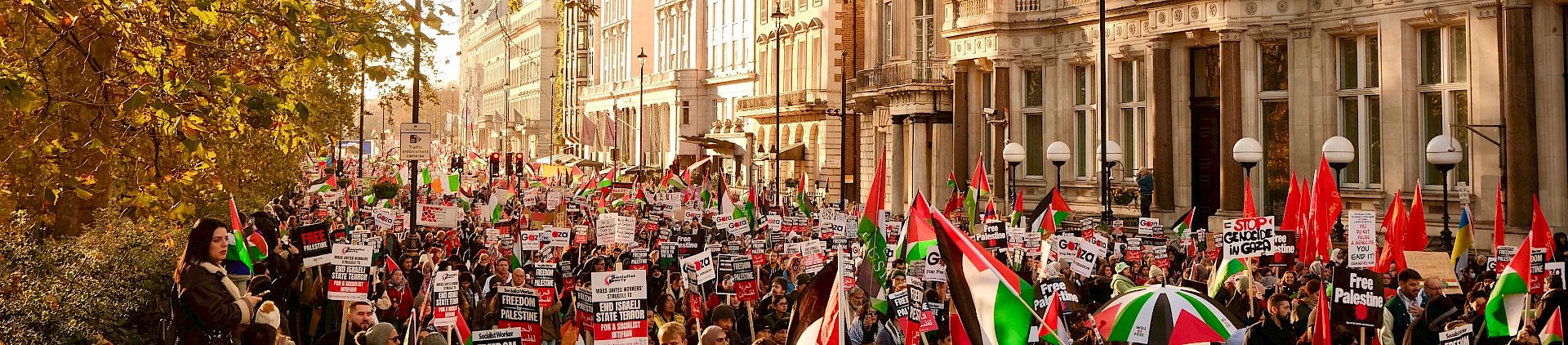
For the past three years, I have been documenting the solidarity movement for Palestine in London and neighbouring cities in the UK as an independent photographer. The following photo essay provides a glimpse into what the mass demonstrations have looked like in London and Oxford against successive UK governments’ complicity and inaction over the Gaza genocide, from October 2023 and up to its current phase. This involved photographing hundreds of ordinary people who reclaimed city streets as sites of solidarity, grief, and resistance against unconscionable tragedy and injustice.
Since October 2023, public space in cities around the world, most visibly main roads and streets, have become a site of assembly for people expressing outrage at Western complicity in the genocide and at the inaction of the powerful – governments, politicians, corporations, policymakers – in preventing it. Nowhere has this been more visible than in the repeated national demonstrations in central London, held regularly since the assault on Gaza began three years ago. People from across the country have continued to gather and march towards the heart of political power in Whitehall and Downing Street, pressuring the British government to end its support for war crimes and call for an end to the occupation of Palestine.
The following images are part of an endeavour to record and preserve what mainstream UK news coverage has too often distorted or obscured about these solidarity marches. This media coverage has routinely minimised the numbers of those in attendance – or omitted it altogether – while describing peaceful demonstrations as 'hate marches'. The fact is that hundreds and thousands of people, travelling from across England and beyond, have effectively transformed London’s sites of imperial memory into living spaces of resistance, mourning, and dissent.
This ongoing documentation project is a humble contribution to the worldwide expressions of solidarity with Palestine, which will only cease when the occupation of Palestine does.
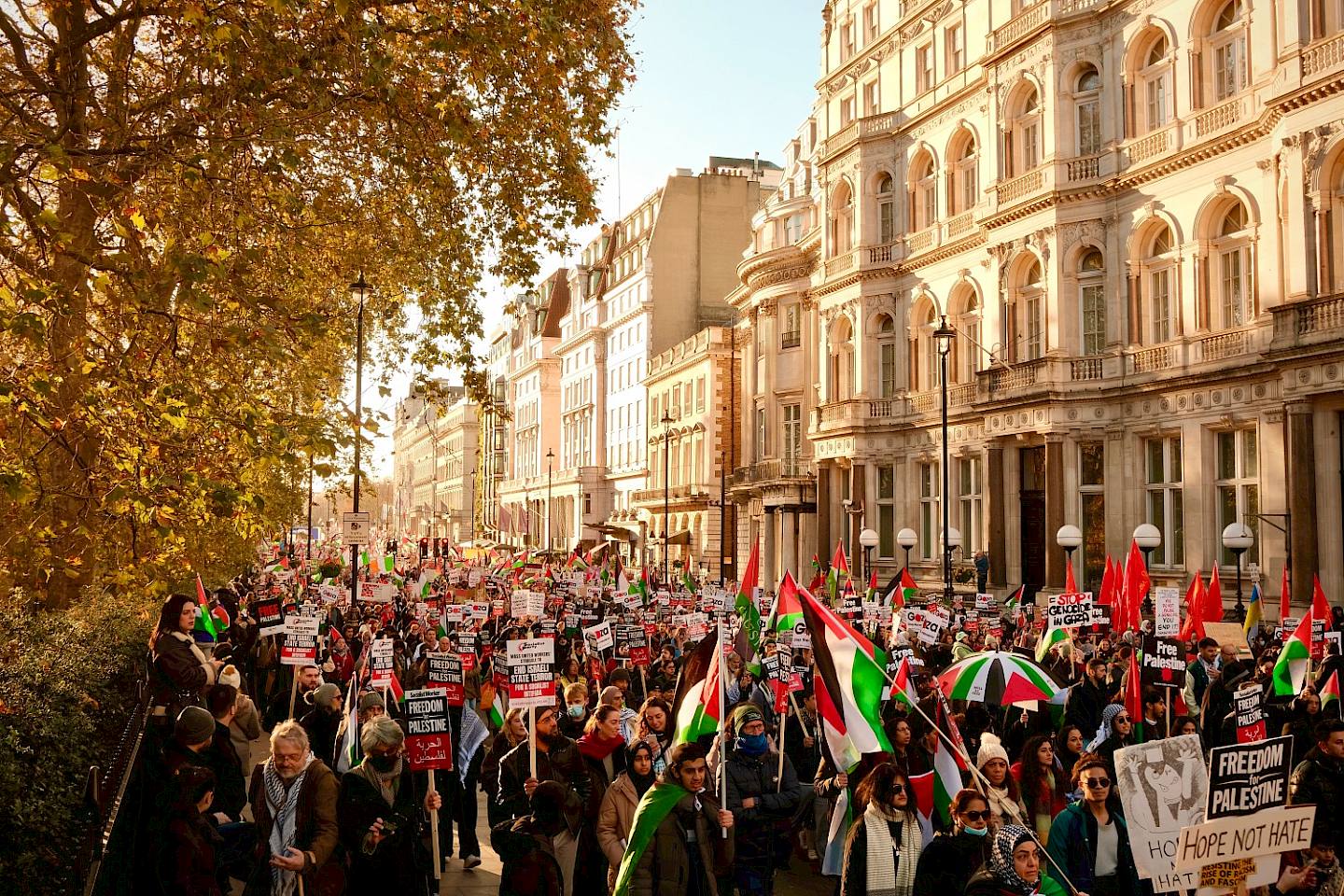
National march for Palestine in London in November 2023.
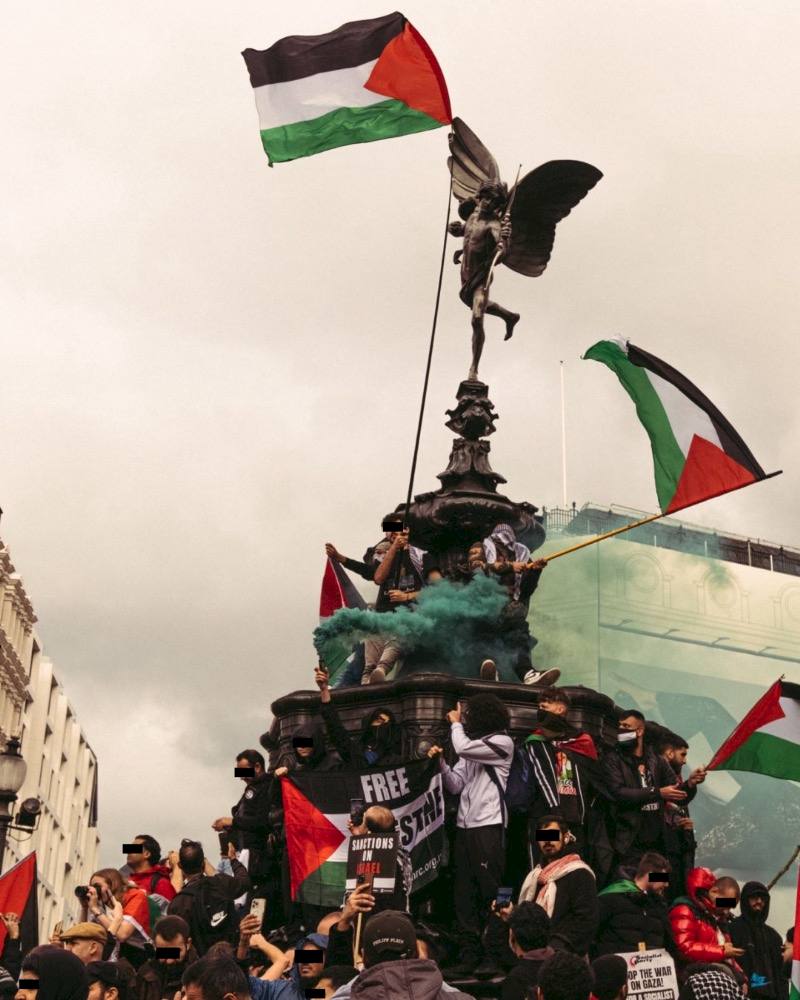
Since the start of Israel’s genocide of Palestinians in October 2023, cities across the world have witnessed sustained public demonstrations against global complicity in these atrocities. One of the clearest expressions of this has been the repeated national demonstrations in central London. Hundreds of thousands of protesters travel from across the country to march on the seat of political power, denouncing British complicity in war crimes and demanding an end to the occupation of Palestine.
This photograph was taken in October 2023, two weeks after the outbreak of the ongoing genocide. At the time, at least 4,385 Palestinians were killed, including 1,756 children, and 13,561 people had been injured. In this image, demonstrators have climbed the Shaftesbury Memorial Fountain at Piccadilly Circus. Raising Palestinian flags above the crowd, they temporarily recast the monument as a site of resistance and dissent. In subsequent demonstrations, police tightened control over access to major monuments, further restricting the spatial possibilities for protest in the UK.
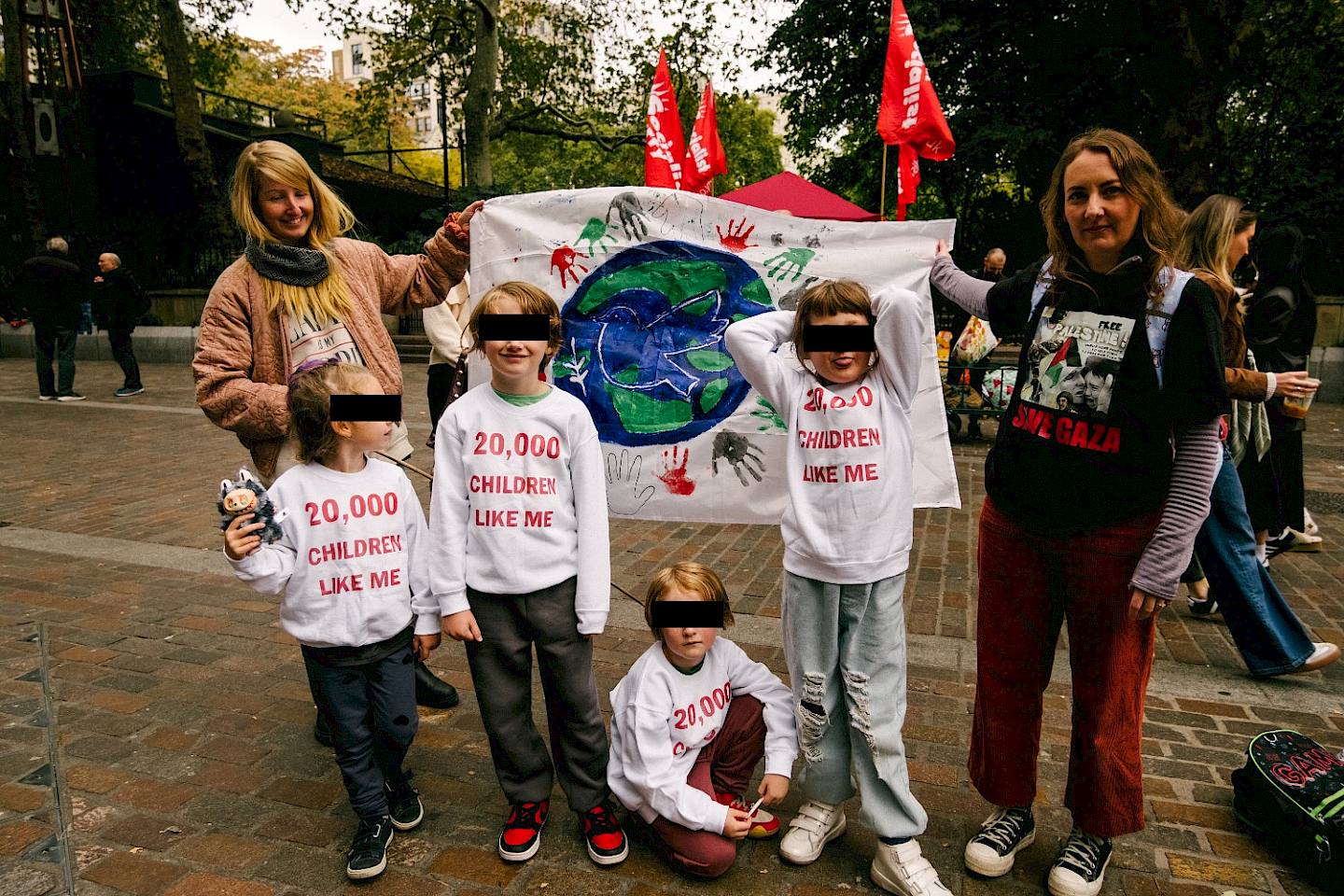
I met this group of children on their way to the national march in London in October 2025. Around that time, Save the Children had reported that the number of children killed in Gaza had surpassed 20,000. After I took this photograph, the children‘s father explained why they had chosen to attend the marches as a family: ’We can’t not involve them, as this injustice will be remembered throughout their lifetime as the worst atrocity of the generation.’
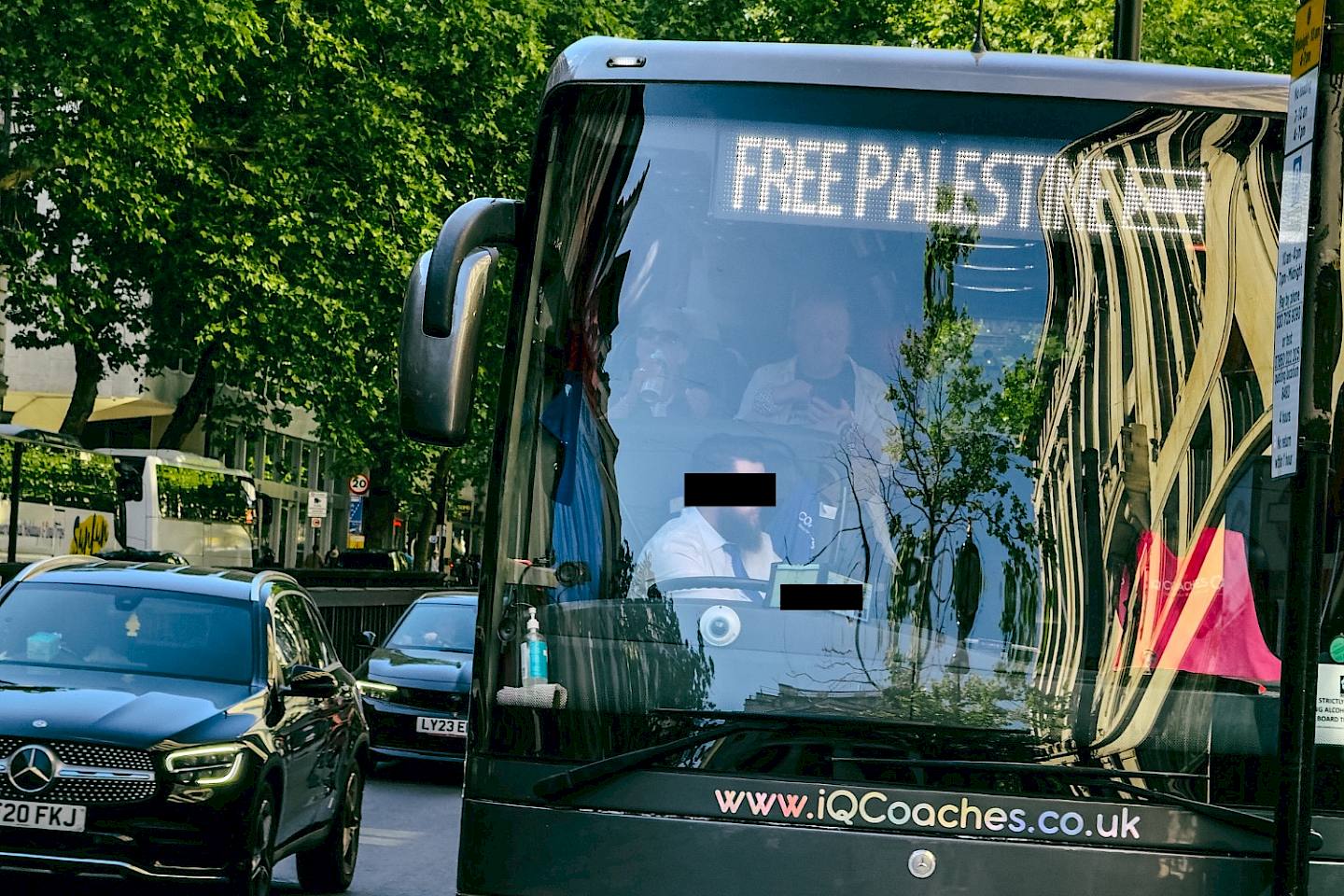
A coach parked in central London during a National March for Palestine, its electronic sign displaying ‘Free Palestine’. Coaches organised by trade unions and local campaign groups have brought demonstrators to the capital from cities across Britain, with many offering subsidised travel. I remember meeting a large group who had travelled from Leeds, starting their day at 5am to reach London for the march’s midday start.
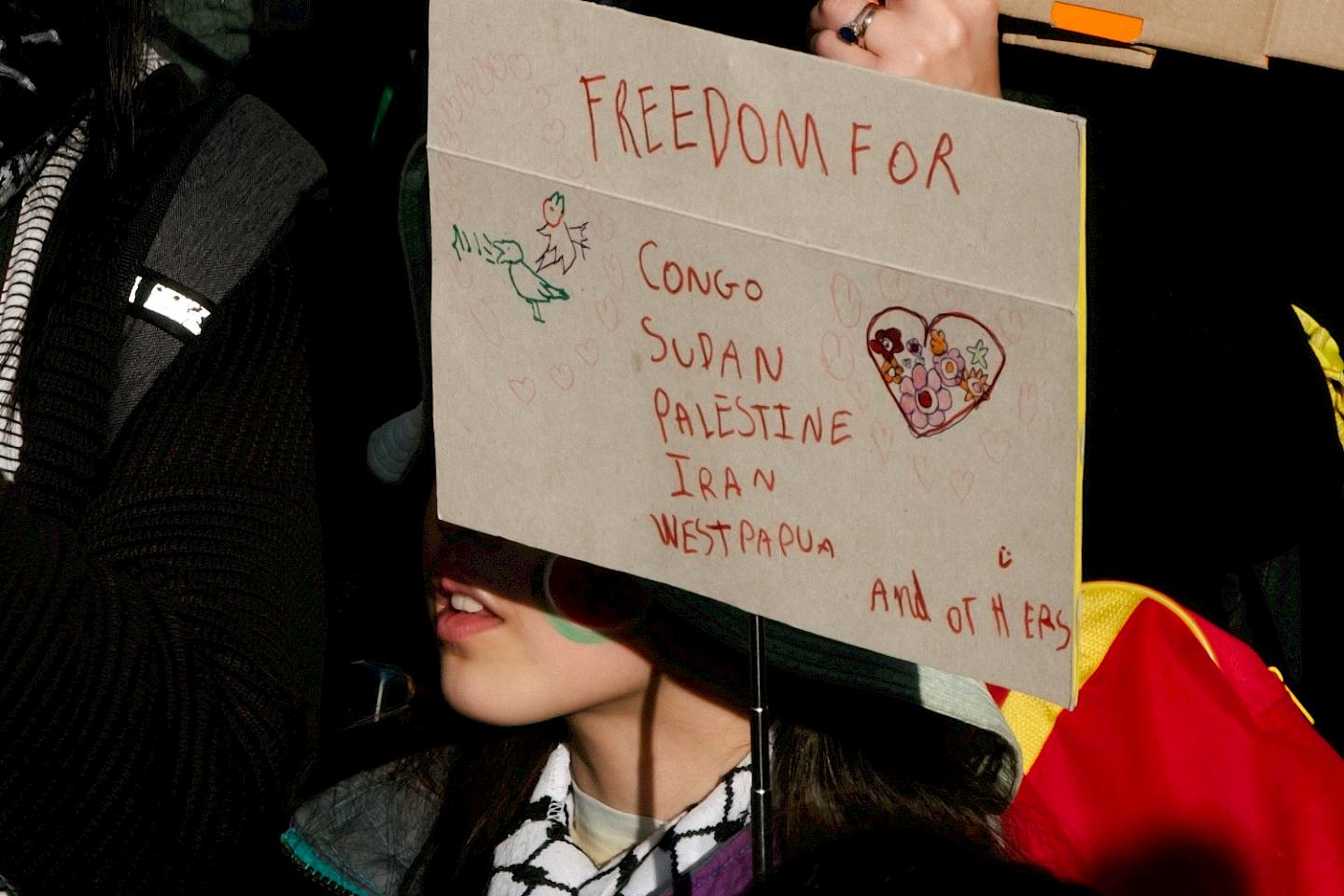
A young girl who travelled with her mother by coach from Oxford to join the Parents for Palestine bloc at the National March for Palestine in central London on 31 January 2026.
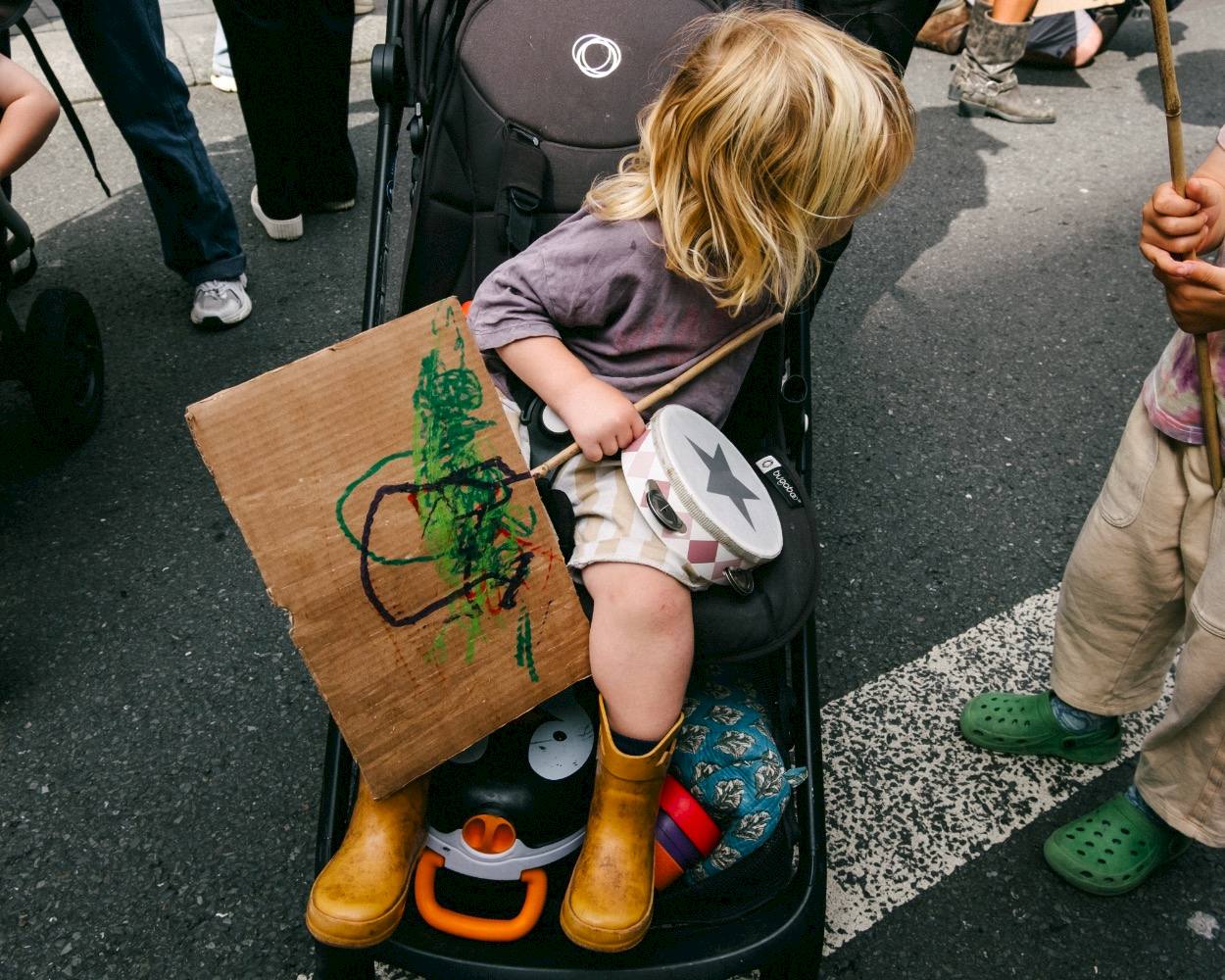
Never too young to fight for someone else’s rights.
On 31 January this year, while photographing the Parents for Palestine bloc at the national march, I found myself thinking of my ten-year-old niece, about to begin a new school year. Her mother was already having to answer questions from her, such as, ‘Why does Allah let bad things happen to other people?’ I don’t know how one might answer a question like that; they are questions I grapple with myself. I am gathering this documentation in the hope that, one day, it will find its way to my niece, and to other children like her, and it will help them make sense of what it felt like to live through a time like this.
While I hope this might one day offer her some sense of a record, I am still left feeling burdened by a sense of this work’s inadequacy. When half a million people march through central London and, the following day, receive little meaningful media coverage – or worse, are met with demonisation and accusation – I believe that the only meaningful thing I can do is keep recording their presence and persistence. In doing so, I return to what Omar El Akkad, in his recent book One Day, Everyone Will Have Always Been Against This (2025), describes as a ‘most pathetic, necessary function’: witnessing.
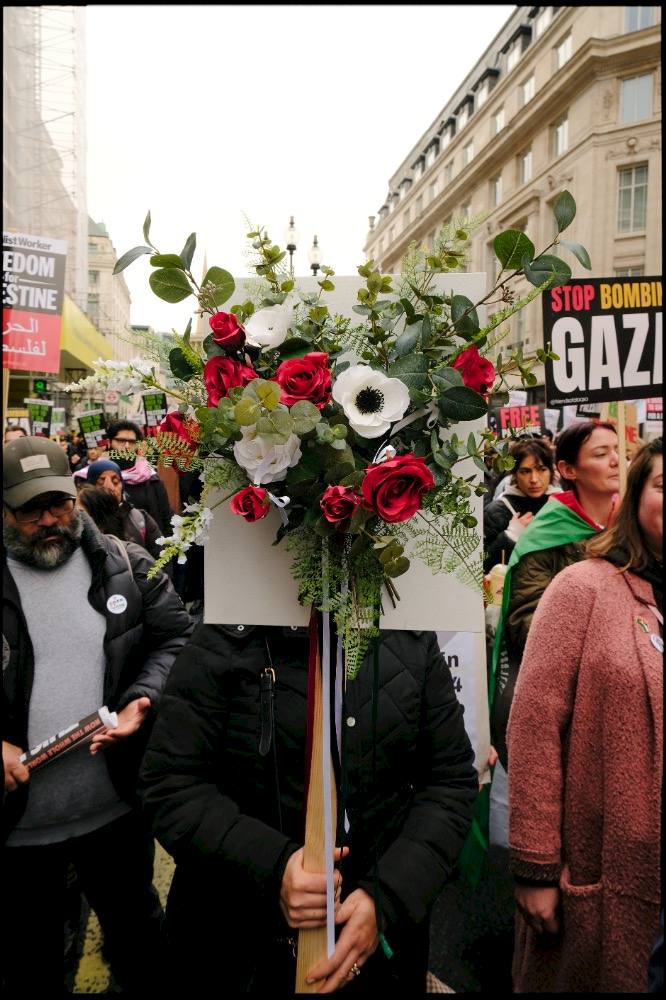
Flowers held during a National March for Palestine in London.
On 7 November 2023, twenty children gathered in front of a makeshift podium outside Al-Shifa Hospital in Gaza and held a press conference for the world. A boy who looked about ten years old spoke as their representative. In an urgent voice, he declared first in Arabic and then in the world’s current lingua franca of English: ‘We have been subjected to genocide, killing, displacement, and bombs falling on our head in front of the whole world … We come to shout as children, and invite you to protect us. We want to live. We want peace. We want a trial for the killers of children. We want medicine. We want food. We want education. We want life’. At the time, the death toll in Gaza had crossed 10,000, and 4,104 children in Gaza had already been killed. By 3 February 2026, the number of children killed since 7 October 2023 reached 21,289, according to a June 2026 UN-commissioned report, confirming Israel’s deliberate targeting and killing of Palestinian children.
At the time of writing this, the death toll stands at 73,651, with 174,592 wounded since 7 October 2023.
It is impossible to wake up every morning with new reports of unimaginable carnage and not wonder what kind of future we are asking the children in our lives to accept. This is a world that – as Madeleine Lane-McKinley describes in her book, Solidarity With Children – ‘day by day, renders their future more apocalyptic, and in which they are taught, day by day, that this is just inevitable’ (13).
My photographs of the UK protests are of those who refuse that inevitability. Among them, thousands of young people and their communities are taking part in a shared struggle for a better world, for children they may never meet, to insist that another future is possible for all of us.
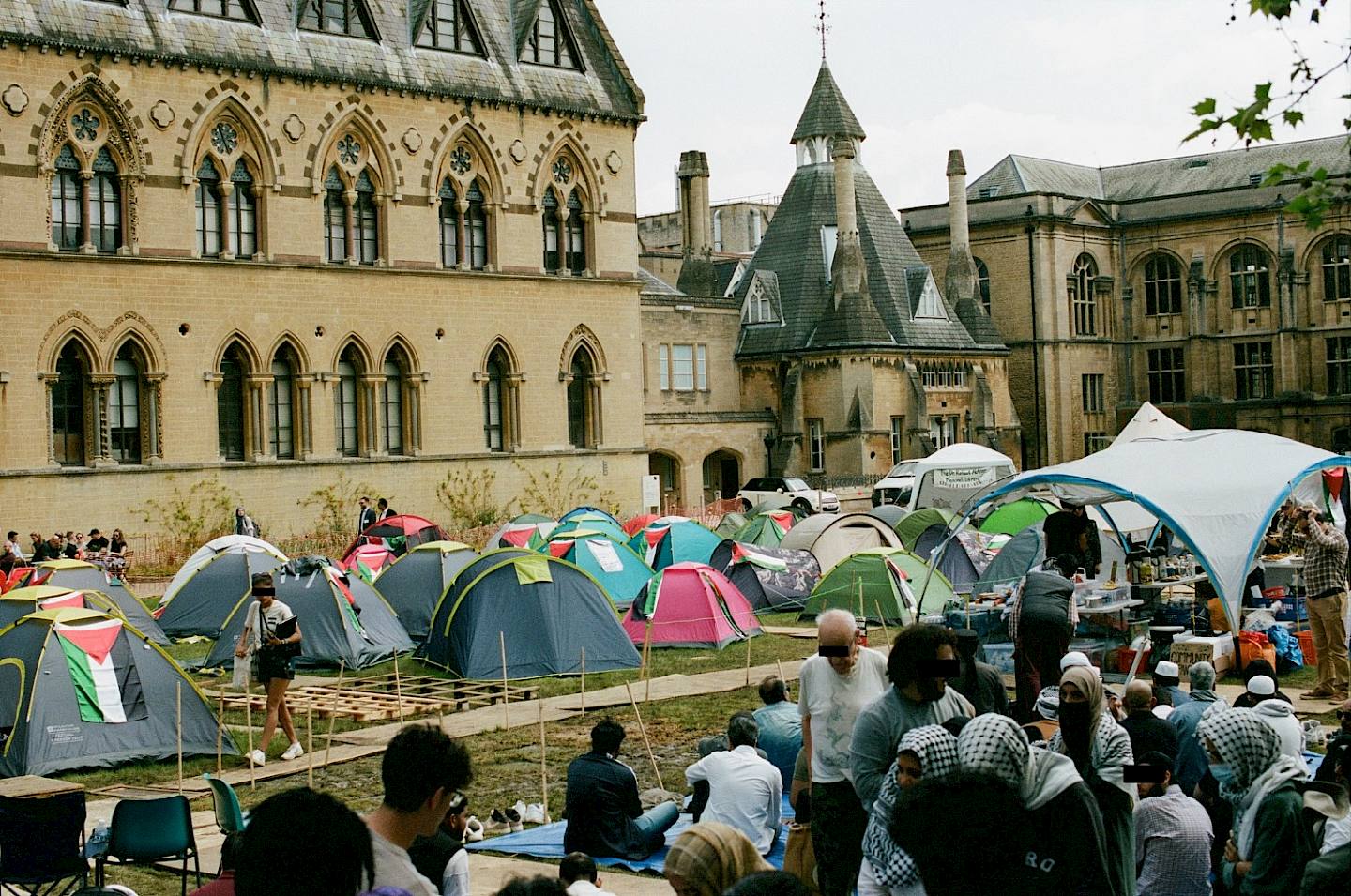
Friday prayer at the first Oxford Liberated Zone, established on the lawn of the Pitt Rivers Museum, which is known for housing a collection of artefacts stolen from colonised peoplesacross the world. Photographed in May 2024.
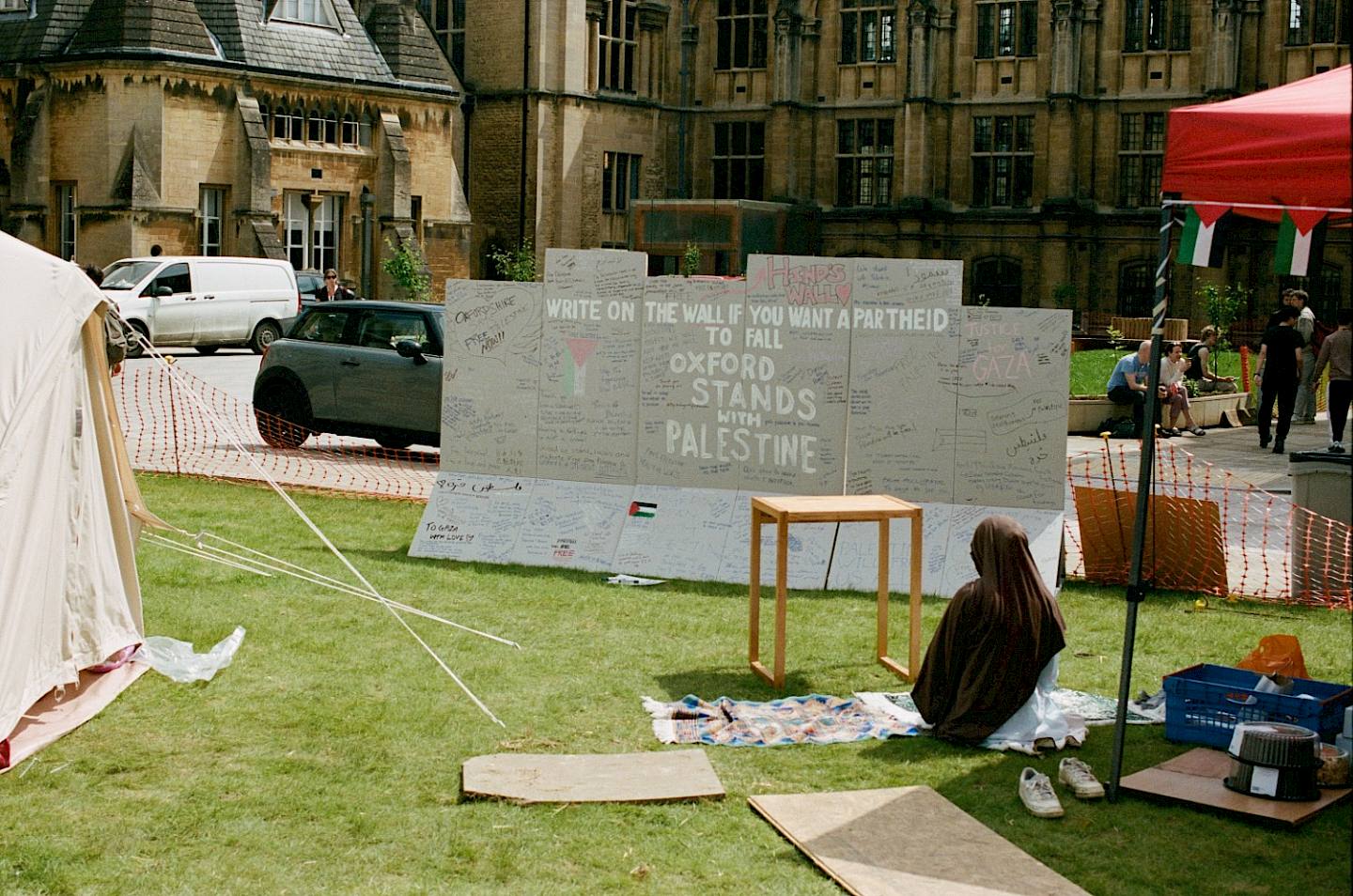
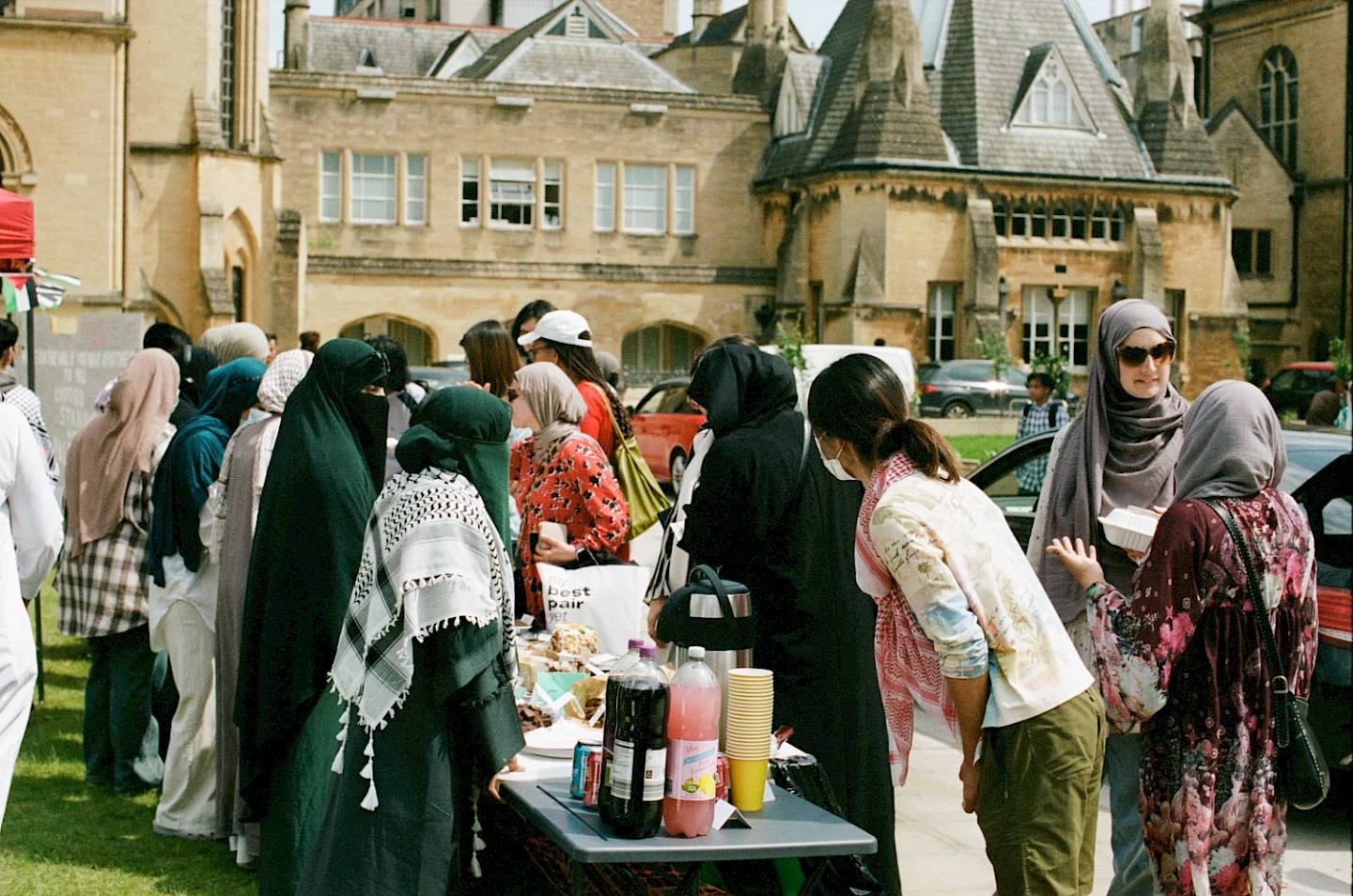
More scenes from the Oxford encampments.
I felt something close to hope – for the first time in a long time – on the lawn of the Pitt Rivers Museum in Oxford. On one side of the lawn were about two dozen tents. In front of them, a larger canopy had been erected where food, juices, and chai were laid out, prepared by people from Cowley Road and neighbouring areas. Between these, people gathered on prayer mats, listening to the khutbah before rising together for the Jummah prayer. Oxford University’s two student encampment sites were maintained throughout May and June 2024 by Oxford Action For Palestine; they were unlike anything I had seen before. The second encampment was established at the Radcliffe Camera after the university failed to meet protestors’ demands.
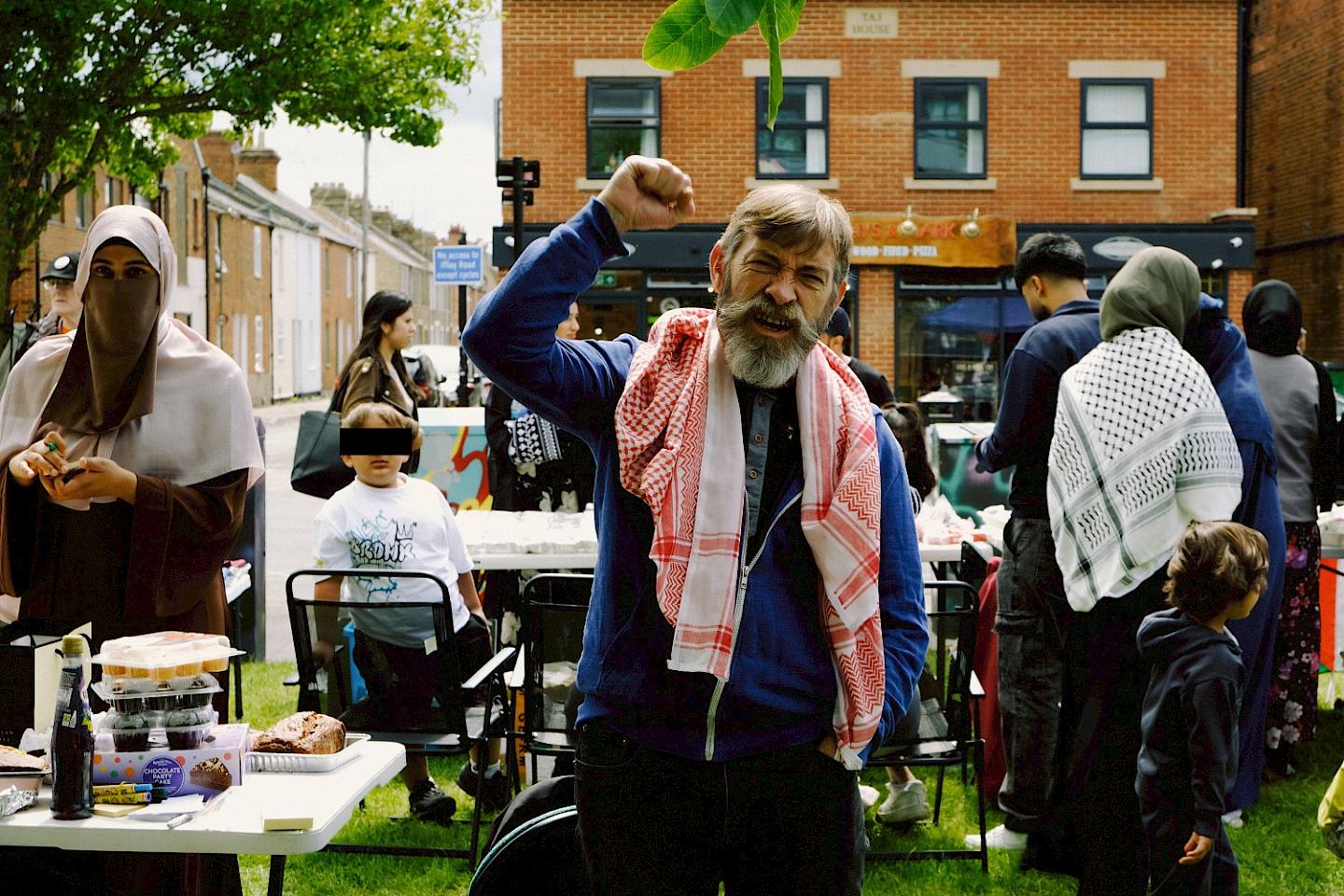
Ciarán Walsh, local historian and community campaigner at a solidarity teach-in in Oxford. Walsh, who was 57, passed away in May 2025.
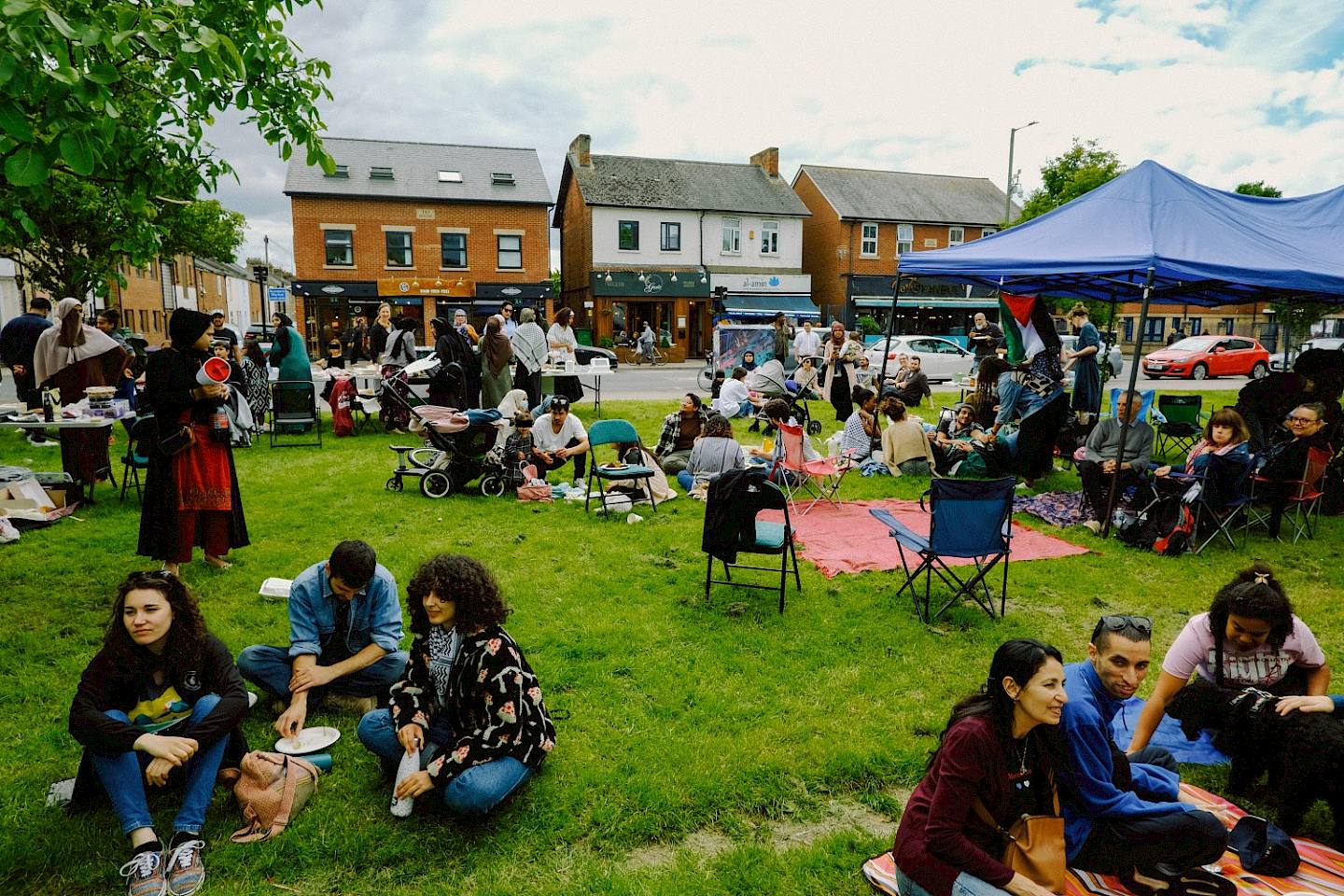
Solidarity Day at Manzil Way on Cowley Road, organised by Help the World Oxford and Oxford Students for Palestine. Photographed in June 2024.
At one solidarity event in Cowley Road, Oxford in June 2024, organised by Help The World Oxford and Oxford Students for Palestine, I heard Ciarán Walsh – a local historian who organised radical walking tours of Oxford – speak about Oxford University’s colonial foundations and the role it played in creating and maintaining the British Empire, and called on people to resist its continual expansion across the city. I had seen him lead marches before, but it was the first time I was hearing him speak. I remember feeling galvanised by the way he made these brutal, heavy histories feel present and immediate in the city around us. I am thankful for his insistence on making this past become a visceral force, connecting struggles from across borders to the ground beneath our feet and reminding us that the past is never as distant as it seems. We still have a part to play in what comes next.
Ciarán Walsh passed away the following year in May 2025, aged fifty-seven.
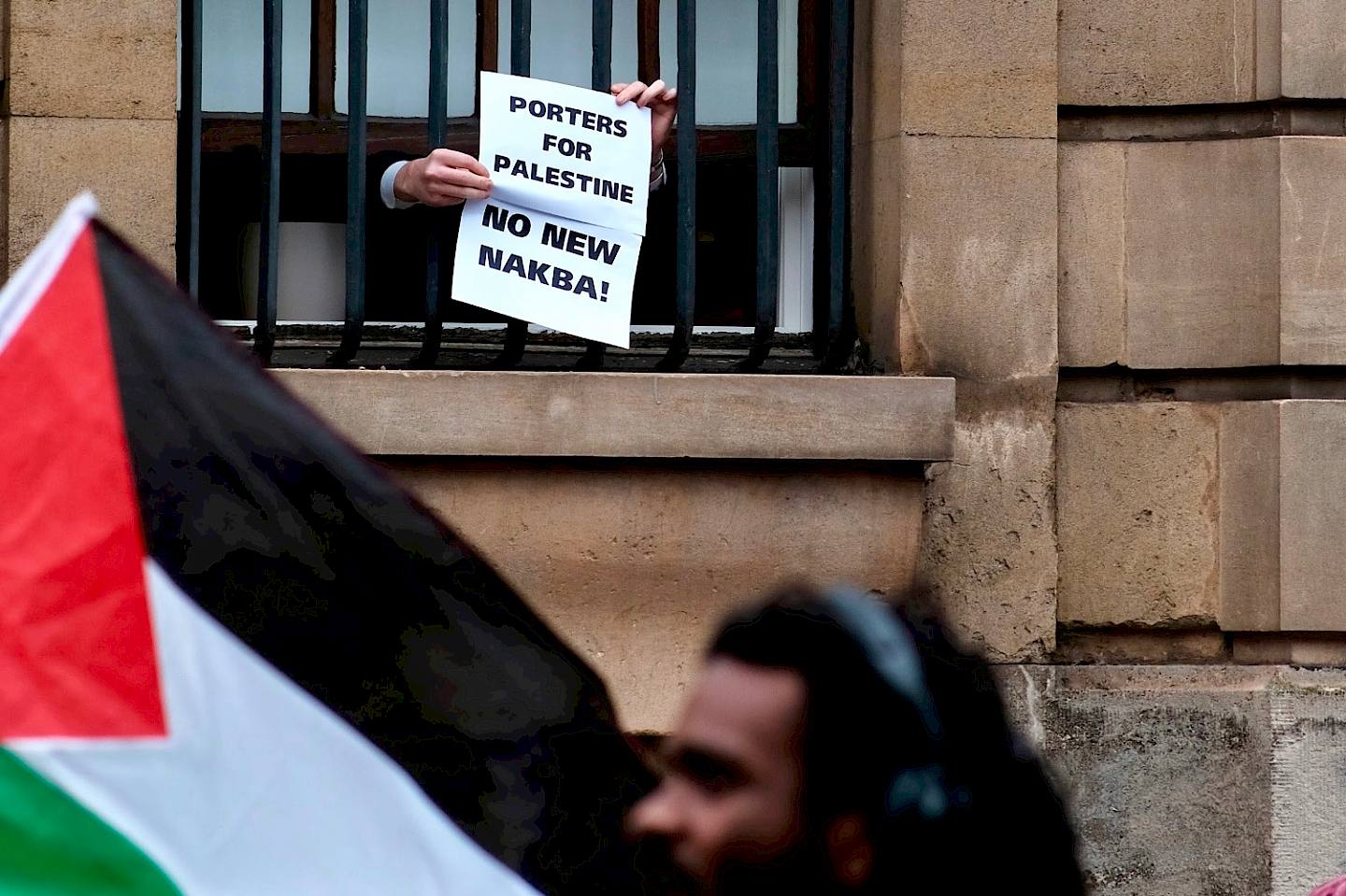
A college porter in Oxford holds a message, ‘Porters For Palestine - No New Nakba!’, through their office window during a march for Palestine in Oxford city centre.
At one Oxford march, I saw a sign emerge from a college window overlooking the high street. The blind was partially drawn, so only the person’s hands and poster were visible, which declared: ‘Porters For Palestine, No New Nakba!’ Their statement is carried as much by the words on the paper being held up as by the gesture itself. For so many, the fear and risk of speaking out against genocide in workplace settings remains ever-present. It will be for future historians to ask how many voices were silenced this way — not through overt repression, but through the quieter, devastating structural class conditions of everyday life.
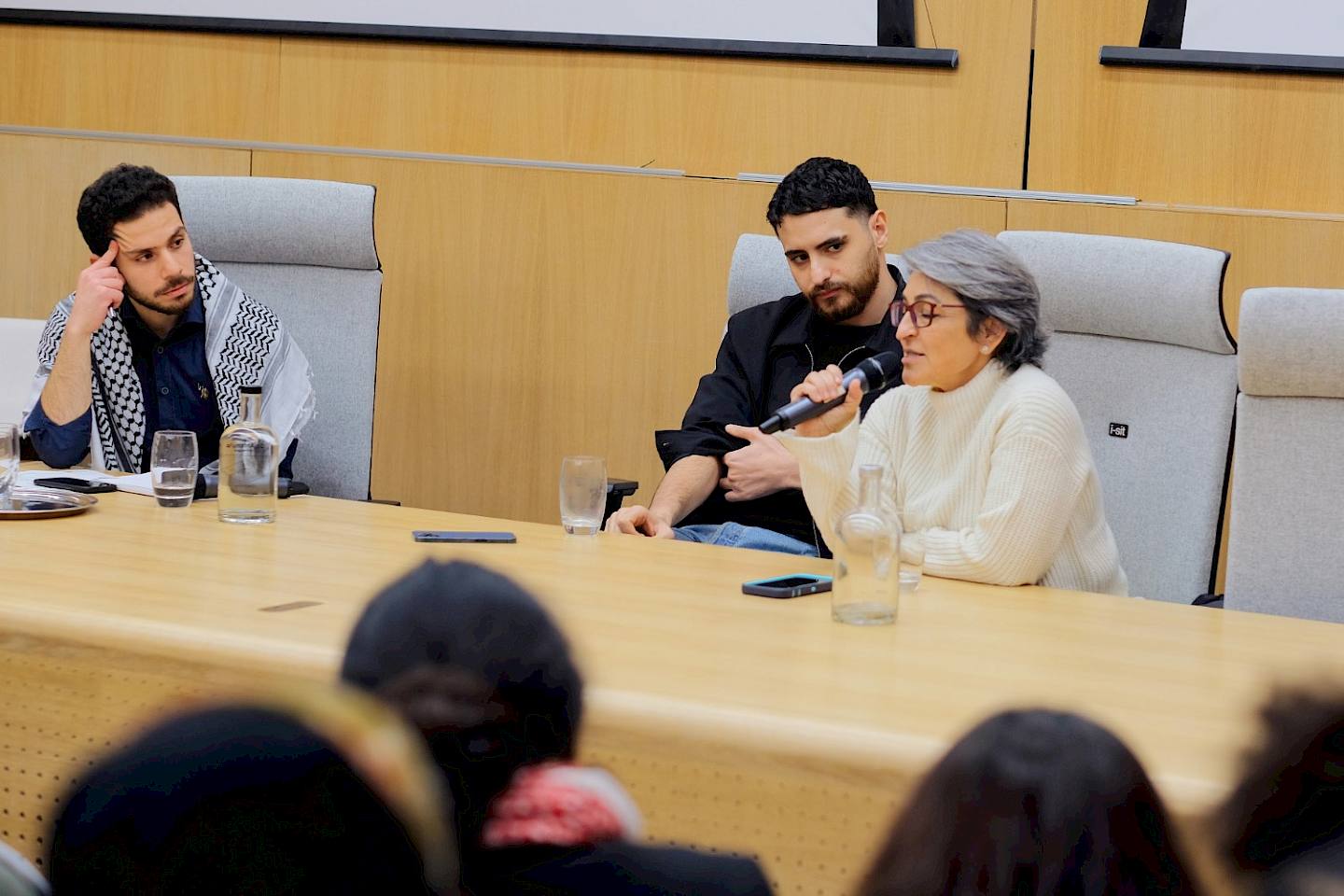
Palestinian American writer Susan Abulhawa and Palestinian writer and poet Mohamed el-Kurd speaking at a free public lecture at St Antony’s College in November 2024, organised by student activists. The conversation was held immediately after their address at the Oxford Union. I appreciated that they chose to speak again in a setting open to all — access to the Union is not equally affordable or accessible. Abulhawa later sued the Union after it replaced the full recording of her speech with an edited version that cut nearly two minutes without her consent.
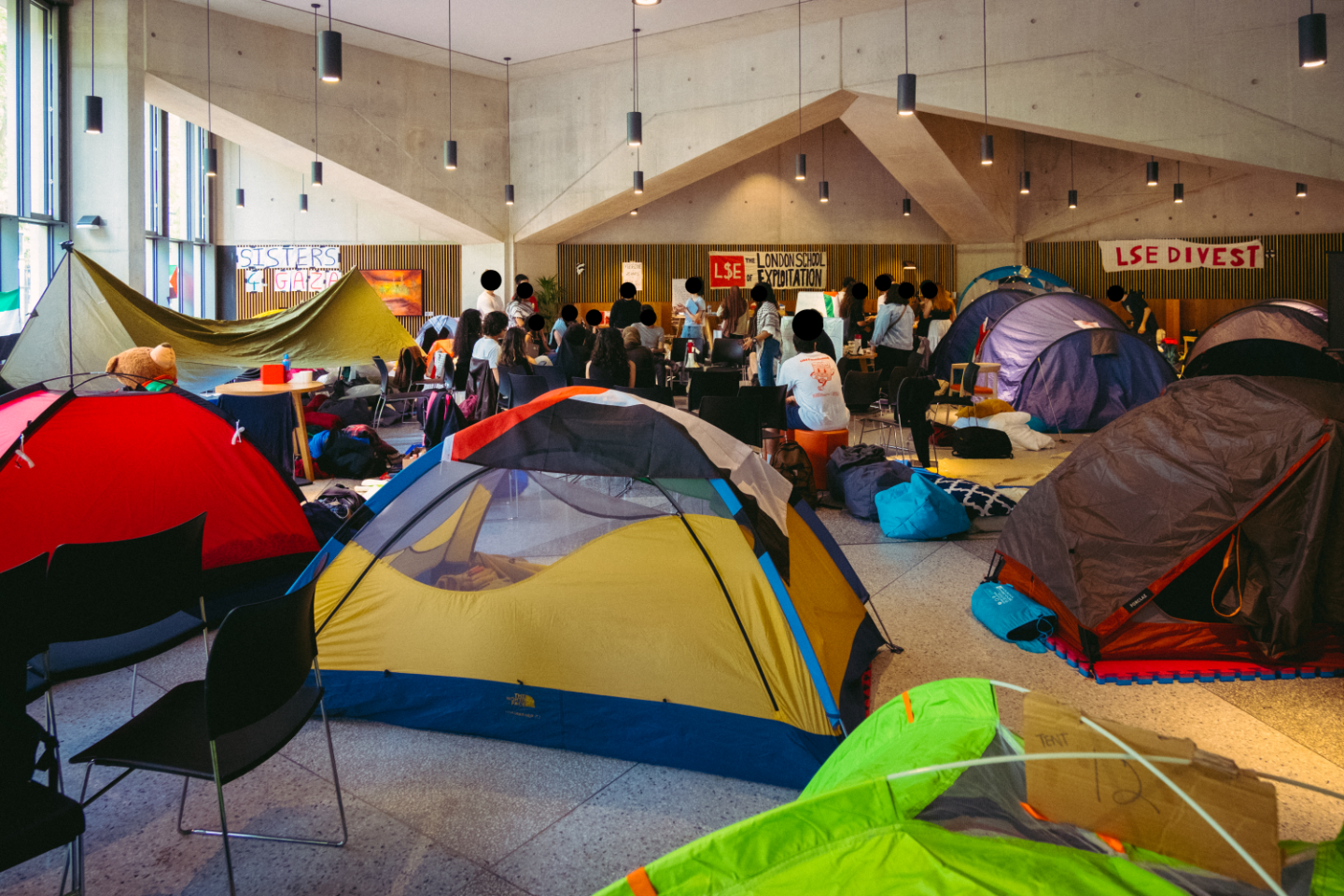
Scenes from LSE’s Liberated Zone, established on the ground floor of LSE’s Marshall Building, which came to be known as the Bloom Building, renamed after Marshall Bloom, an American anti-apartheid student activist who was suspended by LSE in 1967 for leading the first student occupation in the UK against LSE’s complicity in the Rhodesian apartheid. The building is formally named after its donor, Paul Marshall, co-owner of GB News.
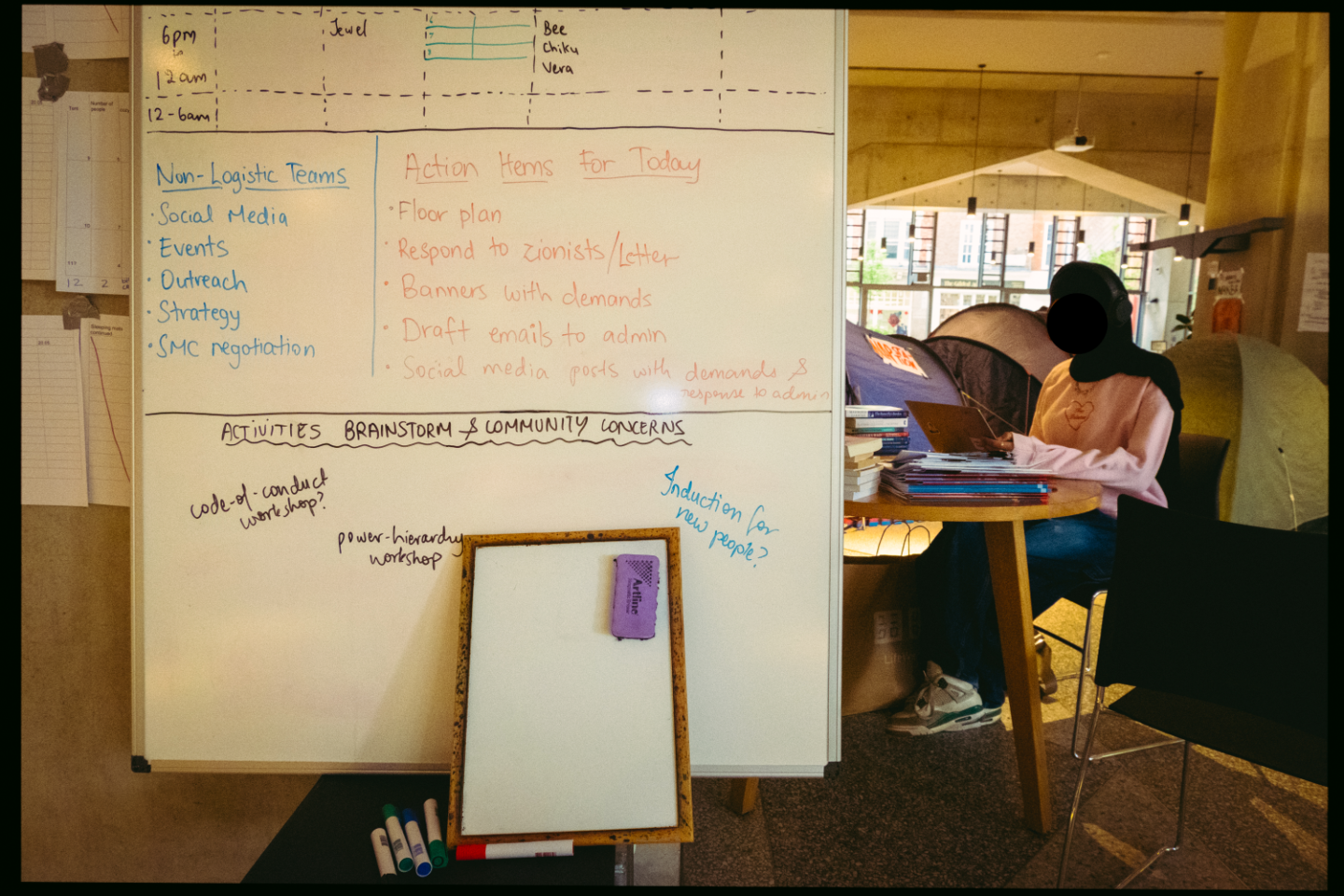
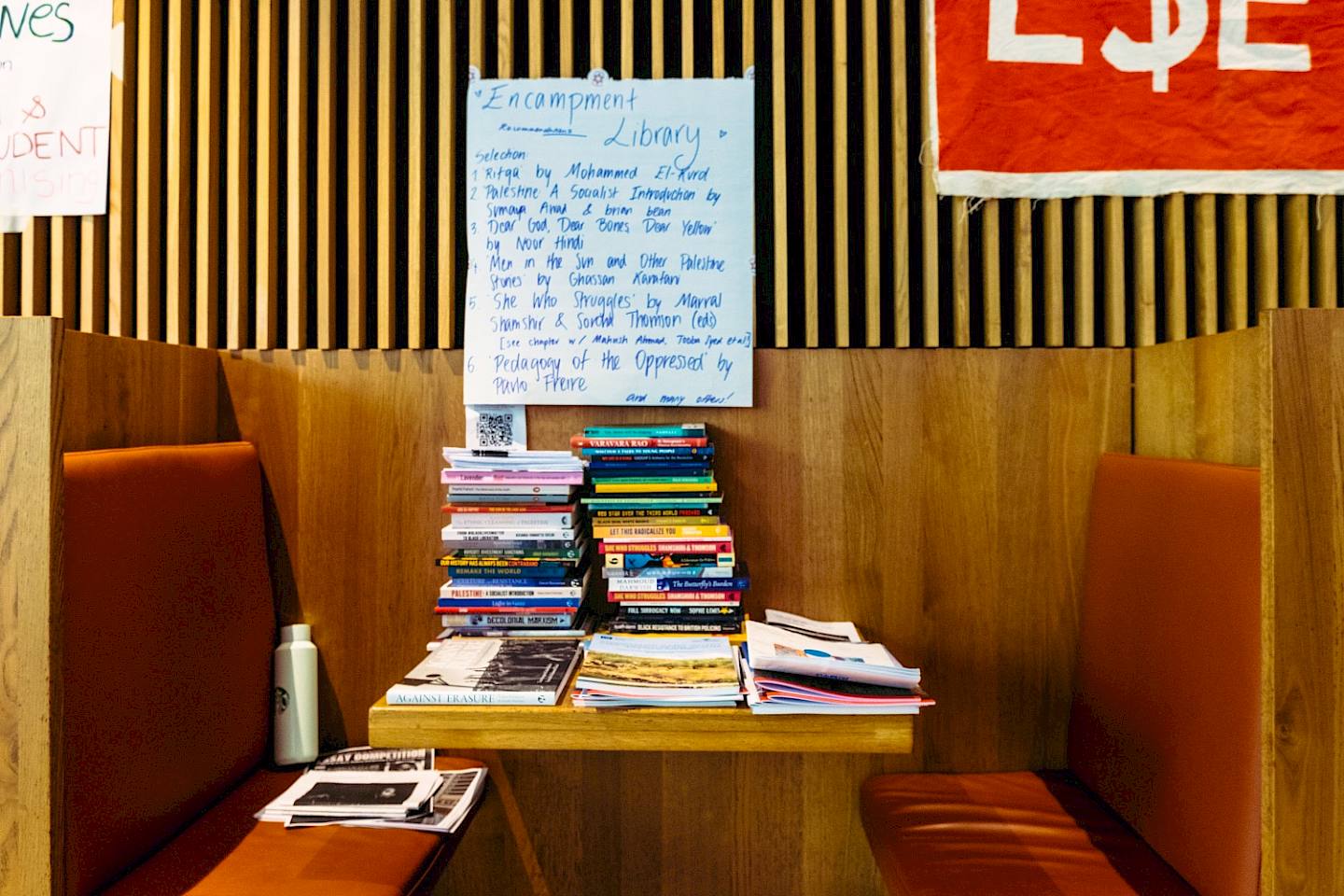
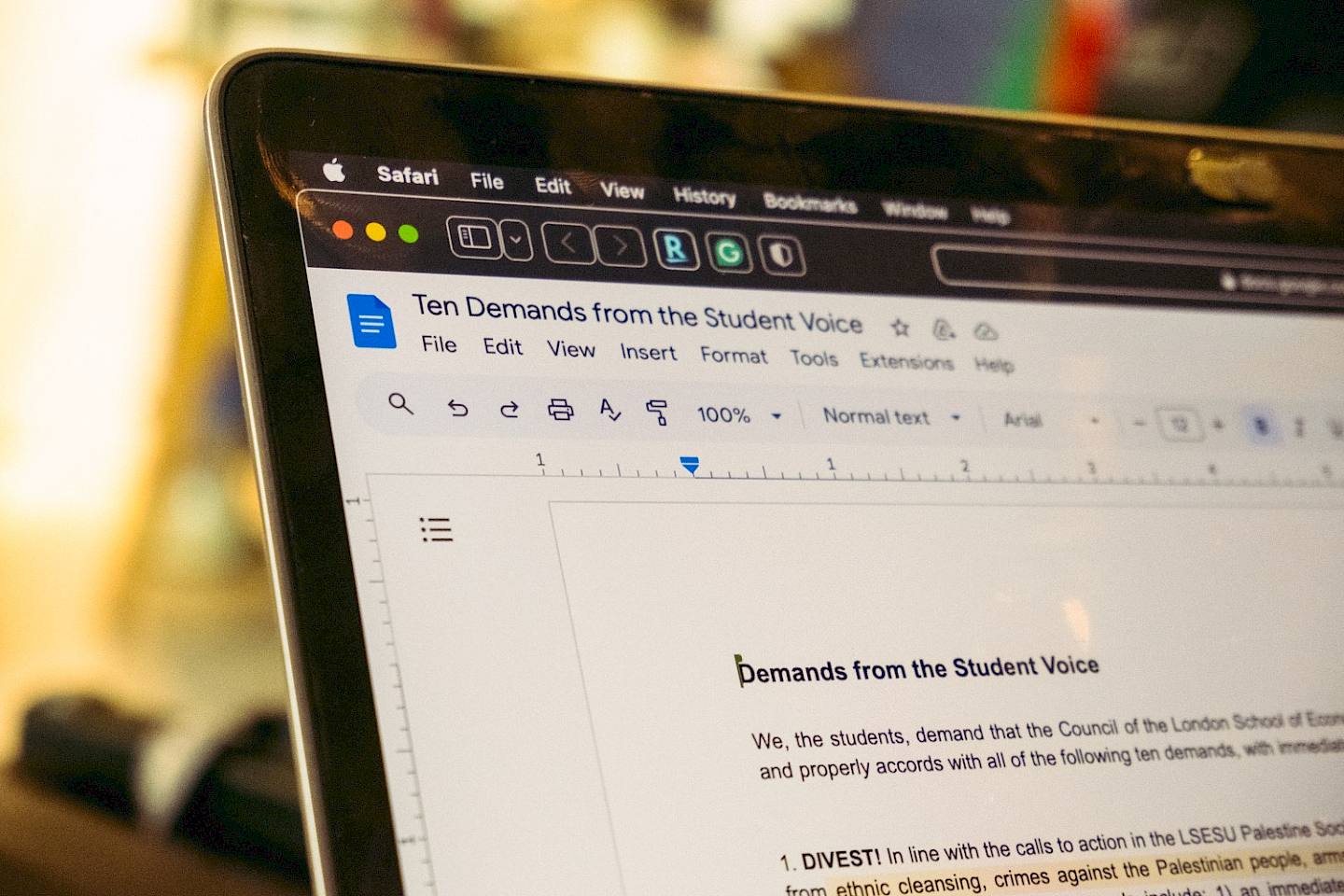
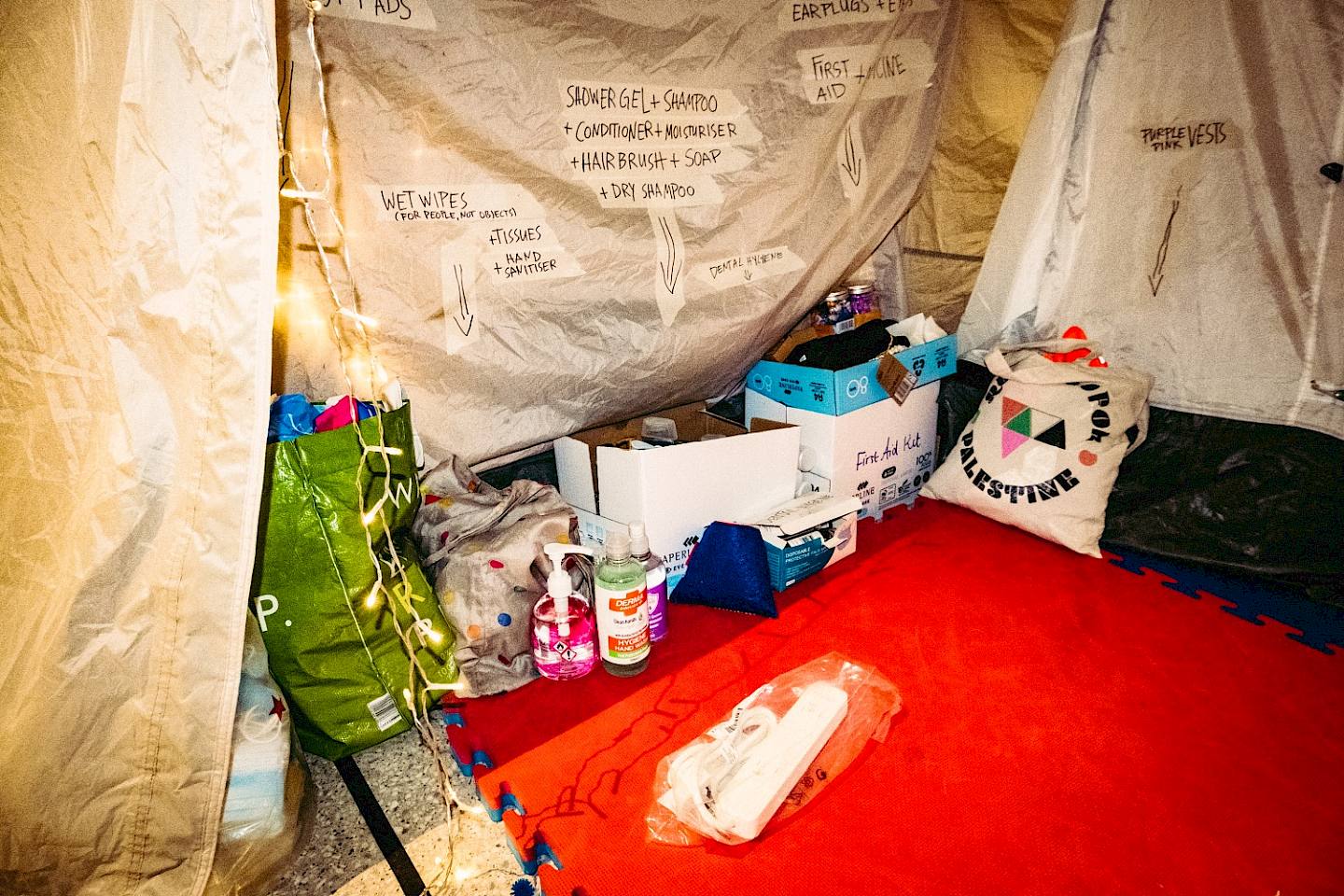
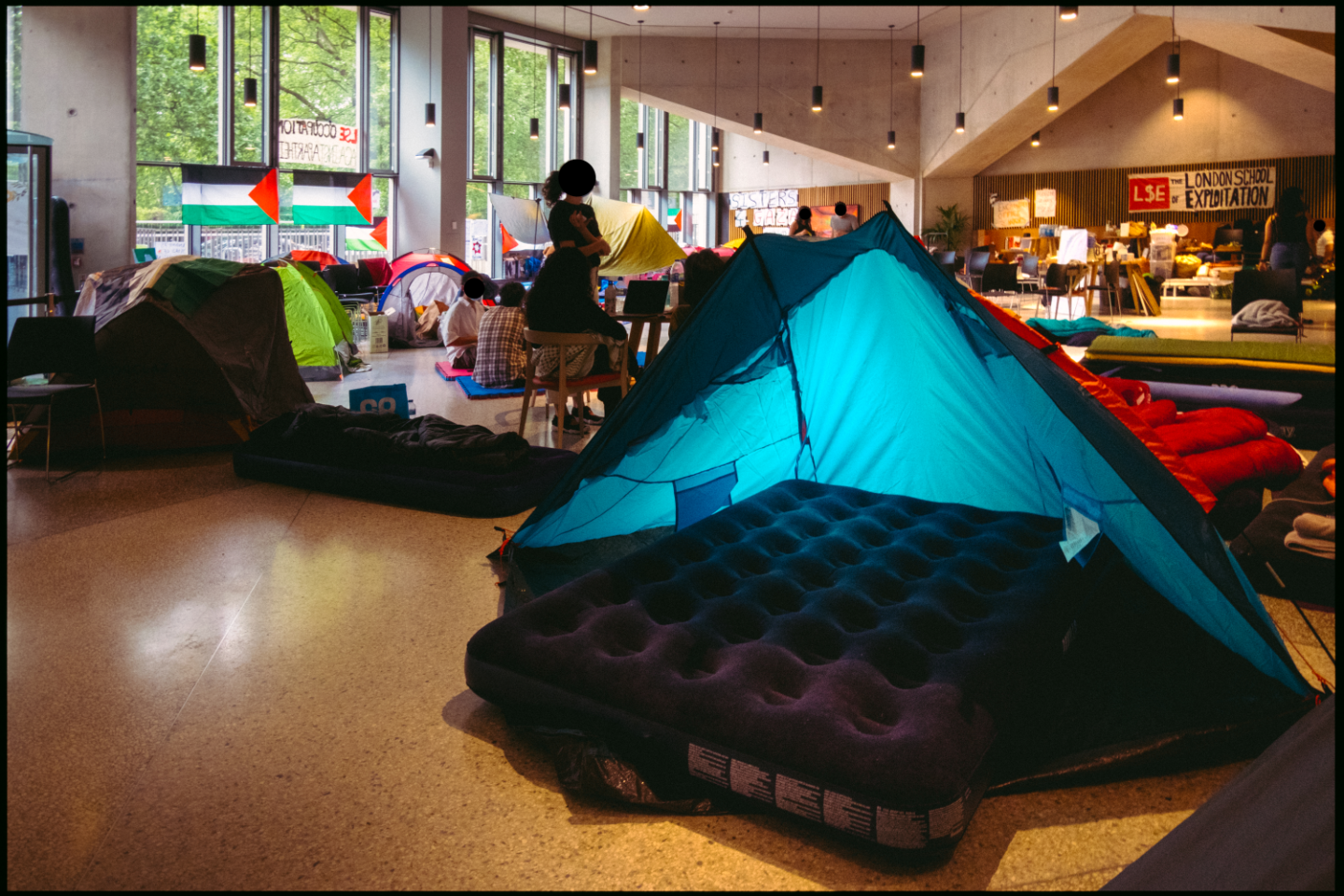
At the London School of Economics (LSE), my alma mater, students and staff published a 116-page divestment report titled ‘Assets in Apartheid’ in May 2024, examining the university’s financial complicity in the crimes against the Palestinian people. In the absence of any meaningful engagement from university management, students then established an occupation on the ground floor of an LSE building, which ran from May to June 2024, when it was forced to end via a shameful court-ordered eviction.
On the day I took these photographs, I met with an LSE professor who had set up a temporary office hours space for students who were unable to attend their usual appointments because they were engaged in protest. Nearby, students gathered in circles to prepare for another round of negotiations, continuing to press the university to divest from companies involved in crimes against the Palestinian people as well as the production and trade of arms and fossil fuels.
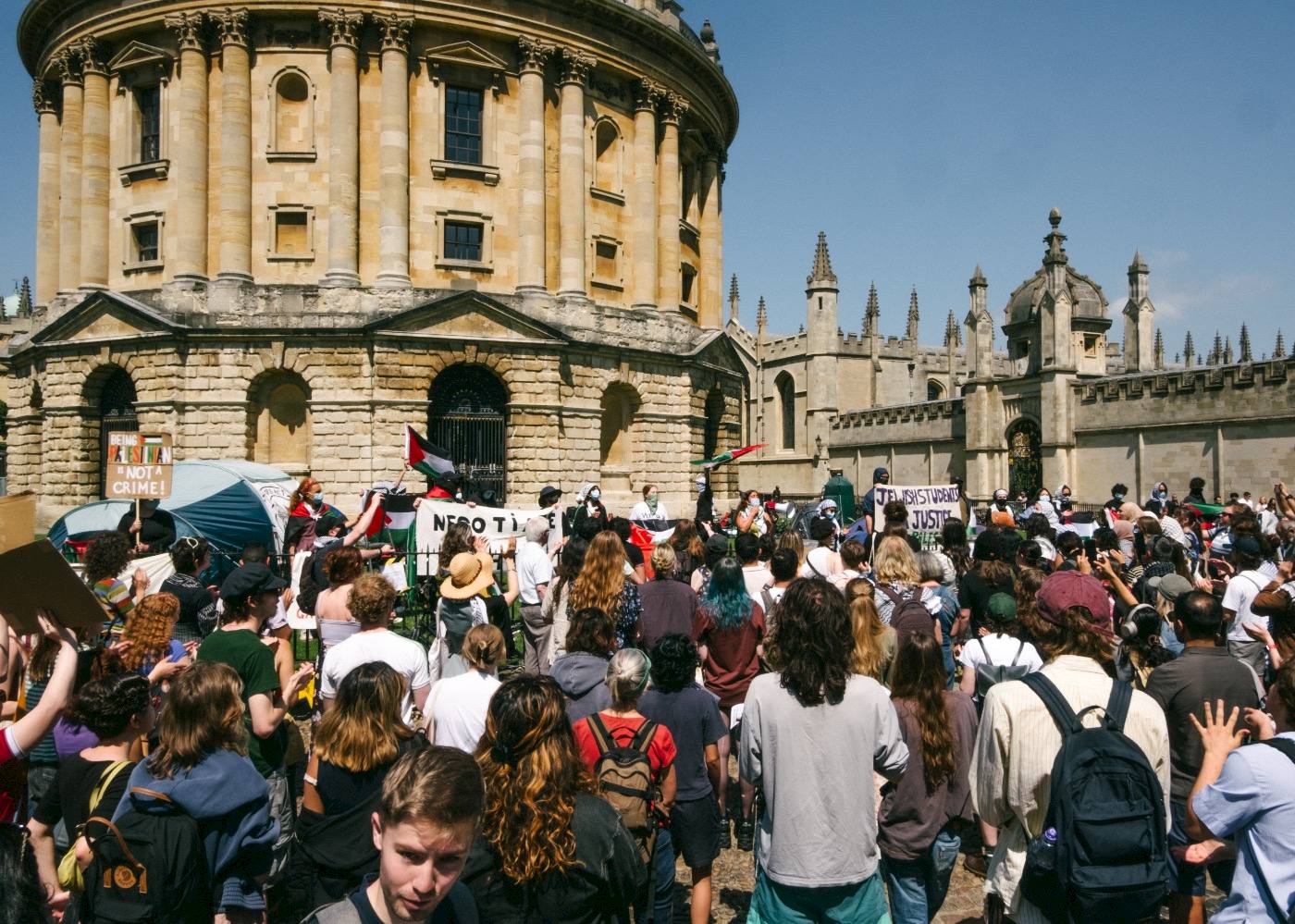
Scenes from the second Oxford Liberated Zone, established outside the Radcliffe Camera.
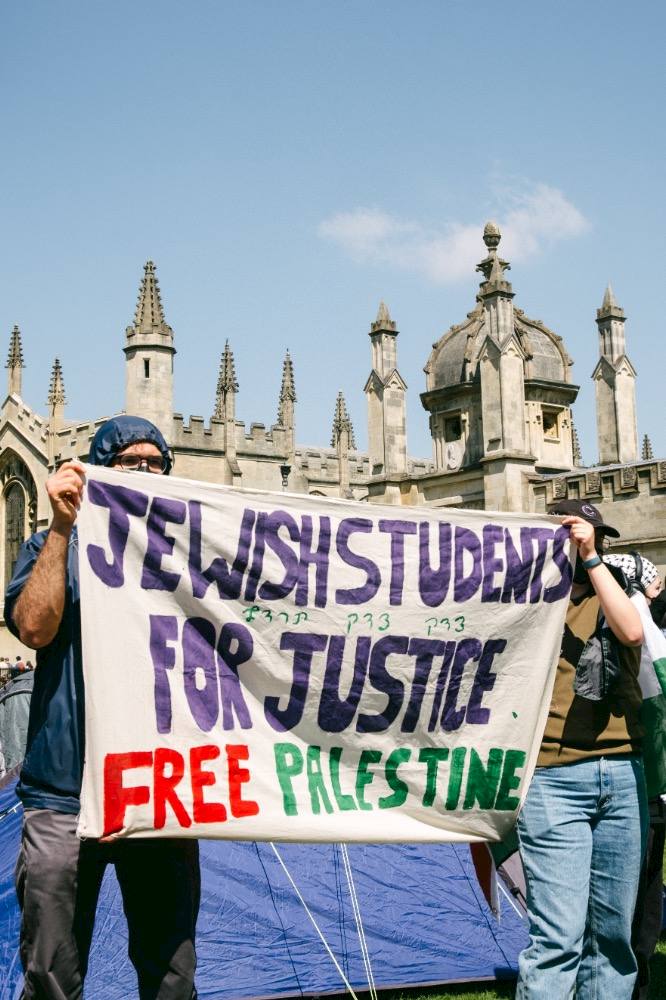
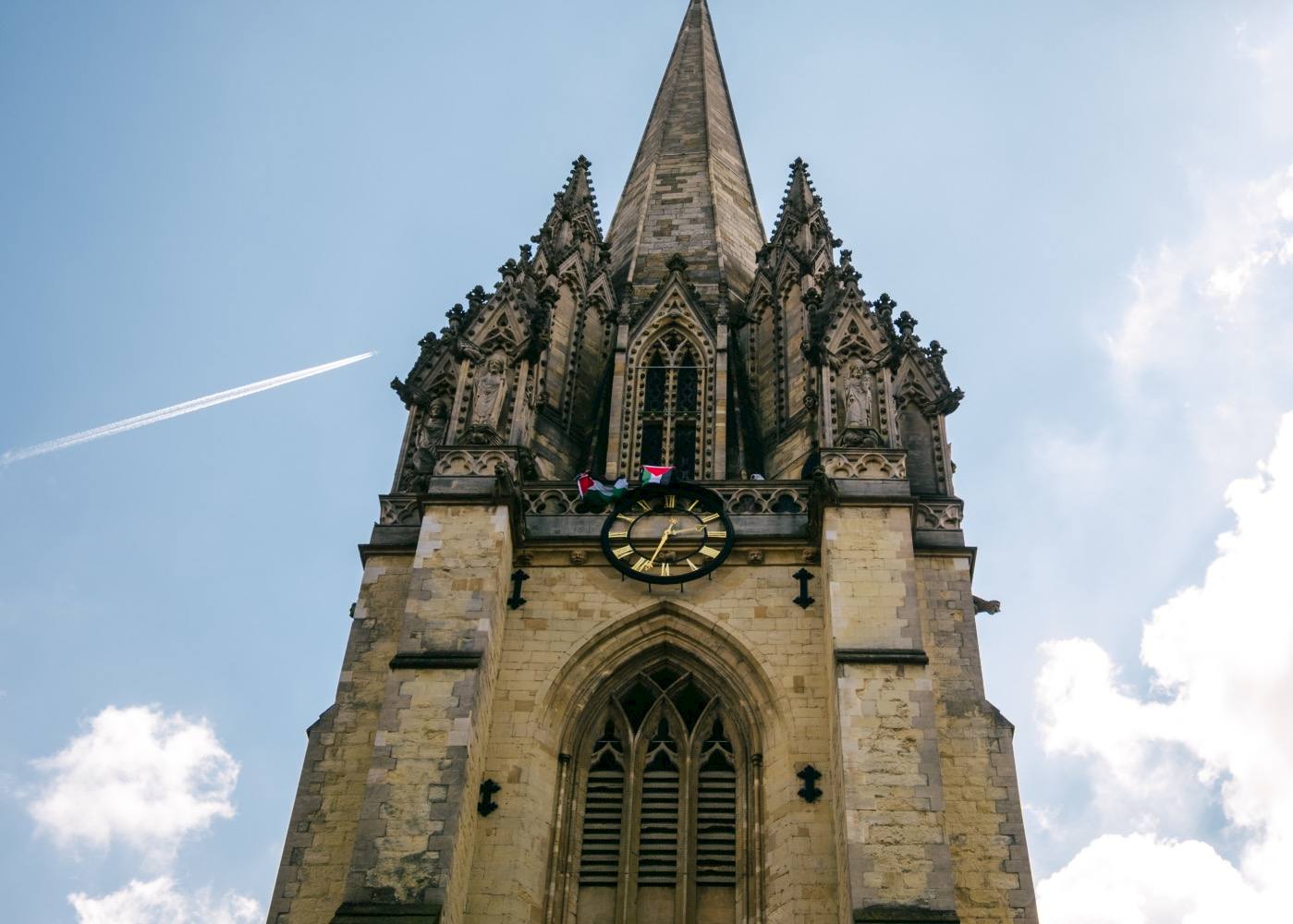
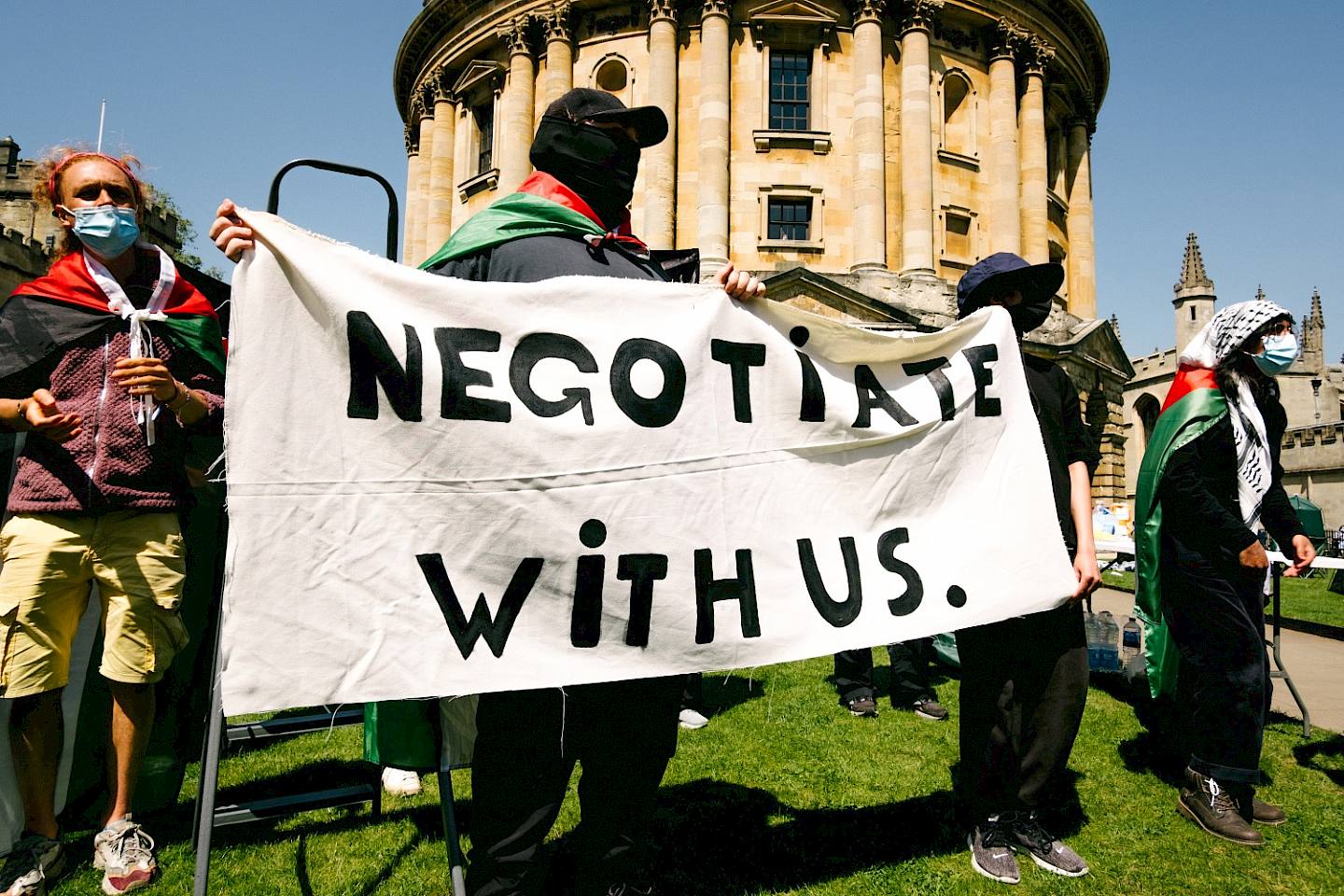
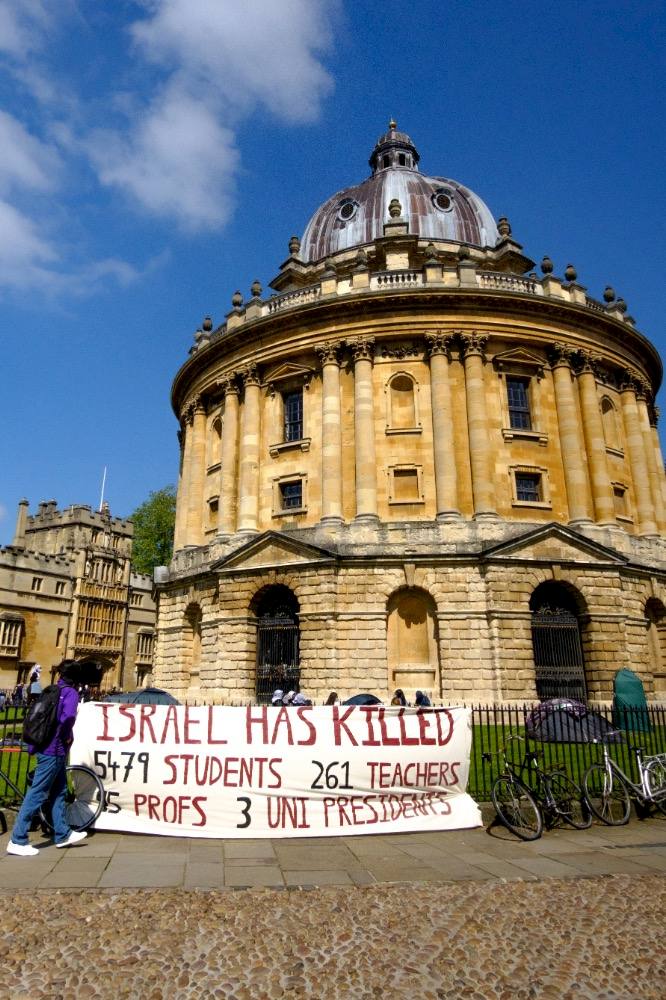
Though these photographs focused on the solidarity movements in London and Oxford – the two cities where I was based during this period – student encampments were taking place all across the UK. In summer 2024, students and staff set up encampments at more than thirty British universities, from Manchester to Leeds to Newcastle, Cambridge, and Oxford, drawing attention to their institution’s ties to investments funding the genocide in Gaza, as well as their links to arms and fossil fuel industries. These encampments offered new possibilities for collective and community-based learning outside the classroom, particularly within elite institutions shaped by their own imperfect and damaging histories. Student-led teach-ins, open libraries stocked with political books and organising materials, and the additional office hours hosted by academics created spaces for learning beyond formal institutional structures. They became safe spaces of knowledge-building, empowerment, solidarity, and collective action — not outside the university but beyond it. They offered alternative ways of being together at a time like this.
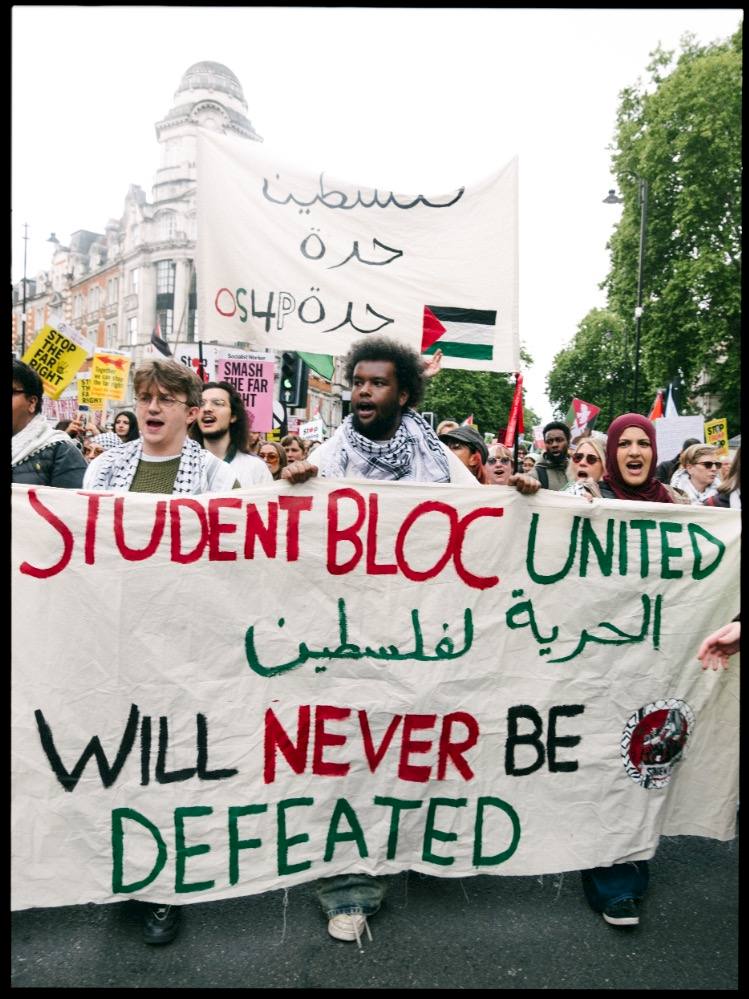
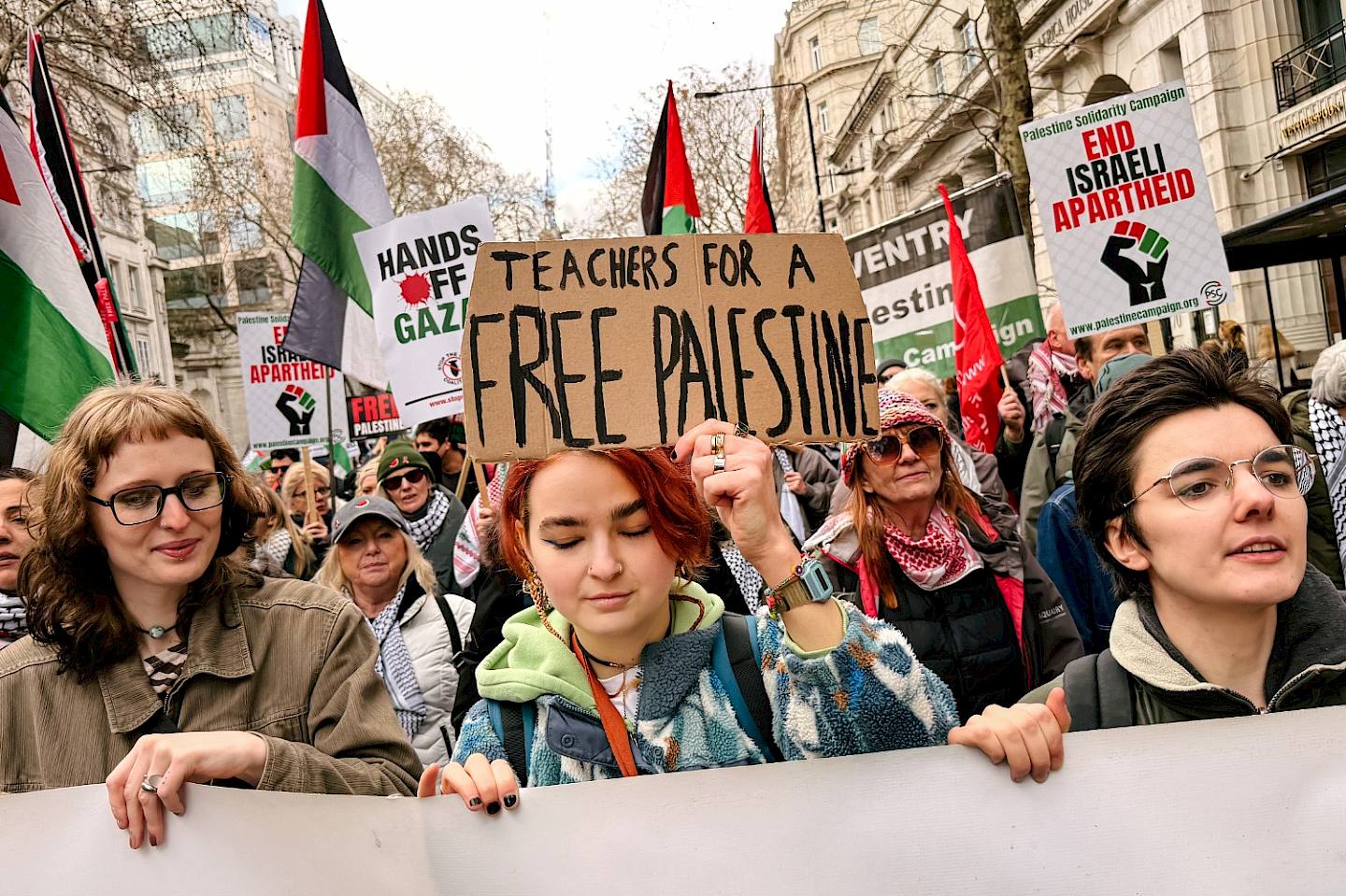
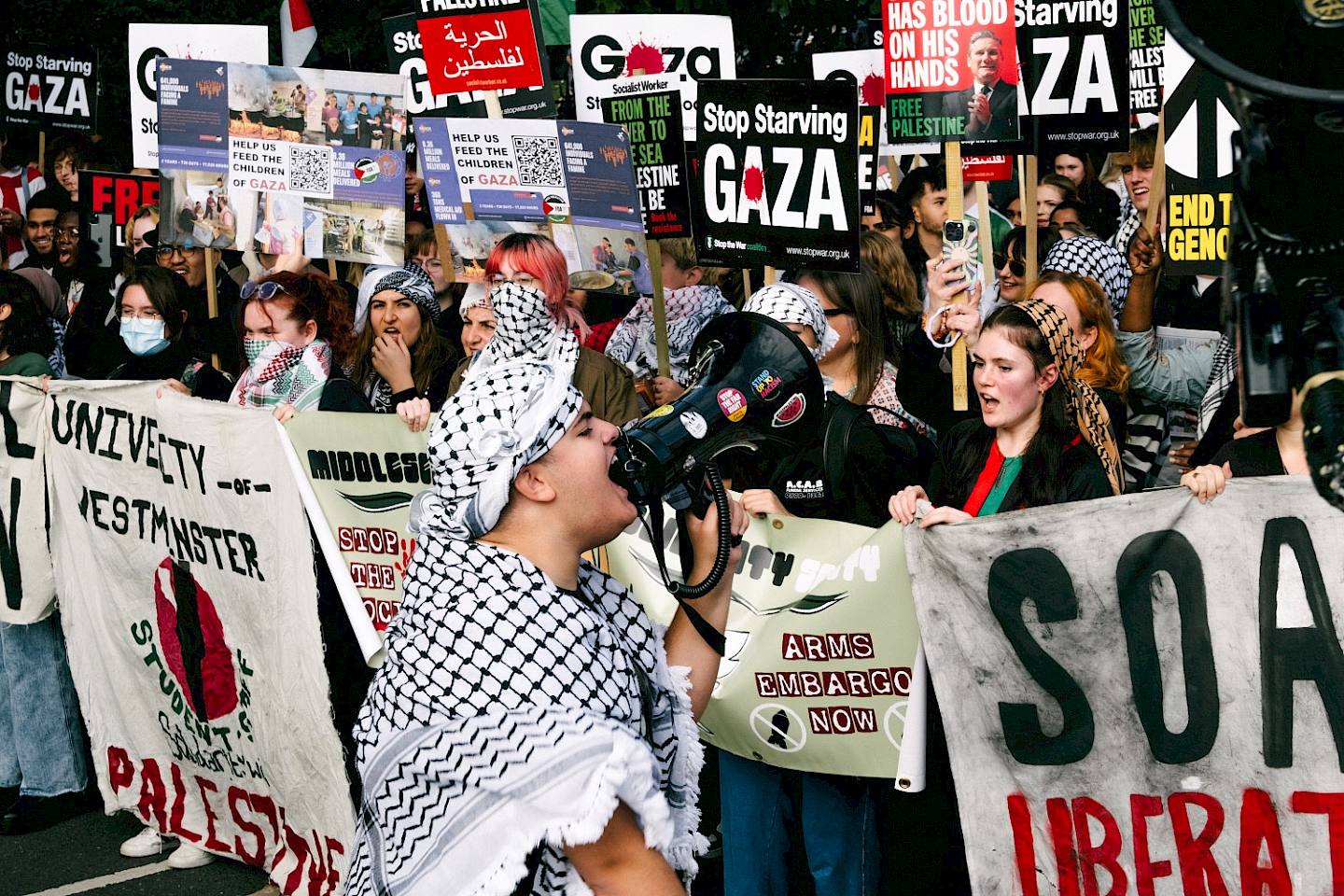
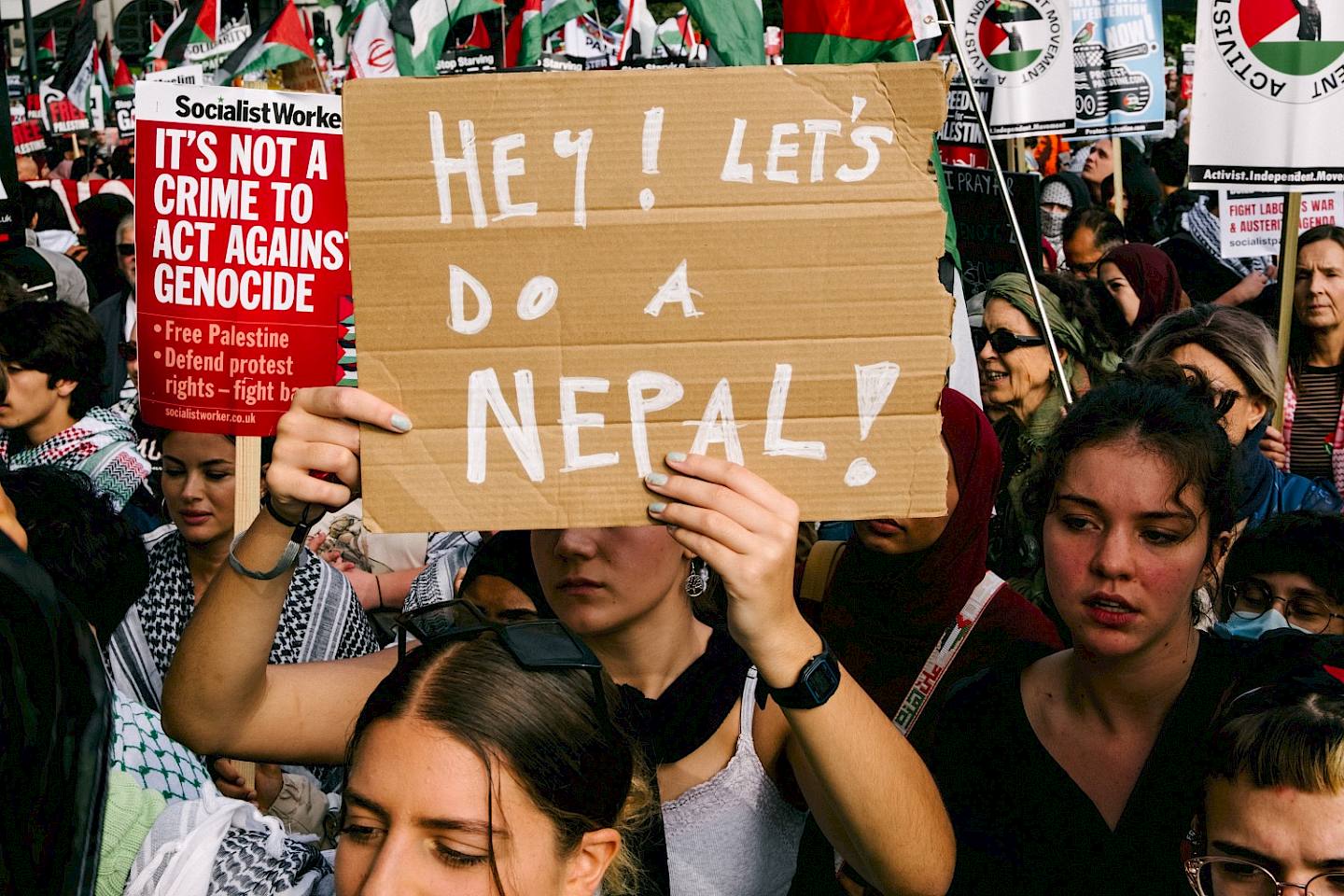
Scenes from the student blocs at the national demonstrations for Palestine. Photographed in 2025 and 2026.
The encampments began winding down that summer under mounting legal pressure, as universities turned to court orders, threats of eviction, and police arrests to clear them. However, two years on, these encampments are not forgotten, nor have their existence been without consequence. The demands raised through the encampments entered formal institutional processes: Oxford accelerated a review of its restrictions on arms-related investments; Cambridge established a working group examining investments and research funded by the defence industry; and at LSE, negotiations secured £250,000 for a scholars at risk programme, then a further £250,000 for Palestinian students after campaigners pressed for targeted support. The encampments have since changed how students and faculty organise, where they are employing new and more refined strategies. ‘You cannot redo an encampment, because this time the authorities are waiting for you. If anything, it is a reminder to think of ways to escalate …’ an activist from the 2024 Oxford encampment told me. Another said, ‘I am now just focusing on capacity building and community work from the ground up. This involves solidarity work, food redistribution, drug harm reduction, political education — things to build the movement at a local level.’
Lessons from the encampments went on to catalyse mobilisation in other ways too. In August 2024, the youth activist group Trans Kids Deserve Better occupied the Department of Education for a week over draft guidance on gender-questioning children; the guidance was later dropped as a standalone policy. Since March 2026, traders and supporters at Ridley Road Shopping Village have maintained a community-led occupation to resist eviction attempts as part of a redevelopment plan.
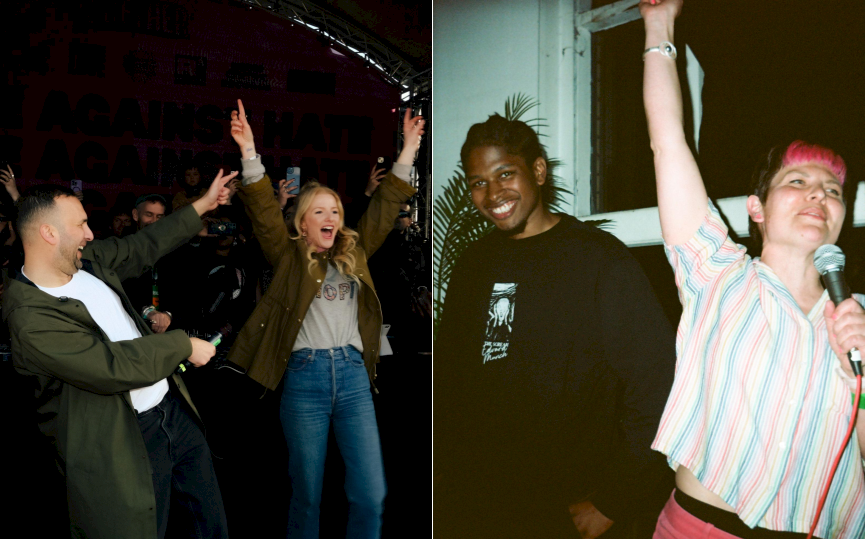
Left: Green Party leader Zack Polanski and newly elected Hannah Spencer MP in Trafalgar Square at the March Against the Far Right in March 2026. Right: Mayor of Hackney Zoë Garbett and twenty-year-old Deputy Mayor Dylan Law celebrate on their election victory night in May 2026.
This past year, with a growing number of UK electoral breakthroughs for candidates critical of the Labour government’s complicity in genocide, my work documenting solidarities extended into covering local politics. In February, Green Party candidate Hannah Spencer won a Labour stronghold in northern England. On a local level in London, Zoë Garbett was elected Mayor of Hackney. Both candidates campaigned on a platform that included outspoken criticism of the UK’s role in the Gaza genocide. Similar changes are taking place in the US as well. Recently, in New York, an organiser at Columbia University’s Gaza encampments, Darializa Avila Chevalier, is now poised to become a member of Congress. These seismic shifts of public opinion that we are witnessing are being driven by young people discovering their collective power and actively using it.
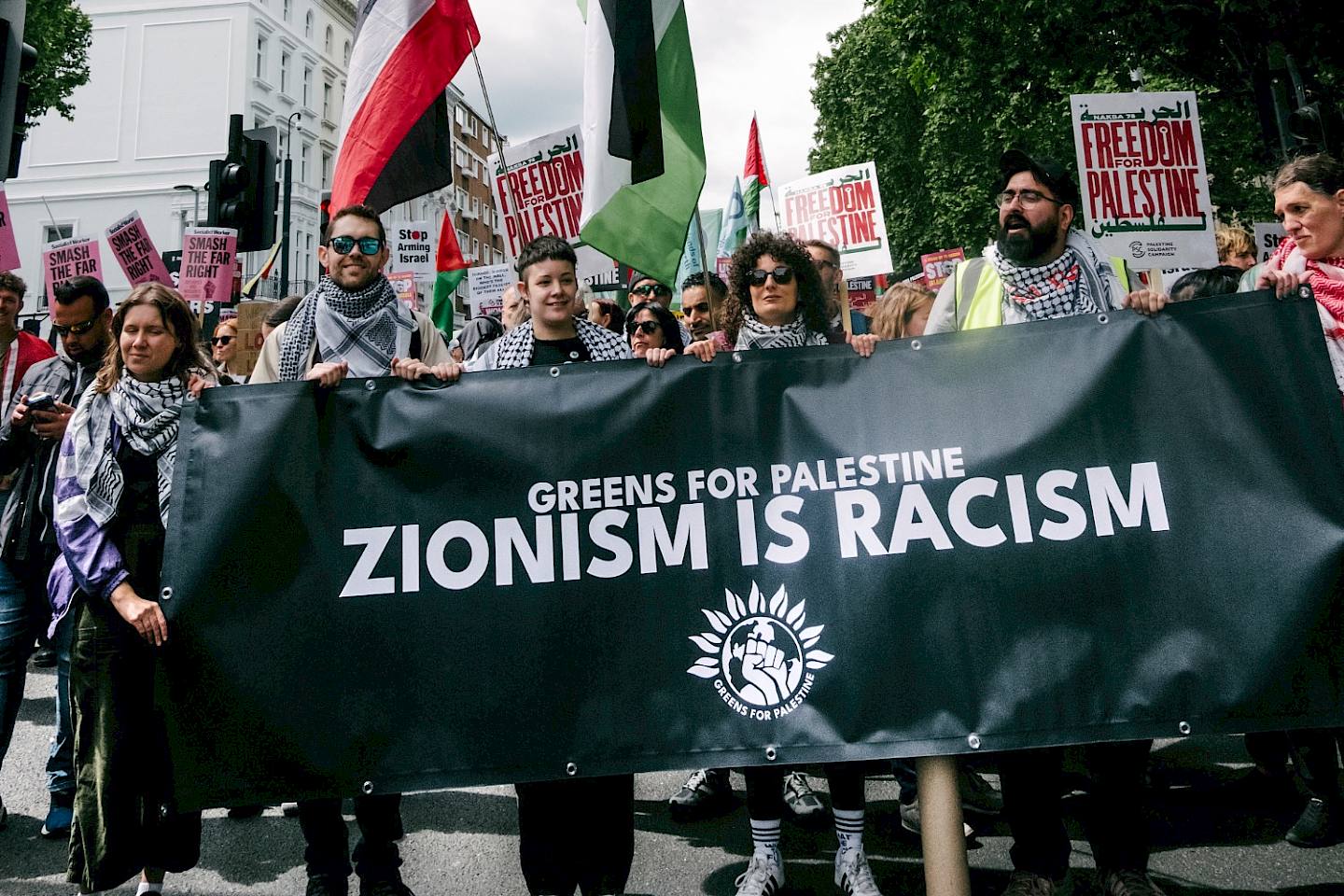
Members of Greens For Palestine, a network of Green Party members, march along Exhibition Road in London during a March For Palestine on 16 May, 2026, to commemorate the 78th anniversary of the Nakba.
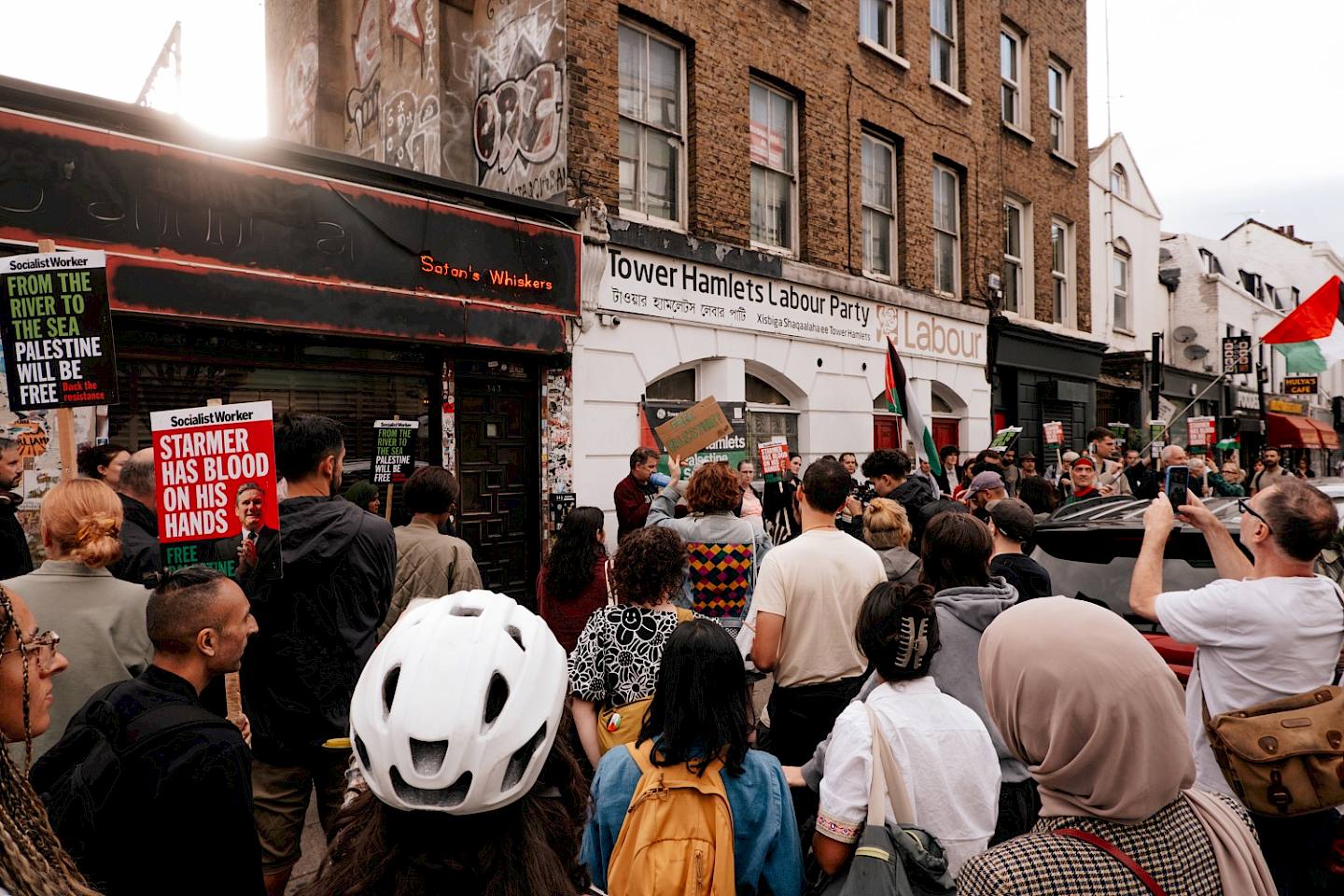
Demonstrators gathered outside Labour MP Rushanara Ali’s office in Tower Hamlets to protest her abstention from the voting on a motion which demanded the government call for a ceasefire in Gaza in November 2023.
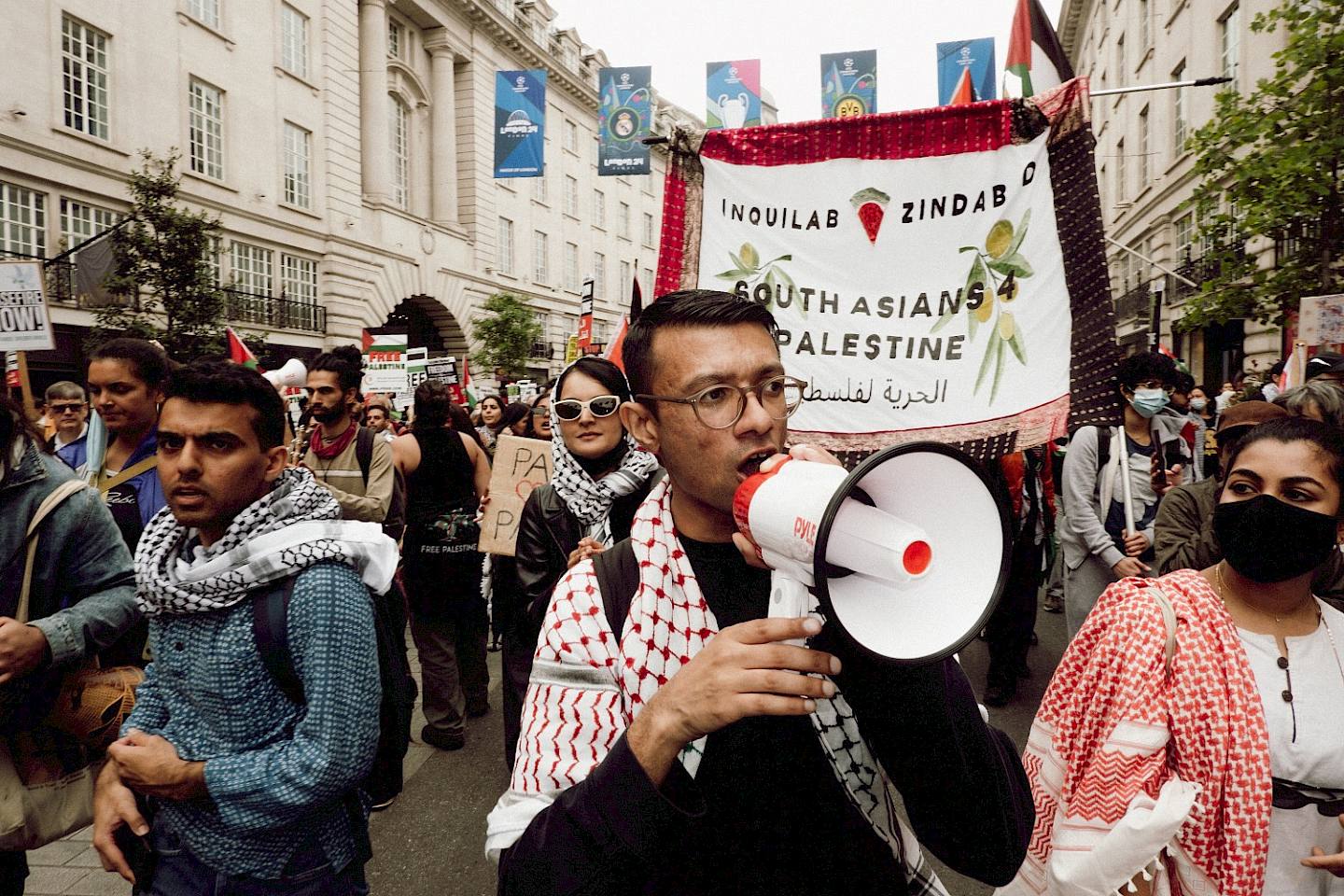
‘Inquilab Zindabad’ (‘Long Live The Revolution!’) reads a banner carried by members of South Asians 4 Palestine, a coalition of South Asians in Britain organising in solidarity with the Palestinian liberation struggle.
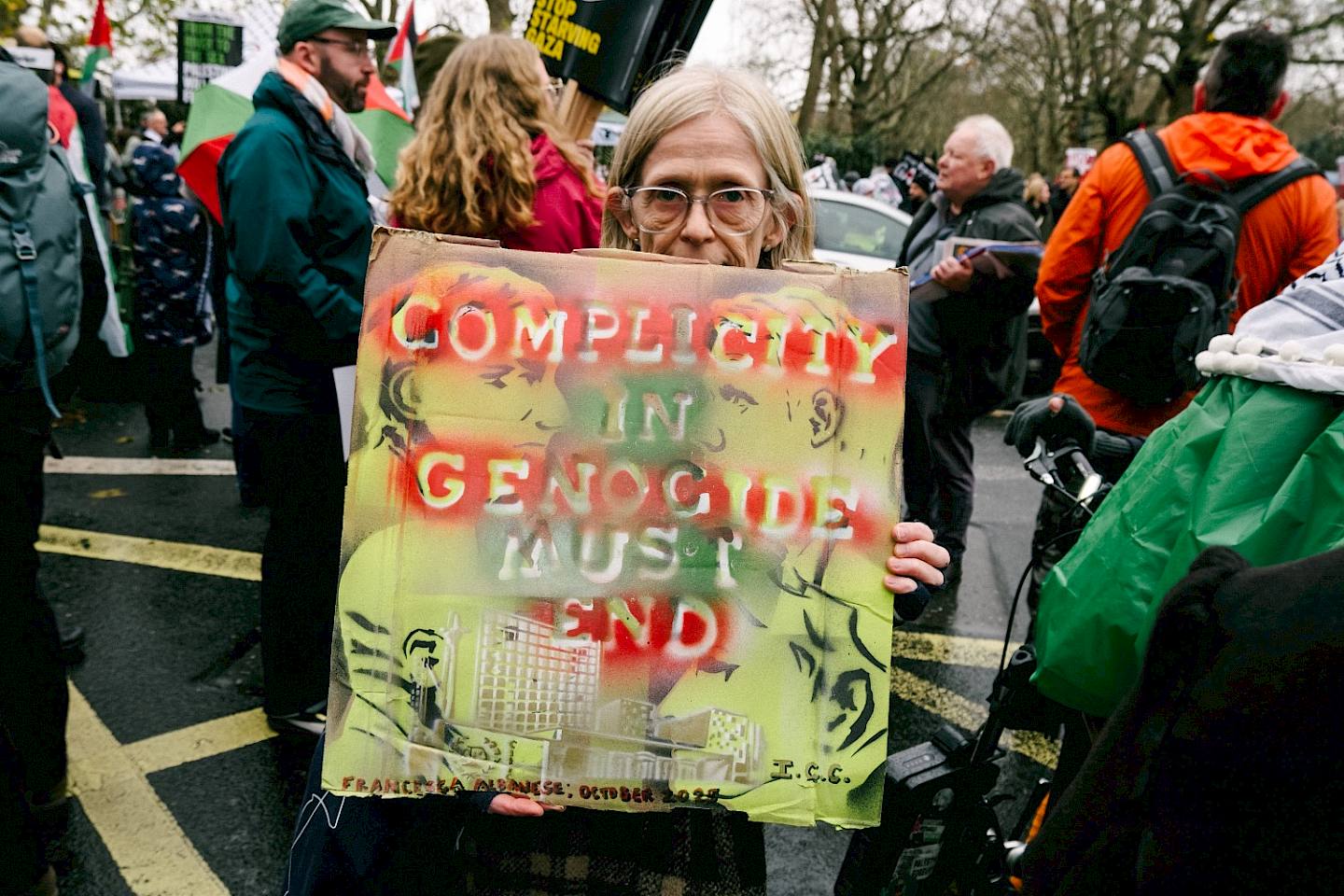
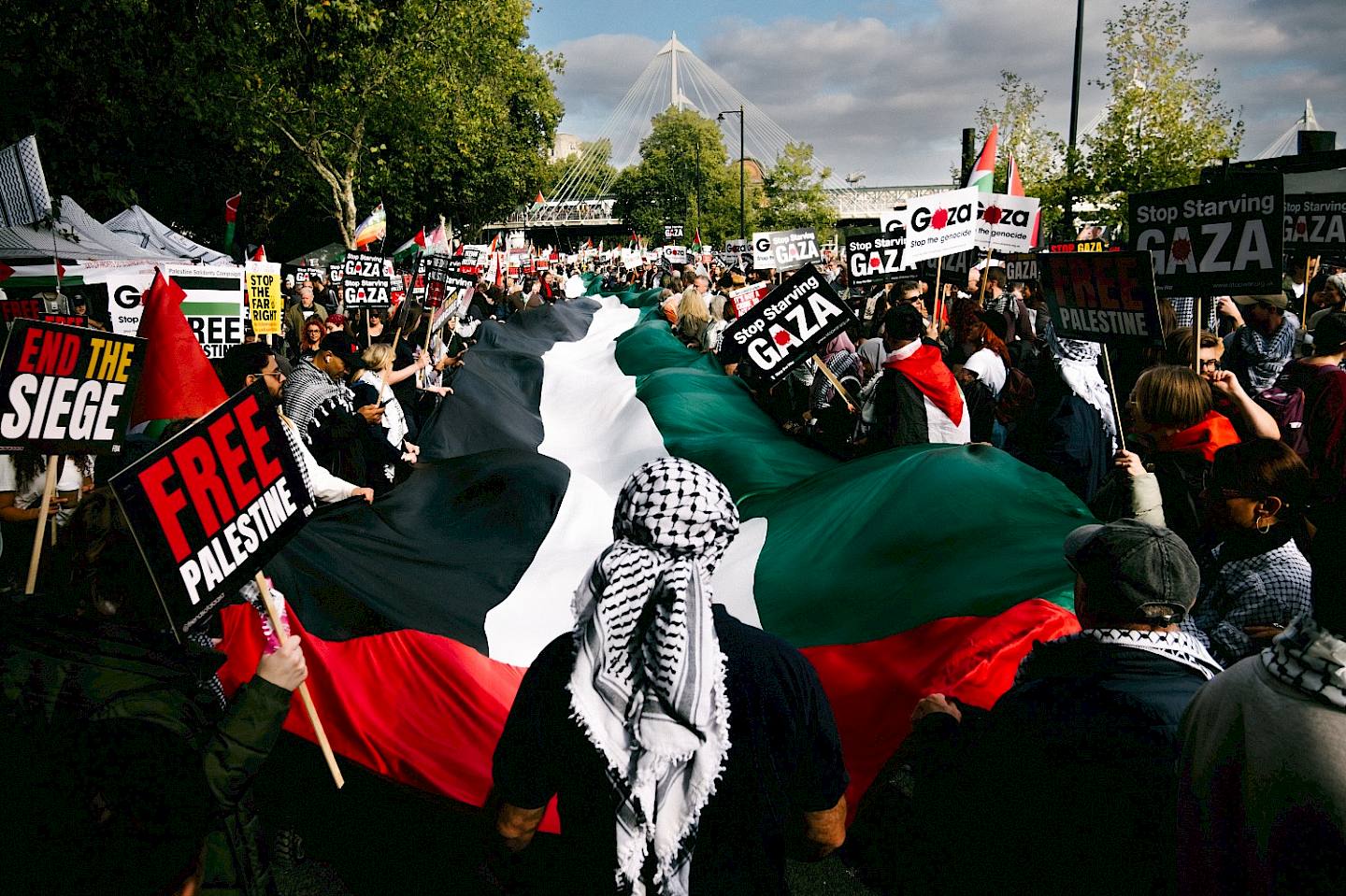
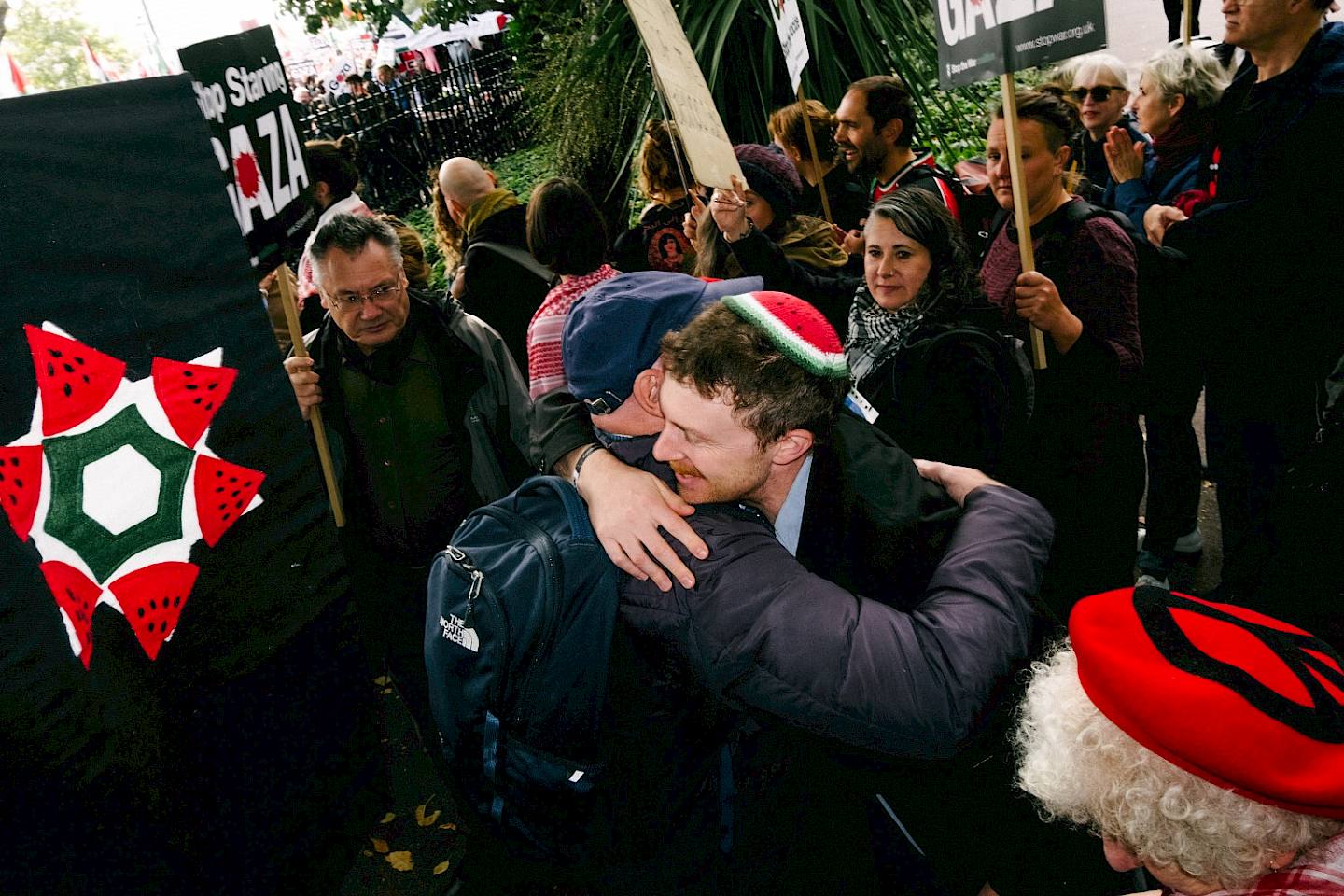
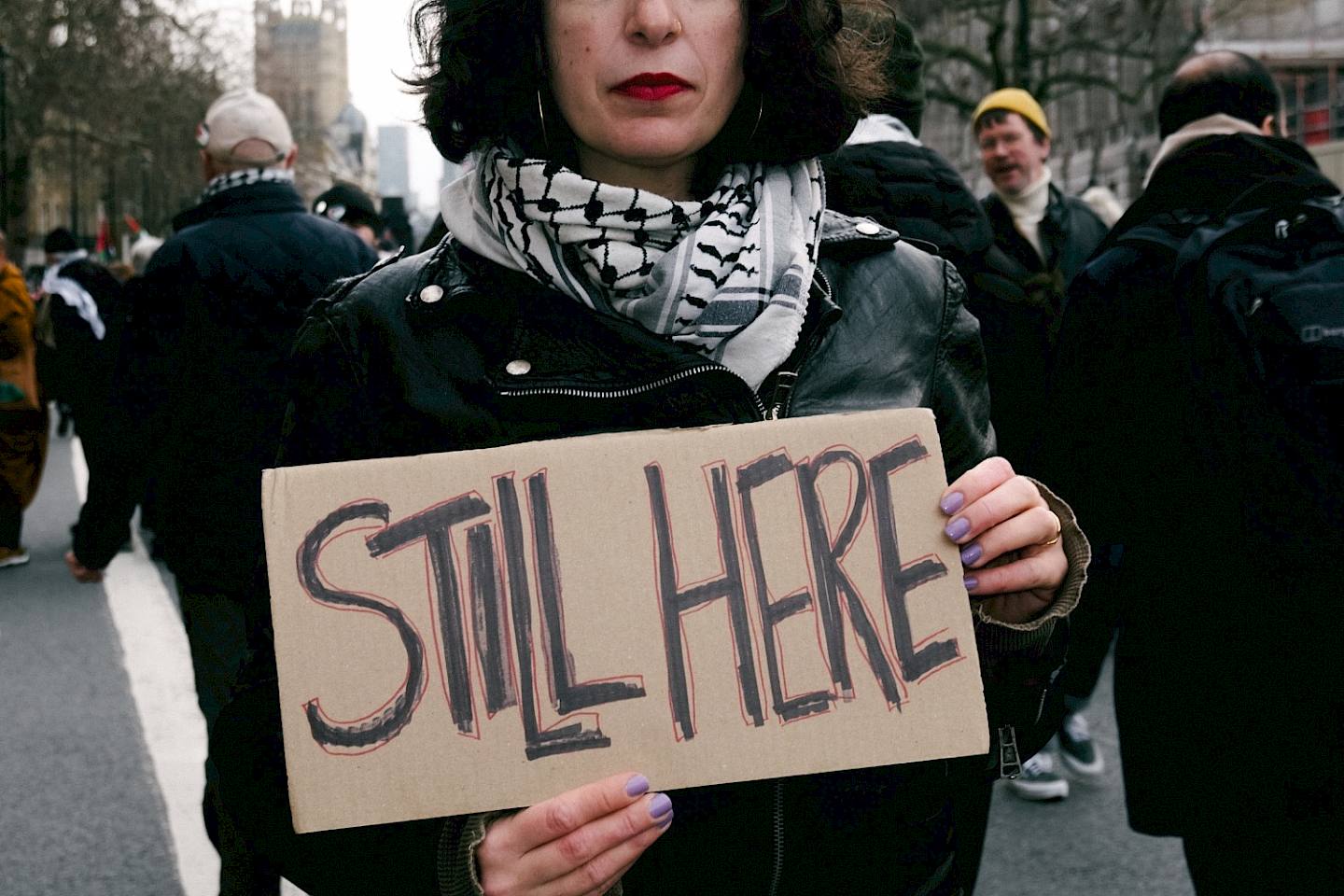
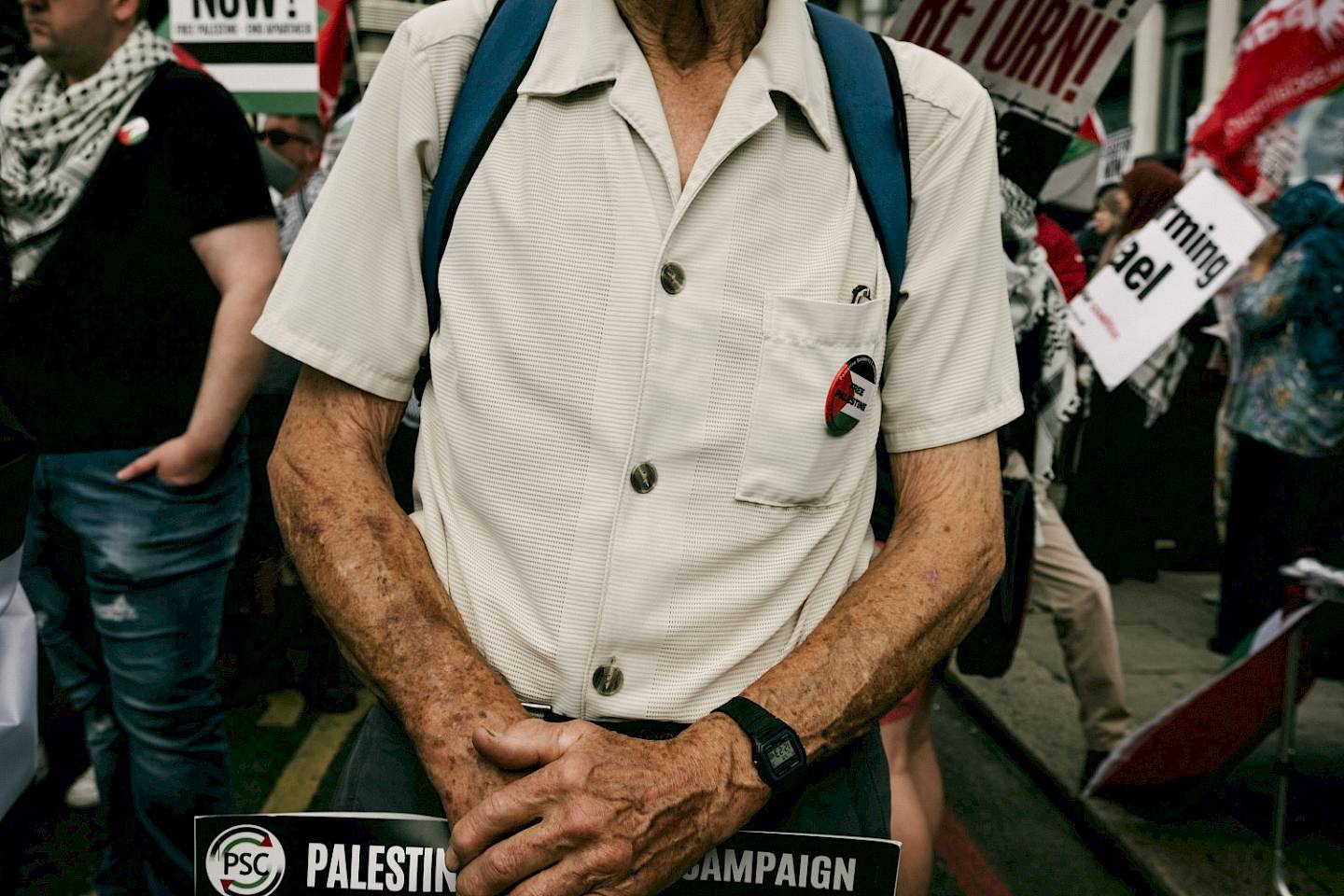
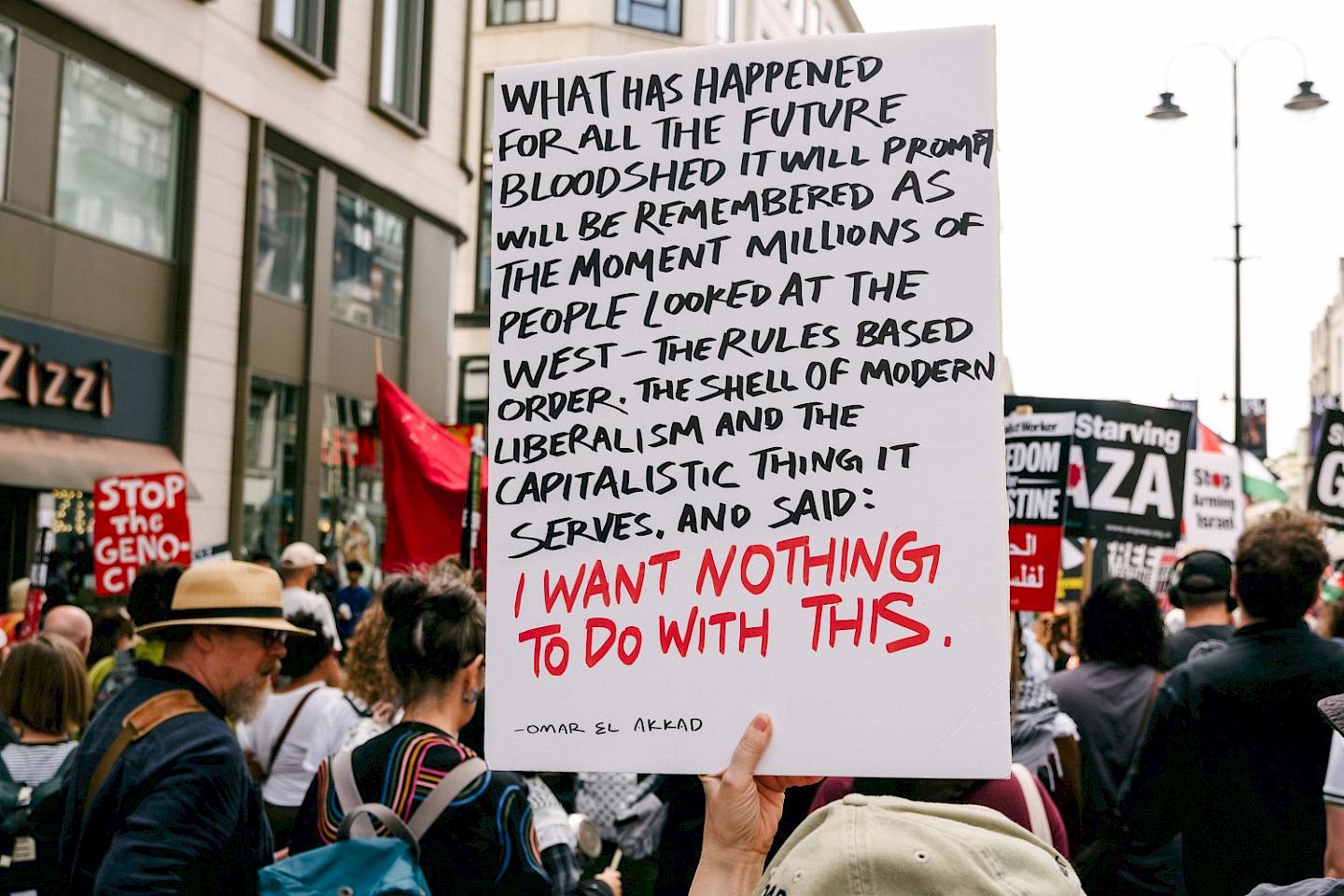
There is something unsettling about documenting these expressions of solidarity while the Nakba continues — while the genocide has not stopped. I return to these images knowing that the young people in them are still marching, still occupying, still asking why all the killing and destruction requires justification at all. I will keep photographing, because it is what I can do. I don’t have a clean ending to reach for or a final photograph to close the record.
This record remains unfinished.

