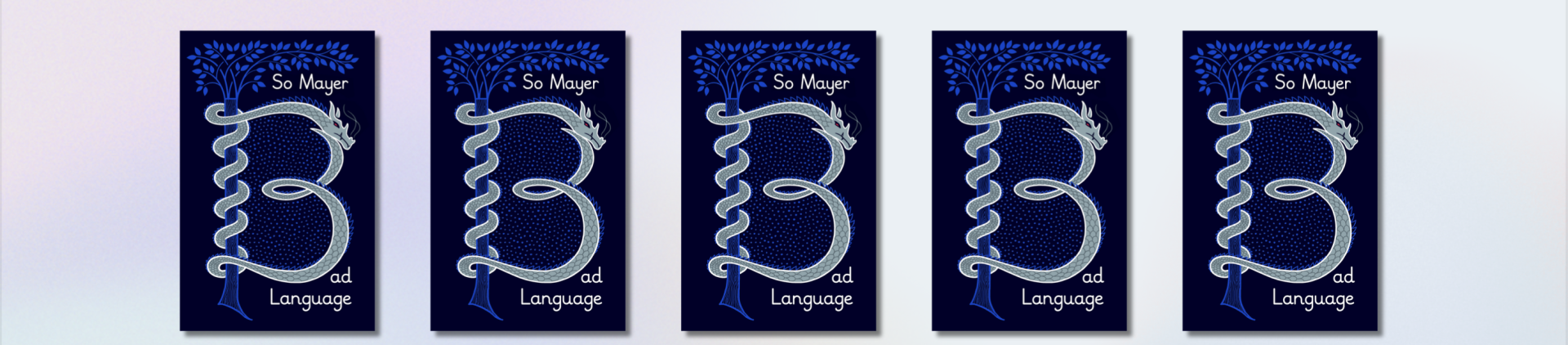
Extract: Bad Language by So Mayer
Read an extract from So Mayer's forthcoming book, Bad Language, a blend of memoir and manifesto exploring the politics of speech, and how language has been used – and abused – collectively and in their own life. This extract is from a section titled 'Shibboleth' – 'a word that draws a border, and makes that border deadly' – in relation to the continued occupation of Palestine.
Shibboleth is a word that draws a border, and makes that border deadly: in the Book of Judges, it leads to 42,000 deaths. This story is often ignored or mistold when the word is used or misused: it has come to mean a secret that differentiates us from them, and its history is carried in that secretive way, too. Shibboleth in fact means something that carries something else within it: it is the part of a plant that contains the grain, such as the ears of corn or wheat that Ruth and Mara were gleaning. It’s an ancient root that once again roots language in gathering plants to make food and clothing. But it is stripped to a husk. What remains of shibboleth is that it begins with sh-, the Hebrew letter shin (as in Shin Bet, the Zionist security agency).
Back in the days of the Judges, the people on one side of the river Jordan, the Gileadites, led by the Israelite judge Jephthah (yes, the one who sacrificed his daughter) pronounced it sh-, but the people on the other side of the river, the Tribe of Ephraim (the territory that includes Bethel, where Jacob got named Israel, again), pronounced it s-. When the Gileadites beat back an incursion by the Ephraimites, they dammed the river and interrogated anyone crossing, commanding them to say shibboleth. Those who pronounced it sibboleth were killed. They were defeated troops returning to their own land by crossing back over the river Jordan. A single letter meant death to 42,000 people, close to the number of Palestinian deaths between that river and the sea as certified in the first year after 8 October 2023 by the Health Ministry in Gaza (although the Lancet estimated that the real death toll, to that date, was most likely nearly double that figure). That’s a staggering number of deaths, a devastating difference to be caused by a single letter. This is why shibboleth now means a speech act that can be life-or-death. There is no balm from Gilead: might equals right pronunciation.
The reason for this accented test is not the singularity but the multiplicity of s/sh/z sounds in Semitic languages. Semitic is itself a sibboleth, in multiple senses. Nineteenth-century EW philologists decided to name a group of related languages that includes Aramaic, Arabic, and Hebrew as Semitic, from the name of Noah’s son Shem. Classical Greek did not have a sh- sound, so Shem becomes Sem in the Pentateuch. So, S(h)emites are the people descended from Shem. They are also the People of the Name, because Shem, as well as being a name, means name, as in the book Shemot. Jews who want to avoid saying the sacred Tetragrammaton, the four-letter name of God given in English as Yahweh, use the circumlocution HaShem, the Name. Just as Jacob was named Israel twice over, so too Semitic is overdetermined even as it loses its association with a name, the Name and naming. S(h)em was selected by philologists as the genus name for the language group not on the basis that he is the (eldest or second eldest) son of Noah, but because he is the direct ancestor, nine generations down, of Abraham. Nominativity is patriarchy, begetting and begetting.
Greek, whose alphabetic system derived from Phoenician, itself a Semitic language, kept a plurality of x and z sounds, but shed its sh-. Hebrew, on the other hand, has letters that are sounded Ts or Tz as well as two different Ss, a Sh and a soft Z. Internalising this plurality, I decided at five that the English language had twenty-seven letters. Under the influence of American import Sesame Street and its alphabet songs, I added zee (written with a cross bar) before zed (written without) to end melodiously ex-why-zee-zed. Additionally – and making Roland Barthes proud, although it would be several decades before I read S/Z – I wrote the first letter of my own name in reverse as a third kind of Z.
Neither my addition nor my reversal were rewarded, but instead were policed and punished as sibboleths. Yet for my patriarch, pronouncing the Hebrew Shabbat (Sabbath), the sacrosanct day, as a slouching, over-familiar, sleepily sibilant Shabbos in Yiddish inflection was a shibboleth into mainstream Jewish community, one that excluded Sephardi Jews who enunciate their Ts. Had they contrived to stay in Spain as conversos (lip-service converts to Catholicism after the Reconquista), conversely, Sephardim would have been forced to pronounce ‘th’ for ‘s’, legendarily a project of Isabella’s lisp projected imperiously and then imperialistically into Castilian pronunciation. Linguistic assimilation is a reminder that there are no safe words. For marginalised people, there are many such shibboleths on which life and death depend.
Shibboleth was most recently seen at its divisive work via the Anglophone media’s obsession with denying people’s right to protest for Palestine’s freedom from Zionist genocide and occupation. It was introduced into the discourse by Zadie Smith, in her 2024 New Yorker essay entitled ‘Shibboleth’, where she described statements of solidarity with Palestine expressed by university campus protestors in the US as:
'a series of shibboleths, that is, phrases that can’t be said, or, conversely, phrases that must be said … It is perhaps because we know these simplifications to be impossible that we insist upon them so passionately. They are shibboleths; they describe a people, by defining them against other people — but the people being described are ourselves.'
A shibboleth, as Judges tells us, is a phrase that must be said correctly or you will be killed. This is not a passionate simplification or an impossibility, but genocidal gatekeeping. Smith assigns to the students the role of gatekeepers — that is, those with the power to force vulnerable others to speak. But from the moment that Smith was writing the essay, it has been the students who have been punished for speaking what power does not want to hear, as university administrators, cops, judges and now the President of the United States have violated, incarcerated, displaced, kidnapped and deported them. Smith makes the claim that the students’ direct and transparent demands, such as ‘End the Occupation’ or ‘Stop Genocide’, are impossible simplifications; this resonates with the powers-that-be designating protest statements as phrases that encode something unspoken, something highly threatening yet also nonsensical. Shibboleth is a useful word for actual gatekeepers because it can do two things simultaneously: it can assert that the speech of those resisting dominance is meaningless, and it can stand at the border and police lisps — that is, the ethnicity, class, gender, sexuality, and ability of your body as expressed through your speech. It does not matter what you say, only how you say it, because it is an identifier. To make certain sounds is to name yourself as outside of bounds. To name Zionism, or sexual abuse, or transphobia, or racism, in the face of their structural denial is always to say sibboleth, because to say it is to render yourself in-fans, a person incapable of speaking. To say shibboleth not sibboleth is a form of interpellation: we speak right in order to be named as citizens, to mark our difference from those others who are subject to state violence.
What shibboleth means, at heart, is that violence is a condition under which we speak. As Isabella Hammad puts it succinctly in her essay ‘Acts of Language’ in the New York Review of Books, which, among other things, is a response to Smith’s ‘Shibboleth’:
'When writers (and pundits and politicians) opine about free speech rights and violations around Palestine they rarely address the material conditions of such speech, including the fact that some speech is met with violence and some is not, in accordance with the unequal distribution of power.'
In an earlier essay on free speech and Palestine in New York Magazine, Andrea Long Chu writes that 'speech has the power to incite action', whether action against dominance or repressive action by dominance, 'because speech itself is already a material act. Yes, anti-Zionism is an idea, not a rock; but if it were only an idea, without any practical potential, then there would be no point in throwing it.'
Long Chu’s rock is a reference to the Second Intifada, often emblematised through the resistance action of children throwing stones at tanks, but is also an evocation of, and homage to, the poet and academic Refaat Alareer, who was killed by an Israeli air strike on 6 December, 2023, just a fortnight before Chu’s essay was published. In a live interview on X on 10 October, 2023, Alareer told The Electronic Intifada, ‘Probably the toughest thing I have at home is an Expo marker. But if the Israelis invade … I’m going to use that marker to throw it at the Israeli soldiers, even if that is the last thing that I would be able to do.’ It was a pen felt around the world. Alareer was a ‘key source of inspiration and guidance’ to We Are Not Numbers, founded in Gaza in 2015 to provide training and mentoring for young writers. To throw an Expo whiteboard dry-erase marker is to foreground the possibilities of pedagogy and creativity, to signal provisionality, improvisation, and the possibility of erasing and starting over. It is a poet’s act, one aware of the vulnerability and constant reworking that makes up mutual meaning-making in the face of dominance. A pen is an object that symbolises language; it is a rock and a concept, and that is how it hits home.
What Long Chu identifies as ‘the power to incite action’ is the potential expressed in the Expo marker used for teaching: that speech and writing can sometimes make palpable a space in which we gather together with what we have gathered and share it. Speaking, writing, reading, and listening to words that name what dominance wants to erase, repeating them with intent and nuance collectively, can in itself be a direct action because it recognises and risks the material conditions around that speech, including arrest and violation.
Bad Language is published in the UK by Peninsula Press on 13 November, 2025.

