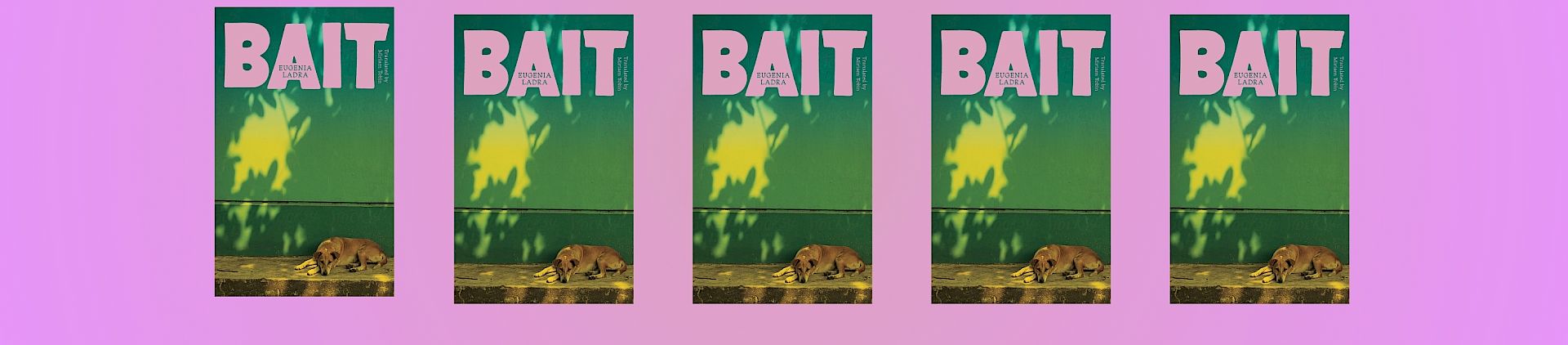
Extract: Bait by Eugenia Ladra, trans. by Miriam Tobin
Read an extract from the forthcoming novel Bait by Eugenia Ladra, translated from Spanish by Miriam Tobin. In the small fictional village of Paso Chico, based on the author's own childhood experiences in northwest Uruguay, two protagonists – a thirteen-year-old named Marga and a man named Recio – form a complex relationship that both reveals and unsettles how forms of violence are normalised within small towns across the country, indeed across many other Latin American nations —'every day without fuss, inconvenience, or even complaint.' This extract is accompanied by a special author introduction.
Author Introduction
From ages nine to eighteen, I lived in Nueva Palmira, a small town in the northwest of Uruguay. In summer, I used to go to a ravine called Punta Gorda, which has a special feature: it’s where the Uruguay River meets the River Plate. By this estuary is a small fishing community with a landscape of canoes, dogs, motorcycles, water lilies, and crabs. But there were also container ships going towards the port of Nueva Palmira, passing by Punta Gorda, and disrupting the natural beauty and harmony of this very wild landscape.
I think the seed for what became Paso Chico, the fictionalised village in Bait, was my experience of that landscape and environment. The uncomfortable and heavy humidity was engraved in my body, and I enjoyed returning to that feeling when I was writing the novel. The same happened with the landscape — it was a lovely exercise to dig deep into my memory to find details of the area once so dear to me. I really enjoyed the creative process of taking a real place and transforming it into one that exists only in my head. I tried, within the universal characteristics of a small town, to give it its own identity and particularities.
During the writing process, I used to think of Paso Chico as the set of a stage production: houses with open doors, winding roads with a corner shop, a bar, and the river as the border, with characters moving around in this lively scene. I was interested in working with only a few elements within a confined space, and this led to the need for a sense of precision. Writing within the set piece of the town allowed me to get to know my characters better, to see them and the dynamics of their relationships clearly.
Bait is a novel of atmosphere and environments, where the plot takes secondary place. We follow Marga, during the summer she turns thirteen, and Recio, a man who arrives in the village with seemingly no past. Theirs is a relationship that grows and becomes tense; at the same time, complex relationships between other inhabitants of the village begin to form. Their relationships are determined and shaped by the oppressive and suffocating atmosphere of the place where they live. Paso Chico is a town that normalises violence, that fosters twisted human conditions. And so the creation of the place had to be the core of the novel.
I’m interested in exploring forms of violence that, like in Bait, are so visible that they end up becoming the norm. I didn’t want to point them out or explain them directly. Instead, I found ways to let this violence run free, leaving the reader to confront it to the extent of needing to name it too. I wanted to say out loud what, in small towns all across Uruguay or any other Latin American country, happens every day without fuss, inconvenience, or even complaint.
1
There were five of them, but they moved as one jumbled mass of arms, legs and rolling eyes. They made their way through La Paraíso bumping into the bar’s rancid walls, smeared with slime and the remnants of worms, to see if they could get out of there, pursue the light that was creeping in through the holes in the tin roof and wake themselves up in the new air that follows a heavy night. When the muddled heap had managed to make it through the door and separate itself, the bodies straightened out and stepped onto the street. Only then, serene, as if they’d grown up from the ground that was holding them, did they take in the stillness of their surroundings: the cracked earth, the glowing sky, the horizon that divided them.
By then it was a little after four, that time of the morning when it’s already light but there’s no sound of motorcycles on the road; when mobile phones with their dodgy reception don’t even vibrate, batteries dead; when children are in their beds, mouths hanging open and bellies slowly rising and falling; when all you can hear is the frogs croaking from inside those houses with doors left open, sheltering within the cement walls.
The five men, having just emerged from the hole in the wall, started walking. They set off in a line, taking up the width of the street, bragging about what they would land the next day, which of them would reel in the biggest catch, and how the people from the Guinness World Records would turn up in the village, and just behind them the broadcasters from the capital with their suits, cameras, and microphones, recording interviews that nobody would see, because of course the news signal was too far away to reach Paso Chico and its tangled wire aerials.
But mid-conversation they fell silent. A howl, very close by and very piercing, left their feet nailed to the ground, ears pricked, waiting for another that soon came — its sound overpowering the chorus of frogs, the river breaking on the shore, the frenzied hum of insects at first light.
The howl of a dog.
It’s not like they cared that much, there was nothing new about someone getting bored, bundling an animal into a bag and going at it until it stopped squealing; most of them had done it at some point. What disturbed them was not knowing who it was — who was riled up at this hour when everything was quiet, the village was sleeping, and theirs were the only bodies that had been up all night.
They picked up the pace, turned the corner and went past Sandra’s – and that garden she insisted on tending even though it looked like a cemetery – and just then the scene materialised before their eyes. Marga, with one foot fixed to the ground while the other kicked over and over again. Amid the dust raised by the blows, the men stared at her, confused, nobody more than Recio who couldn’t understand why his girlfriend, rooted firmly to the spot, was shattering the ribs and backbone of the animal on the earth, making it jerk back and forth.
Only when the dog was quiet and the heads that had peered out of windows returned to bed did Marga lift her gaze. Four of the men continued on their way. They walked past the dog and the girl and the charged air between them, acknowledged her with a dip of their heads and disappeared silently. Just Recio was left, hypnotised by the lump on the road and Marga’s silhouette against the light, on that strange morning in which the echoes of the bar merged with the image of this girl, his girlfriend: frightened face, huge round eyes, scrawny chest covered in insect bites, long thin hands, metal rings on all of her fingers, glinting.
2
It was an afternoon at the beginning of that summer. The heat started to relent and gradually Paso Chico ceased to be the deserted land it became after lunch, when the sun beat down brutally and not even the insects could rouse themselves out of their hiding places. People surfaced from their siestas, aired out their musty homes and joined the crowd that had gathered outside, partly to scope out what was going on, and also to get some air now the cool had descended, to see if they could refresh their sluggish bodies and dispel all that humidity.
That was when they saw him for the first time: lying on the grass beneath the willow, his head against the trunk, a birthmark splitting his forehead down the middle, his body given over to sleep, naked chest rising, then falling.
It wasn’t long before they went over to throw him something to eat. It rained bread, biscuits and hunks of sweaty cheese and he devoured them like an animal, barely looking at what he shoved into his mouth, swallowing as fast as he could, first to satisfy himself, but then, and most importantly, to see if it would appease the knot of worms swimming in his hollow belly.
It was after he had eaten that they heard his voice.
Recio. That was the first thing he said.
A deep silence followed, the kind that settles in the air when no one knows what to say. Then, he tried again. As if his hoarse voice was just getting used to speaking, as if he had a desert in his chest, he said it louder: Recio.
People started to murmur under their breath, but their pretence didn’t last long, and they burst out laughing at this bizarre christening, at how someone, God knows who, had decided to give this boy the name of a grumpy old man instead of something more common. This went on for a little while and when they finally settled down and looked back at Recio, they saw him so shit-scared by their jeering that he wouldn’t say anything else: not where he’d come from, or what he was doing there, or how he’d found the village — a difficult feat when a tiny handwritten sign is all there is to welcome you to the swamp.
Always quick to come up with something to keep their minds busy, the old ladies of the village were left with no other choice but to invent stories about the new boy. They started by saying that Recio, who they guessed to be about eighteen years old, had appeared slinking through the empty streets, like a cat flattening its body to hunt its prey. They said they’d seen him keeping tabs on which houses left their doors ajar during the siesta, looking out for the best one to slip into with the excuse of snacking on something so as not to faint with hunger, and taking full advantage, sneaking off with a few items he could sell on at the port. They might not think it but we already know these types, they come around every once in a while, poorlittlethings, looking at us like butter wouldn’t melt, like they need our help, all, please señora, I’m hungry, and just like that, half-starved mister nice guys, they raid our shacks, making off with mobile phones, radios, some small TV they can fit in their arms, and go back home loaded with loot, their bellies full and their fingers slick from feeling up some sleeping girl as they passed through.
The fishermen said yes, they’d seen him arrive at siesta time, but from the water, in a battered little canoe that had started to flood because of how busted it was, and which had forced him to stop when Paso Chico came into view. That he’d just stayed in the river by the shore, splashing water every so often over the crown of his head, easing the heat that had built up in his body, and that afterwards, dripping wet, he’d headed into the village to see what he’d find. None of this business about sneaking into houses, taking what wasn’t his, or getting handsy with the local girls, señoras.
When the sun went down and the mosquitoes became so ferocious it was impossible to be outside, the villagers went into their houses with little thought for Recio, who soon after appearing became camouflaged among the rest of the young men in Paso Chico, all more or less the same with their worn-out shorts, bodies blotched with bruises, and beads of sweat trickling from their sideburns all the way down their necks. The fact is the boy was alone, in that same little square beneath the same willow, eyes wide like an owl, hoping that time would pass quickly and the early hours wouldn’t grow too heavy, a tall order when you’re in a new place and nightfall is inevitable.
But that was the last time Recio slept out in the open. The next day the villagers organised themselves and put together something resembling a plan, which despite being improvised and having no prior testing, was flawless. Operation Recio would be the same as that of the Virgin: every Friday the statue of the Holy Mother, which had been carved locally in the village, was moved between houses to spend seven days in the allotted home — dutifully overseeing daily prayers, first thing in the morning and last thing at night. Now that the boy had turned up in Paso Chico and had nowhere to go, he would be in charge of transporting Our Lady from one house to the next, and he too would stay for those seven days, as if the price for receiving the Queen of Heaven’s blessings was to host the boy and stick a plate of food in front of him.
On his second day in the village, Recio succumbed to the tour of the Virgin. He walked through the streets of Paso Chico holding the Blessed Mother tightly with his backpack over his shoulder, until he reached the first of the many houses that would be his home. He was in luck. After dinner, he would sleep on a sofa where he could stretch out his body and unwind after all he’d done that day: bathed in the river, wandered around, and completed the errands tasked to him by half the village, only so they had an excuse to talk to him and satisfy all their curiosity.
Bait by Eugenia Ladra (tr. Miriam Tobin) is published by Daunt Books. Out 18 June.


