Alligator by Luiza Sauma
This short, heart-wrenching story by Luiza Sauma centres two brothers, Antônio and José — 'a tall, white madman, and a short, dark índio'. The glorious setting of a Brazilian beach in the sunshine belies the pair's hurting pasts.
You can download this full piece for free during the month of January 2026, or read Wasafiri 124 in print, available to order now.
Antônio was waiting for his older brother, José, on the black and white pavement by Ipanema beach. José had flown in from London that morning, alone, without his wife and children. The air was wet and suffocating, like steam from a kettle. Antônio was shoeless. He stood on the white paving stones, which were slightly cooler than the black ones. Still, he was hopping from foot to foot as José approached, shrouded in glittering silver smoke.
‘Tonho?’ said José.
‘Zeca!’ said Antônio. ‘Tudo bom?’
They hugged. The smoke enveloped them. Antônio laughed. He only saw the smoke when he was happy. It made everything beautiful, as if sprinkled with fairy dust.
‘What happened to you?’ said José.
Antônio looked down at his frayed T-shirt and shorts, and then back at José.
‘You’re all silver, Zeca,’ said Antônio.
José nodded.
London had changed him. He didn’t speak Portuguese like a gringo, but he didn’t seem like a carioca to Antônio. In fact, it wasn’t José’s accent that seemed different; it was the way he moved — faster, but more reserved.
‘Your teeth!’ said José.
Antônio bared his rotten teeth and laughed.
‘Where are your shoes?’
‘Lost them,’ said Antônio, looking at his feet.
‘I’ll buy you another pair.’
José had tears in his eyes. Why was he crying? The sky was so blue, it hurt to look at it. The ocean was unusually calm and the lovely, sparkling smoke was everywhere.
‘Let’s go sit on the beach?’ said Antônio.
‘Yes, let’s.’
It was a Friday morning, so the beach was quiet, apart from the tourists, bums, students, and nutcases — none of them as old-Hollywood handsome as Antônio. The students interested Antônio the most, especially the girls in bikinis lying on their sarongs, oblivious to their perfection, reading anatomy textbooks.
José hired two beach chairs. He bought a caipirinha for himself and a can of fizzy guaraná for Antônio, who had wanted a beer, but José refused to buy him one.
‘I hope you drown,’ said Antônio blandly, when his brother handed over the soft drink.
‘Then we’ll drown together.’
Antônio’s madness didn’t surprise José anymore. Instead, he played along. It was easier that way, even fun at times.
They slathered themselves in sun cream. José made sure that Antônio had put it on properly. He needed it — he was paler. Then they sat on the chairs, drinking their drinks, facing the ocean, enjoying the feeling of the sun sweating them out.
‘Want to swim?’ said José.
‘Yes!’
José asked one of the students to watch their things, and then pulled Antônio away from them, before he said something crazy. They walked to the water, the oddest couple on the beach: a tall, white madman, and a short, dark índio.
∼
Thirty years ago, when he was eighteen, Antônio spent some months living in a damp shared house in Finsbury Park, London, several years before José moved over. He was learning English and trying to find work as a waiter, but interviewers didn’t like the distant, flat look in his eyes. Mamãe wired him money. She was busy with her second husband, Bruno, and had even changed her surname from Haddad to Santos. Papai was long-gone: shot by a car-jacker some years earlier. There were four other young men in the house: a Spaniard, a Frenchman, and two Argentinians. At first, they were friendly to Antônio. They helped him secure job interviews in the hotels and restaurants where they worked, took him to the pub, and bought him drinks. But as the weeks went by, they faded away whenever he appeared, just like the kids at school had done. They didn’t like his jittery, slim hands, his grubby old-fashioned clothes, and the way he combed his blond hair with his fingers every five minutes. Who did he think he was, James Dean? From Antônio’s perspective, his housemates seemed concerned only with sex, booze, and sports. They assumed that he would know something about football, because he was Brazilian, and he was too ashamed to admit that he knew nothing at all. Antônio loved Italian films, American literature, and French cigarettes, and liked to think he looked like a young Marcello Mastroianni. And he did, a bit — enough for people to say of him, when he was older, ‘What a waste.’
∼
Antônio’s first memory: he was walking towards Praça Nossa Senhora da Paz, hand-in-hand with his nanny, Jacira. With her other hand, Jacira was dragging their little white poodle, Kika, on a leash, but the dog just wanted to stop, sniff things, and pee on them. She must have peed ten times on the five-minute walk to the park. Antônio was five years old. The sun was sparkling and white, and the flowerbeds vibrant and hazy, like a faded photograph. As they walked into the park, Jacira gasped and dragged him backwards. Antônio’s legs buckled, and he fell. As he got up, he saw Papai, a few metres away, sitting on a bench, kissing a young pregnant woman on the lips. Papai looked up and saw them, and his face creased with rage. He walked towards them and struck his son across the face, shouting something that Antônio could never quite remember. His ears rang with the blow and with Jacira screaming and Kika barking. Antônio held her furry body and cried hot tears, which the dog licked away. Jacira took him in her arms and carried him home, even though he was too heavy for her slight frame.
Just a sliver of memory. He never told his brother about it. Perhaps Kika had not even been there, but it was comforting to think so. Maybe Papai had begged for forgiveness and kissed his face. Unlikely. For Antônio, it didn’t make a difference. After London, dreams and reality were one and the same ...
Read the full piece here, free to access and download for the month of January 2026 only.
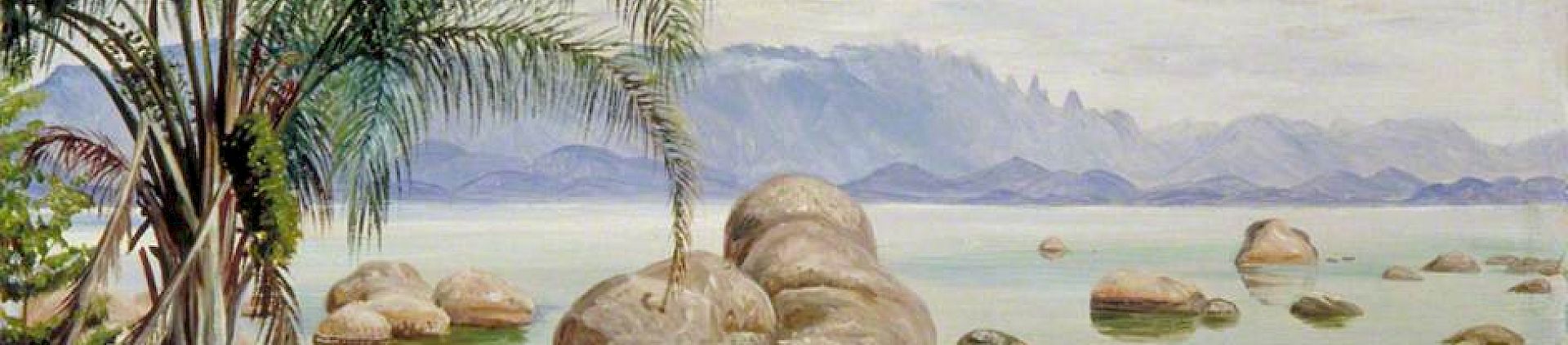
Cover image: Marianne North. Palm Trees and Boulders in the Bay of Rio, Brazil. 1873


Our winter special issue, guest co-edited by Leo Boix and Karina Lickorish Quinn, critically explores the vibrancy and creativity of the British Latin American and Latinx communities which have been unjustly marginalised — both within Britain and beyond.
