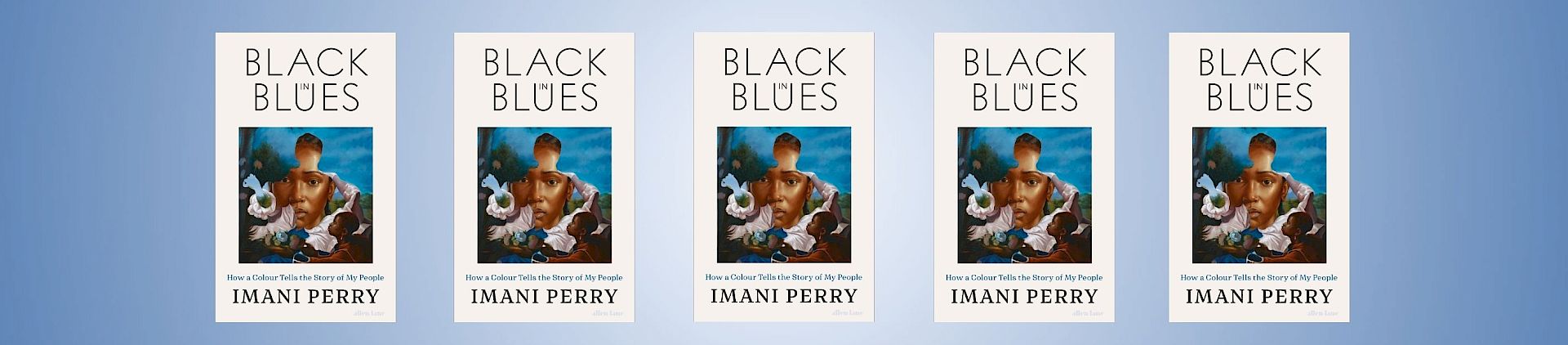
Extract — Black in Blues: How a Colour Tells the Story of My People by Imani Perry
Read an extract from Imani Perry's Black in Blues: How a Colour Tells the Story of My People (Allen Lane, 2026). Drawing from her own experiences, global history, and encounters with music, literature, and art, Perry traces how Blackness and the colour blue have been entwined for centuries — from the West African dyed indigo cloths that were once traded for human life, to American blues music, to Toni Morrison's writing, and more.
Blue Goes Down
I close my eyes and conjure up our home house, a term Black Southerners use for the dwelling where the family gathers. That yellow house with that blue bedroom was built in 1940. It was part of a development intended for White steel mill workers. My Black family was not imagined inside it when it was built. And yet we – or better yet they, because I wasn’t born yet – along with a host of other Black folks, moved into the neighbourhood in the 1960s, as segregated sections of Birmingham gradually opened up. My family settled in a place that wasn’t made for us and called it home. How is that for a metaphor of Black American life? Indeed, I could write hundreds of pages about the colour blue right there in the 'Magic City', as Birmingham is nicknamed. But Blackness, no matter how specific the experience, organically reaches across borders. And I followed it. Having lived over five decades, I have heard and seen blue ringing through Black life at every corner of the world, from Malian music and Yoruba cosmology to the testimonies of rural Colombians. In my blue notebooks, I steadily collected blue blues.
There was one story I found unexpectedly from Liberia that especially resonated with me. Maybe that was because it was recorded at roughly the same time that our home house was first built. I love archival coincidences. Maybe it stuck with me because it felt like the kind of cautionary tale I needed to carry with me as I revelled in the seductions of colour. But it was, as I said, unexpected, having been written down by Esther Warner — a White Iowan woman who set sail for Liberia, West Africa, in 1941 with her husband, Robert. Esther and Robert had met in college in Iowa. He was a scientist and she was an artist. He was employed by Firestone, the tire company, to work in Liberia as a researcher, and she followed him there.
Liberia has an unusual history. The nation was established as a colony in the early nineteenth century to address the problem of Black Americans. Not the problems of Black Americans, mind you, but Black Americans as a problem for the Americas, particularly the United States. Between 1822 and 1861, over 15,000 Black people of the Americas settled there, encouraged by political leaders who could not imagine free Black people fitting into the New World. Some of the Black settlers went feeling like it was the chance to set history right, a return to the continent from which their ancestors had been so cruelly torn. But their return to West Africa created new problems for those who had been there all along. The Black Americans were installed by the US government as elites. And their English surnames, once a sign of their captivity, were treated as a matter of distinction. Upon returning to Africa, they were transformed from being seen as those who bore the badges of enslavement into colonial rulers.
Even though, as a child of the 1970s and a student of history, I knew a fair amount about the dashed hopes of post-colonialism and how it has revealed that Black people have the capacity for injustice like anyone else, it keeps striking me as astonishing that people who had been so recently enslaved could pivot into colonisation and domination so quickly. Learning the history of Liberia is a lesson in the vexing complexity and always just-around-the-bend hypocrisy of human beings.
Although Liberia claimed independence from the United States in 1847, the country was quite vulnerable. Militaristic encroachments from France and the United Kingdom steadily reduced its territory. Liberian leaders struggled to find a firm economic footing. Even with American support (and influence), it was hard to build a Black nation in a world dominated by Western empires. They were pressured – under existential threat – to make some shady deals.
In 1926, Firestone Tires set up business in Liberia. The company was rewarded with an astounding agreement: a million acres for their use at the price of six cents per acre for ninety-nine years. It proved a boon for Firestone. During World War II, the Allied powers turned to them to make the rubber for war machines quickly and cheaply. In turn, Firestone employed Native Liberians on rubber plantations. 'Employ' is too polite a word, however. The Native Liberians were reduced to a status akin to slavery. As the fruits of their labour were being used to fight fascism, they were made unfree in all but name. The contradictions went even deeper. The Americo-Liberian rulers, people who had once been subject to the violence of the American plantation system, grew to be masters of the neo-plantation colonial system that served American economic interests most of all and concentrated power in their minority hands. The shared colour and even shared genealogy between the captives and colonisers did little to blunt the brutality, extraction, and exploitation of Africa and her people.
When Esther arrived in Liberia, a protest movement was burgeoning. But far as I know, she didn’t write about it. She did, however, write a great deal about Liberian people. Esther was fascinated by their culture, and she would ultimately refer to the country as home. Of course one has to be cautious when elite settlers claim a place as home. As a many-decades-deep student of race, and an all-my-life Black person, I was immediately sceptical of her writing about Liberian culture. I’ll admit I initially wondered, who was this White American woman to lay claim to these stories? But I read them anyway. And I felt thankful that she recorded and published them so that they were in books for me to read.
Notwithstanding the fact that these stories had been filtered through Esther, they resonated with me. And that is the tricky part. We human beings are built to love and share stories. It is one of the best ways to connect. Lore transcends difference. And yet storytellers who belong to powerful groups are reasonably met with suspicion because of how the world has been carved up and stratified. They do not speak with voices of the many but rather as members of the privileged few and usually reflect those interests. Wariness is reasonable. After all, the world being the unequal rat race that it is means that even the deepest forms of love must be watched carefully for selfishness and greed. So of course colonials who love native cultures must be too. I loved Esther’s stories, and found myself wanting to retell them, especially one called 'Blue Goes Down'. But was I just like Esther? Maybe. Like her, I wanted to make a home inside Liberian storytelling, even though it isn’t 'mine' in any organic way. Perhaps that means that I also deserve to be treated sceptically. In fact, I am sure it does. I am American, Black American, as were the colonisers of Liberia. But I’m also likely a distant cousin, a descendant of one or many once stolen away. I am made of coloniser and colonised, with respect to these stories and to history itself. That strange intersection makes it hard to name my relation to people of other nations, languages, and territories, even if we belong to the same 'race', according to the history of modernity. Even Ancestry.com’s detailed and seductive mapping of genes by geography can’t untangle all those threads; in fact, it scrambles them more. And yet I have the nerve to want to tell stories about Black in Blues that extend far beyond my national origin. And Esther Warner offered me a shot with an old story I loved about blue in Black life. It is a folktale about the origin of indigo. According to her elegant rendering, the beautiful dye is recompense for grief. In it, a holy woman named Asi disastrously allows her child to die while she gorges herself eating the blue sky. I turned the strange details over in my head, eventually attempting to re-narrate it to earn (and learn) its lesson. I wrote at least a dozen versions, each time adding more 'colour' by adding in details that made it my own. Zora Neale Hurston described a cultural habit of adorning stories in her famous essay 'Characteristics of Negro Expression'. I seem to possess it. So here is my home-written version of 'Blue Goes Down':
Back before what we call the 'Norman' days – when American Blacks and their Whites came and never left –
But after the high gods had already stepped beyond human reach (our wanting ways having been too much) –
A blessed mother, Asi, was tired of her responsibilities, that have-to have-to every day from dawn to dusk.
She was resentful of the burdens of divine prognostication and virtue. Indulgently, she took a grave bite of heaven and had no one to tell her otherwise. Eating sky was supposed to be reserved for moments of piety and devotion. But Asi gorged on her own desire. Reckless, each bite was thick like stew and smooth like wine. It
made her warm, delighted, and head-spun.
Lying on a cotton lappa, with her baby tucked at her side, Asi’s toes pulled merrily at tall blades of grasses.
Her eyes turned fish-blue shimmer
Her body turaco-blazed azure
Tongue coated sweeter than cane juice and thicker than beach swell
To want and take was everything
With a soaked mouth, she sang wild
Floated high away from duty – no oracle, no rite, no responsibility –
Like lightning, she was stricken hot and bright,
Then glimmered: no body, not obliged, no having-to
Just sky drunkenness, beyond sated
She gulped fast, coughed on clouds, drooled rain, spiraled out
Till spent.
At midnight just shy of pitch
Asi came to. She reached to her side. Her heart shook, then dived.
The baby had rolled away like the stone, face down,
A puddle under tiny hips shone blue in the moonlight
Naver string cut now, not just once but forever
All two had breathed, now childless mother alone
Brayed and howled
She clutched the lifeless body tight
Shoved sasabiya beads into her eyes
Anguished, spastic freezing — she jerked to depletion.
Dawn came with the gall turned bitter-breath and her throat raw
It was unbearable
Asi reached a crooked arm up for a taste of heaven
Just a little softness, she whispered, because my baby is gone
But the sky had risen
The high gods had left her
And us once again
This time they’d taken their heavens with them
Divinity spoke in a chorus:
To hold blue now
sinew and mind must be exerted.
The ash of evening fires
shredded leaves
and tears
will be worked together.
Indigo
What was the point of this tale? Maybe the Native Liberian who told Esther the story of Asi was offering her wisdom. Maybe it was intended to warn her about the dangers of greed and irresponsibility. Maybe they hoped she would repeat it to her Firestone-employed husband, and that he, one of the bosses, might choose decency over cruelty. And if so, maybe the story is also a clue about why Esther’s marriage to Robert failed. Maybe she wanted nothing to do with the greed of rubber plantations. Maybe we, I, need to remember the moral.
Having a having way about you – that is, wanting too hard – can make you do terrible things. Certainly, blue is beautiful. And so is yearning for beauty. But greed is ugly, as is any obsession over possession. And that, along with everything one might want to say about gunpowder, empire, and political economy, is at the root of how Black people became Black, as such, that is to say blue-black.
Oral storytelling is improvisational. Like poetry, it explodes the difference between nonfiction and fiction. Imagination, details, and knowledge are all flexible tools in service of the lesson. People, especially elders, repeat stories over and over again with purpose. In the arrogance of youth, we often think they do it because they are absent-minded. Now I know they repeat themselves because they’ve whittled life down into observations that should not be forgotten. They are authoring scriptures of their own.
But once a story is published, and not just spoken, it qualifies as something else: a document. And it stands alongside other documents, including the official ones that make laws and judgments, punishment and property. Some of these supplements, alternatives to official documents, are necessary to add flesh and blood, heart and soul, to what we know. They might even expose the lies of the official tales.
I clung to the story of Asi, turned it over with my imagination, and a new version to print, because it helps me remember there was a time before Black, but not before blues.
Black in Blues: How a Colour Tells the Story of My People by Imani Perry is published by Allen Lane on 30 April 2026.

