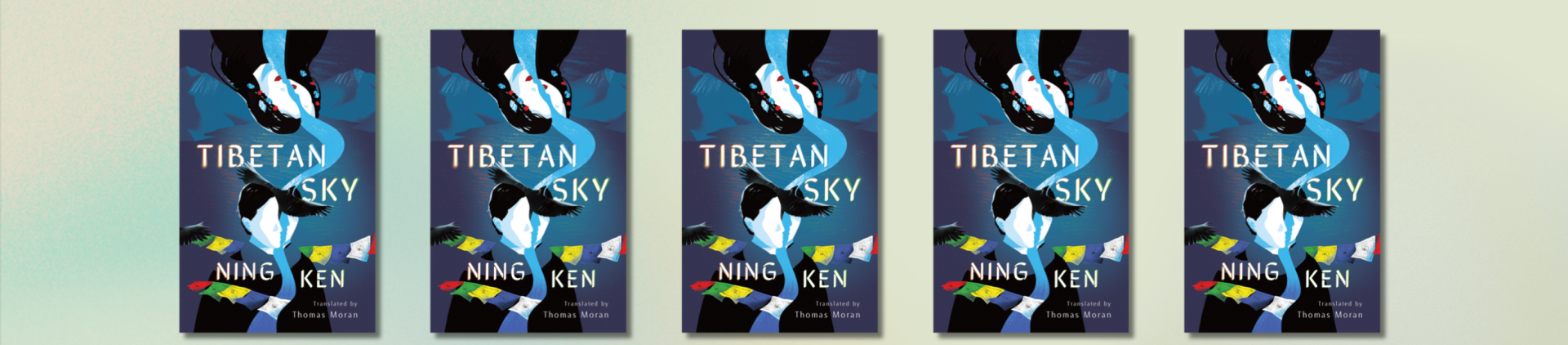
Extract: Tibetan Sky by Ning Ken, trans. by Thomas Moran
Read an extract from Ning Ken's forthcoming novel Tibetan Sky – translated by Thomas Moran – a philosophical work of fiction about a disillusioned academic and the complex history of Tibet.
White. Afternoon. The Thinker. Adhisthana.
The valley. The river settled into winter. Grass. Sandbars. The other side of the river.
Long hair. Blue jeans. A cigarette. Prayer beads on a wrist.
The cigarette didn’t go with the prayer beads very well.
A juxtaposition. Memories.
By the time my friend Wang Mo laid eyes on Ma Dingge, snow had been falling all day and into the afternoon. The mountains were white, everything in sight was pristine, empty. On the plateau, Wang Mo said, you can never tell how large an area a snowstorm covers. Snow might have been falling all along the Lhasa River, maybe even along part of the Yarlung Tsangpo too but no farther away than that. No storm can blanket the entire plateau, Wang Mo said, just like sunlight can’t. Maybe Ma Dingge was seeing distant sunlight in his mind’s eye, perhaps he was seeing sunlight from beyond the far mountains. To look at him you would have thought so. Snow covered his robe of red pulu wool, and even though the snow had filled the folds in the fabric, he seemed untouched by it. Depending on how you looked at him, he was a snowman, he was a sculpture, he was The Thinker. Behind him was the white expanse of the monastery, and the snow seemed to be pouring down from that direction. The monastery was ancient, it had once flourished. The active monastery complex was enormous, and it was surrounded by an equally enormous expanse of abandoned, ruined buildings. The monastery and its ruins were a pale hue in the background, which is not a metaphor. I don’t mean the historical background, it was literally in the background as Wang Mo looked at Ma Dingge, like a mountain might be in the background as birds fly by in the foreground.
Ma Dingge was meditating, he was in the moment with no thought of any past or any future. He was motionless, still to the point of stopping time. He never held on to time, which is why he had all the time in the world. He was sitting on a huge boulder – Wang Mo had once sat there himself – that rested on an otherwise barren slope. Ma Dingge was facing the snow below the mountain, the river valley, the river settled into winter, grass, sandbars, the mountains on the far side of the river and sunlight beyond the mountains and into the distance. Ma Dingge was in all of these places at once.
Ma Dingge’s hood was pulled over his head and covered in snow. All you could see of him was part of his face, just visible under his hood, like he was looking out from a window. If it weren’t for the glint from the frames of his wire-rimmed glasses and the light reflected in the lenses, he would have looked exactly like a snowman. You could see his eyes through his glasses. They were extraordinarily pale. Whatever the weather, it always seemed to be snowing in his eyes. His gaze seemed to take everything in but also turn everything away.
Wang Mo and Ma Dingge knew each other, but at that moment Ma Dingge saw no one, and so Wang Mo was able to walk back and forth in front of him as if Ma Dingge were a statue. Wang Mo was wearing a leather jacket and a grey checked scarf. The scarf looked somehow wrong, like the external manifestation of Wang Mo’s troubled soul. Wang Mo stood near Ma Dingge for a long time, and the snow soon covered him too. He and Ma Dingge were objects occupying adjacent points in space. Like one statue in juxtaposition to another, Wang Mo said. He was pleased by his simile and thought that by standing perfectly still he could experience the mysterious realm where Ma Dingge had gone.
As the author of this novel, I will interrupt the narrative from time to time with thoughts and comments, and the first thing I have to say is that Wang Mo’s simile was in fact inapt. Wang Mo had a rich inner life, he was a man of sensibility, but he was infatuated with his inner life, and his sensibility was often too delicate. I say his simile was inapt because usually – or at least much of the time – a statue captures some timeless emotion, attitude or expression, and therefore if one were to say that Ma Dingge in meditation was like a statue, it would be understandable, if a bit forced. Wang Mo was standing stock still, but his mind was racing and his expression was changing constantly, so no matter how still he stood, he could not be compared to a statue. To put it another way, in Wang Mo’s face you could see time passing, you could see impermanence and change. So, while Ma Dingge and Wang Mo were indeed in the same space and adjacent to each other, it was nothing like one statue in juxtaposition to a second statue.
Yes, you are right, Wang Mo was a friend of mine, as was Ma Dingge. Several other characters who will make their appearance in this novel were also friends of mine. I understand them. I know them well. I lived among them for a long time. I lived in Tibet for many years, off and on, and I have written about a few of the people I knew there, but there are even more I have never written about. It is not easy to tell their stories. They are set in Tibet, which gives them an inherent interest, but still they are not easy to tell. Actually, because they take place in Tibet it makes them more difficult to tell. There is something about Tibet that cannot be captured in language. Tibet works on the emotions the way music does. Tibet is abstract. It is something you feel. It escapes narrative. You cannot describe in words what is special about Tibet (those characteristics that are like music) or what is special about the people there. We relate to Tibet the way we relate to music. For years I have tried to write about Tibet but to little avail. I have not succeeded, and this time may be no different I’m afraid. I’m not trying to tell the story of what happened in people’s lives. I’m trying to write about existential being. It is relatively easy to tell someone’s story, but to capture existential being in language is almost impossible, especially when that existential being has the qualities of music.
Wang Mo went by Wang Mojie, but his real name, the name on his National Identification Card, was Wang Wei. He didn’t use the name Wang Wei, but the people who knew him in Tibet didn’t call him Wang Mojie. They shortened it to Wang Mo, which was a bit sarcastic and teasing but also, of course, a gesture of a little respect. We are often fascinated by people we find both ridiculous and admirable. Wang Mo shared his real name with the Tang dynasty poet Wang Wei. The Tang poet’s literary name was Wang Mojie, which is where my friend got the name he used. He did, in some ways, pretend to be like the Tang dynasty Wang Wei, who was a Buddhist who wrote about the peace and beauty of the countryside, but actually my Wang Mojie or Wang Mo was the opposite of everything the poet had been, and he admitted as much himself. It is impossible for times like ours to produce people as free, natural and unrestrained as the Tang dynasty Wang Wei. At best, all our age can produce is people like Wang Mo. For several reasons, including the demands of fiction, from now on I will refer to Wang Mo as Wang Mojie, which will have its significance.
Everything begins to change in the moment of its becoming, and precisely at the moment that the idea of the statues came to Wang Mo’s mind, he was surprised to discover that Ma Dingge was not, in fact, motionless. The snow on Ma Dingge’s robe and hood was melting and falling from him. This was happening slowly, like the imperceptible change in the shape of a cloud. When we perceive a change, it is always at the moment that the change accelerates. Change begins before we are aware of it, and we perceive it only as its pace increases. This is true of many phenomena; we notice them only after they have begun to change and as the change accelerates. This is the experience of existing in time. Wang Mo saw that Ma Dingge’s red robe was quickly free of the snow, its colour now particularly vivid because it was damp. The falling snow had retreated from Ma Dingge. It seemed to stop at a distance from his body, forming an oval around him. Ma Dingge sat in the middle of this oval like a lamp or like its flame, glowing, transparent. From a distance, it was like seeing lamplight in a window on a snowy night. Nearby, Wang Mo’s students were yelling and laughing as they chased one another. It was just noise to Wang Mo, but when the sound reached Ma Dingge’s ears it might have sounded to him like birdsong in heaven for all one knew.
We left him alone, we let him listen to the birdsong, Wang Mo said. Some of my students came running over towards the boulder, he said, but I held up my hand, stopped them and made them turn around. They were just running around, without any thought of disturbing anybody, like birds in flight. They had noticed Ma Dingge right away, but they were used to him and found nothing unusual about the sight of him sitting out on a boulder in the snow. The birds had seen him before, the children had as well. A pack of dogs ran after the children, the children wrestled and tumbled in the snow, and the dogs imitated them. Now and again, the dogs dashed in and out of the woods just below the barren slope, kicking up plumes of snow. The dogs played even harder than the children. Typically, the dogs followed the children to school every morning and followed them back home every afternoon. They never entered the school compound. They lay outside the gate.
From Tibetan Sky by Ning Ken, translated by Thomas Moran. Published by Sinoist Books in October 2025. Order your copy now via our Bookshop.org page.


Inside Wasafiri 123, you'll find interviews with Andre Bagoo and Christina Sharpe, a lead feature poem by Devika Rege, our 2024 Essay Prize winning articles, and much more. The issue also includes a special section – Tibet: In Focus – showcasing creative-critical commentary by a range of contemporary writers, translators, and artists.
