Iyer by Senan, trans. by Meena Kandasamy
This humourous, tongue-in-cheek fiction by Tamil writer Senan – translated by Meena Kandasamy – follows Iyer, an upper-caste man who arrives in London and begins working at a chicken shop on Walthamstow High Street. There, he navigates visa quagmires, house-hunting, coworker drama, and falling in the 'wrong' kind of love. This text is from Senan's latest book-length work, titled Londonkaarar (Londoners).
Supported by a grant from the Open Society Foundations.
Iyer is not a name usually given to anyone. It is a term that refers to a particular caste. It is customary to call people belonging to the Brahmin caste – the upper castes who are priests in temples – as Iyer. Temple priests are distinctly visible: they do not eat meat, they tie their hair in a topknot called a kudumi, and they wear these heavy kadukkan in their ears.
Our Iyer was born into a family that used to perform the prayers in an Amman temple. The temple, located on a tiny island between India and Sri Lanka, was completely destroyed by the Sri Lankan Army during the siege. Iyer’s father, his grandfather, his great-grandfather – generation after generation – had all served as priests in that temple. It is customary for the villagers to call all the males born in the family as Iyer and the females as Iyer-amma. But this Iyer had never performed prayers in any temple anywhere. As the temple was destroyed, he came to London to save his life and seek other means of livelihood.
The British Government did not believe a word of what he said. They dismissed everything with a single line: ‘lacks credibility.’ It was during this time that he found a job, off the books, at a chicken shop.
Every piece of chicken he fried came out half-done, looking absolutely pathetic. Sugan went through many travails trying to teach this man how to fry that living-being called a chicken. It did not yield any fruit, or, for that matter, fried chicken. Sugan, Saravanabavanar’s son, was from the same village as Iyer, and he was in charge of the shop. Iyer’s family had never allowed Sugan’s family to enter the temple where they officiated as priests. The caste practice – that none of the so-called lower castes who eat beef can enter the temple – was upheld as a custom from the time the temple was built.
When Iyer started frying chicken, Sugan had no time to brood over old grievances or work out delicately how he ought to approach the man. The shop, near the busy Walthamstow High Street, turned frantic on Friday nights. Customers poured in without a pause. ‘Aiyaa, please don’t just stand there watching, pick up that chicken and put it in the box’ — that would have presumably been their first conversation.
Breaking Iyer in was horrendous torture for Sugan. On his first day, Iyer earnestly believed that he had worked himself to the bone, dashing here and there, doing this and that. He held the idea that the appearance of movement was work. But because he lacked the actual skill required for the job, he never finished a single task that needed to be done. The entire workload descended on Sugan, who seethed in anger.
Eager to help, Iyer took the chicken from the frying oil before it was cooked. Looking at the pan where the chicken lay half-raw, Sugan lost it even more. ‘Aiyaa, why do you keep pulling out the chicken when it is only cooked halfway? ‘Keep your hands off the chicken for now,’ he scolded. ‘Brother, teach me and I will do exactly as I am told,’ Iyer said, and he was assigned the task of stacking takeaway boxes.
But Iyer never stopped being habitually offending when it came to pulling out the chicken way before it was sufficiently cooked. Sugan would lose his cool and chide him – ‘You do not have eyes or what?’ – and yet, Iyer's stubborn, relentless efforts softened him. About the Amman temple, the two of them never exchanged a single word. Sugan's looks appeared to be trying to tell Iyer something, and not knowing what to do or how to respond, Iyer would keep his head down and, as was his regular habit, lift the chicken out before it was done frying. ‘Aiyo!’ Sugan would scream, lunging at him. The coldness between them would melt, loosen up a bit. And yet some wordless language went on making utterances between them all the while.
**
In London, there are shops on every corner selling fried chicken with a side of chips. Most of these shops are staffed by workers who have come from Asian countries. And it is mostly foreigners who buy and eat this fragrant chicken soaked in oil. White people eat only American chicken, KFC and such-like. Sometimes the white kids from poor neighbourhoods come looking for this chicken. One cannot buy two chicken thighs for two pounds anywhere else. Those two pounds were Iyer's daily wage in the early days of his employment. Under British law there was no need to pay him the minimum wage. People with no valid visa had to take whatever pay they were given. In a bid to secure his papers, Iyer appealed against the decision of the Home Office – when that appeal failed, he filed a fresh appeal – and this was how Iyer’s life struggle went on with barely a pause.
It was just as the fight for his right to remain was almost drawing to an end that Iyer fell in love. He was afraid that if he fell in love without a visa, people would say he was only doing it to obtain the coveted visa. That is why, until the visa landed, he hesitated to declare his love.
The powerful British state did not have the power to stop him from falling in love. In that same shop there worked a Black woman, Chantella, who fried chicken superbly to crisp perfection, and Iyer fell for her — it was a one-sided love. It is very rare for Africans to work in Asian shops. It is equally rare for Asians to go and eat at African shops. The tale of how Chantella ended up working in this particular shop deserves a separate rendering.
However, it would be no exaggeration whatsoever to say that the incidents that shook this area began precisely from this improbable, impossible love. Sometimes, when a great earthquake happens, there is a tectonic shift that displaces the very plates of the earth. It would change the landscape forever, as we knew it. Plants and living creatures, carried off to new, unknown climates, would struggle for their survival. That is exactly what happened to the chicken shop neighbourhood.
But Sugan, as if he had foreseen all the dangers and their eventual culmination, warned of them in advance. Don't love that Karuppi! Don’t love that Black woman! Sugan chanted it like a mantra over and over again. What was the use? No use. There was no use even in him trying to ruin it indirectly. He had tried telling him, ‘Aiyaa, look, she eats everything!’ Iyer's love for Chantella welled up — it was inevitable, unstoppable, fated.
Sugan would be enraged, his temper reaching a fresh peak each time. But Sugan’s anger was not about the love itself. He reckoned that Iyer was going to loaf around with Chantella and end up cheating. On the other hand, that alone was not the reason for his anger. Most Asians held the belief that Black people and white people would sleep with just about anyone. That a true love could not blossom where Black people or white people were concerned was a matter of fact. That is why he did not concern himself too much with the love aspect of their relationship. His preoccupation and anger were rooted in self-interest: if these two people who worked in the shop teamed up as a couple, his own working hours would suffer. He felt that if Iyer and Chantella decided things between themselves and fixed their work hours to suit each other, he would no longer be able to do as he pleased. He was afraid that a far greater share of the work would land on his own head. Otherwise, he simply did not believe there was any epic love flourishing between them.
Iyer could not make his Tamil brothers and sisters understand that his love for Chantella was true love. ‘Aiyaa, stop talking such mad stuff,’ they would say, cutting him off. ‘He is joking,’ these Tamil brothers and sisters would say in all seriousness, steering the conversation away in another direction.
Of course, annoyance was another reason for their cruel behaviour. Iyer was a married man. Marrying young had been the default practice in Iyer's family. Because he had no visa, he had passed thirty years of age without getting hitched, and his parents, swimming in grief over his circumstances, decided to take the matter into their own hands. They frantically sought out and found a woman who would wash and wipe and worship his feet, cook his meals and feed him on time, and live with him. Hidden away in the belly of a lorry came twenty-year-old Deivaanai, the daughter of Indiran. She stepped off at Dover.
Deivaanai had grown up as Indiran's little baby girl. She was the sort of slim where you could clasp her waist in your one hand. ‘She has come straight from Ethiopia,’ Iyer would make fun of her. Such daily remarks were as natural to him as breathing. Sometimes, he would shout: ‘Bring on the snacks, Pamela.’ If she was a little slow, two slaps would land on her cheeks inside the bedroom.
Iyer was in the midst of a severe crisis at that point in time. His solicitor had demanded ten thousand pounds to fight the case against the Home Office. He was paying it to him in small instalments. When Deivaanai arrived, he lacked any means to rent a separate place where they could live together. He was staying in a small flat above a shop on Walthamstow High Street. It was a flat with a tiny kitchen and a single room. Right next to the bed inside the room, you could find the bathroom. No one would believe that three people whose asylum claims had been rejected were living inside this tiny, tiny place. They had arranged their bare-bones life so that two of them shared the one bed and the third person slept by the kitchen door. When Iyer realised that it would be impossible to live in this home with Deivaanai, he wandered around looking for a home, and his hunt led him to Deivam.
Deivam, who lived in an apartment beside the East London Crematorium, happened to meet Iyer quite by chance. Please bear in mind that in Hinduism there is no such thing as chance. Iyer, having been raised in a family steeped in the Saiva worldview, knew this all too well. What is chance after all but one of two things: either Fortune has caught hold of you, or Sani (Saturn) has. Those of you who wish to know more about Sani: please just take the Metropolitan line and get off at East Ham station. Turn right, walk for about five minutes, and you will come to a massive temple. In the right-hand part of that temple, you will see one idol around which many women and men circle (or do we say, circumambulate), again and again in fearful devotion. Hindus live in terror when they think of Sani, they tremble even to utter his fancy name. That is Sani. Sani, or Saniyan when you hate him all the more, is believed to be the anthropomorphic (human, for the layman) form of the planet Saturn, the sixth planet from the sun, and he possesses the power to strip away everything you own, your money, your goods, right down to your life. If Saniyan takes over your life, it means your story is finished. In London, if you ever meet a Tamil, try saying Saniyan to them. By the way their face falls, you will understand the absolute dread of an entire community.
Iyer's Saturn came to him in the form of Deivam and laid siege to his life. Deivam was a distant relative of Iyer. Some kind of kin, too complex for me to draw a family tree and explain in detail, because to this day even Iyer does not know what kind of relative he was. Deivam had finished a PhD at Cambridge University. Because he could not find a job, he went door-to-door pushing random advert-flyers through people’s letterboxes. If anyone dared to mock him – ‘Did you really study at Cambridge? Why have you not been able to find any other work?’ – he would deride them in equal measure, somewhat lunatically. Even the art of expressing affection had turned within him into an exercise of his mockery-muscle. It was his habit to roast every human being he met. Immediately afterwards, he would embark upon a lengthy discussion about his Cambridge PhD.
When Deivam met Iyer for the very first time, affection oozing out of every pore in his body, he clasped him in a tight hug.
At once Iyer asked him for a room to rent.
‘Aiyo! Aiyaa, you're practically my relative. Come with me, stay with me. The rent is quite low!’ saying so, Deivam took Iyer under his custody. Until then he had been living alone in that little one-room flat: it had just a single bedroom, living room joined to a kitchen, and a small bathroom. Deivam rented the room to Iyer and Deivaanai and started sleeping in the living room. Within a few days, Iyer came to the realisation that he had lost Deivaanai's love. Soon, he picked a fight with her over every little thing.
‘You're using a tender little thing and squeezing the life out of it,’ Deivam would chide him.
‘Are you a human being at all?’ What would begin as a seemingly innocent comment from Deivam would soon become a strangely heavy discourse saturated with content from feminism through postmodernism and post-structuralism all the way to Marxism. As if in conclusion, he would point out to Iyer: ‘You are a male chauvinist!’
Deivam was a great devotee of the Goddess, otherwise known as Pamela Anderson. Deivaanai kept bringing Pamela to his mind all the time. Her slim figure, her soft speech, her open, wide smile that won you over, the long hair that came loose and flew about even when there was no wind — every passing instant of her presence melted Deivam. Not knowing how to handle this love triangle, Deivaanai ran back and forth between her room and the kitchen situated right in the corner of the living room.
Deivam took on a new avatar: he drank excessively and mocked Iyer brutally. In this new incarnation, the distance between Iyer and Deivam kept widening by the day. When Deivam was drunk as fuck, he would speak in the coarsest language, and he never once hesitated to flaunt his Cambridge PhD.
Iyer grew sick of life: the good man who was spotted with sacred ash and sandalwood in Nallur now staggers about like a common drunk spouting filth! How could he make sense of this transition!
Left to himself, Iyer approached Kedaranathan (grandson of Naachimuthu and Nagalingam, the man forever going on about temple sponsorships and such like) and sought his guidance. Kedaranathan took it upon himself to rectify the situation. So, he came forward to instruct Deivam: ‘Brother, it is not enough if you have studied; you need to be civilised also.’
‘Are you setting up your proxies against me? I will fuck you for fucking with me!’ said Deivam. Gathering up all of Iyer’s belongings in the flat into two black bin bags, he set them down outside the flat's front door. He professed his love to Deivaanai, his own Pamela Anderson.
Getting mixed up in this quarrel cost Iyer heavily. He lost his old job. With nowhere to go, he forced himself upon Deivam, lodging himself temporarily in Deivam's living room. The two black bin bags stuffed with his belongings were left by the entrance door. Iyer lined up a list of all his friends and acquaintances from whom he could borrow money; he tried contacting them one by one, but nobody came forward to help. Someone took pity on him and gave fifty pounds. Another, twenty; yet another, seventy pounds, and whatever loose change he had on him. Everyone gave him only what they could spare.
Coming to the conclusion that there was no one else other than Kedaranathan (Temple Man) he could turn to for help, Iyer undertook strenuous efforts even to find out his address. Overwhelmed to see the Benz car parked outside his home, Iyer walked in. Kedaranathan did not even invite him inside, he spoke with Iyer right there in the doorway.
‘Thambi, I will pay it back before my seven-and-a-half-year Saturn is up,’ he said, asking for a loan. Kedaranathan was sophisticated: ‘I'm retired, Aiyaa. These days I only handle the Nagalingam Trust.’ His refusal to lend landed like a thunderclap.
‘So your good-for-nothing grandfather is whom you name the trust after?!’ Iyer muttered these things from pure spite, walking away from Kedaranathan’s home feeling forlorn. Seven-and-a-half-year Saturn started working harder. On the way back from Kedaranathan's house, he got drunk on Stella (Stella Artois, the famous wife-beater beer) with the cash he had on him. Neither Deivam nor Deivaanai was home. They had perhaps gone strolling in the park. Deivam was immensely happy walking arm in arm with Deivaanai. Stella, meanwhile, had turned to piss and pushed forward, past holding. Pissing against the shut door, Iyer kicked the door to force it open. Suddenly a bulb went on in his brain, as they show in the comic books. Deivaanai's jewellery, the cash Deivam had kept hidden inside a book, the brand-new jacket he had just bought: Iyer took it all and walked out. After this, he never went back there again.
From that point onwards, Iyer's entire way of life changed.
And yet, to this day, many Hindus who knew them as a couple go on believing that he is still faithful to Deivaanai, and that the two of them will somehow be reunited and live together.
When Iyer was on the lookout for a job, Kedaranathan had asked him to go and see Baskaran. On meeting him, Iyer stretched himself to his full height, straightened up, then suddenly fell flat at his feet. Iyer's hair got caught in the man's expensive Nike trainers. On hearing the resounding ‘Aiyo!’ that escaped Baskaran, Iyer immediately understood that he had secured himself a job at the chicken shop. The next day, Iyer simply shook his head, gathered up his hair into a topknot, and started work. The Black woman Chantella was thrown into confusion watching him. Taking in that fluttered reaction from her in a flash, Iyer (who told Sugan that one must not let a good chance slip) fell in love with Chantella. But this carried on as a one-sided love. Chantella did not yield to any of his games.
Sugan had all sorts of suspicions about Iyer’s love. One lingering doubt was that Iyer was only pretending to be smitten with Chantella so that he could move into her flat. But that something indeed was running between them — some teasing, some agitation, something he could not quite name. Sugan could not resist being witness to this.
Chantella set her target on Iyer's vegetarianism and struck a deathblow. A few days into the work, at Chantella’s command, Iyer swallowed a whole chicken leg in a single gulp. His bravado landed a lethal kick to his seven-and-a-half-year Saturn that had gripped him so far. The chicken went down his belly with a thrill. Even so, the state of the chicken Iyer fried saw no change whatsoever — it was always half-cooked and miserable. Sugan tried to advise him: ‘Aiyaa, please fry it the way you yourself would like to eat it.’
It was at just this time that the British Home Office too surrendered. Accepting that it had made certain mistakes, the Home Office granted him leave to remain.
‘Look how the Jupiter transit brought along by Chantella is working,’ Iyer rejoiced.
As he pointed out to Sugan that within a year he would be granted British citizenship, many plans raced through Iyer’s head. One of his ideas was to take revenge by breaking into Deivam’s home again, and looting his money and Deivaanai’s jewels. He had mentioned the broad outline of this, obliquely, to Sugan's friend Ramesh, who had once worked at Kurinji Restaurant in East Ham. Ramesh's positive response fired him up all the more. However, every one of these thoughts ended up being brushed aside when he remembered his ongoing love story with Chantella.
Watching their flirtations, Sugan would sometimes feel utter disgust.
‘My dear Sugan, forgive me,’ Iyer would fashionably apologise.
‘Don't love, please just don't love, that Black woman,’ Sugan would sing, as if he were in a Bollywood musical. He kept all of his chiding restricted to Tamil because while the Bollywood vibe was great, it was not his intention to hurt Chantella. At any moment, it seemed these lovebirds might start chasing each other round and break into song. Sugan would conjure very romantic scenes of the chicken shop floating high up among the clouds.
Knowing that his story with Deivaanai was over, Iyer’s parents started searching for a bride again and renewed their pressure to get him remarried.
‘A phone call came yesterday too, my son.’
‘Marry Deivaanai, marry Valli — that's the only refrain, isn’t it?’
‘If I say I'm going to marry a Black woman, they say they won't believe it.’
‘Stop talking nonsense like this, they say, and dodge my declaration.’
‘Let my divorce papers come through, then we shall see about the rest.’
Listening to these tales, Sugan would feel his ears bleed.
Was it love that Iyer felt for Chantella? Or was it plain lust? Or was he going through this elaborate ruse just for the sake of a roof? Sugan, unable to make out the truth-value of any of this, kept fretting.
Iyer would boast about her: ‘See, there is a good deal of meat wrapped round the Black woman’s frame; she is not the skin-and-bones like our lot, not the Pamela Anderson type.’
Chantella, fondly called Karuppi (Tamil word meaning a black woman) by Iyer, would often look at him in astonishment. His hair gathered together and tied into a knot. A half-there gaze. ‘Aye, when you are talking to someone, you should look that person in the eye,’ she would tug his topknot, pulling his head up. Iyer’s heart would pound.
Sugan had taken the liberty of giving her lessons in Tamil swear words. She would prod Iyer in his big belly and go all in with her knowledge of these important words. When she swore in her broken Tamil, it sounded like flirting and cooing, and Iyer would blush. When she tilted her head back and laughed so that her dreadlocks swung, he would want to gather her up then and there and hold her in his arms. Iyer would steal sidelong glances, again and again, at her breasts and her ample behind. She would notice, pretend not to, and laugh to herself.
‘Instead of frying the chicken, why’s he standing there staring at this?’ she would point at her own backside, looking quizzically at Sugan, and they would both laugh. Iyer’s face would redden with embarrassment. His throat would go dry.
‘Her lips look delicious enough to eat, the way you peel an orange and suck its wedges,’ Iyer once said to Sugan. Sugan stopped what he was doing and looked Iyer up and down once. ‘Sixer!’ Sugan said. Iyer laughed shamelessly.
‘White people's lips are like a thin, straight line scored across their face. They smear lipstick on, layer after layer, and struggle to make their lips look bigger. There's nothing there for play. Nothing to bite into. That is why they have to make a great show of kissing, smacking away. Before lip even meets lip, they shove their tongues inside. White people kiss with the tongue, bro. Imagine! And then they call it love!’ As Iyer rattled on and expounded his thesis on White People And The Problems Of Kissing Them, Sugan would try to calm him down: ‘Why get so worked up, Aiyaa?’
The Black woman’s thick, dark lips are the death of me, Iyer would say. When she laughed, her teeth gleaming dazzling white, her smile struck his heart like lightning, he would say. When she spoke, the cadences, the dips in her voice, the specific sounds she made chuckling — Iyer relished every single one of them in exceptional detail. I have no clue where all this is going to end, Sugan would say, laughing and exasperated. Even though he was a first-hand witness to the unfolding of the grand love affair, he refused to believe it would end up as real love.
‘Why has God made only Black people perfect?’ Iyer asked.
‘God just made their skin black, that’s all,’ Sugan replied.
‘And what do you think you are – fair?’ Things escalated to a point where Iyer would leap on Sugan with such arguments.
One night, Iyer shouted: ‘Chantella, you are a great beauty.’
‘Whaaaaaat?’ Chantella shouted back, her eyebrows raised.
‘I have never seen a beauty like you in all the world,’ said Iyer.
Her face bloomed with a sudden shyness. She shoved Iyer away. ‘I'm telling you seriously,’ he said.
That day, after work was done and they were walking out of the chicken shop, she came and linked arms with Iyer. ‘I'm really drunk. Can you hold me up so I don't fall and fracture some bones, and get me home safely?’ she asked Iyer. Without the slightest hesitation, Iyer said yes, a little too eagerly. His heart thudded loudly. She leaned again and again on Iyer's shoulder as they walked home. He had never known such feelings before. The blood rushing in great heat to his head calmed down his own drunkenness. There was no great distance to walk home. She was living in an upstairs flat at the corner of the very same street as the chicken shop. The moment they got inside and were on the sofa, Chantella sank into his lap. They spent many hours on the sofa, tangled and rolled over each other, making love. Iyer lay there tracing the curves of her body, admiring every inch of her, kissing her endlessly. Feeling exhausted, she drew both his hands in and pressed them against her chest so that she could fall asleep.
He felt as if some unnamed otherworldly feeling had taken hold of him. He held her tight.
The next morning, they looked at each other, their eyes twinkling. They each held a coffee mug. ‘Will you look after me,’ she asked softly. The longing in her voice touched Iyer’s heart. ‘I will live just for you,’ Iyer promised.
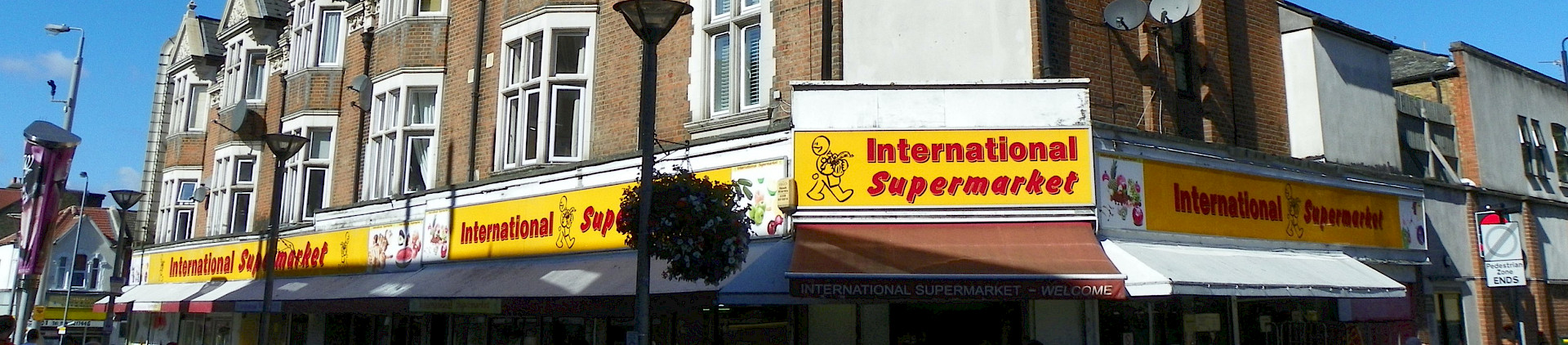
Cover image: International Supermarket and St James's Apartments, High Street, Walthamstow, London E17


