The Spirits of Shah Alam Camp by Asghar Wajahat, trans. by Aditya Vikram
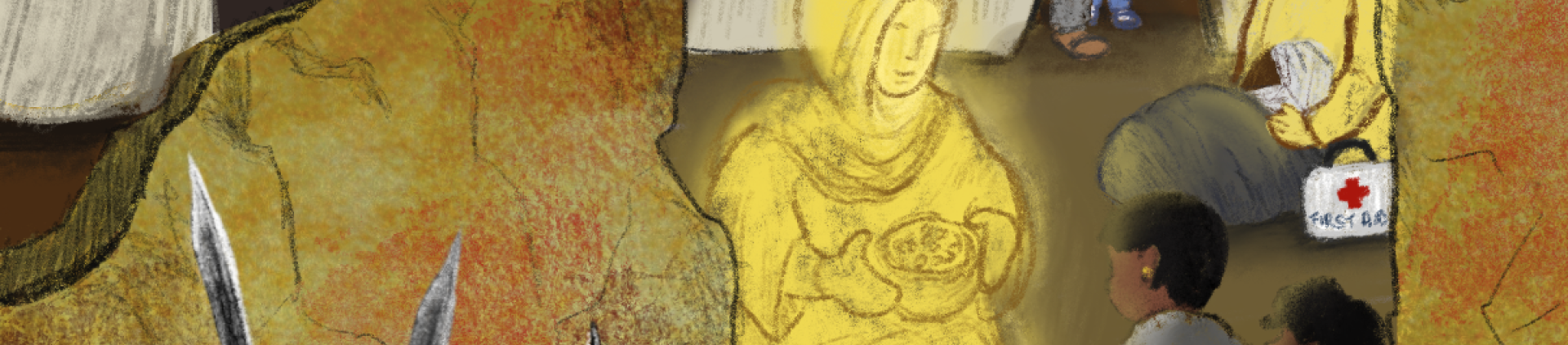
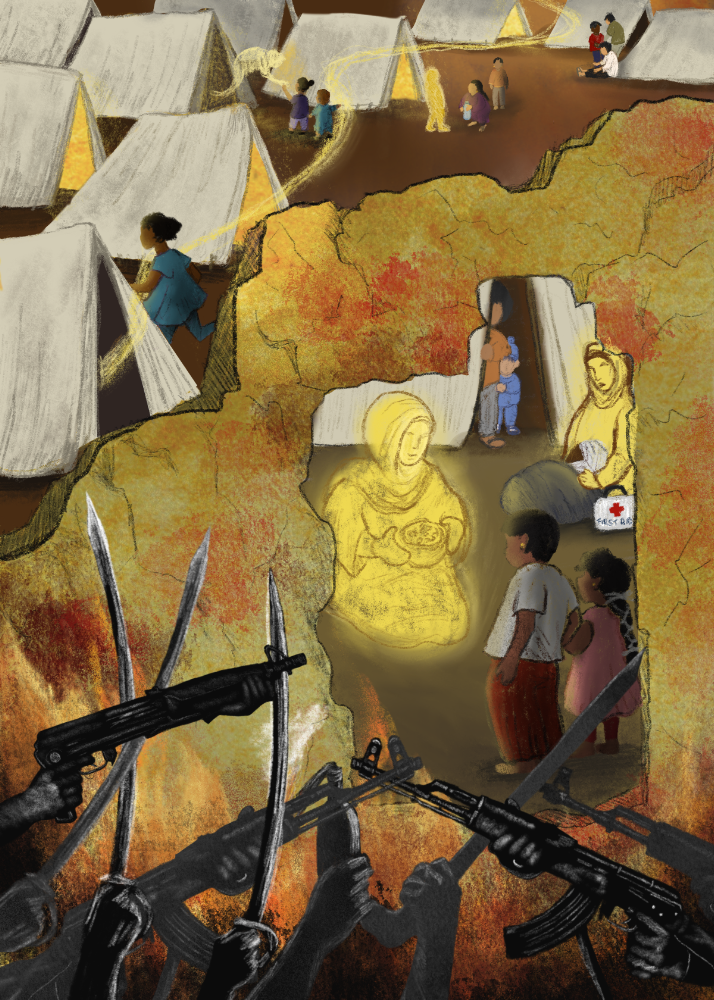
On whose face do the shadows of a divided history fall? This short story by Asghar Wajahat – translated from Hindi by Aditya Vikram – observes a refugee camp set up in the aftermath of the 2002 pogrom in Gujarat, India, haunted by the spirits of lost loved ones. Writing in an unabashedly Muslim voice, the story is narrated similarly to a dastaan, an oral form of Urdu storytelling from North India, and examines the psychic wounds of marginalisation based on faith, class, and gender pervading a rotting democracy. With an illustration by Simone Khanyi Hadebe.
This piece is commissioned in tandem with Wasafiri 127: Solidarities.
Supported by a grant from the Open Society Foundations.
(1)
The day passes this way or that in Shah Alam Camp, but the nights are tumultuous. There is so much noise that all sounds go unheard. Screams and summons, clamour and din, wails and hollers, sighs and sobs. It is a time of such selfishness … Allah save us.
Spirits come to visit their children at night. They caress the heads of their orphans. Meet the children’s empty eyes with their own and mutter. Hold the children to their breasts. The heartrending screams of spirits echo in the air; they had been burnt alive.
When the entire camp falls asleep, the children wake up. They long to see their mothers and eat with their fathers.
‘How are you, Siraj?’ Amma’s spirit asks, caressing her son’s head.
‘How are you, Amma?’
She looks happy, and says, ‘Siraj, I am a spirit now. No one can burn me anymore.’
‘Amma, can I be a spirit, too?’
(2)
After midnight, a woman’s anxious, maddened spirit reaches Shah Alam Camp in search of her child. Her child is neither in that world nor in the camp. Her heart sinks. The other women’s spirits also join in the search for her child. They sieve through the camp together and go to the moholla where the houses crackle in the fire. Because they are spirits, they are able to enter the burning houses. They look in every nook, every corner, but the child is not found.
In the end, the spirits go to the rioters. The rioters are making petrol bombs for tomorrow. Cleaning guns. Polishing weapons.
When the mother asks them about her child, they laugh and say, ‘You madwoman, when groups of ten, twenty people are burnt together, who keeps track of one child? He must be lying in some heap of ash.’
‘No, no, I have looked everywhere … didn’t find him anywhere.’
Another rioter says, ‘Oh, is she the mother of that child we left impaled on the trishul?’
(3)
Spirits come to Shah Alam Camp after midnight. They bring food from heaven for their children. They also bring water, medicines, and whatnot, giving everything to the children. This is why no child in Shah Alam Camp goes hungry, roams around naked, or falls sick. As a result, the camp has gained great renown, its fame even reaching nations far, far away.
When a major politician from Delhi goes to Shah Alam Camp for an inspection, he is elated. ‘This is such a fine place — all Muslim children of the country should be sent here,’ he says.
(4)
Spirits come to Shah Alam Camp after midnight. They stay with the children all night, and gaze at them lovingly, thinking about their futures. They talk to each other.
‘Siraj, now you should go home,’ the mother’s spirit says to her son.
‘Home?’ Siraj shrinks in fear. Sickly shadows stirred on his face.
‘Yes, how long will you stay here? I will come to see you every night.’
‘No, I will not go home … never … ever …’
Smoke. Fire. Screams.
‘Amma, I will live with you and Abbu.’
‘How can you live with us, Sikku?’
‘But Bhaijaan and Aapa also live with you, don’t they?’
‘They were burnt along with us.’
‘Then … then I … I will go home, Amma.’
(5)
After midnight, a child’s spirit comes to Shah Alam Camp. The child glows like a firefly in the night. He flies here and there, and runs and runs through the entire camp, leaping playfully, causing mischief. The child speaks clearly, he doesn’t stutter. He clings to his mother’s robes, to his father’s finger.
Unlike the other children of Shah Alam Camp, this child is overjoyed.
‘Why are you so happy, kid?’
‘Don’t you know why? Everyone knows.’
‘Why?’
‘Because I am evidence.’
‘Evidence? Of what?’
‘Evidence of bravery.’
‘Whose bravery?’
‘Those who tore me from my mother’s belly and split me in two.’
(6)
Spirits come to Shah Alam Camp after midnight. The spirit of a boy’s mother comes to visit him. He is astounded.
‘Ma, why are you so happy today?’
‘Siraj, today I met your grandfather in heaven. He introduced me to his father … and he to his grandfather … and he to his great-great-grandfather … I met your great-great-great-grandfather today.’ Her voice teemed with delight.
‘Siraj, your great-great-great-grandfather was Hindu … Hindu, understood? Siraj, tell everyone this. You heard me?’
(7)
Spirits come to Shah Alam Camp after midnight. A sister’s spirit arrives, in search of her brother. Looking persistently, she finally finds him sitting on the stairs. The sister’s spirit is elated. She leaps to reach out to her brother, calls him lovingly, ‘Bhaiya!’ The brother hears, but he does not listen. He sits there like a figure of stone.
The sister says it once more, ‘Listen, Bhaiya!’
The brother doesn’t listen or even turn towards his sister.
‘Why are you not listening to me, bhaiya?’ she cries. The brother’s face flushes red as fire, his eyes burning. He springs up, and begins to hit his sister. People gather around. Somebody asks the girl what she has said — what has enraged the brother enough to beat her?
The sister speaks: ‘I only said ‘Bhaiya’ when I called out for him.’
An elderly man replies, ‘No, Saleema, no! Why did you commit such a huge blunder?’
The old man begins to cry profusely. The brother starts beating his head against the wall.
(8)
Spirits come to Shah Alam Camp after midnight. One day, an old man’s spirit arrives along with the others. He is almost naked, with only a skimpy dhoti tied high around his waist, chappals on his feet, and a wooden stick in his hand. Somewhere in his dhoti, he has tucked away a pocket watch.
The spirits ask the old man, ‘Is some relative of yours also in the camp?’
The old man says, ‘No, and yes.’
The spirits think that the old man is deranged and leave him to himself. He begins to circle the camp.
Someone asks the old man again, ‘Baba, who are you looking for?’
The old man responds: ‘People who can murder me.’
‘Why?’
‘Fifty years ago, I was killed by a gunshot. Now, I want the rioters to burn me alive.’
‘Why do you want that, Baba?’
‘To show them that I did not die when they shot me with a gun. And I will not die even if they burn me alive.’
(9)
In Shah Alam Camp, a politician asks a spirit —
‘Do you have a mother and a father?’
‘Everyone was killed.’
‘Sisters and brothers?’
‘No, I don’t.’
‘Do you have anyone?’
‘No.’
‘Are you comfortable here?’
‘Yes, I am.’
‘Do you get food and water?’
‘Yes, I do.’
‘You have clothes and shelter?’
‘Yes, I do.’
‘Do you need anything?’
‘Nothing.’
‘Nothing?’
‘No thing.’
The politician is pleased. ‘This boy is smart,’ he thinks. ‘Not like those who got to stay alive.’
(10)
Spirits come to Shah Alam Camp after midnight. One day, Shaitaan’s spirit comes along with the others. Seeing the state of things, Shaitaan feels a pang of shame and embarrassment. Unable to meet the eyes of others, he hesitates to look up. He bows his head, changes routes swiftly, and turns into corners where there are no people. Finally, the people catch up to him. He speaks to them with real shame: ‘All this that has happened … I didn’t have any hand in it … I swear by Allah, I didn’t have a hand in it.’
The people respond, ‘Yes. Yes … we know. You couldn’t possibly do this. You, too, have standards.’
Shaitaan draws a cold breath in and says: ‘Good riddance! A burden has been lifted from my heart … you all know the truth.’
The people say, ‘Allah Miyan also came a few days ago. He was saying the same thing.’


What shapes do solidarities take in these strange times we are living in? How can we find and forge solidarities when faced with genocides, human rights violations, and inexplicable injustices daily? Can storytelling play a role in liberation?
