Lauri Kubuitsile on Writing War and Southern African Fiction
Wasafiri's Deputy Editor, Vamika Sinha, spoke to Botswana-based writer Lauri Kubuitsile about her novel, The Scattering — a work of historical fiction set against the backdrop of the Herero and Nama genocide and Second Anglo-Boer War in southern Africa.
Set at the start of the twentieth century, the novel spans German South-West Africa (presently Namibia), South Africa, and Bechuanaland (presently Botswana). It presents the entwining stories of two different women, Tjipuka and Riette, and their experiences under German and British colonial rule in the region.
The interview further explores women's realities during war, Botswana's literary scene, and southern African writing more widely.

Vamika Sinha: What was the genesis of The Scattering? What led you to want to write a work of historical fiction that specifically explored the Herero and Nama genocide?
Lauri Kubuitsile: I live in Mahalapye which is where the followers of Kgosi Maharero eventually settled. There’s a very large Herero population here, and yet I realised I didn’t know this history. That was not right. At first I researched only to educate myself. As I learned about what had happened, a story began to form in my mind. Eventually that story needed to be written. It’s how all of my stories begin, really. An idea that won’t leave me.
VS: On the global stage, southern African fiction tends to be dominated by stories from South Africa or Zimbabwe, and less so Namibia or Botswana. Why do you think this is, and why is it important for you to bring their histories to the fore?
LK: South Africa has a large population, enough people with high incomes to buy books, and a good distribution network. Namibia and Botswana have small populations. Also, Botswana was not developed when the country gained independence. There was much to do, so perhaps the arts got sidelined. I think also our population is small with wide income inequalities, and, as you know, books are discretionary purchases. There’s not enough money to support any sustainable trade market in Botswana. As writers, we must look elsewhere for publication. That makes it more difficult to be a writer, but not impossible.
VS: Why did you choose to foreground Riette as well as Tjipuka – women of two different races and positionalities – but who live through different historical wars in the book? Why did you specifically also choose female protagonists?
LK: I wrote the book not necessarily to write about the genocide. I wrote the book to look at war – the personal effects of war – especially for women. Women carry heavy burdens during war. Rape is one of the main weapons of war, as we see now in Sudan, as we see everywhere. Women are mainly the ones subjected to that weapon. If a woman is raped and then found to be pregnant, she will suffer recrimination, and even be ostracised by her own people. Women stay behind, keep things going. They must clean up the mess of war, both the physical mess and the psychological mess. Their work can sometimes even be seen as bad, as if they are the enemy. There are many instances of this all over the world. Women do this war work, yet they are mostly absent on the list of heroes, and absent in the historical record about wars. Absence doesn’t mean they were not there; it doesn’t mean that their work was not important, that their experiences were not heroic. Absence means that their role was not written down by the historians who decide the narrative of the record, historians who glorify the atrocity of war, and who want to erase the clean-up, the healing, the difficult answers to difficult questions. The sort of things women attend to.
Tjipuka and Riette are very different women, and yet their stories reflect each other. This is what I wanted the book to be about too. This is what I believe about the world. It’s through our similarities that we can reach across and find our connections. When we do, we will understand the true nature of this world and our place in it, our role here. We will understand that fighting our sister or brother is immoral, as we should. We will finally understand the sin of war.
There’s not enough money to support any sustainable trade market in Botswana. As writers, we must look elsewhere for publication. That makes it more difficult to be a writer, but not impossible.
VS: This book won the Best International Fiction award at the Sharjah International Book Fair in 2017, and you have won/been shortlisted for various other prizes. How have prizes shaped your career trajectory as a writer? What do you think is their importance, especially in boosting writers from the African continent?
LK: Prizes get your name out there. I’ve had a few important connections established because of prizes. More importantly, prizes have emboldened me, and made me think at least I am on a path that some see as right. Prizes gave me courage to continue. That matters a lot in the sea of rejection I normally swim in.
VS: Which novels or other texts/media inspired and influenced you while writing this book? One novel that came to mind for me while reading your book was Yaa Gyasi’s Homegoing for the way it brings characters together across generations and times, but who are still centred on a particular historical-regional nexus.
LK: The two books that I thought of when writing this book were The Memory of Love by Aminatta Forna and Half of a Yellow Sun by Chimamanda Ngozi Adichie. Both of these beautiful books look at the personal effects of war. It’s so easy to discount numbers of dead and facts about the destruction, to let them roll over you without another thought. But when we tell the story of a single person, we then feel the real suffering caused by our constant warring. That was what I wanted to do with this book.
Women do this war work, yet they are mostly absent on the list of heroes, and absent in the historical record about wars.
VS: Can you describe your research process for the book? In your Acknowledgements, you say ‘so much of the history of southern Africa is unwritten’ and then provide a list of 14 texts. How difficult was it to find these texts, and are there more? Were there critical gaps and absences you noticed while researching? And did you speak to any survivors/descendants whose lives or families were directly impacted by the genocide and other historical events in the book?
LK: I used primarily academic papers; I read a few books. I looked in Botswana’s archives. I did not interview families. I found afterwards that most families were not even aware of the history. I did have a Herero historian read the book to assist with anything I might have gotten wrong.
When I speak of the unwritten history, I’m speaking of the history of all women and of Black southern Africans, especially history told from their point of view. My novel is fiction — that gave me the liberty to create what I suspected was missing. This is why, as Hilary Mantel has said, historical fiction can fill in the holes in the historical record. It may not be factual in a scientific sense, but it is in a human sense, which is more important and often more truthful. It sets things straight. This is needed especially when someone chooses to ignore whole sections of history, skewing it in a way that serves their purpose. The women were there; they had agency, they did things that mattered. They were heroes. The same too for Baherero. They were not victims without agency. They had motives for rising up, they had plans, they had internal politics, and external motivations. They were strategic. They were heroic too. They are not merely victims of genocide, with such narratives so easily dropped on Africans all over the continent. These tired historical narratives that so often draw lines between good and bad, black and white – when it is clear wherever humans live there is only grey – are things I have no interest in.
VS: You have been a full-time writer in Botswana for years. How do you feel about the country’s literary scene, and how would you like it to develop, both domestically and region-wide across southern Africa? What is needed to nurture these stories more, to encourage new writers, as well as bring them to bigger audiences?
LK: My feeling is the government should support nonfiction only. This is important to get our stories in print — our stories that in many cases would not find a worldwide audience. Stories of our history, of the political scene, memoirs, and other important nonfiction books.
As for fiction, we must accept that our population is small and it will be a very long time before a writer could live off trade sales within our borders. In any case, fiction can find a worldwide audience. We have fascinating stories here in Botswana. We must take advantage of that. Write. Send out. Get rejected. Edit. Send out again. Compete on that world stage any way you can. Our stories will get out there.
In general in southern Africa, and the entire continent, the distribution of books is abysmal. I often can’t get my books that were published in South Africa here in Botswana. This is not only the case with books. Africa has a problem. We don’t trade within the continent. It’s a problem that I believe our leaders know and are working on. If COVID-19 taught us anything, it taught us that when push comes to shove, Africa is on its own. We best learn that truth and get busy solving the problem. Hopefully, this will trickle down to books.
The Scattering by Lauri Kubuitsile is out now in the UK from DAS Editions. Buy it via our Bookshop.org page.
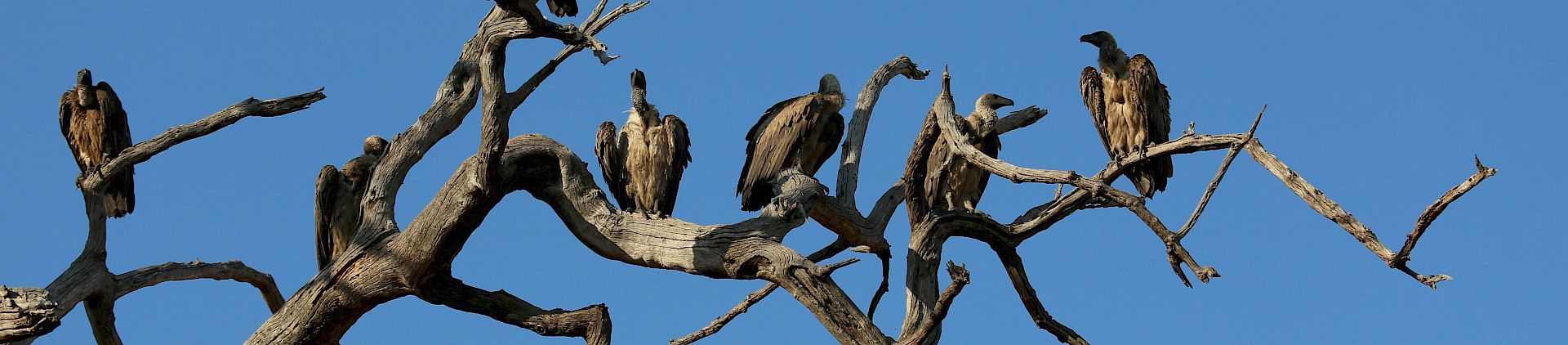
Cover image: Several White-backed Vultures (Gyps africanus) near Cuando River, Chobe National Park in Botswana.


