Meditations: Gouri Sharma on Aria Aber’s Good Girl
In the final entry in our Writing the Self, Writing Berlin series (conceived by Divya Ghelani), Berlin-based journalist Gouri Sharma reflects on Aria Aber's Good Girl (Bloomsbury, 2025), a cathartic bildungsroman of a young Afghan woman living in Berlin. As a reporter and a South Asian immigrant herself – 'a racialised woman caught between worlds' – Gouri explores the book's impact on her own understanding of grief, sexuality, pain, and politics.
Wasafiri’s Meditations series features creative and personal responses to literature, asking writers to seek connections with themselves, their own work, and any texts they may be reading. Lying between criticism and life writing, each Meditation offers a unique angle to view the writer and the reader, and the world around them.
Supported by a grant from the Open Society Foundations.
This year will mark ten years since I booked a one-way flight to Berlin to try my luck as a freelance journalist, carefree and in my early thirties. It was the summer of 2016; Brexit had just blown apart EU-UK unity in a shock result, still etched on the faces of my fellow travellers. Meanwhile, I was entering a Germany grappling with the arrival of nearly one million people from across the Middle East and neighbouring regions. Still, I was feeling excited about my new solo adventure, open to whatever lay ahead yet unaware of the rollercoaster ride that was about to come, filled with grief of all kinds as much as growth and joy.
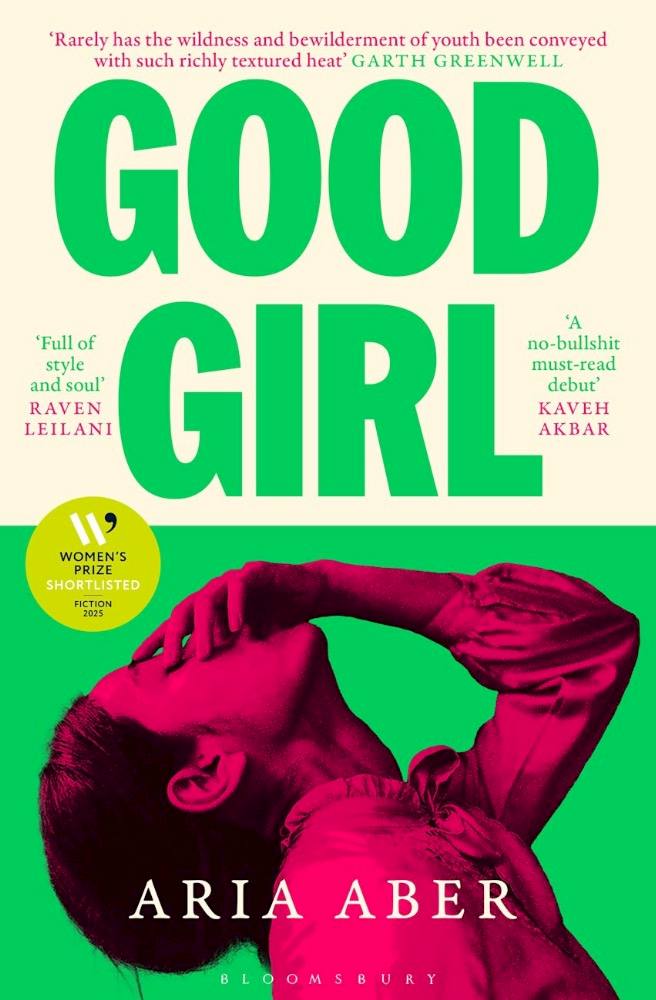
Recently, I had the opportunity to read the award-winning poet Aria Aber’s debut novel, Good Girl, which follows Nila, a nineteen-year-old girl living in a social housing estate called Gropiusstadt in Neukölln, a district in southwest Berlin famous for its rich ethnic diversity and home to large Turkish and Arab populations. Nila’s parents originally arrived there as refugees from Afghanistan, and in the novel, she is coming to terms with the loss of her mother a few years prior. Nila spends her time seeking to escape not just her house, but also her grief, pain, and fragmented self through drug-fuelled partying, photography, and sex.
This meditation serves as a reflection on the impact Good Girl has had on my understanding of grief, an emotion I felt so forcefully in Berlin following the passing of my father five years ago in November 2020, while also being at the forefront of documenting the darker side of the German capital as a journalist. Yet, while writing, this has also become an homage to what I have discovered as the other side of the coin of grief — that we grieve because we love so dearly.
Between Different Worlds
Aber’s parents immigrated to Germany from Afghanistan in 1990, and she was born a year later and raised there. Good Girl is subsequently set in Berlin in the early 2000s – just before the hyper-gentrification era of today – characterised by steep increases in the city’s once famously cheap rents, and where English, in some parts, is heard more than German. Aber portrays two parallel worlds — one is the city’s techno clubbing scene, bursting with characters as messy and kaleidoscopic as Nila in different ways. For instance, Tamara, a woman in Nila’s clubbing circle, is an out-of-work artist and model with a ‘twitching eyelid … [who] always demanded to dance’ (76). During a night out, Nila shares how later, after losing touch, Tamara would ‘turn into what one imagined an amphetamine junkie to be like — drawing window blinds, looking over her shoulder’ (76). This reckless underbelly of drugs and partying is juxtaposed with Berlin’s immigrant community life, marked by state neglect, stifling poverty, alienation, and everyday racist and domestic violence. Nila describes her housing estate: ‘Swastikas tagged to our doors, the skinheads down the hall greeting us with predictable slurs … Frau Storz, obsessed with her ferrets, called us Oriental, oblivious to the current trend in politics’ (240). On her own extended Afghan family, she remarks: ‘Even my rich aunt Sabrina, the thin and perfect bird, hurled belts and books and plates across the room, aiming at her husband in a hot, brilliant fury’ (66).
Early on in the book, Nila attends a Berlin Biennale party with her older lover, Marlowe. On her way there, she has an interaction with the Afghan bakery owners in her area, who eye her suspiciously because of what she is wearing. ‘I didn’t belong to the people in the bakery, nor did I belong to these people either’ (107), Nila thinks later, referring to the artsy intellectual publishers and architects she is mingling with as she looks over the city from the heights of the party’s hotel rooftop. ‘I was from here, and not once had I stood on a rooftop of this calibre. Neither had my aunts or uncles or parents. My dead mother,’ she adds (112). When Nila is later caught with Marlowe by her uncle, who is a taxi driver, he accuses her of ‘besharam hasti’ [you have no shame] (246) — she wants to respond by saying she does feel shame, but for being related to him. We watch Nila struggle in between the worlds of class and racial hierarchies.
Aber stitches together themes that particularly resonate with me as a second-generation South Asian woman raised in the UK in an upper caste Brahmin Hindu Punjabi family. From memory to intergenerational loss, belonging, language, and the dysfunctionalities of a dislocated diaspora, I found grief accompanying me – both my own, and for the difficulties Nila was experiencing – throughout the novel.
The Grief of Writing Berlin
As a freelance journalist, I’ve been covering racism, gender, and diaspora in the German capital for a decade, and Aber’s descriptions of the city are similar to the realities documented in my work. Nila’s recounts of everyday racism and questions of where is she really from, directly echo the underlying themes in my reportage on white German racism within immigrant communities, such as this piece covering the experiences of racialised second-generation Germans who are regularly otherised in school, social events, and job settings by white Germans who assume they are not really from here.
Indeed, the kebab mafia murders that Aber writes of in Good Girl – based on the true story of the racially motivated killings of nine people in Germany in the early 2000s, victims later criminalised as being linked to organised gangs – also felt eerily close to the far-right attack that killed nine people at two different shisha bars in Hanau, a city in western Germany, which I wrote about in 2020. Both cases embody the criminalisation of immigrant communities that the powerful right-wing press (as well as others within the German mainstream) has latched onto to legitimise the violence they commit against them.
We grieve because we love so dearly.
This political backdrop, and the conversations Nila has with her clubbing friends about immigration, often blur the lines between fiction and journalism. In one post-party hangout, Nila recalls having to self-soothe as soon as immigration is mentioned: ‘Out of nowhere, as always, like a war whose threat is in the air even when it cannot be seen, the topic of immigration came up. I cut a line, poured vodka into a tall glass of orange juice, and tried to slow my breathing’ (152). Having told none of them that she is Afghan – hiding instead behind other nationalities, such as Greek – she stays quiet as her peers discuss a fictional bombing in Bremen from when some of them were children, and how no one had been killed or found guilty. Nila only speaks up to correct them about the fact that someone did die, a flower seller, likely an immigrant. ‘Exactly,’ Doreen, one of the group, says in response, showing how diminished her view is of immigrant life.
Grief has fuelled much of my reporting on Berlin, a feeling that has been heightened further as Germany has stayed steadfast with its pro-Israel position amid the genocide in Gaza. Yet, despite the political and racial tensions, there’s still something very unique about Berlin. Amid my own maternal family history, violently shaped by the Partition of Punjab in 1947, I’m fascinated by how a city moves on from being as brutally divided as Berlin once was. It attracts many interesting people, those perhaps labelled as oddballs or misfits back home, and has a rich and accessible cultural scene (at least for now) and a strong entrepreneurial and creative energy. And where else is it possible to head out to an amazing club on Friday night, stay until Saturday morning, go home to recharge, then head back to the dance floor until Monday morning?
In an interview for Vogue, Aber shares that Good Girl is actually somewhat of a love letter to Berlin, and this comes through in the poetic lyricism that she employs to describe day-to-day details. For instance, ‘In Berlin, the cathedrals’ stained glass was covered with frost, and most days, I put on my red hat and my black coat and walked out into the crunchy snow to my job at the jazz café in Kreuzberg, the kind of place with red-painted walls and old leather seats, which tried to present a facsimile of a gone century’ (5). This beautiful description not only evokes for me the sense of fascination that I’ve felt about this city’s rich history, but it also makes me appreciate Aber‘s building of visual imagery: the simple pop of red colour is a sight to behold in this city with its notoriously famous winters, where a day descends into darkness from 4pm.
I feel kinship with Nila’s bond and even a sense of ownership over this beautiful, damaged city, when she says: ‘Oh, Berlin, my old Berlin: Sometimes the streets did welcome you into your arms no matter how far you sank’ (195). Whether it’s been coming to terms with parental loss or being tasked with reporting on yet another far-right attack here, I too have often found that this city, amid its divided past and present complex identity, has been an active observer – and somehow a holder – of so much pain, both its own and its people’s, rather like a loving parent.
‘Gandi Gouri’
In Good Girl, Nila loses herself in clubbing and a fraught sexual relationship with the older Marlowe while trying to outrun her parental and everyday grief — experiences somewhat familiar to me. As time has passed, I have found myself, somewhat surprisingly, on a journey of exploring and discovering the hidden and deeply silenced parts of my own creative and sexual identity.
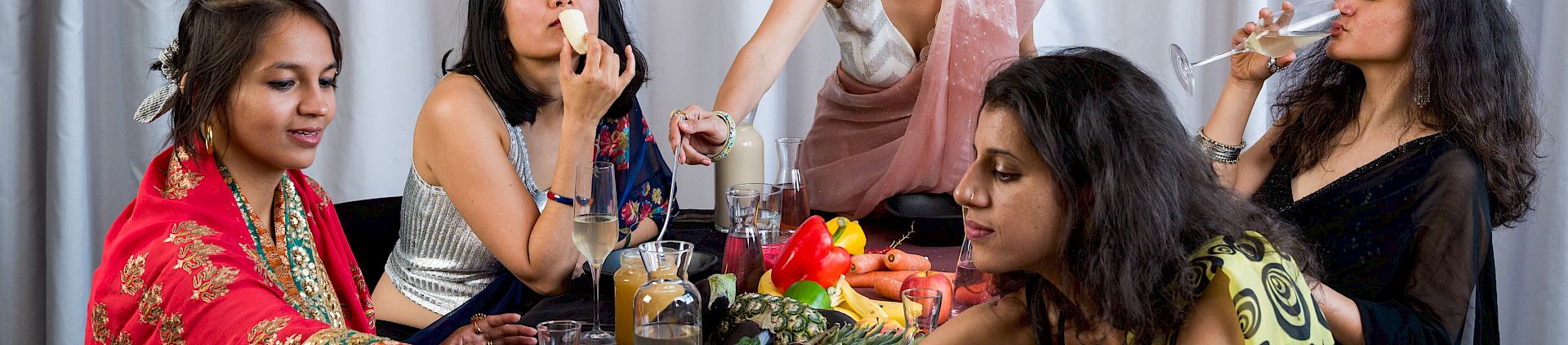
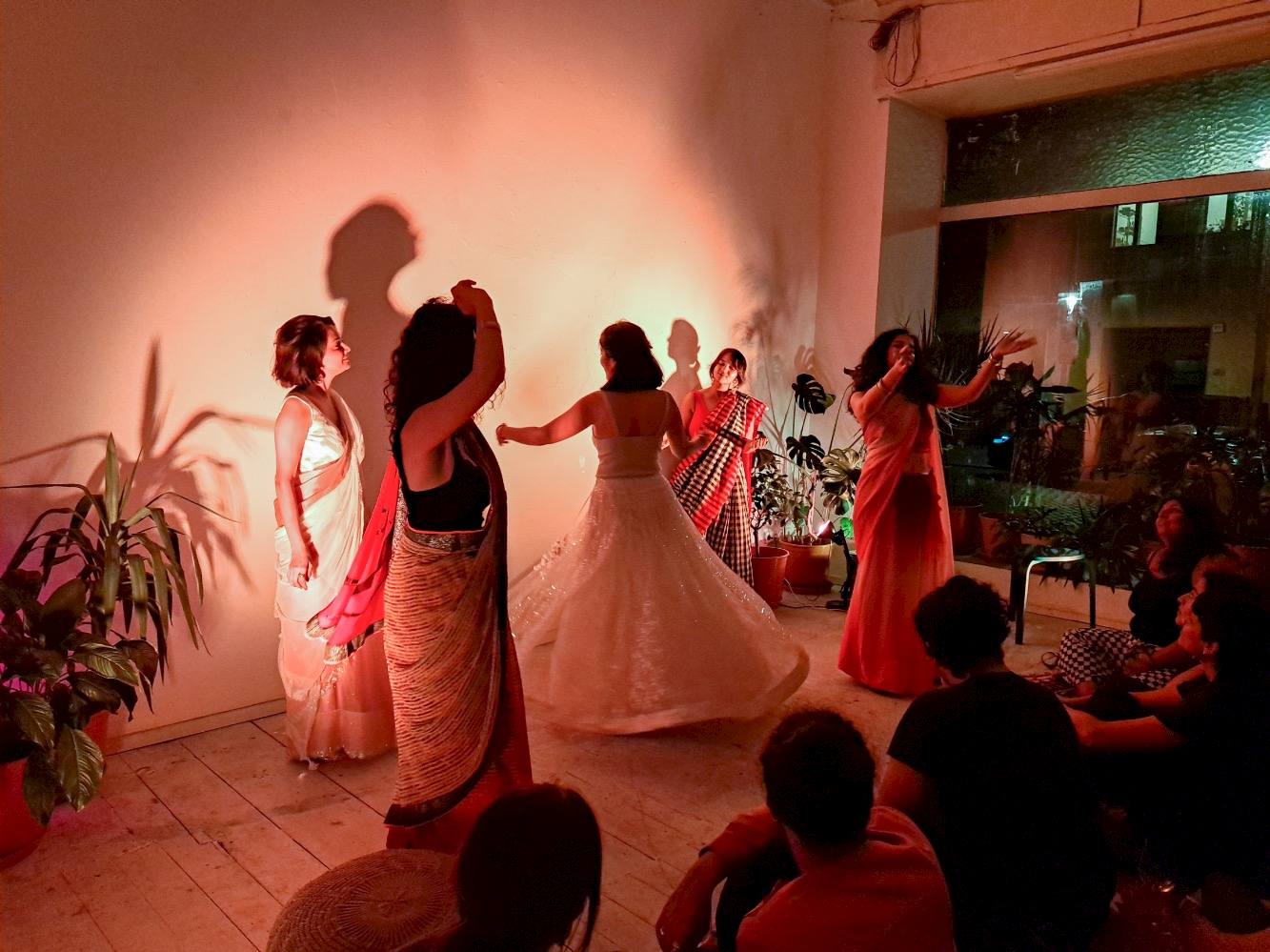
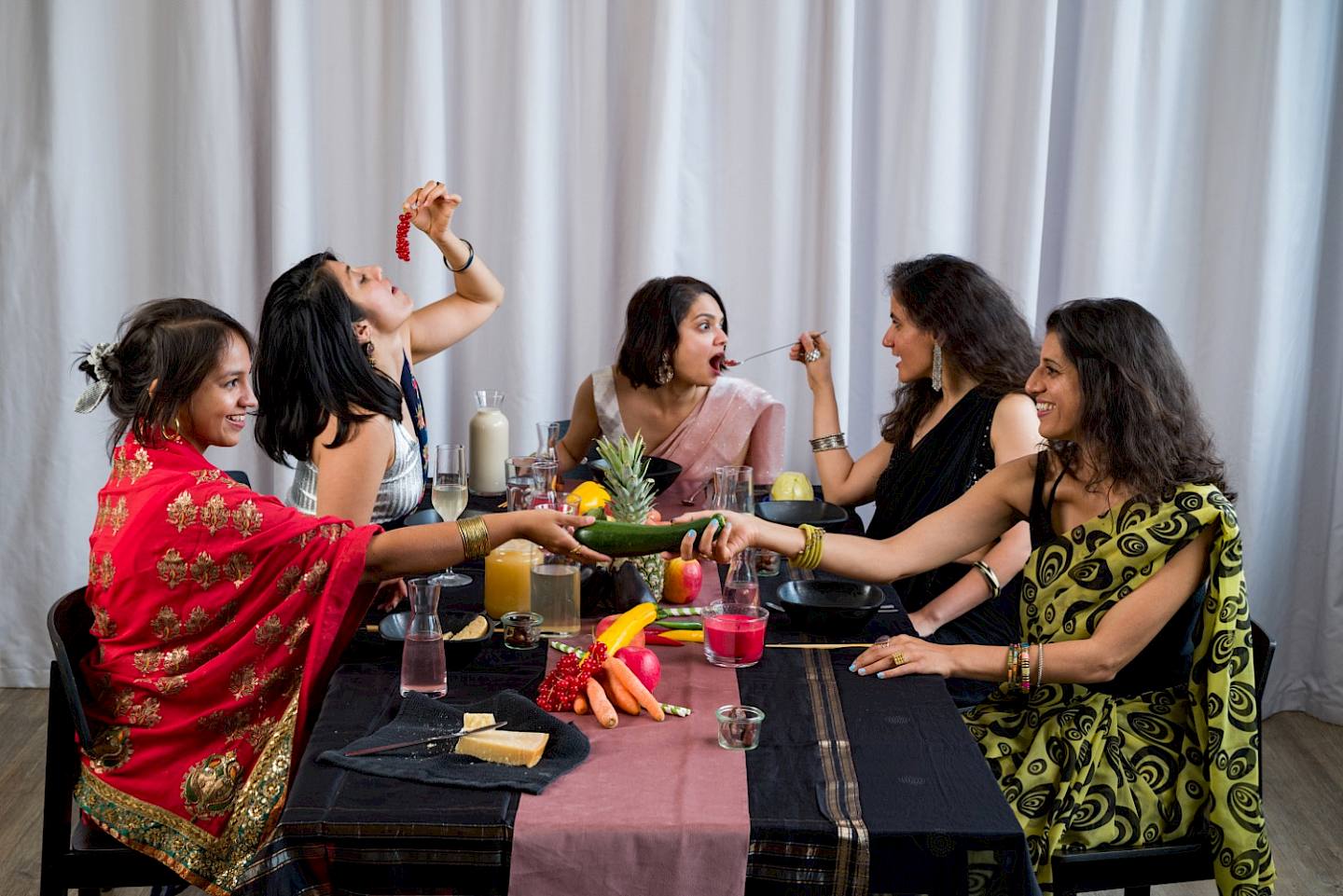
In August 2025, I did a public performance alongside four other South Asian women in Berlin as part of our recently formed ‘Sluts in Sarees’ collective, where we seek to sensually reclaim and joyfully reimagine narratives around South Asian female desire through writing and performance. We draped ourselves in sarees – soft pink chiffons, silver, shimmery, deep-cut, boob-revealing blouses, multi-coloured prints, classic black-and-white-chequered cottons – dressed to impress mostly ourselves and each other. In a performance lasting around forty minutes at a feminist-led art gallery, we shared our stories of anger, pain, and feelings of shame as South Asian women raised differently within India and the diaspora, who are now living in Berlin. We also shared some of our fantasies and expressed our gratitude to the women – whether family members or Bollywood item girls – who have shown us different ways of expressing ourselves beyond what our cultures have allowed us.
I performed two pieces: a playful story about an intimate sexual encounter with a woman working at a Berlin start-up, and an empowerment piece called ‘Gandi Gouri’ (gandi means ‘dirty’ in Hindi), which refers to the nickname I was given during my teens as I was more openly curious than girls my age about sex. The opening lines were: ‘This is a story about a girl named gandi Gouri / Brown boys, bless them, didn’t know how to handle her, brown girls, rightly so, didn’t trust her. So gandi Gouri they said, trying to get into her head, trying to shame her into bed.’ The piece’s final part on not caring what people say about me was especially nerve-wracking to share, but it also felt like a release. I showed a new side of myself to others, and most importantly, to myself. I saw this as a dedication to my younger self, to help her heal from past sexualised, hurtful experiences.
Reading Good Girl while writing this slut-shaming piece for my performance granted me the chance to revisit my younger years, a ‘rebellious’ period in which I was plunged into the deep bass sounds of London town, liquored up and locked into dark corners with all sorts of urban dwelling no-gooders. The temporal feelings of dance floor freedom, vividly described by Aber in the scenes where Nila parties at the Bunker club, felt familiar, and also brought back some good memories: ‘On the dance floor, we staggered and twisted around one another’, ‘sticky and aroused’ while stumbling to the bar (76).
We watch Nila struggle in between the worlds of class and racial hierarchies.
I therefore really resonated with the nature of Nila’s desire, with its inability to be girdled — ‘the lavish, life-altering, catastrophic kind [of desire] that a girl feels for wildness’ (119). I have shared so many of Nila’s experiences as a racialised woman who is caught between worlds and possesses this unruly, curiously creative, and sexual energy — unrefined, often unguided, and clouded by internalised shame. ’As she says of an encounter with an older man in the club, ‘My nipples hardened despite myself, we were adhering to an ancient script, like when I was working in the cafe and imagined men touching me’ (52): Nila’s unbridled eroticism is almost involuntary. I like as well how she juxtaposes the ancient, human, natural act of lovemaking with how modern patriarchy sees unregimented sexual impulses in women, especially women of colour, as shameful. Elsewhere, Nila describes one of her early encounters with Marlowe: ‘Feverish, I slithered from his touch, but when I reached for his belt buckle, he pushed my hand away. “No,” he said. “I decide when I want to fuck you.” I felt excited and reckless all at once. “Okay,” I said, surmising that my role was to yield. He wasn’t like Felix with the low libido, who thought my incessant hunger for touch was disgusting’ (22). Again, we see both how Nila internalises her role as a sexual woman as submissive, and also how her desire is coded as excessive in terms of the patriarchy.
A New Gaze
About halfway through the book, Nila recalls her experience with a woman named Setareh, whose parents have also immigrated from Afghanistan, and who becomes Nila’s first queer love and queer sexual experience. During one of their earlier conversations, Setareh shares that ‘she feels she has never been liberated from her parents' gaze’ (173). This line has stayed with me as I feel it speaks to the healing, reflection, and growth that’s possible when there’s distance, authentic distance, from the roles we play with our parents. Five years ago, I didn’t know that the loss of my father (alongside two other male family members) would create an opening for me to look at myself beyond a patriarchal gaze; yet there I was on stage, freshly owning these parts of my sexuality and consequently, more of my authentic self and erotic power, just as Audre Lorde teaches us.
I have shared so many of Nila’s experiences as a racialised woman who is caught between worlds
While Nila loses herself in clubbing, drugs, and sex to cope with her grief – including the death of her mother – pandemic-related closures in 2020 forced me to retreat within myself to cope with mine. As the first full year since my father’s death drew to a close, I went to Malta alone for a week, where I filled out a notebook, read a trashy romance novel I found at the Airbnb, and sat in silence and solitude trying to calm my grieving body by the sea. As I watched the waves, I started to see how coming to terms with the death of a parent isn’t a linear process. It can also be an embodied one that, as Nila says as she connects deeper with her grief, is ‘so fundamental that I am still living in the shape of its loss’ (178).
Reading this book as I honoured five years since the life-altering moment of my father’s passing, I smiled when I learnt that on the exact anniversary of his death, I would be on stage with the sluts. In the audience that cold November night was a dear friend, visiting from India, with whom I had shared many nights dancing to drum and bass in London in my twenties. There were also a few of my closest Berlin friends and my partner — the beautiful people who have come into my life since my dad’s death. Performing alongside these wonderful women felt like a sensual, saree-styled opportunity to celebrate my life and how far I’ve come in Berlin, and I’m keen to continue learning how to turn this powerful grief into a deeper love and sense of gratitude — for myself, my father, my city, and my loved ones. And in this poetically infused, sometimes heavy-hearted, coming-of-age debut novel, I wanted the same for its protagonist. I was relieved to read how Nila chooses herself over her limiting relationship with Marlowe and leaves home to pursue photography studies in London. In doing so, she also makes her father, who just wanted a better life for her than he had, proud. Near the end of the novel, Nila acknowledges her arc, and its resulting clarity: ‘The tremendous world I have in my head. But how to free myself and free it without being torn to pieces. And a thousand times better to be torn to pieces than to retain or bury it in me. That’s why I'm here, after all, that’s completely clear to me’ (334).
Cover image: Sluts in Sarees collective – Nainy Sahani, Madhvi Ramani, Ripu Daman Singh, Shobhna Shahare, Gouri Sharma. © Ashir Singh

