Meditations – Sophia Arnold on ‘By the River: Essays from the Water’s Edge’
In this Meditations piece, our current CHASE intern Sophia Arnold reflects on her relationship with rivers and water bodies, and the wider environmental humanities, from Cambridge, UK. Woven in is her reading of the 2024 anthology By the River: Essays from the Water’s Edge (Daunt Books), inciting important conversations on how we can better care for our climate.
Wasafiri’s Meditations series features creative and personal responses to literature, asking writers to seek connections with themselves, their own work, and any texts they may be reading. Lying between criticism and life writing, each Meditation offers a unique angle to view the writer and the reader, and the world around them.
I was on a date a few summers ago when the person I was seeing told me that there was a spot in Grantchester where you could skinny dip with a group of regulars. I remembered this conversation one record-breaking, thirty-four-degree day last summer (when I was about ready to jump into a wheelie bin of iced water), so I immediately began fantasising about rushing off to the meadows.
Later that day, I reached out to a friend who had also mentioned this group before, and they told me there was a waitlist. I began researching online and read an article stating that King’s College (the owners of Grantchester Meadows, and part of the University of Cambridge, one of the largest landowners in the UK) actually now prohibited swimming in the lake next to the River Cam due to ‘anti-social behaviour’. Defeated, I let my hopes of swimming in the one bit of semi-clean water in Cambridge evaporate. Even with global warming rapidly heating the landlocked city, incessantly spawning E-coli spreading throughout the river, and the steep price of a pool membership, the climate crisis and water treatment plants weren’t going to hit pause because of King’s College’s policing of green space. So, I sat in front of my desk fan and played Pink Floyd’s 'Grantchester Meadows' instead, sucking on an ice cube.
Writer and environmentalist Roger Deakin had a similar experience when trying to swim in Hampshire’s River Itchen, although his approach was far more unflinching than mine. He explicitly protested for his right to swim even while facing aggressive written and verbal private property notices. In an essay for By the River: Essays from the Water’s Edge (2024) – an anthology on the ways rivers socially and politically shape our daily lives, creative practices, and understandings of the world – Deakin provocatively explains that rivers are part of ‘open country’ (65). In England’s vibrant freedom to roam campaigns – such as those led by Right to Roam, The Ramblers' Association, and historical protest actions like the Kinder Scout mass trespass – riverbeds and riverbanks are included. These waters are muddied by commercial interest and fishing rights issues, but the impetus for freer leisure, social, and cultural access to rivers for the public firmly remains.
By the River includes essays by twelve contributors: Niellah Arboine, Amy-Jane Beer, Deakin, Marchelle Farrell, Tessa Hadley, Jo Hamya, Amy Key, Rebecca May Johnson, Michael Malay, Jamal Mahjoub, Caleb Azumah Nelson, and Ellena Savage. Naturalist, writer, and campaigner Amy-Jane Beer, in her essay, has further fuelled my understanding of the UK’s exclusionary policies regarding access to flowing water in the riverbed. In England, ‘the public has statutory right of access to a mere three per cent of rivers. In the other ninety-seven per cent if you swim or float along in any kind of watercraft, you’re likely to be committing trespass’ due to rights of navigation (82). Upon first reading this, I felt myself deflate.
I've always been drawn to rivers and bodies of water. Mary Oliver famously wrote in her 2016 essay collection Upstream, ‘attention is the beginning of devotion’, and it's the years of wandering local shorelines and riverbanks that have built my environmental consciousness. When I first moved to Cambridge in 2022, I walked the Cam’s length – from the tributary closest to my new home, to its most northern point just outside of Ely – and it instantly gave me a way to feel at home in an unfamiliar city. As I began to better understand Cambridge, I simultaneously got to know the state of the river’s water. During the pandemic, I read a piece in passing where the author vividly described the panic they felt upon leaving the house, and how they thought they could see the COVID-19 particles in the air just waiting to reach them. On my walks, this thinking gave me form to understand the agricultural run-off and sewage in the river — I felt I could clearly see the bacteria swirling through the water, inciting numerous water warnings and sickness.
Reading further into By the River, I learned that the River Cam has had a group of people rallying for its rights since 2021. I look at the river now and wonder how it could be protected in court; if initiatives such as The Universal Declaration of River Rights were instituted, what words might be invoked to assert its inherent right to carve through the landscape and nurture its ecosystem? Can equal treatment for nature, through local customisations of international declarations, become a tool for preventing the worst of the climate crisis? How do actions such as these embody a care and commitment to respecting, enhancing, and promoting climate justice and environmental relations, in whatever contextual form that may look like?
Personal and communal connections to rivers can be embodied, gravitational, and essential. They also frequently have fraught, brutal histories. Looking at Birmingham’s canal system, writer and scholar Ellena Savage reminds us, in her essay for By the River, that to look at a canal is to look at the whole infrastructure of the climate crisis. Engrained within rivers’ architectural designs are aspects of violent colonial rule and trade, the Industrial Revolution, and a mentality of British exceptionalism:
'Goods plundered from the colonies were transported efficiently around the island, feeding and clothing the emerging class of industrial workers. Without these long, straight canals lined with puddling clay ... Britain’s industrialisation might have had to wait until the advent of the railway, almost a century away. Like every aspect of Britain’s economic development, that first act of industrialisation depended on the riches exploited from enslaved labour and colonial plunder' (108).
It is these colonial logics of expansionism and environmental disruption that have manufactured the ‘Anthropocene’ — a term for human-induced meteorological and geological change. The Anthropocene is a major topic of debate for many academics and policy makers, one that Heather Davis and Zoe Todd view as having the potential to be ‘a critical project that understands that the ecocidal logics that now govern our world are not inevitable or ‘human nature’, but are the result of a series of decisions that have their origins and reverberations in colonization’ (763).
This argumentative thread runs throughout By the River. Writer, editor, and broadcaster, Niellah Arboine considers the longevity of the folkloric mermaid(s) River Mumma, inhabiting Jamaica’s rivers, in her essay for the anthology. She reflects on how this deep, cultural relationship to the river might evolve in light of pollution, waste, and climate change:
'Sometimes I think about the streams and rivers drying up once we’ve taken everything River Mumma has known and respected, leaving nothing behind but sticky clay and exposed rock, bleached by the sun ... I think of her choking on toxic chemicals dribbling down into her home. Would this sting and blur her vision? I think about her ingesting foreign microplastic, crystallising her from the inside out. I think about how the world’s freshwater species have been rapidly declining over the last five decades, and I imagine River Mumma looking on helplessly while her children suffocate. How would it feel to watch her children dying overnight, her grief sharp and sudden?' (54).
But Arboine knows, ‘whatever happens, River Mumma will continue humming her songs long after we’re gone’ (55). In other words, tales of River Mumma, alongside the many folkloric water figures central to different cultures, like Nibiinaabe to Ojibway people and Rusalka in Slavic cultures (49), will surpass the current climate crisis through the continued and embodied refusal of its effects as insurmountable. Arboine concludes: ‘... it is difficult not to believe in the power of River Mumma; if not a physical being, then certainly as a force created from the depths of history, fear, creativity and the faith of a people. Stories of River Mumma have survived voyages, colonisation and even death itself. To know her is to know the resistance of a people’ (53).
For his anthology essay, Michael Malay – a writer and Environmental Humanities lecturer at the University of Bristol – takes the viewpoint of the river’s intrinsic rights to flow and nourish its ecosystem as a starting point. Through outlining his experiences of night fishing for globe-travelling eels, while unpacking the racist policies that have affected the Windrush Generation, Malay entrenches how borders are ‘conceptual putty’ (95). Hostile environments, he ruminates, systemically underpin both our political and river systems — separating eels from their wetlands, and families from their homelands. ‘What all this amounts to, it seems, is a failure of care — and sometimes even an embargo on hospitality,’ Malay writes (94). But much like activists and support organisations working with asylum seekers and refugees, eels sneak through sluice gates and continue their migrations regardless. ‘They are persistent and filled with a form of love — the desire to keep existing in this world. For they don’t know any world that’s better, despite all the obstacles in their way here. Their ingenuity is also a kind of hopefulness, a hope that the world’s roominess, its hospitality, might persist’ (94-95). Water offers the possibility to enable these lines of flight and movement for refugees, asylum seekers, and migrants; yet it also remains a hostile, dangerous, and frequently fatal space, claiming thousands of lives each year.
There is a vast array of historical, legal, political, and ecological barriers to physically and culturally accessing waterways being fought against in the UK and worldwide — for instance, the Indigenous-led Water Protectors against extractivism and settler colonialism across North America; technological innovations to clean up Ecuador’s ‘plastic-choked’ Portoviejo River; and anti-dam protests in Arunachal Pradesh, India. Yet, upon reading By the River, I was still filled with hope. Among the grave descriptions of biopolitical manipulation, corporate exploitation and pollution, and cultural exclusion from water bodies, the book undulates through stories of individual and communal connection, care, and respect for the writers’ respective rivers. It performs a counternarrative to the fatalist news reels asking us how we can lessen the effects of climate change and pollution individually, and rather presents embodied snapshots of resistance to the operationalised, anthropocentric utilisation of waterways and the natural environment at large. This anthology demonstrates how it is our personal and communal relationships that can formulate a resistant environmentalism and build a sustainable climate justice movement for systemic change, one where we can all feel devoted to supporting our streams, rivers, and oceans. By the River may not have been designed as a manifesto, but I feel just as impassioned as having read one.
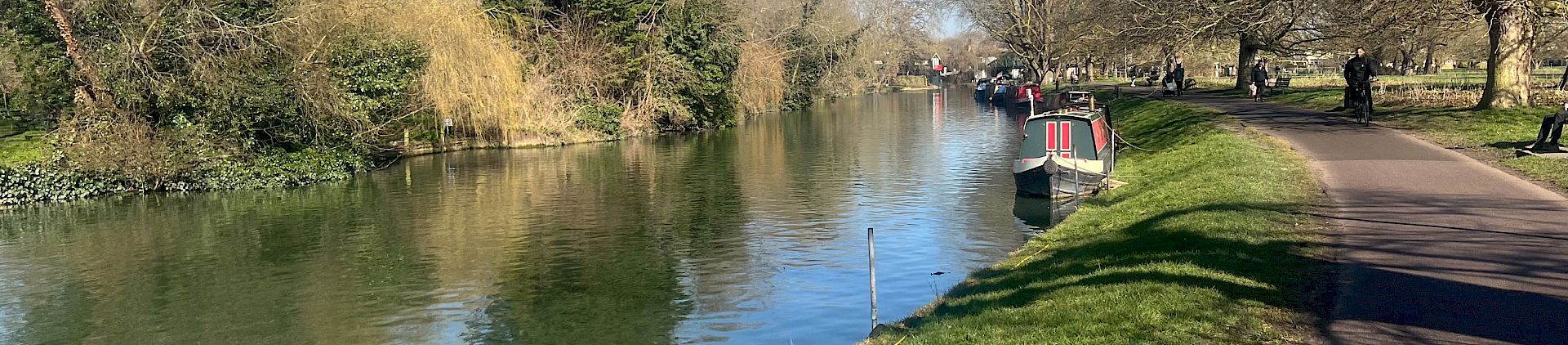
Image of the River Cam, courtesy of the author.


Guest edited by Stephanie Jones and Charne Lavery
