My Six Rules for Telling Global Majority Stories by Santanu Bhattacharya
Indian novelist Santanu Bhattacharya is the Fiction judge for the 2026 Queen Mary Wasafiri New Writing Prize. In this essay, he shares his guidance on staying true to the global majority story you want to tell, based off his own experiences and reflections as a published author in an industry that continues to greedily capitalise on 'diversity'.
The 2026 Prize is open for submissions until 30 June 2026. Submit your work here.
The space for global majority writers to be published and read in the Western world is ridiculously constricted. I don’t need to present stacks of evidence to prove my point, but here is some anyway: a quick scan of the most recent Booker Prize winners shows only two out of the last ten were books by authors of colour (one was a co-winner, and only one of them was set in a non-white, non-Western context); the latest Lit in Colour report says that a measly 1.9% of GCSE students in England studied books by authors of colour; and this 2020 study revealed that only 22 of 220 titles on the New York Times bestseller list were by authors of colour.
It is no better in the non-Western world. Though the data is variegated and patchy, much of the anecdotal evidence I've encountered suggests that bestsellers in the West do better business in the Global South than books by local authors. No surprises there, since the book trade is driven by the imbalanced economics of marketing, sales, and distribution, largely decided in Western headquarters. Most regions don’t even have thriving publishing industries that can support, celebrate, or sufficiently compensate local talent.
As creative content becomes more policed and politicised, fascist regimes increasingly crack down on writers, books get banned in schools, and artists are forced to self-censor — space for writers of colour is shrinking at an alarming pace. Room for us to share, learn, be in conversation with each other, or simply ask for help, is in fact barely existent, complicated further by how globally and culturally spread out we all are.
In February 2026, I completed three years as a published author. I consider myself one of the lucky ones; it has been exhilarating to be able to create original work that has found readers above and beyond my wildest dreams. Still, this journey has not been without its share of ignominy, despondency, and strife. In this piece, I share some reflections on my trajectory, even as my thoughts are still evolving. While these may apply to all kinds of writing, my personal experience is largely in long-form or short fiction written in English, and with primarily global majority main characters.
1. Mine the Micro; Leave the Macro to Show Itself
Stories are essentially about people. Sure, they could be about cities, countries, histories, or cultures. But what truly propels the story forward, hooks the reader, and makes them stay until the end are the people who populate the story’s landscape. To give a story its full due, therefore, it is important to flesh out the lives of its main characters — to interrogate them in a manner that spans both their interiorities and exteriorities.
Global majority storytellers have been conditioned into believing that the stories we tell are worthy of attention only when they’re about macro national or geopolitical issues, like civil wars, colonialism, migration, etc. Or, when they fit into Western notions of our worlds and their specific customs, like arranged marriages, caste hierarchies, mysticism, and so on. This is partially derived from what Global Majority books have actually been (and continue to be) published and celebrated internationally, and partially by the proclivity of our own cultures to minimise, or even disparage, stories that highlight personal wants and desires.
It is true that global majority lives are led on the frontlines of seismic social and political shifts. Whether in our home countries or as immigrants, our life paths are a disproportionate function of the macro. It is no surprise, then, that oftentimes geopolitical events become the bedrock on which our stories are built. But this shouldn’t have to be a prerequisite for publication and recognition. Nor should it be the primary entry point into our storytelling.
When asked ‘What is this story about?’, the answer would rather be, ‘It’s about a person who ...’ than ‘It’s about an event that ...’ Once we switch the lens from wide-angle to zoom, a good story can start to form. I continue to find it pleasantly astonishing how a character leads me to broader themes that I hadn’t even initially set out to write about. A story about a rigged election could turn into one of gender politics. A minor plot about a relative’s backstory could expand into the overarching framework for a novel.
Trust your protagonists to lead the way, surrender to what they want to talk about, and turn off any thought of what the publishing industry expects of you.
2. Don’t Flatten the Narrative
I don’t know how we’ve ended up here, but most literary fiction has ceased to be interesting. There — I said it! Fiction today – the kind that is dubbed literary and high art – is lauded and awarded for pushing at the limits of narrative void: nothing really happens, and no one says or does anything of significance. Characters seem to be in free fall without any agency over their circumstances or actions. To me, this is the total antithesis of the human spirit. It is also a wasted opportunity to give the reader a full-bodied experience.
It wasn’t always like this. The major writers we venerate (thinking of Dickens, Austen, Marquez, Tagore, even Shakespeare, if you want to go that far back) wrote wholesome entertainers, replete with vibrant characters, grand moments, and punchy dialogue. The point of telling a story is not to put your audience to sleep!
Global majority societies are anything but uneventful. And I don’t say this in an exotifying, sense-smell-colours sort of way. Our expressions are layered and loud; our emotions are worn on sleeves; our public spaces are theatres of human interaction. We’re freer to converse, and more open to share. If nothing else, we’re just more populous. There is no reason why our stories shouldn’t capture and capitalise on that vividness and drama. Don’t skimp on the intricacies of language, culture, and humour. A story is never fully realised until it is securely located in its place of origin. And characters are never fully written until we’ve seen them all naïve and twisted, hurt and hateful, confounded and in charge.
3. Don’t Write for Fads or, God Forbid ... the White Gaze
I see this in the book world a lot: books creating buzz for simply being ‘relatable’ and ‘believable’, or for making the commentator ‘feel seen’.
The politics of ‘being seen’ are messy, misleading, and fallacious. Global majority people are not only extremely diverse, but carry complex intersectional identities that create very specific lived individual experiences. There is no one person like your character. And you’re not in the business of telling anyone’s story for them ... it doesn’t even need to be your own story, either, when it comes to fiction or poetry.
Choose your characters not because they fill a quota or keep you safe from the criticism of exclusion, but because they are interesting people for you and your readers to hang out with. Make sure you know them as individuals, not as a demographic. Ask them questions, understand their backgrounds and motivations, put them in awkward situations, give them distinct tics and mannerisms. Make sure to get your facts right — dates, locations, lifestyle, languages. Be honest with yourself if a character isn’t fully coming through (for whatever reason). That doesn’t mean you shouldn’t write them; it just means you need to do more work, and maybe get some help. There is a right time for a story to be told — sit with it.
Trust your protagonists to lead the way, surrender to what they want to talk about, and turn off any thought of what the publishing industry expects of you.
Sometimes, I imagine spin-off short stories for my various characters to give them a life of their own. By the end of the writing process, you should know so much more about your characters than what you’ve been able to put on the page. Start with your protagonist and let them lead you to the others. In my first novel, One Small Voice (Penguin, 2023), I wasn’t going to mention the protagonist’s grandmother at all, but she insisted on making an appearance in the second draft and never went away.
Don’t aim for ‘believability’ or ‘relatability’, either. Readers’ realms are wildly different: what is believable for one might be totally over-the-top for another. For centuries, global majority readers have read about English villages and shepherd’s pies and daffodil groves, or American ranches and cowboys with guns — almost none of which was relatable to us.
Global majority worlds are complicated, warped, and multidimensional. When depicting the world of your story, be unapologetic about how it functions, what its spoken and unspoken rules are, and how people act in those spaces. The white gaze will try to fit your square peg into its round hole again and again. Resist it. Or better, turn it on its head. Run riot and critique your own world and people, but do it through the eyes of your characters, not because it doesn’t measure up to vacuous standards of white liberalism.
But also reconcile that you will never make everyone happy. Some of the most vicious criticisms may come from your own people. It’s fine. Take a deep breath and move on.
4. Unlearn Your English
And re-learn it the way the story needs you to. Most postcolonial societies are obsessed with the languages of their colonisers, which remain sources of status and credibility. English is particularly hegemonic as the modern world’s most powerful lingua franca.
But here’s the conundrum: global majority stories often do not take place in English at all, or in combinations of English and other vernaculars. So we have to become writers, translators, and interpreters all at once. Also, so much of our history has been recorded outside of the written word — tales and events that colonisers actively censored or haughtily ignored or were simply ignorant about. Many of these stories have only been kept alive orally, through bards roaming our villages or via matriarchs passing down anecdotes.
There is no such thing as ‘perfect English’. A language spoken in some shape and form all over the world takes on different hues and textures on the tongues of different people. As a storyteller first, my primary pursuit is to tell the story well, and language is a tool in service of that goal. I spend a lot of time channelling the right language for a story: who is the character, and what is the mood I want to build? For example, in my second novel, Deviants (Penguin/Westland, 2025), when portraying a Gen-Z protagonist, the English I chose for his first-person voice reflected his generation’s lingo; it was a literary risk and a creative challenge, but it felt apt to portray the depths and nuances of his mind without losing the frivolity, laconicism, and contemporaneity of a sixteen-year-old.
I embrace my multilingualism wholeheartedly, and find innovative ways of showing it off on the page, remaining militant about doing so without italics, glossaries, and inane epithets. If I’m writing dialogue not in English, the speech needs to capture the cadence of the spoken word. My punctuations are nonconformist, in order to mirror the ebbs and flows of oral storytelling. I don’t aspire to be the writer who is simply known for their five-page-long sentences or inventive adverbs if that is not the preoccupation of the story I’m trying to tell.
5. Don’t Be Lazy
I say this partly in jest — because anyone who has written even a short piece knows how much work writing takes. All of it solitary. You’re your own entrepreneur and your own startup, your operating system is a blank page, and you have all the freedom to build whatever product you want. But I also say this in earnestness because sadly, the (mild) push for diversity in publishing has meant that a lot of surface-level, virtue signalling, plain lazy writing has made it to the shelves, often by celebrities and influencers.
Don’t let the dazzle of representation be an excuse for not doing the hard work. Asking yourself these questions consistently throughout the writing process helps: Do you like what you’ve written? Would you spend time reading it? Does it match what you envisioned for the work when you first started? And are you proud that this will now exist in the world with your name on it?
The white gaze will try to fit your square peg into its round hole again and again. Resist it. Or better, turn it on its head.
Set a high bar for quality at the outset. I find that reading avidly, diversely, and incessantly helps. I’m flabbergasted by how little aspiring writers (and published authors) read! Sure, re-read the classics if that’s your jam, and the bestsellers if you want a finger on the pulse of the market. But the real eureka comes from finding books that are saying and doing things in novel ways, that make you envious while inspiring you to strive harder.
I now almost exclusively read emerging voices and fresh perspectives. Books by debut authors are a window into the future of writing. Small presses such as Hajar Press, Indigo, and Verve regularly publish fantastic books by lesser-known or upcoming writers. Independent bookshops like Round Table Books and Common Press (both in London) have amazing event line-ups focusing on marginalised voices. Platforms such as Wasafiri, Commonwealth Foundation’s adda, PalFest, the Deodar Prize in India, among others, work hard to showcase global majority talent.
Also: read works in translation. There is no bigger asset for a global majority writer than to dive into all the weird and wonderful worlds that translations open up. You might find yourself making more notes from an obscure story set in an Albanian village or the Surinamese coast or an Indonesian rainforest than the biggest prize-winner that year.
I also draw inspiration from other media, like film, music, painting, and photography. After all, whatever the medium, we’re all storytellers.
6. Dump Your ‘Greats’
We’ve all been socially conditioned to look up to some writers: those whom our parents and teachers recommended, those who got famous when we were young, those who planted the first seeds of writing in us. As good as they might have seemed at that time, I have since learnt that the architecture of capitalism thrives on the lionisation of a few, and at the expense of the many. A large proportion of available resources flows into amplifying only a handful of voices, regardless of whether their work continues to be cutting-edge, or even interesting. In the case of the global majority, I could count on my fingers the authors whose names have circulated as ‘greats’ for several decades now, with very little space created for newer writers who have subsequently entered the fray.
I embrace my multilingualism wholeheartedly, and find innovative ways of showing it off on the page, remaining militant about doing so without italics, glossaries, and inane epithets.
As a writer, the act of reading becomes an exercise in critical thinking rather than blind worship. The practice of writing is, in itself, an equaliser: it humanises your heroes, no matter how many prizes they’ve won or how many copies they’ve sold. You see yourself doing some things better than they may have. Or you realise they have written in a different time: the linguistic aesthetics, market conditions, postcolonial hangover, access, and stature, were different then. Most importantly, how we think about the world has evolved exponentially even in just the past few years. For example, understandings of mental wellbeing, masculinity, racial dynamics, etc are a lot more nuanced now, informed by lived experiences, updated social theories, and expanded modern discourse. Lean into that rather than following a preset template from the past. Don’t tell yourself: I want to be the next [insert famous author name]. You’re your own voice with all sorts of new, unique ideas and material.
I take a lot of pride in what new global majority writers are trying to do today — from Deepa Anappara to Avni Doshi, from Arinze Ifeakandu to Saleem Haddad, from Omar Musa to Aube Rey Lescure, to name just a few. We’re breaking new ground by telling stories on which no light has been shone before, and going into intimate places that our forebears didn’t dare touch. There are more of us writing and being read today than ever before. Every day you choose to write, you crack open the glass ceiling a little more.
Read a conversation between Santanu Bhattacharya and Kiran Desai in our latest print issue, Wasafiri 125.
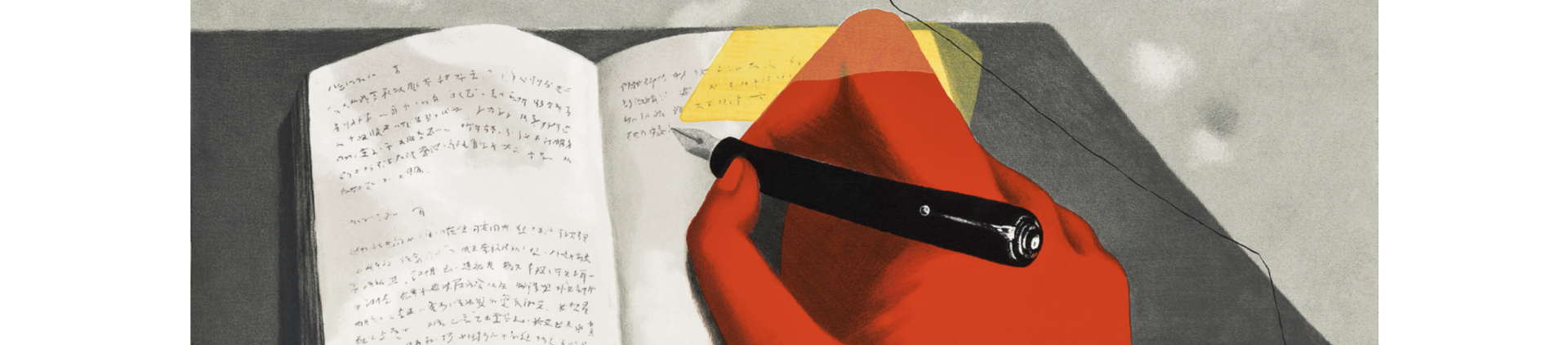
Cover image: Writing by Zhang Xiaogang (2005)

