‘I Was Destined to Do This Nonsense’: Siddhartha Lokanandi on Hopscotch Reading Room
As part of our Writing the Self, Writing Berlin series, editorial intern Divya Ghelani spoke with Siddhartha Lokanandi, who runs Hopscotch Reading Room, a Berlin-based English-language bookshop he founded in 2017. A haven for the intellectual – and political – bibliophile, Hopscotch is regarded as ‘an outlier of a bookstore’ in both its home city and beyond, for its intentional centring of non-Western, anti-racist, Global South, and anti-colonial perspectives, as well as minor literatures. Previously touted a ‘diasporic pharmacist’, the shop’s gregarious, eclectic, and warm-hearted founder Siddhartha has become a distinct fixture in Berlin’s literary scene after almost nine years of running his ‘book pharmacy’ on Kurfürstenstraße. Yet, due to unforeseen external circumstances, he is now in search of a new permanent location for his shop.
This interview took place amid Siddhartha putting his books away in storage, in preparation for Hopscotch to go into hibernation for the first few months of 2026. As customers milled and browsed the shelves, Divya and Siddhartha travelled down the bookseller’s past — including early libraries that shaped him, advice he received from his teacher Edward Said, his love for used books, and memories of seeing art with Claudia Rankine. They further discussed the role of independent bookstores in the fight against scroll culture, and the consequences of being actively pro-Palestine as a business based in Germany.
Over the course of their conversation, Siddhartha’s bookselling acumen reveals a rich and staunchly political literary and curatorial philosophy, one that attempts to capture a complex and chaotic present moment from the confines of an oft-conservative German book culture.
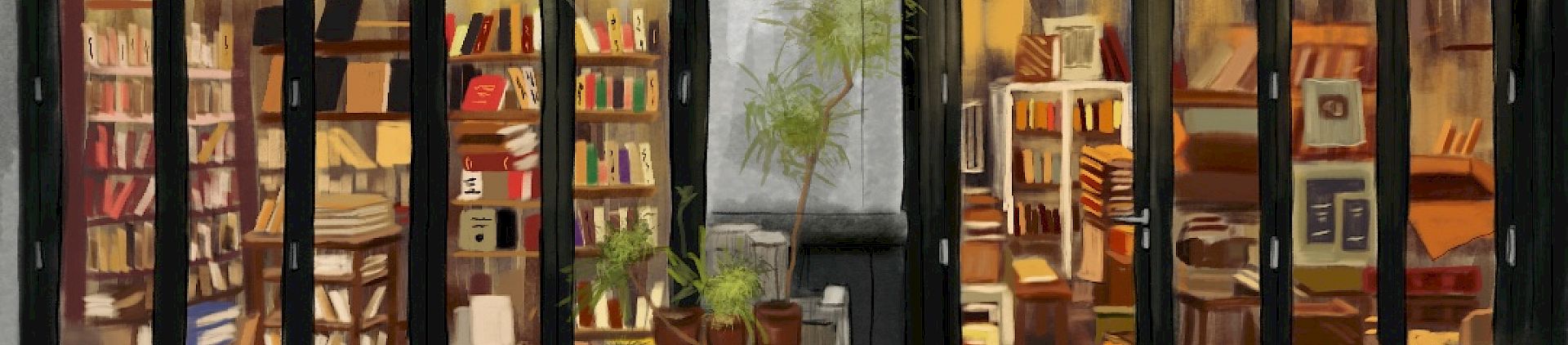
With illustrations by Simone Khanyi Hadebe
Divya Ghelani: You've just returned from spending several months in South India with your mother, a former librarian. Was it she who fostered your love of reading?
Siddhartha Lokanandi: I was influenced by both of my parents. My father grew up knowing that reading would help you get somewhere. But books in 1970s India were expensive, partly because we were under the Soviet umbrella. We couldn't import paper that came from Singapore because it was very expensive. Instead, we had popular books made on newsprint, which were much cheaper. Think of Sidney Sheldon. There's a canon of authors – popular American and British pulp writers – that made it into newsprint. It’s the sort of paper where if you sneeze, you blow through three pages. Commando Magazine was another important one for me. It was popular with South Asians because it was founded by a British ex-army guy who really knew how to do distribution.
I also grew up on a used book circuit. Very few new books came to us, and the old books all made it through via a very, very complicated pattern of transport.
DG: Sounds exactly like what's happening at Hopscotch.
SL: Absolutely. I have mined the used book logistical thing. I still care more deeply about used books than new books. They have a much more interesting history. So, my love for reading came from my father, who read the newspapers we could afford every weekend. We bought three, I think, and then he would get foreign magazines like Time, and a couple of others like Newsweek from his company library, which were mainly reading materials for CEOs. (Back then, Indian magazines were a very thriving print media, especially in Bombay, where we lived from the late 1980s.)
DG: And you were in your mother's library, where she worked?
SL: Yes, for a while. Then, later, she worked for a library in Bhubaneshwar, a city we lived in for a while, too. I remember I got to read Popular Mechanics magazine there. By the time we moved to Bombay, my mother was working for a very prestigious economic research library, the Indira Gandhi Institute for Research Development, which for the first ten years of its inception was funded by the Reserve Bank. She had such a big budget that she didn’t know how to spend it. It had kind of an open chequebook, because they really wanted to build it to attract Indians working abroad back to India. The library’s ambitions coincided with India’s economic liberalism.
My mother worked from 9 or 9:30 a.m. to 5:30 p.m., so sometimes I had no option but to go to the library after school. She would say, ‘Wait here. Look around and read.’ So I used to prowl shelves like I do now. These [gestures towards bookshelves] are library shelves to me, which is a full circle moment in my life.
I mean, if you believe in the idea of destiny – which my mother strongly does – and which I’ve now started believing in my middle age ... Yeah, this is destiny. I was destined to do this nonsense I'm doing now.
DG: Your website says Hopscotch is an English-language bookstore centring anti-colonial, non-Western, diasporic, and queer perspectives. When you first imagined owning a bookshop, was this the vision you had?
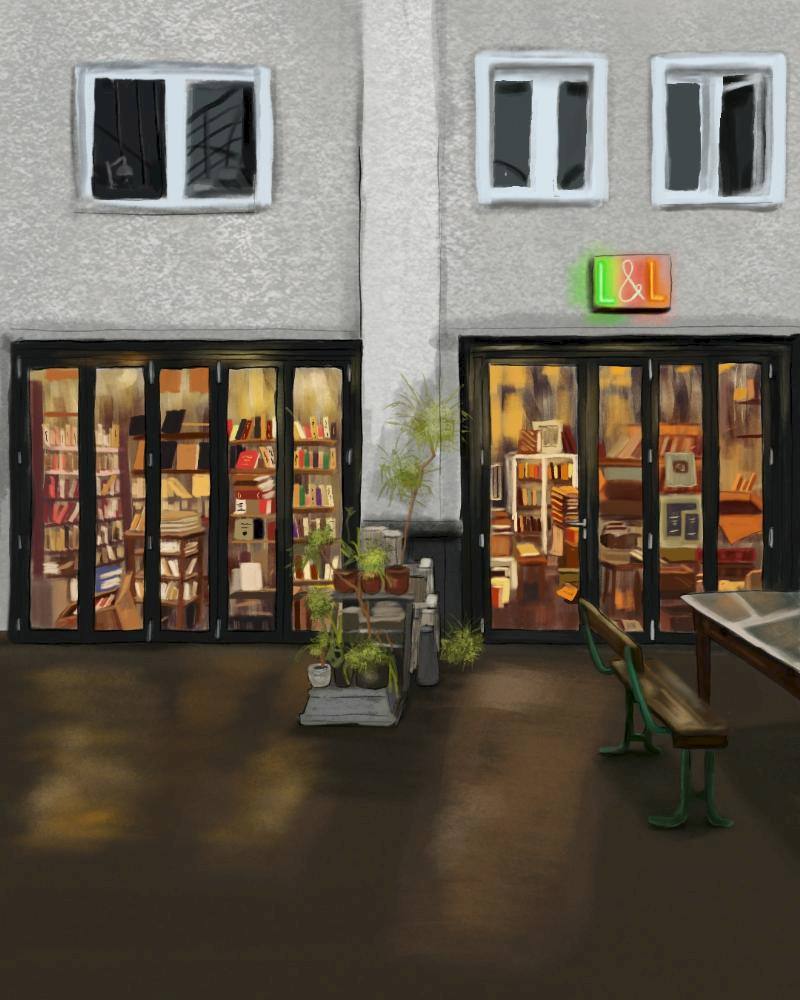
SL: I didn't have a vision; I just wanted a bookshop. The language I use on the website is partly marketing exigency. People ask us ‘What are you?’ in Germany. They are very nervous about things if they're – you’re – not clear. They need to know, to characterise you in a certain way. So, I characterised the bookshop, which is what we are growing into now. Of course, in a sense, we were this from the ‘get-go’, because we are it — I am it. The anti-colonial and non-Western thing — you just do it, because in a sense you are or become it by dint of twenty years of living in the West and thinking about things. We don't want to be decolonial though, because decoloniality in the way it works in this country is very, very complicated. It's very historically confusing. I would prefer to be anti-colonial than decolonial. And, [for me], that means we collect, buy, or sell certain kinds of books.
DG: What does it mean to centre such different perspectives in a city like Berlin? To shape bookshelves and build a public reading culture that's against the local tradition or canon?
SL: We centre the Global South while being anti-colonial, non-Western, anti-racist, and so on. But that difference is frequently lost in Germany when people come into the bookshop. They see a POC bookshop, which is an important politically correct term of the here and now, but it’s also more benign.
DG: Like it’s stripped of its robust politics ...
SL: Absolutely. I mean, you can now get grants from the German state if you're POC and Zionist! It's important that you don't criticise policies about Israel. This is why Hopscotch is not funded by the state. We are very much funded by our own means.
Of course, this also means we are precarious. We don't really know how to make a living. We are doing okay. We lost some money during the early days of [the genocide in] Gaza. People were very confused about what we were. But now it's clearer for them, and we survive. We kind of survive.i
We don't want to be decolonial though, because decoloniality in the way it works in this country is very, very complicated.
DG: You previously worked in publishing for Verso Books in the US. I wonder how that experience motivated you to leave it and open a bookshop instead?
SL: Publishing does not exist unless there are committed booksellers. I worked in publishing in the era of peak chain store retail. Basically, we were selling books as a chain store while independent bookstores were closing by the day. It was very difficult to sell books. I realised this because I was already working in an independent bookstore – a used bookstore in New York – on the weekends. It was called Mercer Street Books, in Soho, a very hip part of New York. Lots of people coming; lots of culture. We were open till midnight, so that really helped with sales.
DG: You probably helped the dating scene out a lot.
SL: Yes, I worked Friday and Saturday nights till midnight or later, and couples would come on dates. I feel couples are increasingly coming to bookshops on dates. They don't buy books; they just stare into each other's eyes or do this [performs a person browsing the shelves aimlessly].
After a certain time, I decided that publishing really was not for me. First of all, it made me very stressed because Verso was going through a crisis. I joined it at the end, when they were bailed out by rich white men who wanted a certain kind of accountability but didn't understand anything about the market. The retail market for bookselling was very complicated in the 2000s. It's much clearer now because of social media, but also because of the rise of independent bookstores.
Nowadays, people are learning that independent bookstores are a viable, important part of culture. I think we have reached a kind of critical mass where bookstores will never go out of fashion. They are a bulwark in the battle against scroll culture. People scroll while they’re at Hopscotch but we are firmly seen as a very viable alternative to scrolling culture. That's very important … that people recognise us as such.
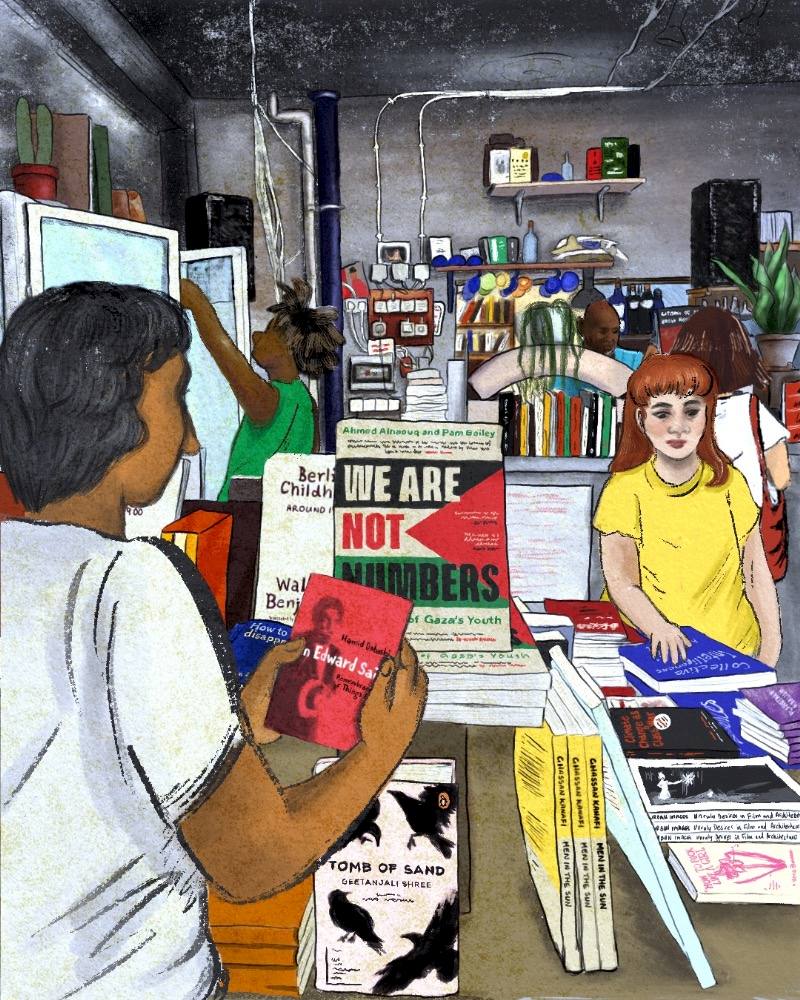
As a bookstore, we have hip books that are new, ready, and available but also accessible to a very broad range of audiences. We also sell books that are pop, or should be popular. It’s funny. It seems to me that every month somebody in the zeitgeist picks out a Black thinker and makes them popular. For over three years, it was Baldwin. Now we are at Toni [Morrison]. Before that it was someone like Nikki Giovanni or June Jordan ... Audre Lorde, Baldwin, Audre Lorde in Berlin. And now we are on … what are people reading? bell hooks. It's kind of crazy. Then I make sure that I have enough bell hooks to last three months.
DG: When you say ‘people’ are you talking about young people?
SL: Yes. Our entire audience is – 80% of it – 22, 24, until 40. 90%.
We have reached a kind of critical mass where bookstores will never go out of fashion. They are a bulwark in the battle against scroll culture
DG: What do you think is the general book culture in Berlin? And what do you see as the role of Hopscotch within it?
SL: People read a lot here. It's really a boon to be a bookstore because we have such shitty weather, and because people are a bit more sceptical of technology in Germany than they are, say, in India, or even in England or America. The Anglo world has – because of the overblowing preponderance of technology being made, distributed, and consumed in English – been altered. When you are in France, Spain, or here, it's a little bit more removed from all of that. It's also a generational thing. There are more older people than younger people in these three cultures, so people are perhaps more sceptical. We benefit from all that. People don't necessarily latch onto social media so fast. This is still a country that reads a lot.
DG: So obviously Hopscotch fits in the literary landscape a lot in that sense. But where does it, perhaps more importantly, not fit in?
SL: The politics. We are clearly perpendicular. We come from a different cultural background, which means cultural baggage, memory, history, and all the attendant nuances.
DG: How did the pandemic affect your business?
SL: The pandemic was the best for our business because our model is based on education. And for me to sell books, I need to know and understand you — where you're coming from, your background, your holes, the lacunae in your knowledge. That helps people like us sell books. Because I'm a good bookseller, because I have taken it as a calling, but also as an art form and as a skill, I continuously work on those sets of skills, knowledge, and practices. I can give you a book tailored to your knowledge.
This is still a country that reads a lot.
When the pandemic happened, we could not receive customers. But Berlin let bookstores survive because they knew that bookstores were an essential part of culture here. They let supermarkets, flower shops, and bookstores remain open (in very strictly regulated terms, of course). Per square metre, you could only have a certain number of people. This is how we began to receive people on an appointment basis.
We became like a book pharmacy. You could come sit on a chair at, say, a 3-metre or 5-metre distance from us, and we could have a meeting about what you wanted to read, after which we would sell you things. We did 45-minute appointments for eight to ten hours a day. It was amazing. Earlier, we were doing book drop-offs, and so on.
Me and Erin Honeycutt (my former colleague at Hopscotch, and founder of CUTT PRESS) often met people who were not asking for books. They were literally using us as shrinks because they were lonely. Erin, who is a writer, found it very quickly exhausting and moved on from that in a heartbeat. As for me, I loved it. I loved it.
DG: I see you curate the most amazing events programme.
SL: That is simply because we don't say no to anybody. You want to do an event? If we have room in the calendar, we will put it in. Post-pandemic, we did 79 events in 90 or 120 days or something! We were absurd.
DG: Why though?
SL: I think German culture, literary culture in general, is elite and exclusionary. In Germany, book events are still ticketed. You pay 8 to 10, 12, or 15 euros, and you get an event with an authority and a moderator who asks certain questions about the book so you can have a discussion. You get a glass of wine for the ticket, and then you buy a book along with that, which can cost 25 or more euros, because new books are not discounted in Germany, which helps independent bookshops. So, if you're a German publisher, you can be assured that your book will not be sold cheaper on Amazon, which even now is the largest seller of cheap books in the country.
German culture protects bookstores but paradoxically makes them elite. So we decided not to charge for our events. All our events are free, which is saying something in this place. Moreover, we say yes to all manner of young people who are making books to come and host events here. We have done extremely well with some amazing events. And we keep doing events with people who can't otherwise, who make experimental books, do experimental things, make books as part of their project at school, and so on. That has helped us build an audience.
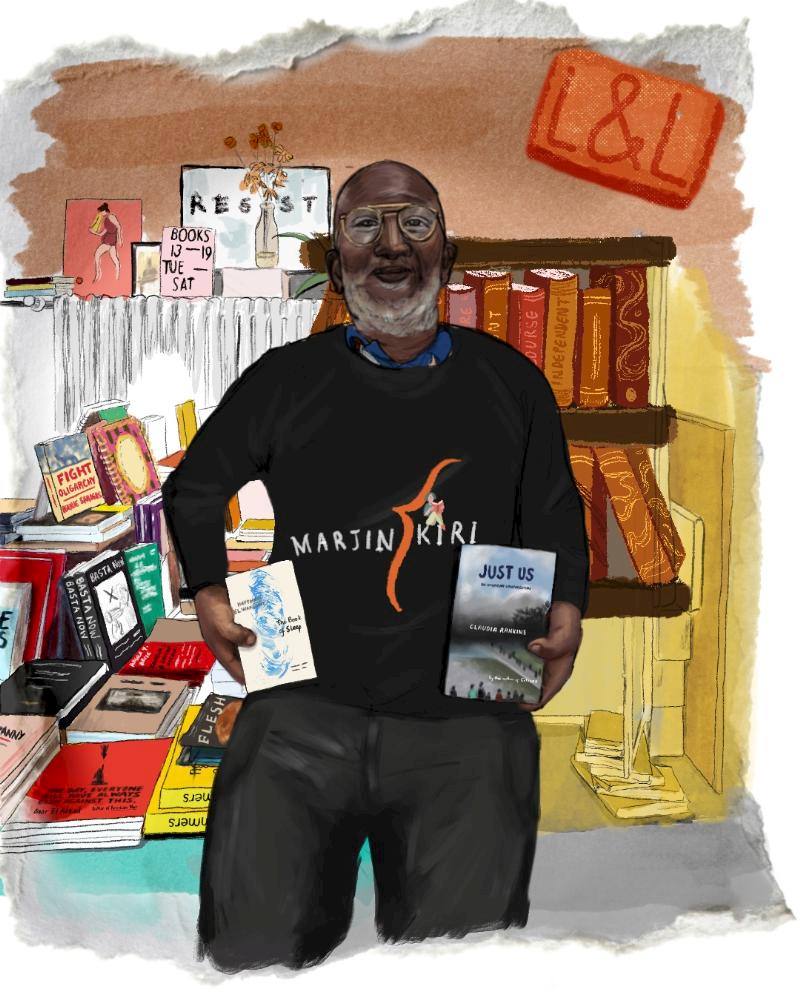
Also, people here take literary events as an occasion to go out. They don't necessarily buy books. They want to go out, meet friends, have a glass of wine or a beer. That's an interesting thing that I learned here — to be part of this culture means you have to find a way to inscribe yourself, to insinuate yourself, into the wider culture. If literature events are the way to do it, so be it.
We are somewhat of an outlier as a bookstore. We are a very special bookshop in the kind of politics we display. By this, I mean there are only a couple of other bookshops like this in Berlin that are against the genocide,and explicitly for Palestine, [recognising them] as a people being killed by German bombs, and so on.
German culture protects bookstores but paradoxically makes them elite. So we decided not to charge for our events.
DG: I read that Claudia Rankine was a friend of yours. She’s currently a DAAD fellow with the likes of Geetanjali Shree. Have you met her?
SL: Geetanjali’s Tomb of Sand is incredible. It's literally the last great Indian novel I’ve read. This is one of the most enjoyable novels.
DG: I loved it too much. When the crow started talking, I lost my mind. I laughed out loud. I slapped my hand on my thigh, Siddhartha, and I said, ‘This lady is amazing. She doesn't give a shit!’ It made me so happy.
SL: And it's very important to understand why she doesn't give a shit in a language that is heavily prescribed. There is a joy inherent in her language play.
DG: It's like a child, almost. A bossy girl, an eight-year-old genius. But, of course, it’s deeply political.
SL: As for Claudia, I met her while a bookseller in New York in 1997 or 8, when she was a young poet. She was working at Barnard College, and I think she found it very white. She made me realise my own otherness as a non-white bookseller in New York. I think she had not hitherto met a non-white bookseller. We had an astonishing conversation about Louise Glück, who was one of our teachers, and whose poetry, I must confess, I didn't understand then. I understand it even less now. But Claudia liked it, as every MFA kid did. Oh, and we went to see art together, which was my first experience of seeing art in New York. I believe we went to see a Gerhard Richter show that blew me away.
DG: Which other Berlin-based writers have you met through the bookshop whose work or life stories have particularly moved or affected you?
SL: Well, you and Rajeev [Balasubramanyam], of course. You know, Berlin is a city of exiles.
There are a lot of people I am drawn to or whose work makes them underdogs in a classical way, because they're ignored by the German majority culture. I think the greatest writer I have met, quite frankly, is the Egyptian modern writer Haytham El-Wardany. He wrote a book called How To Disappear and another called The Book of Sleep, published by a Cairo-based press called Kayfa ta. It is probably our bestselling book — fitting for a book written in Arabic by an Egyptian writer living in Berlin for the last twenty years, and entirely apt for the audience we have tried to cultivate. We also worked with him on a small reprint of an essay he wrote on Gaza, titled ‘Gaza 2035.’
That is a writer that I have really appreciated getting to know, who I wouldn't have met if I didn't live in Berlin. We are friends, but it's also a tenuous friendship because I try not to be too friendly with the writers. I don't know why, but it's like a thing with gallerists and curators. I really like this perspective.
DG: In some ways, I think of you as an art collector. A curator of books, for sure. I'm looking through your bookshelves, and there's an arrangement that feels a bit chaotic, but also carefully and lovingly tended to. It's as if you've made a home within them. I was wondering how you approach building Hopscotch's collection.
SL: It's chaotic because it reflects the world. It has no beginning or middle or end. I'm very much a function of the world I live in. I try to respond to the world. I try to give the world my attention and respect that it deserves, because it's a very complicated world, which in turn creates confusion and chaos and pain in my brain. Maybe it's a little bit unfair of me to reflect that, to pass that on to the customers, but that's what I try to do. We [Indians] are very chaotic.
That's part of its beauty — for many people. But for Germans, not so much. Germans like order, progression, but here you are launched into a space that is very dense. Density is a hallmark of my thinking. Confusion, also. I want to throw it back at the people. If you give yourself the time, and you trust your instinct and intellectual ability to understand, then the thing makes sense. If not, then you're in trouble.
Bibliophiles love this space. I had an amazing encounter on Saturday evening with a collector from Amsterdam. They spent five and a half hours here. They came at three, and we said goodbye at half past eight. I don't have it enough. Once a year, it sustains me for a couple of months.
Hopscotch is a space for dissent. It's a space for minoritarian discourse, which is ultimately what Wasafiri is within the larger literary culture of England.
DG: People often talk about you in relation to this bookshop and the international writer scene. Are you aware that you are something of a figure here in the literary community?
SL: No, because I live in my bubble, and I'm a workaholic who works, you know, 100 hours a week.
Before I have ideas, Divya, I have enthusiasms. I'm still an enthusiastic person. I'm enthusiastic about every book I order. I order books out of enthusiasm. Some now I order out of obligation, because of politics, and so on. But many are pure enthusiasm. What does it look like? What can I glean from it? How can I share it with somebody? It's become a dubious pleasure.
DG: Why is it dubious?
SL: Because of the sense of responsibility in trying to make sure that books that are otherwise normally not ordered are on our shelves. Like all the books on Palestine. We Are Not Numbers: The Voices of Gaza’s Youth, edited by Ahmed Alnaouq and Pam Bailey, is a book of oral histories of Gaza's youth, and it's a fucking horror, a devastating book to read. But it's published by Penguin, and it has become a bestseller in Germany, which is a testament to how many things have changed.
DG: What's the strangest or most memorable interaction you've had in this bookshop?
SL: My life here is governed by a notion of serendipity, which means I would not be surprised if you came here one day and met your PhD supervisor, unbeknownst to you. That's a minor serendipity. A major serendipity is when you come, pick up a book you like a lot, and meet the author here. This has happened several times. It's a thing that spooks my colleague quite a bit. She really finds it very unsettling.
DG: I feel like you're doing some sort of spiritual work. Do you see it like that?
SL: I don't really know the connotation of the word spiritual. I grew up in an Indian tradition. Serendipity is spiritual. I don't want to make too fine a point about it, but it’s important for me. Serendipity conscience has dominated my life. I mean, I'm in bookstores accidentally. I do bookstore work because I fell into it in the most glorious way possible in New York, validated by people like Claudia [Rankine] and some other writers. Edward Said was another big figure who told me it's best not to be in grad school if the institution cannot bend towards you, so why don't you create an institution that you can work with? Because I was telling him I can't be in Columbia [University] anymore, blah, blah, blah. Then he said, ‘Yeah, just go on your own and take a chance.’ So, I took a semester off, started doing this bookselling, and it has worked.
DG: I wondered if you wanted to recommend writers or literary networks that Wasafiri's international community should know about.
SL: Wasafiri should definitely pay attention to the circuits that are developing among non-white writers born in Germany. There are few German books translated into English, and there are even fewer written by non-white writers from Germany.
We carry a few of them. One is by Olivia Wenzel, a book called 1000 Coils Of Fear. They're masters of Sprachmischung [meaning language mixing]. Mischung [mixture] is a very dirty word in Germany, with connotations of blood-mingling, Nazism, and its biological antecedents. They don't use the word mischung in the same casual context as we do, but what you and I would call Creole or Spanglish, English, Indian English, the kids are writing in this sort of ‘mischung German’ or ‘German Creole.’ We don't pay enough attention to it because it's not literature as such, not the Poundian formulation.
We are the literary capital, the commercial literary capital of Eastern Europe. There is astonishing Eastern European literature being made here in Berlin. Only a little bit of it makes it out. Someone like László Krasznahorkai is winning a Nobel Prize. He lives here, by the way, not too far away, and he’s lived here in exile. Then we have the Eastern European network. Krasznahorkai is now the most famous. But before that, there was an even greater writer from Russia, Vladimir Sorokin, who's lived here for a decade, and actually can't go home now. There are other writers coming who are exiled here because of sexuality or politics in countries in Eastern Europe. They're not necessarily cancelled or something, but they just feel more secure and beloved here. There are many writers from Ukraine who have come here and are published. These are all minor literatures, at least in Germany.
DG: What makes a perfect day at Hopscotch for Siddhartha?
SL: I want to leave my house so that I can come here. I want to leave my house, which gets a lot of sun, to a place which also gets a lot of sun. That congruency. It is beautiful. I know that I will get people in the shop. People will usually come later in the day when they've had a walk, or they have had their coffee, and then ask you something. They're excited to read books. They know that they'll find something. Some of them know me and will expect me to recommend something. It's too nice to be asked sometimes to recommend a book. Because my goal is also to kind of push books onto people.
I mean, if there's something I'm guilty of, it's that there's too much choice here. So it depends on me to push that book. And I like to push that book. Which means there are usually more than two copies because most books are single copies. Then we will have a nice chat, and then they will meet a friend or somebody they didn't know was going to be in Berlin or here. They’ll go off happy ... because we are also a meeting spot. We would like to be a meeting spot more than ever. It'd be nice to have a café where they can sit and drink, but we are not there yet. They will stay till the end, and then we’ll go for a drink. I often just go home after work. Sometimes it's good to have an in-between point. Bookselling is hard work.
DG: Tell us more about CUTT PRESS, the riso-print publishing project that Erin Honeycutt currently runs as part of Hopscotch.
I want to leave my house so that I can come here.
SL: We make available in affordable editions a limited run of books that are not found anywhere in the world, usually written by non-white writers or writers from the previously colonised world. It’s a small imprint, available only in the bookstore. We don't sell it online or to anybody we don't meet or to whom we can’t pass on the enthusiasm that we feel for these books in person.ii
Hopscotch is a space for dissent. It's a space for minoritarian discourse, which is ultimately what Wasafiri is within the larger literary culture of England. We call ourselves a space for the global majority, but we are acutely conscious that we are a space for the global majority in a national space where we are the minority. We are also a space of contrarian thinking, which takes a long time to percolate downwards into the body politics of a nation or a territory, and so on. Especially in Germany, where they are thinking as a nation much more stubbornly. Whether independent bookshops like ours survive ... in the end, cultures get what they deserve.
Endnotes
i The bookshop is moving location. As 2026 unfolds, Berliners can find Hopscotch dispersed at the following locations: Opening mid-January at GROTTO (Hansaplatz), readers can find a rotation of books from Hopscotch’s collection throughout 2026. Zig Zag Reading Room in Brussels has part of the collection too. Hopscotch is also in the process of building an online shop.
ii CUTT PRESS is also moving locations. Erin Honeycutt – Siddhartha’s key collaborator for many years – began it in 2020 as an imprint for zines, pamphlets, and reprints from the archives of Hopscotch Reading Room. She is looking for a new studio space to continue the work.


