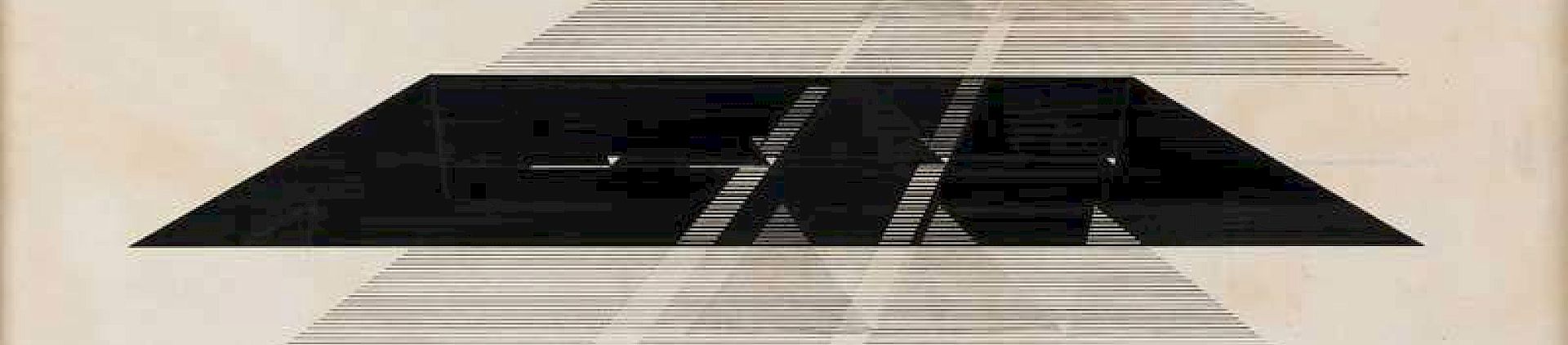
Porous Lines: An Interview with Mantra Mukim by Victoria Adukwei Bulley
Victoria Adukwei Bulley interviews poet Mantra Mukim about his debut collection, Glitchwork (the87press, 2026). They discuss the grid or mesh as a form of poetics; a failed moon landing thwarted by unexpected error that informed Mukim's writing; other inspirations from visual art and music, like Nasreen Mohamedi and Aphex Twin; and the influences of growing up in the industrial and forest landscapes of Central India.
Supported by a grant from the Open Society Foundations.
I think, often, about how a debut introduces the world not only to itself but also to all of the work by its author that may follow — its future siblings or children. This is not to say that artists and writers are wholly defined by the first moves they make publicly, but instead – and more thrillingly – that a debut has the capacity to throw open the horizon of both its creator and its audience. Glitchwork by Mantra Mukim is one such debut poetry collection. Released in April 2026 by the87press, it moves with rigour across sections and forms, traversing the post-industrial landscapes of Mukim’s childhood in Raipur, Central India, while simultaneously making leaps through time, space, and even into space itself.
Mukim’s poems are green with the unruliness of the natural world, yet they are also orderly and grey — which is to say, metal-like. Not metallic, as in shiny or gaudy, but full of linearity, constantly underwired by his eye for the way that the artificial, too, can withstand, mimic, even collaborate with the organic. Kaleidoscopic, formally brave, searching, and inventive, these poems are unabashed about their fascinations and yet deeply generous in how they invite the reader to walk alongside them, slowly. It is this quality that strikes me most of all, the sense that throughout Glitchwork the reader is invited into a different engagement of time and thought. It is as though there lie, behind the poetic interface of language and form, further layers of language and meaning that cannot be communicated without that initial negotiation.
It was a joy, therefore, to speak with Mukim about his process, informed as much by visual art as it is by music. We spoke, among all of this, about the glitch, the grid, the line, and the long poem.
by Victoria Adukwei Bulley
Glitchwork
sometimes vacant settles in us sometimes vacant settles sometimes
it brings our knuckles to blood as if the creature was
our fault the grass growing on its hide its love of debris perverse
stitches on the sky it calls ‘clouds’ everywhere
we will be asked to identify the angel glowing in our thumbprints
why it carries that face of deep why it winnows
our hearts as it walks rigs our praxis if only we could name once again
what is truly owed to us — i
Victoria Adukwei Bulley: Mantra, I’m so happy to have spent time with your writing. It was my friend Azad [Ashim Sharma, editor at the87press] who first mentioned you to me. I want to ask you about the origin story of Glitchwork. How did the ideas arrive to you, and how did the project begin to take shape as a book?
Mantra Mukim: It was an accidental arrival in some ways, because I did not really think of it as a book. When the87press got in touch about whether or not I had a book going or if I wanted to submit something, I was like, ‘Oh, I don't know about that, but I'd love to think about the book as an artifact that considers its own making.’ And that became a kind of experiment in the work itself. I love origin myths, and I have huge regard for all the different kinds that surrounded me when I was growing up. The origin myth for this one, if I were to invent one, would probably be Aphex Twin. I wanted to write something about his work because he was one of these electronic composers and musicians that I was listening to quite obsessively during my undergraduate studies. I would study in Delhi and, in the summer, go back to my parents in Central India, which is where I grew up. There, I would listen to Aphex Twin on repeat because I felt that his work existed between ideas of industrial destruction and sublimity. He was doing things with industrial sounds, but at the same time, he was interested in the ambient, the lush, and the fey. Those were the things I was interested in too, because in Central India I was surrounded by industries and mining, part of the economic landscape there. I was also surrounded by tropical forests and a Naxalite rebellion [an armed Maoist insurgency] raging to protect them. So, it was the repetitive industrial sounds and the possibility of subliminal encounter that I heard in the music of Aphex Twin.
The book really started as an homage to Aphex Twin when I moved to the UK. I tried to find out more about his work and see where he came from, to know if there was something in the landscape that resembled Central India, and I realised that Cornwall, in its de-industrial quality, was key as a discordant landscape. It has a mineral richness and yet, at the same time, a certain kind of decrepitude that sets in any kind of post-industrial landscape. I wanted to write in the same way he was composing these sounds, to find some kind of a middle passage between the sublime and the industrial. Something in his work inspired me to make a similar gesture in my own.
VAB: That’s incredible, because one of the things I was thinking about when I was reading Glitchwork was its lushness, the way the word ‘lush’ contains that sense of abundant forest and vegetation. I was so interested in that interplay between the natural world and what is artificial — everything that has been constructed by the hands of humans. There's a particular set of couplets that I was struck by:
‘metal brings no owners only settlers’ friends loved
me once for all the trees i could name in Bilaspur
counterfeits accompany the fire welding
melding carrying the face to subtle
constructions broken limbs of words
will heal once again mouths will nest there’
It's the constant presence of industrial decay, yet persisting greenness. It made me think about The Mushroom at the End of the World by Anna Lowenhaupt Tsing, that sense of nature having the final word, despite and in spite of …
MM: Yeah! I was quite interested in the industrial plant as a way of seeing the artificiality in nature. I had been surrounded by peepal trees in India — there are a lot of them that grow onto public buildings, creating niches and nooks and crannies in different parts of a building, especially one in varying states of disrepair. You’ll have an architectural complex, and then a looming, a blossoming, a merger, and taking over.
So yes, I would see these trees blasting off from buildings in India, and that perhaps became one of the ways I would think of the interface between organicity and construction. It is a dynamic that involves both craft and nature — one that I find quite productive, and something I love thinking about in my own work, about how books can become something that's kind of mechanised. I’m thinking about what is expected of the book in a poetry landscape, about what it can or cannot deliver. What is the organicity left in the process of book-making? I'm also constantly drawn to the question of what the book is for. Is it somewhere on the side of mechanisation, or is it really on the side of organicity, with pressures of mechanisation, navigating one or the other?
VAB: This is so fascinating. I want to ask about the book’s title, about this idea of the glitch, which moves through the book as a whole. The line ‘glitch is a wound without an outside’, which comes from the central long poem titled ‘Glitchwork’ keeps echoing for me. Where did this focus come from?
MM: It came from a rather specific place. There was a glitch that had been identified in the [Chandrayaan 2 Vikram] moon lander that the Indian Space Research Organisation sent into space a few years ago. It was very close to touchdown, but something happened during that process which meant it came down too fast. It succeeded in landing, but not in the way that the people on Earth wanted it to — that soft landing that everyone craves for in the space race, a landing that allows the object to live exactly as it was living on Earth. So they set up a failure analysis committee to see what went wrong with the machine, and they're still not clear what exactly went wrong. They did all their calculations, made all their predictions, they had a clear line of flight and landing, but something went askew. The glitch came in from nowhere, and that was interesting to me because the cause or the threat wasn't from outside; it wasn't from another object, a projectile, a missile. It wasn’t another anything in the way we generally think of threats, but something within it that wanted to fail, that wanted to glitch. I was quite moved by this, the idea of a glitch from nowhere, where this error, this failure, just occurs — the irrationality of this in an object that is in many ways the apotheosis of human creativity and technical knowledge. It really does bring the god back in the machine as a glitch, the deus ex machina. That incident informed my writing of the poem ‘Glitchwork’ as a separate section, and I began to realise that what was happening in different parts of the book was this focus on the idea of self-sabotage, of errors, mistakes, and failure. It was poetry being scared and embarrassed about its own weakness, a deity being scared and embarrassed about its own deification, the pilgrim being apologetic about a mistake that is not really a tangible mistake, but rather a part of who we are as humans.
VAB: There’s something both terrifying and liberating about that. On the one hand, there’s a lack of control, in spite of all preparations – because, as you’ve said, all the calculations for the lander were correct – but on the other hand, there’s something hopeful in the glitch precisely because it’s humbling. I’m thinking about the role of advanced technology in weapons that are used in genocide, for example, in which cases the glitch that causes the failure of the weapon is a kind of angel.
I also wanted to ask you about the concepts of the grid and the line in Glitchwork. These terms show up repeatedly, and as we know, there is no grid without lines.
MM: There is an element of inorganicity to how I approached the concept of the line. On the cover of the book is a drawing by Nasreen Mohamedi, who is this painter in post-independence India who went from painting landscapes with perspective, using colours and contours, to just drawing lines. She spent around ten years in the 1970s just drawing pure geometric lines. I came across a diary by her where she's talking about lines and what they mean in a work. I was completely drawn by the idea that here was someone who was exposed to all kinds of heterogeneities and layering as an artist, but what ultimately streamlined her work was this purely abstract concept of the line, It’s almost an artificial concept, right? Because a lot of people would argue that lines do not exist in nature — there are no geometric lineated structures in it, everything is slightly askew and asymmetrical. I was drawn to the fact that you could reduce this otherwise complex layered structure to something very precise and straightforward. I was drawn to it for reasons that I haven't processed fully and I'm still sort of wondering why that is so appealing to me as an idea.
The grid really allowed me to think about some kind of compression. This was really interesting for me, because I was constantly thinking about writing about things I find quite complex, diverse, and plural in their own ways. There was no other way to systematise them and think of their totality, except through a certain kind of line that runs through them, that intersects them, that is, in some ways, both deeply modern and artificial, yet has possibilities of a certain kind of primitivism, of knowledge that's been buried and is not easily available.
The glitch that causes the failure of the weapon is a kind of angel
Mohammadi's work looks at telegraph lines, for example, which encapsulate and reduce complex, urgent messages into pure infrastructural facets. Sometimes, all you can see is a telegraph line, ripe with the possibilities it carries. For me, this became a weird but productive way of thinking about communication as something artificial, mechanical, and industrial, something that is produced as a wire first. That is what I was exposed to, growing up in a region known for its steel production, most of which is produced in the form of straightened or flattened lines. Obviously, the raw metal itself is not linear, in the same way that inner life is not linear. It is more amorphous, existing in shapelessness — yet the only way to extract it and make it make sense is through a line. And when that line meets another to create a grid or a system, there lies the possibility of making it porous or making it melt or glitch again.
Within that kind of gridwork, there are all these possibilities of accident and chance-like weird encounters. I realised that's how I was seeing a lot of the landscape around me. I was seeing both this deep ordering or patterning, as well as constant possibilities of accidents and breakdowns, and those two went completely hand in hand. They didn't seem like two different things, or like one negated the other. It appeared as if people were constantly making grids, and people were constantly trying to exceed and transcend those grids, in turn making new grids. I don't know if this sounds legible at all …
VAB: It is, particularly when you speak about the nature of metals, and how at the point of extraction they don’t have linear form, but once they are processed and extracted – once the ores have undergone human interference – then they are blocked into these bars, right? I saw the arrangement of these structures as a kind of mesh work, in the sense that mesh has holes but is also a barrier. It's an obstruction that also allows for filtration. Some things can pass through and some things can't.
I love the way your mind works, and one of the things I most love about poetry is when it’s used to contend with something that is not even mostly understood yet. I deeply admire what you’ve said about your fascination with the line as being unfinished. What I understand clearly is that the writing process involves the negotiation of such complex, intersecting, and large ideas that the concept of the line provides a kind of relief. It’s a sharpening mechanism, a framework to hold thought ...
MM: I love the use of the word 'mesh'. One way I was thinking of the grid – which might not be the classic Agnes Martin kind, like the American urbanscape – was in latticework, what we call ‘jali’ in Hindi. A lot of the lattices in architecture, in houses and urban construction in India, are built with a principle of ventilation because these are extremely hot climates. There was this porousness to the grid, to the mesh, that I found appealing. It was also the fact that there was something hidden and secretive about them, yet they allowed a certain kind of interface, some kind of exposure. The poem, for me, is supposed to do that. The work of craft is like creating these meshes or lattices. Without wanting to sound anti-confessional, I feel that poetry needs that lattice. It needs that mesh, where the cleanness of the abstract line has a porousness of something seeping through from behind. That idea kept coming up in different ways, as a grid, because the grid is supposed to be a space that, on one hand, is disciplined and deeply concrete, and on the other hand, is also profoundly navigable. It's holding something and making possible something that is inexpressible and transcendental.
Excerpt from Glitchwork
Each line is born with three hands that it uses to wage a war against sensory
reductionism. Some lines are born with a non-terrestrial vision. Few lines
I have known personally were born either as too much or as too little.
There are still lines out there waiting to be added to the endless mesh.
Plainer surfaces with concentrated depths — ‘each line is born of effort, history and pain’. The book is full of lines that do not intersect nor give
us a mesh. The book reeks of the hand. One line alone can birth a swarm;
it can bring voice to the world. A line born out of wedlock is generally
rewarded with depth. Lines born in raipur have severe back pain. They do
not know their source, they often let the calamity shape
themii
VAB: This is so thrilling to hear because – and I’m about to get into my astrology bag for a moment – I've been thinking about the role of Saturn, which is very much a planet related to responsibility. Saturn is a planet that’s seen as having this very structural, elder, masculine, and grid-like character but, essentially, the key reason why that emphasis on structure is there is because without it, Saturn simply cannot be responsible for the resources it allows to flow. In other words, that grid or structural interface is a means and not a barrier, even though it can look like one.
MM: I am a Capricorn, so for me structure is quite important. But Nasreen Mohamedi definitely saw structures as part of her interest in the inexpressible, or in the limits of representation. She did not approach the limit of representation as a gesture against art itself, such as Lucio Fontana’s tearing of the page or leaving it blank. For Mohamedi, it was to return to strokes — very basic strokes that someone could draw in a school classroom with a pencil and ruler.
There was this porousness to the grid, to the mesh, that I found appealing
VAB: In the same way that you were speaking about the presence of an interface – the grid, the mesh, as a kind of poetics – I'm interested in how you see the long poem. I'm thinking about your lines: ‘The world loathes the cover of a long poem. It is not a cover full of accretion’, and then later on, the statement: ‘Duration is how grids die.’
MM: I've been quite interested in the long, long poem, in the sense that I don't think I know any other way to write. I find the end of poems quite hard. To answer your question anecdotally, I used to also write in Hindi, and one of the reasons I sort of stopped – I might come back to it, I might stop stopping at some point – was because I showed some poems to Vinod Kumar Shukla, who used to live in my neighbourhood in Raipur and was by far one of the greatest Hindi poets of his generation. He looked at them, and was very kind to comment and make some changes, and of the things he said was that I really did not know how to end my poems. He pointed to the end of each short poem that I had left with him and said, this just feels like you're beginning another poem here, it doesn't feel like the end, and that really stayed with me. It shaped a kind of fear of ending poems, which is what drew me to the long poem, because you can suspend the end for a very long time, and you don't have to make that decisive cut. In a cinematic sense, it's like a long take. It's where you can leave something on for a very, very long time, like slowly cooked lentils. So I was quite fascinated by this idea of duration. I also realised that most of the pieces of art I was really interested in were quite durational and played with time in a way that somehow felt indulgent but also radically uncomfortable.
For example, a lot of the Indian classical music is performed over long durations. There are pieces where someone plays a single note for thirty-five minutes, arriving at that note from different places and different registers. That is the idea of duration that allowed me to escape some of the embarrassment about endings I felt. The poems can involve a play on unity and continuity and, at the same time, not be one composite organic unit. This allows for a lot of expression that could not have happened otherwise.
There is an element of inorganicity to how I approached the concept of the line
VAB: The part of it that's most attractive to me is exactly the sense that, if you allow yourself to see it through, you can make it to places that you may not have even thought possible. You get to make surprising discoveries on that journey.
MM: I feel like duration is a place in many ways. I think of the German artist Anselm Kiefer who works a lot with books and their erosions. He takes, let's say, a book by Paul Celan, and then sees it decompose over a period of time. I am quite drawn to durational pieces where something happens to the object and other things are invited into that process. I think about how a tree is such a complex structure, how all its little sinews host an array of different birds precisely because it is complex. That's what long poems sometimes allow me to do in the act of composition. They give so much breathing room that everything that feels important or imperative gets said because you are able to say: Come in, stay, you know, squat, if you like.
VAB: That really is indicative of a real kind of generosity of spirit, and it makes me think about humility too — humility to the process, because we know our human lives are finite, right? We don't know how long we have, and we live in a sense of time that can feel extremely fraught and critical. To inhabit this late-capitalist age – in which there is a near or distant crisis every day – and to have a long-durational relationship to one’s work feels brave. And also powerful, because it does actually expand time — no longer does it have to be a human timeline, it could be the timeline of a bird, as you say, making a nest in this tree, or other life forms that exist in time in ways that transcend our usual sense of things.
What has been your favorite thing about writing Glitchwork? What has made you feel the most proud?
MM: Pride is not something I associate with poetry at all. I even say somewhere in the book that the book is embarrassed of itself. Embarrassment, for me, is quite generative when I think of poetry. I know this sounds weird, but if I’m slightly ashamed of doing something, then it must be right, right; it must be just out of place enough that it's productive. Having the book out has been interesting because I have felt that with every reading I have done from it, and even this conversation with you, has made me more of a poet than I was before. The book makes this possible in a way that a poem does not; the book allows you to return to the world in a different way. It is perhaps because it is a first book, and that is its own kind of creature.
Endnotes
i First published in Ludd Gang in 2023, this excerpt was due to be printed on page 67 of the book-length poem Glitchwork (the87press, 2026). However, for reasons unknown, it fell through one of those treacherous crevasses between proof and print and disappeared from the final book completely. Here it is, speaking to and for the book from the elsewhere.
ii Excerpt from Glitchwork (the87press, 2026).
Cover image: Untitled by Nasreen Mohamedi


