Strains by Sarah Anjum Bari
In this life writing piece shortlisted for the 2024 Queen Mary Wasafiri New Writing Prize, Sarah Anjum Bari explores matrilineal relationships, patriarchal expectations, obedience, and rebellion for South Asian girls — and how hair can be at the root of it all.
The 2025 Queen Mary Wasafiri New Writing Prize is open until 30 June 2025. Read the full guidelines and submit your work.
I.
Dol dol duluni
Ranga mathay chironi
Bor ashbe ekhoni
Niye jabe tokhoni!
My first flight was on my aunts’ elevated knees. Lower body lodged snugly between their legs and upturned feet, I’d hug their shins, prop my chin up on their knees, and SOAR. Dol dol, swing swing, my aircraft looped up and down, higher and higher each time. Our soundtrack was that children’s rhyme every Bengali child grows up listening to. It picked me up over the skies of my bed and announced the arrival of a departure, an escape, an imminent adventure. The chorus rushed in, EKHONI – a giant, giddy SWOOSH – and my seat tilted upward, my face hurtling down through space. Air spun in my tummy and by my ears, my hair poured into my mouth and eyes, snagging onto the cotton pajama legs keeping me airborne. I would squeal, my locks would tangle into knots. It is the feeling of my messy hair that I recall most vividly from those moments in the air.
Playing dol dol on my mother’s sisters’ knees was my first taste of freedom. It was the first time I felt my gaze resting above others around me, and it mattered to me, even then, that only I at that given moment could see the top of the bed or the sofa and that finger-stained patch on Nanu’s wall just so. My body existed alone in its airspace. In that solitude, I felt the vibrations of innumerable possibilities. I suspect that’s how every child who grew up playing dol dol feels about the song, and I suspect what makes it so special is that it marks a time from our lives when our bodies existed with complete and utter abandon. When happiness didn’t necessitate stability, and messiness was a symptom, if fate had been kind to us, of mindless joy. It didn’t matter who looked, or how, only how we could look at the world. I suspect what makes it even more special is that this first of freedoms is a uniquely Bengali experience, because it is girded and propelled by family. By what their bodies make possible for ours.
Sixteen years later, I find myself on my back on Nanu’s bed, hamstrings straining from the weight on my shins. My aunts have married by this time, and I love their children so much that every muscle in my body aches to lift them up in the air, to hear them giggle. If flying had felt like ecstasy, it is an even greater joy now to be able to pass on that freedom to the next baby girl to join our family after me. Arwa has my smile, Ammu and my khalas say; she’s loved with the fervour I received from my first day in this home. But her gaze is sterner than mine ever was at her age. This girl is going to set us all straight, we chant, she’s going to wrap us around her tiny fingers. I feel a solidity in her that will be harder to bend to others’ whims. I sense it in the way she refuses food she doesn’t like, while I had stomached all the mango-and-boiled-milk concoctions that made me want to hurl as a child. I was a quiet receptacle of rules, and what I didn’t agree with I revolted against by making up imaginary scenarios in my room. Arwa demands conversation, eyes sharp, voice unwavering. To get her to agree, you must explain your rationale to her 4-5-6-year-old mind.
But, I relish, we share the same curls. Hers are longer even than mine. They fall over her waist and shower my face and chest when I lift her up on my knees. She’s ready to dive headfirst before the rhyme reaches its end, her goofy, bunny-toothed smile about to hit me on the nose, and I sing to her what had so many times been sung to me when I used to fly. Swing and swing, run a comb through that hair. The groom will come any second now to quickly take you away.
~
Arwa isn’t the first child I sing dol dol to. Before her came her brothers, who sat quietly on my knees until being lifted off their feet genuinely took them by surprise. For them I merely changed the lyrics. Instead of a groom, Baba would come and take them out in my version of the song. Their gender naturally demanded that change. Singing the unchanged verses to Arwa made the words feel like pebbles in my mouth.
I heard, finally, the terror that lurks in the verse. How quickly, in two short lines, a child on a swing transforms into a woman who must neaten her hair. How inevitably she becomes a bride awaiting a man.
In its rural setting, which was where the song likely originated, the lines could simultaneously be a forewarning and a celebratory chant of actual events — a young bride girl, an older groom. In the urban and more privileged context of our home, it was the second line of the song that unsettled me when I became the one singing it. That abrupt moment of change; that tipping point at which hair begins to shape societal conventions of character. Each shade of that line grew more ominous depending on how I read its tone. ‘Wait’ for your husband, he must be any second now. Be ‘ready’ for your husband, he’s arriving any second now. Be ‘aware’ of the groom, he’ll take you away when he arrives.
Correction: I suspect what makes the song so special for some of us is that it marks a time when our bodies as young girls existed with complete and utter abandon.
II.
Body parts seem to lodge onto you when you grow from a girl to a young woman. Of all these appendages, in those sixteen years between Arwa’s and my childhood, I felt most strongly the presence of my hair on my body and life. Unlike my skin, which bristled with fur as its smells and textures shifted, the coils shooting from my scalp didn’t change when I began to grow. But their power, their failures, and potential to draw attention turned them into sites of much action. All the TV commercials foreshadowed this impending drama.
In the 90s and the early 2000s, if you wanted to sell hair products in Bangladesh or neighbouring India, your ads had to dangle the dream of gleaming black hair, silky and straight. Films, television, and books echoed relationship dynamics stereotypical to the Bangladeshi family in those days. There was slapstick banter between uncles and nephews, as in Humayun Ahmed’s serials. Social conventions were satirised in his novels and in Ityadi’s magazine skits, where the poor outwitted the rich. In movies, the working class hero perpetually foght against capitalism, only to win over the father of the woman he loves. In Eid special telefilms, there was the pull of the village winning over the man returned from the city, and the woman by the riverbank who was usually the reason he stayed.
In all these plots, a woman was the lodestone against which the hero and the villain – their impulses and their politics – gravitated. She was the muse, the moral compass, the catalyst, and the end goal of change. She was beautiful — this was an important fact of the story. And her beauty, symptoms of her situation in life, lay in her hair.
The richer or bolder these female characters, the wavier would be their hair. Particularly frizzy were the locks of the women who sought to seduce men or misbehave with elders.
No matter how unruly, though, her hair straightened itself out by the time she became mother or wife at the movie’s denouement. And it was this domesticated figure who starred in the TV commercials. Cheerful, gentle, content, her role now was to nurture. She cooked, served food, hand-washed her family’s clothes – the products being advertised were her weapons in these grand projects – and when she did, she had shiny, straight black hair. You trusted her more for having that hair. That hair came from one storyline most integral to the TV commercial canon: in this one, she rubbed oil into her daughter’s scalp, whose turn it would soon be to become beautiful like her mother.
What these cliches were tapping into – and were perhaps informing, too – is the centuries-old ritual of mothers and grandmothers passing on love, life lessons, secret joys, and admonishments to daughters sat between their knees, at the foot of a bed, a staircase, a family porch. These were moments of interiority in which a mother finally untied her own bun, or the grandmother recalled past love affairs, in touch with their girlhoods again. They were chains of nourishment transmitted through touch.
But chains, just like touch, can constrict as much as they stabilise. There is something indescribably vulnerable in sitting between a matriarch’s knees and having your hair oiled and tied. You surrender your ear to stories that risk imprinting onto your own. You risk your strands becoming entangled. What I practice as self-care now, caressing my scalp with black seed oil infused with onion juice at the end of a tiresome week, felt to me for decades like a form of imposed discipline at home. I felt stifled, and forever ambivalent of the gazes and hands that sought to smooth my strands into acquiescence. Perhaps I had subconsciously made note of the warning embedded in dol dol duluni’s childhood rhyme. Perhaps I noticed how different my hair looked and felt from the gleaming black waterfalls glorified on screen. A part of me always sensed that the coming years would force me to slick down, tie away, straighten out the bits of myself that stood out. The more that my mother and grandmother sought to tame my hair with oil that felt like a repressing force, a thing I couldn’t wash off my skin, the more I associated censorship with the women who were raising me.
The media of my childhood didn’t touch upon this charged undercurrent between generations of South Asian women. They co-opted it into a more sinister form of vulnerability, as did the Bollywood movies that shaped definitions of glamour across most households in the subcontinent. Going by the versions of womanhood that were most commercially popular in the region, it was silky straight hair, hair that all looked alike and not much like many forms of actual South Asians, that drew awe and love and lust. And I was entering the age where you want to inspire all of that.
III.
I hated that my hair sprang in a different direction every hour. These were no glossy ringlets out of what would become the CGM dream, but a mop that ballooned in rain and heat, grew angry with dust, caked into unfortunate permutations of curves and flat patches in humid weddings, birthdays, class parties. My hair had its own moods, its own command over how it would interact with each outfit, each temperature in the weather, each day spent with or without shampoo. None of them came expected, and all of them seemed determined to push me into acutely uncomfortable social situations. I was 13, 14, 15, 16, the vast universe of my attention wrapped tightly around others’ perception of how I must look and sound. Most girls around me – the girls who we agreed were beautiful – had hair that knew just how to act in a ponytail. Mine always seemed to miss the memo.
The version of me that revels in curly hair care now knows that I was perhaps not alone in such insecurities. We were all growing into our bodies and each other’s desires. But those years gave me a complicated relationship with what it meant to behave. The iron was too cumbersome, and blow dries not something I could go to the salons for every day. But there was a new hair product on the block, one that would effectively lift me away from sitting between a matriarch’s legs. Malaika Arora used it in her dance performances before the Filmfare Awards. Kareena Kapoor used it to fashion herself into Poo. She was strutting down the scenes of Kabhi Khushi Kabhi Gham, through the campus of King’s College London, where one of my aunts was attending university. Forever the propeller behind my flights, my khala brought the contraption home. I started waking up an hour earlier than I had to for school, snuck into my parents' bathroom with my mother’s GHD hair straightener, and flattened my curls into soft, shiny conformity.
I donned a weird kind of denial stepping out of the doors on those mornings. Believing, for starters, that my mother wouldn’t notice what I’d done to my hair. Believing also that, straightened, my tresses could fly and bounce and flow into messes of a socially acceptable form.
It made me feel free from judging gazes that were mostly my own. Gave my body the skip of confidence. Charm followed easily. A personality developed. I was popular, sought after, finding it easy to be myself on the days when my hair looked like someone else’s.
At home, there were rousing fights with my mother. Unlike that voice in the rhyme from my childhood, Ammu wanted me to let my hair misbehave. She wanted me not to care about the male gaze, or a patriarchal gaze, though she wouldn’t use those words. She worried that continued exposure to heat was killing the spirit of my curls. I told her she just didn’t understand. Amidst all the shouting, my father gently pointed out that it was a Bengali mother’s right to nurse her daughter’s hair into health, and that I looked more like their baby girl – freer, lighter – on the days that I left my curls alone. My refusal to comply made me, in their eyes, unruly — the daughter who refused to sit between my mother’s legs.
The 2025 Queen Mary Wasafiri New Writing Prize is open for submissions until 30 June. Submit here.
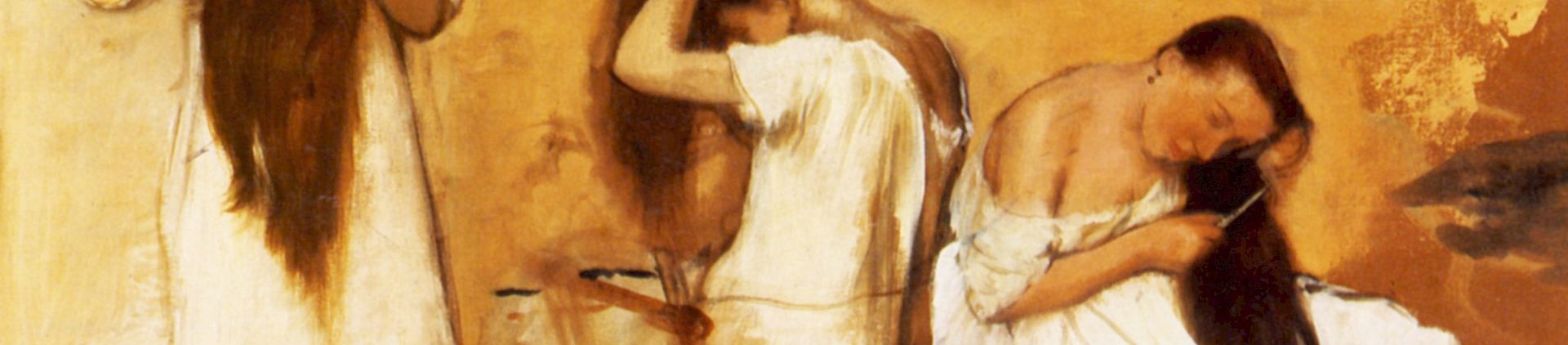
Image: Women Combing Their Hair by Edgar Degas

