This Eternal Present: Mona Kareem and Safa Khatib in Conversation
In this wide-ranging interview – on the humour of maps, immigration officers, pilfering through a father's library, and more – Safa Khatib speaks to poet and translator Mona Kareem about their latest collection I Will Not Unfold These Maps and the evolution of their poetics and practice amid Arabic and American publishing industries. This piece is published in tandem with Wasafiri 122: The UAE Issue, where Mona is a contributor.
How can a poem be read as a fluid map, a document that demands a revision not just of 'who', but, more importantly, of where we are as we read it? In this interview with Mona Kareem, this problem of 'where' emerges as a question of relationships — to friends, to cities both past and present, and to strangers. Sitting together, Mona and I shared a conversation that travelled from Sumer to the Red Sea to Nebraska to the shelves of their father’s library in Kuwait. As we moved between readings of poems from I Will Not Unfold These Maps (Poetry Translation Centre, 2023), vignettes of personal life, the politics of immigration, and the intentions of literary translation, the nuances of Mona Kareem’s vision as a poet came to light.
In one sense, this is a vision formed through hard-won literary friendship, as when they describe their love for the only poet who wrote a negative review of their first book. In another sense, it is a vision sustained by relentless historical investigation — an investigation Mona directs most intensely toward their own work. 'I asked myself recently why I don’t have love poems,' they reflect, before arriving at another way of seeing: 'Friendship and love don’t really have a border between them; they’re part of the same territory, in a way.'
by Safa Katib
Safa Khatib: I wanted to begin our conversation with the idea of maps, which might seem an obvious beginning because it is in the title of the book. Both critics and poets talk about the relationship between ‘poetry and place’. What often happens, though, is that the poem is assumed to be responding to or witnessing a sense of place that has already been imagined and established elsewhere, like through a national government document. There is a tendency to immediately absorb the poem into what Ammiel Alcalay calls ‘a discourse of sympathy and expertise’, in which we talk about the poem – especially the translated poem, the poem that arrives from another language, from elsewhere – in terms of an order of things (a map of the world, for instance) that is already given. Rather than asking the more difficult question of whether the poem itself demands a completely different way of seeing things — a new discourse entirely.
What I have noticed when I started reading your work is that the poems really asked me to disorient myself. First, I must change the way I am seeing before I can even begin to start seeing what the poem is up to, and where it is taking me. So, I wanted to ask you first: where are ‘we’? What would it mean to make a map of the present? Is such a thing even possible? And how do you approach this kind of question?
Mona Kareem: I treat maps with humour. They require a kind of irreverence. Maps started to happen when empires expanded; a map is a violent tool in that sense. It is violent because it is static. It doesn't really reflect the experiences of people. So, I like to think that the only type of mapping that we can do is a fluid mapping.
You mention ‘place’. When reading my poems, people usually notice how much place is really ambiguous, and I’ve struggled with that. I personally like to push myself, to be like, how can I sketch a real place in my poems? Just as a personal challenge. But I also embrace this anxiety of making the place ambiguous because I was never afforded a belonging to any place. I never took a place for granted so that I could say oh, here is my place, and I will present it to you. Whether living in the Middle East or in the United States, I have always been a stranger to some extent. I wanted to write poems that disorient, as you said, all kinds of readers — both the biased ‘outsider’ reader, and the reader that already can predict you, the ‘insider’ reader.
I think this has a lot to do, of course, with my identity as a stateless person. I am also someone who comes from this wonderful legacy and canon of Arabic literature, a literature that is rich and inherently transnational. But at the same time, coming from a minority within a small country, I struggled between this very specific reality I lived and this really grand literary tradition.
At times, this situation made me feel like I may have to find myself speaking like a pioneer. But the thing about pioneers is that sometimes they have to simplify a lot. They just have a burden. So, I decided I wanted to displace this burden onto the reader. I want to slip away from this burden by saying that yeah, I do belong, and I do have a map. I do have a place — but it's never settled. If my reality is never settled, why should I pretend otherwise in the poem?
I treat maps with humour.
SK: I'm thinking about how we don't even learn who the speaker of the poem ‘Cities Dying Every day’ is, until the stanza where they reveal that they died ‘when Sumer surrendered the throne’.
MK: Yeah, 5000 years ago!
SK: Right, so there isn’t any reader who can come to this poem and feel comfortable or, like, oh, I can locate myself immediately. Transferring that burden of asking ‘Where am I’ is really essential to the poetics of this collection.
Where were you when you began to write poems? How do you think about your trajectory, both in terms of where you've lived and your work as a poet, over time? You have three books of poems now in Arabic, aside from this selected edition in English. You also have a chapbook that appeared trilingually. How has this experience of writing and working been for you?
MK: Just to give an idea of when I started: I was a teenager writing poems. By coincidence, I submitted to a local publisher and they said: We're going to publish this. So, I became this child poet. I wasn't allowed to leave the house on my own, but I could write books!
SK: You were 14, right?
MK: Yeah. But really, when you read my early poems, there were two threads to think about. First, a lot of it was rebellion against the family. I really hated being subjugated as a kid — as a girl, but also as a kid. I loved resisting. For example, I loved not sleeping. I would just stay in bed, determined not to sleep, just to defy the rules. Even though I come from a big family and our parents didn't try to micromanage us, I still felt that subjugation. I think it is the condition of the modern child to be denied the right to move freely.
I was always fascinated with the world of adults. I felt that they get to do whatever. Poetry was my way to trespass into that world of adults. My father had his own library at home and he was very protective of it. That library was my first crossing into the adult world. When he was not at home, I would just sneak in and look at the books. At some point, he decided to use me as free labour and help him organise the library. That gave me an official role, but basically, I thought of literature as an escape. And as this way of, again, entering the adult world.
Also, when I started writing and reading these books, I found all of these worlds that I felt there was no way I would see. I say all of this because family was really the main theme in my first two books: the fragile woman, the grandparents who are representatives of, say, the ancestors at large. Then there were also some political poems that were more about the times. For example, writing when the Iraq War was happening. And there were poems about having questions about those events. When you’re a kid, you don't really know much, but you can see there is something happening.
When I went to college, I had a very anti–literature stance, in the sense that I thought that that was not real life. And I decided I was going to live real life. So I went into theatre. I was organising politically and I was just letting myself be taken on different adventures which took me away from literature.
When I came to the US for graduate school, I realised that when I was stripped away from my whole social support system – the familiar things, language, memories, plays, all of that – the only thing left for me was the poem. Poetry was something that was second nature for me. It's this thing where when you are vulnerable and so alone, that's your place. That is for you. And you can take it anywhere with you. No one can take it away from you.
So I think this is the kind of thematic trajectory, between the family and political awareness, and the striving for a sense of life, with the poem as a last resort. Aesthetically speaking, the only thing I can say is that I'm someone who looks back at my older poems and tries to break my patterns. I do this without a certain goal, but more out of a desire to expand my poetics. My worst fear is to just stay in place and be a redundant poet. I think of looking back as an opportunity.
Transferring that burden of asking ‘Where am I’ is really essential to the poetics of this collection.
SK: All of this makes me think about how so many of your poems are involved with both enacting and questioning what it is to ‘witness’. The poet is often travelling between a ‘now’ and ‘then’, a ‘here’ and ‘there’. Your poems ask: what do we do with what we witness in the world? You have a poem near the end of this book, ‘Lot’s Wife’, that riffs on this.
MK: ‘Lot’s Wife’ is a Biblical figure and also a Quranic figure. I’m really fascinated with her. In Arabic we have a name for her, ‘Waliha’, which means ‘she who longs’ or ‘she who loves’. This name really triggered the poem for me.
SK: There is so much that this poem contains. There’s a sense that it is holding multiple spaces and places in time at once.
MK: It is a poem with a two-fold attention. There is the poet living in exile, encountering a sculpture, which then brings her in conversation with another woman entering exile, from a past time. What I enjoy about the figure of Waliha is that she is rarely recalled with any sympathy, at least in the Abrahamic religions. She is someone made into an example of how things can go wrong when you don’t follow God or Man, when you enjoy life against their will. The punishment is tragic compared to her actual sins — exile and destruction of the place of her past, memory, and very self. So, salvaging Lot’s wife and relating her to the contemporary migrant is evocative specifically because pity and empathy are exhausted ways of relating to one another. The poem mythologises and canonises the migrant figure at once to try and reclaim her – and ourselves, in the process – from sacred violence.
I think it is the condition of the modern child to be denied the right to move freely.
SK: Let’s move to your translation work. You have translated Ra’ad Abdulqadir, among others. Can you talk a little bit about your translation process, your experience as a translator, and what you are seeing in the US literary translation scene now?
MK: I was someone who grew up monolingual and then in college, learned English and majored in it. I used to read a lot of world literature in Arabic translation. I decided, just as a personal practice, that anytime I would encounter a poem that I love, I would translate it into Arabic. It was a kind of journalling. I never thought about translation as a ‘serious’ business in that sense.
I was introduced to translation as a more rigorous literary practice when I came to graduate school in the US; you start to realise that translation has politics, aesthetics, and has to do with negotiations between cultures. There are all these hierarchies. What literature do we translate from? How do we treat this literature right? There is a whole system to it. Then I began to feel a sense of responsibility. I'm someone who loves Arabic poetry and there is so much it offers to Anglophone readers.
There is a tendency in Anglophone literature to prefer novels because they are easy to consume. They are so popular because there is also something anthropological about them. You read and you understand. But this is something I love about poetry: it never gives you full access to a culture. It's always like, no, there is some distance. That distance is really important. It is an important estrangement.
I have translated poets that I enjoy and who I think represent something unique in Arabic poetry. With Ra’ad, he is very much a storyteller. There is something cinematic about his poems. Even though he is a 70s poet, he became prominent in the 90s, when Iraq was under sanctions. If you read many of his poems, you see that the protagonists are actually objects, not human — a table, a window. He felt this despair of reaching an age where humans are not enough as speakers. You have to do something to make a numb reader relate to you as you are undergoing this slow death.
I thought I would never translate novels as I have a lot of declared animosity towards them. I wrote a whole dissertation to say why novels are horrible. But, at the same time, I found myself translating Octavia Butler's Kindred (1979) from English to Arabic and it was really enjoyable. I have noticed that in Arabic literature, a lot of race–conscious novels are coming up. But I have found that many of them tend to be flat — there is something missing. A lot of them fixate on racism as an everyday experience rather than also a systematic phenomenon that deserves historical excavation. When you talk about experiencing racism, you need to also scrutinise your own history. It's not just about encounters.
And then I encountered Butler's novel and I was astonished. I love how this novel, that is written in classical narration with a first person speaker, does a wonderful job in helping us understand how slavery informs the present in the US. The past is never dead; it is always shaping the present. Butler offers this simple and yet also very complicated solution, which is time travel. Through this device, you are able to have a more historical understanding of the race problem in the US.
So, I translated it into Arabic. We have a lot of bias against sci-fi [in the Arab world]. We think of it as Star Trek. It is not popular, and people were suspicious at the beginning. But then people loved it, and now other Butler novels are translated by other translators. I will say that I love translation. It teaches me so much about how literature and culture are not separate from economy and politics: they are all ruled by power relations.
When you talk about experiencing racism, you need to also scrutinise your own history. It's not just about encounters.
SK: What you are saying about translation makes me think of the different mediums you have published in. In addition to your books of poetry, you have a chapbook, Femme Ghosts, which came out in 2019 as a trilingual edition in English, Arabic, and Dutch. Can you talk a bit about your relationship to publishing and to the process of putting out that book? What are the challenges you have encountered while publishing, either bilingually or in Arabic?
MK: We don't have the chapbook form in Arabic publishing. You will only find chapbooks if they are children's books or illustrated books. I love the chapbook format because sometimes certain things don't need to be said in 100 pages.
In the case of Femme Ghosts, it came out of a residency I did in the Netherlands. It was more about the process of sitting with two translators and sharing my poems and going back and forth about how to read the poems, saying ‘No, it shouldn't be read that way; it should be read this way’, and so on. That was beautiful.
To elaborate on publishing: when you and I went to the AWP conference, I remember how much we poked fun at how career-oriented many people were. You meet someone who just started writing, and they are thinking about how they can publish with the top five publishers. You need to make ten years of mistakes to get there! This is something that I did not experience as an Arabic-language writer because that industry is not a billion-dollar industry like it is here [in the US]. It is very much about having a publisher that believes in a certain intellectual project and, if you subscribe to that project, you publish with them. Pretty much everyone is an independent publisher, except for certain exceptions where they are government-funded and more focused on knowledge production. That kind of organic publishing industry really afforded me so much freedom and informed my relationship to literature as a relationship of love and curiosity.
SK: Your poems are often very tonally complex. Poems that seem, at first, to be the most despairing or sad end up being the most funny. There's a lot of humor woven in with grief. Even in ‘Cities Dying Every day’, there is humour at work underneath a number of lines (‘dent my country's nose’).
I’m thinking of Jadaliyya, one of the most important journals in the world for arts, culture, and politics in the Arab world, and how it has turned to humour as a way of critiquing lies and propaganda that justify genocide. Humour can do so much work poking holes in dominant discourses. How does humour work for you as a vehicle in your poems?
MK: Early in my writing career, I used to be very biased against humour because I thought it was not serious. At most, I would be sarcastic. I was also anxious, thinking about how much I am judged as a woman poet, in that I am already perceived as unserious. In Arabic literary criticism, we have a lot of bias with male critics being patronising, essentially saying ‘Well done! You wrote the book!’ So, I was always trying to be even more serious, even more aesthetic and literati in that sense. But then you encounter certain poets and realise, wow, humour can do so much. As a stranger, humour really helps you. When you are a foreigner to a culture, humour is a way to diffuse things. It can also be a great passive-aggressive way to deal with sexism and racism.
I think my first experience of consciously embracing humour was in the Netherlands. I [first] flew to London and a woman at the airport, this police officer, insisted on doing a – what do you call it? – personal search. To say the least, I felt humiliated. My eyes were tearing up, just violated. So I get on the flight and write a poem titled ‘Ode to the Security Woman’. It is a bleak and sarcastic poem, but then it ends in a humorous way. That humorous ending was how I relieved the trauma in a way.
I will say that I love translation. It teaches me so much about how literature and culture are not separate from economy and politics: they are all ruled by power relations.
SK: There is very rarely a ‘solitary poet’ in your work, even or especially among the ruins. In general, your poems are set in this eternal present, and they are filled with relationships. Can you talk about the relationships that have meant the most to you over time, as a poet?
MK: I asked myself recently why I don't have love poems. This was striking, especially because I'm someone who, when I pick up a poet that I do not know, to decide if I should buy their book, I look for the love poems. If you can move me with a love poem, I will buy this book. When I thought about it more, it turned out my love poems were mostly about my friends. I really love this fact. Maybe this has, again, an important relation to how the child resists the mechanisms of control. Friends are the first people we choose in life. They are not chosen for you. There is no blood relation, so there is a lot of power and freedom in choosing them and being chosen by them.
In this book, there is a poem about a friend who disappointed me, a suicide poem where she throws herself off the cliff of my heart. Again, the dramatic teenager! I'm someone who believes that friendship and love don't really have a border between them; they are part of the same territory, in a way. Maybe our patriarchal, heteronormative world wants us to think otherwise. But I really believe that friends play such a huge role in my life emotionally. So, I put them in the poems.
One person I want to mention is the late Palestinian poet Mohammed Al-Asaad, whom I have known in Kuwait. He was the only one to write a negative review of my first book, and I loved it so much. I felt he was the only guy who didn not patronise me. Many people were like, oh, she's a kid, good job! I was so grateful for his honesty. It helped me learn who to look for, and what a real literary friendship looks like.
SK: What are you working on right now?
MK: I'm one of those people who works on several projects at once, and I'm trying to not do this because, especially as an academic, it's not smart. I just recently finished a poetry collection that is titled The Green and The Arid and a lot of these themes are in those poems. One of them that I want to talk about in this new collection is how migration is not an experience that is only related to the West. I remember realising that I am not really the first immigrant in my family. I am just keeping the tradition. People have travelled so widely within the region. In my case, I had to cross continents.
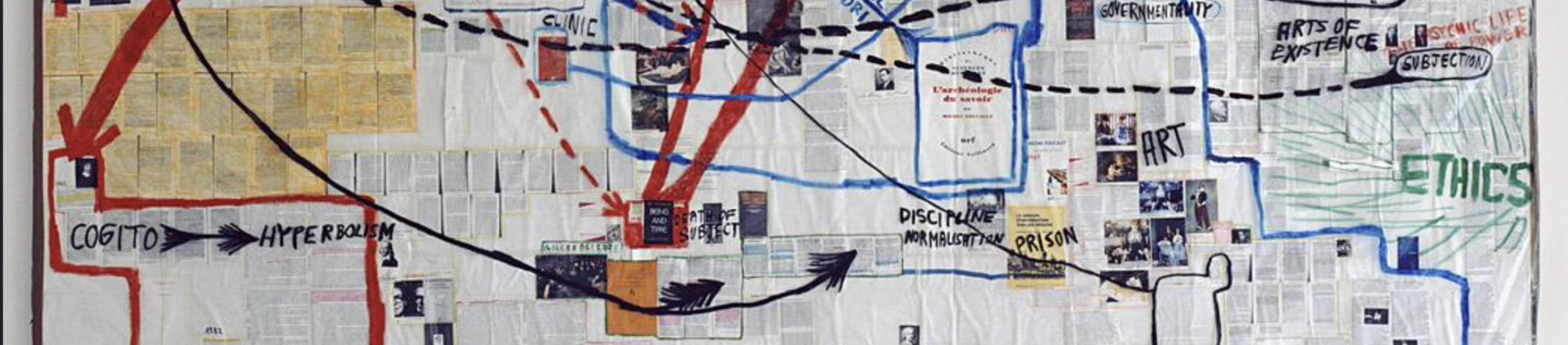
Image (cover): Foucault Map by Thomas Hirschhorn, 2004 via WikiArt © Thomas Hirschhorn
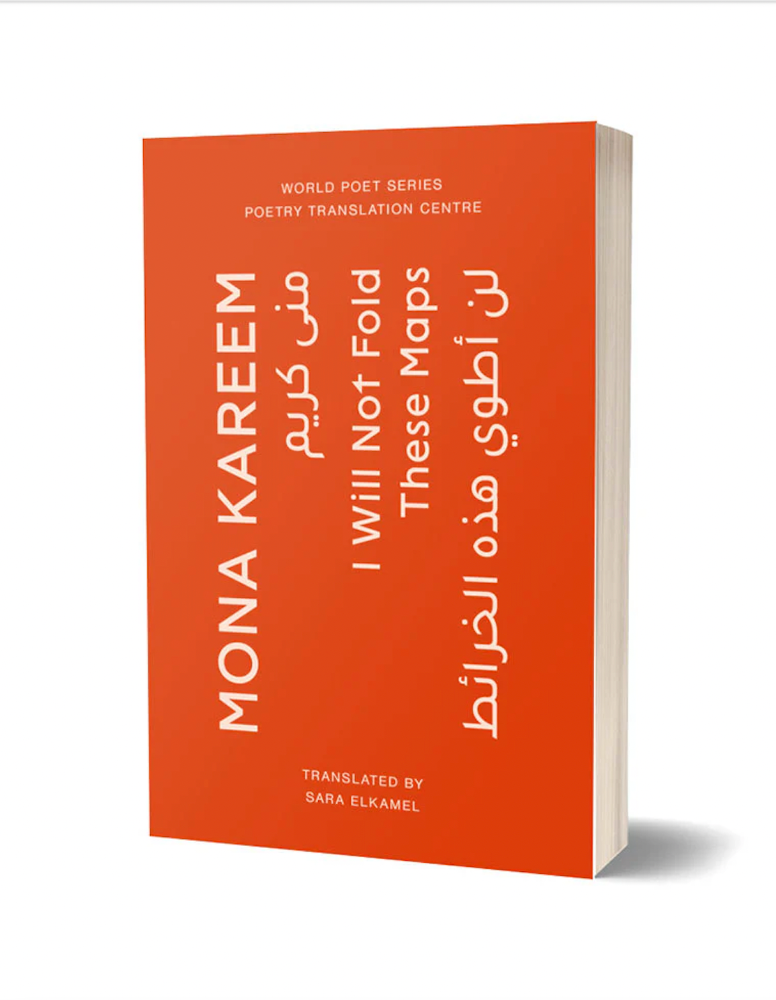
Image (book): I Will Not Unfold These Maps by Mona Kareem, trans. Sara Elkamel (Poetry Translation Centre, 2023). Image courtesy of Deepak Unnikrishnan.


Our summer special issue, guest co-edited by Laure Assaf and Deepak Unnikrishnan, explores the United Arab Emirates’ literary and creative scene — away from monolithic representations of the region. Its contributors are makers – of books, arts, texts, and community – with ties to the United Arab Emirates and/or the Gulf. They are brought into conversation across generations and disciplines, reflecting on what this place is for them, and what it does to them. They talk about risk, memory-making, taxis, and televised dreams — pushing the lines, or treading them carefully.
