Three Poems by Sanna Wani
‘"Had I known how you would arrive, I might have avoided you," I said to God' — these new poems by Sanna Wani swirl with the elements of ars poeticas and (de)constructions of the writing process and the self. Desire, attention, nature, nationhood, ache, and creation all come together in this beautiful trio of poems.
Supported by a grant from the Open Society Foundations.
Gratitude Against Despair
an abecedarian after Lorna Crozier
People ache.
An ache is an appetite.
The bees stink with my lust.
Cauldrons of my grief could go cold in the city.
I notice death noticing me.
Ekphrasis and exegesis have a few things in common.
Flowers, first of all.
And God.
The sun.
‘Had I known how you would arrive, I might have avoided you,’ I said to God.
Like ice on the rain.
‘Just because you can doesn’t mean you should,’ God says back to me.
Kites, and other creatures of the sky, understand my questions.
Loss is a lesson in love, a theory of light.
Mountains preside over us, and longing.
Notable mentions are just as worthy as wins.
An owl, an opening; Penelope, a dove.
People are quiet. They love a quiet dawn.
Silence rose over the ashes of the day, papery and pliant.
Sheltered, loneliness spoke to me.
Tumultuous, toothy, terrifying.
Umbrellas have been through much worse than me.
In our purses, we carry vestiges and verbs of mourning.
Who, what, where, when — sometimes, I ask: how?
The axe of my desire is why.
And then there’s you.
Your longing.
A zoo.
Umbrage
I memory. I nation. I borrow civility. From time to time, society asks me to become a flag, but I decline. I can count the places from which I emblem. Hair, skin, bone, and nail. I hate being a symbol. I hate being claimed. I hate the idea that modernity has confused belief with identity, and identity with revelation. Hate is a bottomless desire. Like any feeling, it reveals me to the world, and the world to me. Liberalism will claim that this act is useless, tiring, soul-sucking. I disagree. My hate is another name for my anger, and anger protects me, like a gun. Nostalgia can be a form of deceit. The earth is littered with nations. I can count them like rats. Like mice. I bet God scoffs at us. I bet my memory hates my knowing. Doubt fills my thoughts, like a tank. If I got to choose, I would be a fish in my next life. I would not drink coffee alone at my desk each morning, thinking of the nation of my family. Luck has abandoned the likes of us. Even my poetry resents me. It’s winter. In Kashmir, the lupins still rise. In this country, nothing blooms but the frivolity of my ambition.
Some Ideas About A Novel
after Heather Christle
I can write about anything. Only a few words belong in this sentence, but try telling a poet that. My sentences are a mile wide and going nowhere.
I am always spinning my wheels around a paragraph, uninterested in coming to any conclusions, a behaviour I picked up from the music I like.
My current draft has a lot in common with clay at the bottom of a lake, unsifted and unwedged,
its particles lopsided and damp, like a statue left unfinished.
That metaphor was a gift. A simile, to be honest, is a nuisance. Generally, a pest when it comes to prose: I am walking like a dog, the wind howls as if on fire, the skyscrapers are like the trees.
Nothing is like or unlike anything, except maybe for my mind and its terrain, which is the focus of my attention these days, the project I am bushwacking my way through.
I hate writing love scenes almost as much as I hate writing violence. The world is full of holes, and I’m trypophobic. This is why I’m a poet, a giant prancing over the trees, into the sky, which is as white and clean as a fitted sheet.
Writing fiction is like grasping at the hand of the statue I mentioned earlier. Gentle or firm, a touch can make a limb come loose. Oops! Oh, well. I’ll put it back together … again.
Reconstruction is not a bad way to spend a Sunday in the mountains, while the trees watch over us dutifully, imbuing the process with dignity. Just kidding! The trees don’t care about dignity.
If there is a word for my process, it is humiliation. It lacks grace but is interested in honesty. Maybe that is a metaphor I can gift to someone else someday.
Some language, though, is not meant for giving. Not everything is meant to be an image on the page. If you betray beauty enough, poetry will stop trusting you. An ending is just a choice.
If I were to choose to end this poem here, I might ask the spectre of my protagonist – who follows me around like a shadow – if she liked it, and she would probably say, No.
‘Thanks!’ I would tell her. ‘I appreciate your honesty!’ She’s a lot like my husband. I have to ask her permission before I put her in my poems, because trust is more important than art.
Right now, she is the size of the minnows we saw at the marsh, the algae and the moss. The snails, light enough to walk on water.
She has been wading for me into the rivers of time, trying to bring back a few ideas. Our story unfurls like a houseplant on my desk.
Like the child I may or may not have someday, I have been waiting to meet her for a long time. I want her to stay. She thinks I’m alright.
But if she asks me to write that scene again, she might not like me for a while. It’s fine! I’m human! I’m always searching for a way out.
I know the truth is the size of a window, and I can fit through it, sometimes. Sometimes, outside, the deer pass by, shaped like blessings. They come with a few reminders.
Time is trivial. Patience is a practice. In order to write, I need to walk. In order to walk, I need to eat. It’s like preparing for a marathon, only less annoying.
My whole life, I have had the stubborn desire to run toward God. I wish I knew why. It’s form of hubris — and longing.
At any age, you can learn to float. That’s how a dream begins to grow a body.
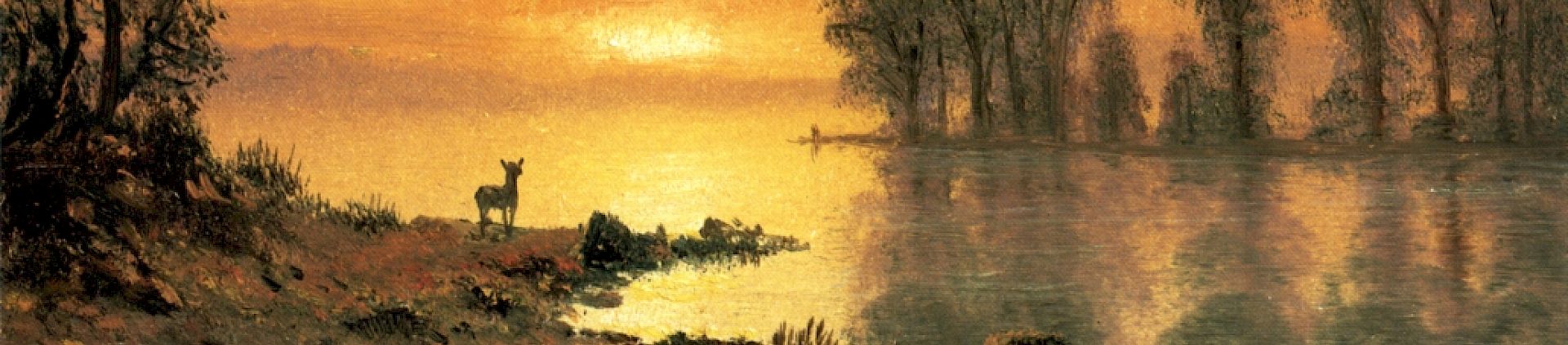
Cover image: 'Sunset, Deer, and River' by Albert Bierstadt
