Diminutive Muses: Three Poems by Adalber Salas Hernández, trans. by Arthur Malcolm Dixon
For the Venezuelan poet Adalber Salas Hernández, 'poems are not unlike the microorganisms that act as his diminutive muses,' writes his translator from Spanish, Arthur Malcolm Dixon. Four such poems are presented here in both languages, where the reader is immersed in imagery from the Bible alongside observations of tiny living forms. Accompanied by a translator's note from Dixon, these poems become a meditation on the complexities of life at both large and small scales, between the tangible and intangible.
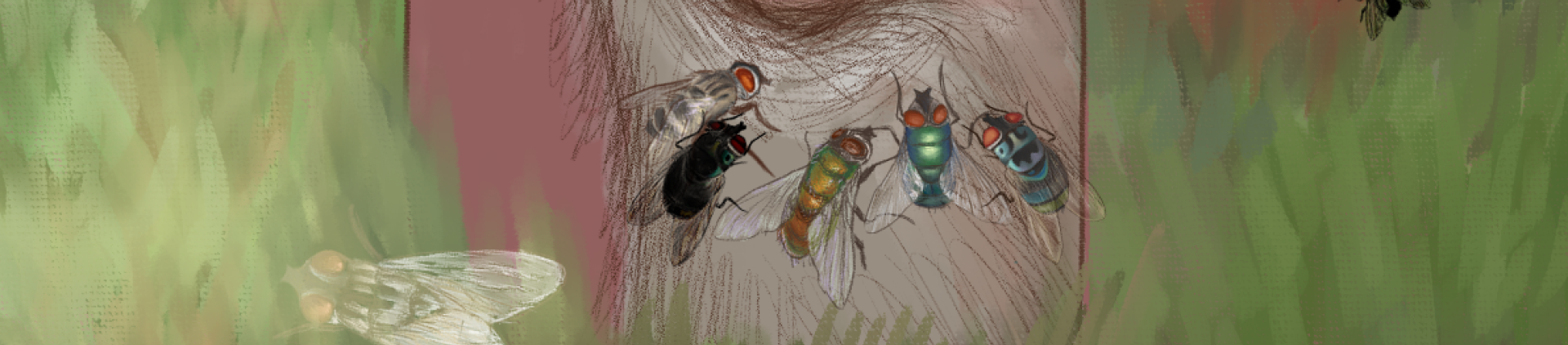
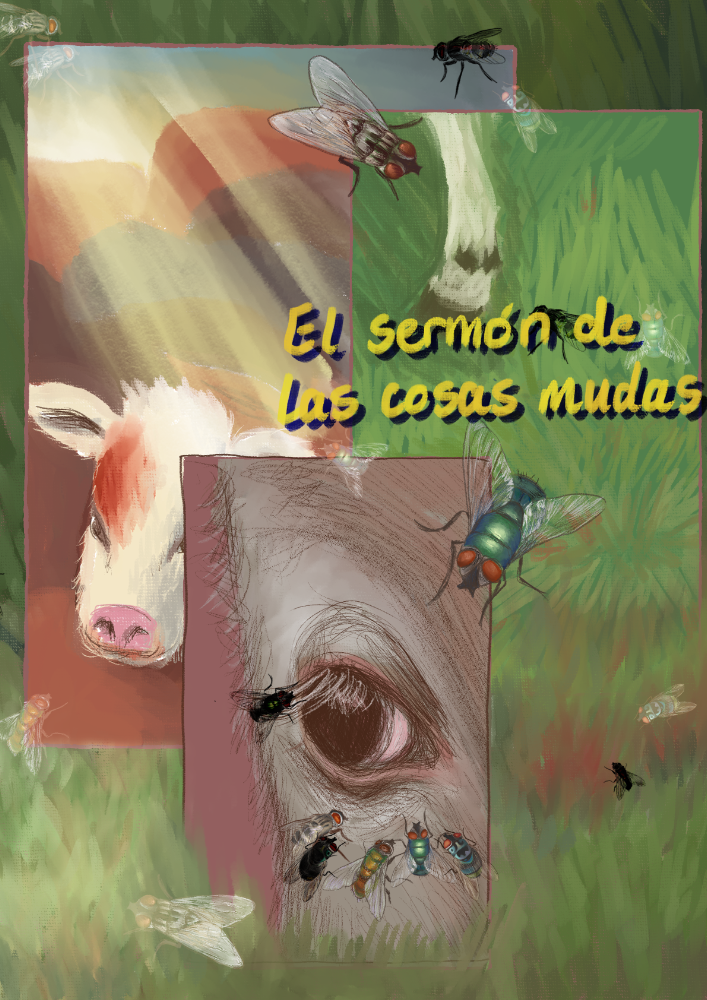
With an illustration by Simone Khanyi Hadebe.
Supported by a grant from the Open Society Foundations.
Cain
At the beginning of time was the sea. A
roofless sea of muddled currents.
In it, as if lost or dragged along to play
a game of rules unspoken, cells. They were
the new inventors of the circle, the
pioneers of the wheel when
nothing yet rolled: detached
monads. Makers of the whip
and the leg, of the tentacle that tempts
and tests, first measurers
of space. Bacteria and archaea and protozoans,
we call them, though they are too
small for names,
preceding mouth and ear.
Some were sated by the banquet
of carbon dioxide, the feast
of sun like a repeated fruit:
the world’s first-born harvest.
But another, perhaps
the first to attempt an embrace,
enclosed and attracted and mouthlessly swallowed
its neighbor. Phagocytosis,
sang the angels in chorus.
Said neighbor would have writhed and even
let out a weak scream, but
the voice did not yet exist. So there was no
howl, no protest, no mourning, no one
asking from on high: where is your sister,
whose blood cries out to me from the ground?
Thus life’s cold song began.
Caín
Era el mar al inicio de los tiempos. Un
mar sin techo, de corrientes confundidas.
En él, como perdidas o arrastradas a un juego
cuyas reglas nadie dictaba, células. Eran
las nuevas inventoras del círculo, las
pioneras de la rueda cuando todavía
no había nada que rodara: mónadas
desasidas. Fabricantes del flagelo
y la pata, del tentáculo que tienta
y tantea, primeras medidoras
del espacio. Bacterias y arqueas y protozoos,
les decimos aunque sean demasiado
pequeñas para los nombres,
anteriores a la boca y al oído.
Para algunas bastaba el banquete
del dióxido de carbono, el convite
del sol como un fruto repetido:
la cosecha primogénita del mundo.
Pero alguna otra, quizás
la primera en intentar el abrazo,
rodeó y atrajo y tragó sin boca
a su semejante. Fagocitosis,
dijeron los ángeles en coro.
Esta se habrá retorcido e incluso
habría soltado un grito flaco, pero
todavía no existía la voz. Así que no hubo
alarido ni reclamo ni duelo ni nadie
preguntó desde lo alto: ¿dónde está tu hermana,
cuya sangre clama a mí desde la tierra?
Así empezaba la vida su canto frío.
1 Corinthians 15:13
In the fourth minute decomposition begins.
Now nothing breathes in there, now
the exacting ocean of the blood falls calm.
Cells begin to break down,
spill their enzymes: be digested from within.
Bacteria, left to their own devices,
will devour the intestines,
their interminable knot, their subcutaneous embrace.
They are rot and its practices.
Then come the first explorers
with their turbid thirst and handsome names:
calliphoridae, muscidae, sarcophagidae,
blowflies, bluebottles, with sudden eyes
and speedy legs, enraptured by the smell of fat
and sugars teeming underneath the skin, the lipid
treasures, spilt saliva of the living.
They come laden: lay their eggs in the most prosperous
orifices: nose, mouth, ears, anus,
wounds that open doors through skin.
Down there, tissues gradually unravel,
muscles retract. Ants come too,
and beetles: there they found a slow country. The inside
seeps in, subtle, the body’s rivers overflow.
Meanwhile, larvae start tubular lives.
So many mouths,
so much hunger with neither eyes nor legs, dragging itself
through the body’s passageways with steadfast love,
in obstinate communion, eating up that flesh that now is of
its resurrected flesh. The tendons are drawn back,
the bones revealed.
The dead body grows less dead by the minute: now come
cockroaches, centipedes, a rat or two,
attracted by the lush scent of these fruits.
It is the idiot Eden of the offered body.
All within it chews and sucks, digests and defecates,
all an industrious gut. In there the book of life
is written in reverse, with jaws and legs aplenty,
with one-eyed calligraphy. And now the worms
are pupae and the pupae flies that soon will come out flying.
Flies indeed, daughters of an unfine blood,
as are the angels and the planets.
1 Corintios 15:13
Al cuarto minuto comienza la descomposición.
Ya nada respira allí adentro, ya
se aquieta el océano minucioso de la sangre.
Las células empiezan a romperse,
derraman sus enzimas: se digieren desde el interior.
Las bacterias, abandonadas a su suerte
devorarán los intestinos,
su nudo interminable, su abrazo piel adentro.
Son la podredumbre y sus oficios.
Entonces llegan las primeras exploradoras
con su ansia turbia y nombres sonoros:
calliphoridæ, muscidæ, sarcophagidæ,
moscardones, moscardas, con sus ojos abruptos
sus patas rápidas, enloquecidas por el olor a grasa
y los azúcares que bullen bajo la piel, los tesoros
lípidos, la saliva derramada de lo vivo.
Vienen cargadas: ponen sus huevos en los orificios
más prósperos: la nariz, la boca, los oídos, el ano,
las heridas que dan paso franco tras la piel.
Allí abajo, los tejidos se desanudan de a poco,
los músculos se desdicen. Llegan también las hormigas
y los escarabajos: fundan allí un país lento. El interior
se filtra tenue, se desbordan los ríos del cuerpo.
Mientras, las larvas comienzan su vida tubular.
Y cuántas bocas,
cuánta hambre sin ojos ni patas, arrastrándose
por los pasadizos del cuerpo con amor meticuloso,
en comulga terca, comiéndose esa carne que es ahora
de su carne resurrecta. Los tendones se descorren,
los huesos quedan a la vista.
El muerto está menos muerto cada vez: llegan
las cucarachas, los ciempiés, alguna rata,
atraídos todos por el olor lujoso de esos frutos.
Es el edén idiota del cuerpo que se ofrece.
Todo en él mastica, todo chupa y digiere y defeca,
todo es entraña laboriosa. Allí se escribe al revés
el libro de la vida, con mandíbulas y patas muchas,
con caligrafía tuerta. Y ya los gusanos
son pupas y las pupas moscas que pronto saldrán volando.
Moscas, así, hijas de una sangre tosca,
como lo son también los ángeles y los planetas.
Lazarus
His time on this earth was short.
When he was little, he nursed from his mother’s
udder a milk bitter
to our mouths. When he was older, he sniffed at
his neighbours, wallowed in the mud,
consumed with gusto grains, wheat, corn,
and the leftovers they left out for him.
His squeals could have been mistaken
for a child’s.
He lived five years, twenty-two
less than he could have.
He mated exactly
thirty-three times and sired six piglets,
one of which has not been cooked
yet. If he had been given
some intelligence test,
he would have passed. If someone
had put a mirror before him,
he would have recognised himself.
He could answer to his name.
Hog, swine, fat pig,
he never knew the words
with which we named him
were our favourite insults.
He would not have cared.
His sty was paradise: enough.
The machete fell two times
into his cervix. The first blow was clumsy,
ineffective. Then came broken blood’s
embrace around his neck.
Four hours after he was slaughtered,
scientists from Yale University’s
School of Medicine
administered to his brain a solution
rich in nutrients and oxygen.
Something in him was reactivated, cells
again responded, almost
as if they were still within his skull.
There were even a few flashes, glimmers,
one or two synapses — thus his neurons
spoke in the abyss.
His birth and death
now lay behind him,
monotonous and lit
like two identical lamps.
The rest of his body was drained of blood,
cut into pieces, packaged and sold:
a torn and world’s-end thing.
An inattentive observer might
have mistaken his skeleton
for a dog’s: the same posture,
the snout thrust forward,
the minimal cathedral of the ribs
lacking its shrine. But a thorough examination
would reveal teeth flat like stairsteps,
a forehead unusually pronounced, toes
on feet almost human.
The excess bones were
ground and scattered
like old salt.
Lázaro
Fue breve su tiempo en esta tierra.
De pequeño, mamó de la ubre
de su madre una leche amarga
a nuestra boca. De mayor, olisqueó
a sus pares, se revolcó en el lodo,
comió con fruición granos, trigo, maíz
y las sobras que por ahí le dejaban.
Sus chillidos hubieran podido confundirse
con los de un niño.
Vivió cinco años, veintidós
menos de los que hubiera podido.
Copuló exactamente
treintaitrés veces y procreó seis lechones,
de los cuales uno no ha sido cocinado
todavía. Si hubiera sido sometido
a alguna prueba de inteligencia,
la habría pasado. Si alguien
hubiera puesto un espejo frente a él,
se habría reconocido.
Era capaz de responder a su nombre.
Chancho, cerdo, puerco feliz,
nunca supo que las palabras
con que lo nombramos
son nuestros insultos predilectos.
Tampoco le habría importado.
La piara era el paraíso: suficiente.
Sobre su cerviz cayó dos veces
el machete. El primer golpe fue tosco,
ineficaz. Luego manó el abrazo
de sangre rota por su cuello.
Cuatro horas tras haber sido sacrificado,
científicos de la Escuela de Medicina
de la Universidad de Yale
le administraron a su cerebro una solución
rica en nutrientes y oxígeno.
Algo en él se activó de nuevo, las células
volvieron a responder, casi
como si estuvieran dentro del cráneo.
Incluso ocurrieron algunos fogonazos, destellos,
una o dos sinapsis —con ellas sus neuronas
hablaban en el vacío.
Atrás tenía ya
su nacimiento y su muerte,
monótonos y encendidos
como dos lámparas idénticas.
El resto de su cuerpo fue desangrado,
despedazado, empacado y vendido:
cosa rasgada y fin de mundo.
Un observador despistado habría
podido confundir su esqueleto
con el de un perro: la misma postura,
el hocico proyectado hacia adelante,
la mínima catedral de las costillas
sin relicario. Pero un examen preciso
revelaría los dientes planos como escalones,
la frente inusualmente proyectada, los dedos
de las patas casi humanos.
Los huesos sobrantes fueron
molidos y dispersados
como sal vieja.
Translator's Note
Adalber Salas Hernández’s El sermón de las cosas mudas [The Sermon of Silent Things] is his latest book of poems, published in 2025 by Spanish press Pre-Textos. In this collection, by evoking the Bible and biology – the proverbial miracle and primordial soup – Hernández succeeds in summoning poetry not only from the written page but also out of the palpable world. For the Venuzuelan poet, essayist, and translator, poems are not unlike the microorganisms that act as his diminutive muses — both can often go unnoticed in a world fixated with larger-scale things. But even when we aren’t aware of them, they’re lurking and growing and multiplying within us, simple but complex, small but significant.
I recently read somewhere that we humans can carry one hundred trillion bacteria in our bodies. I wonder how many poems we are able to carry, too. Like the unicellular beings that came before us (and will someday come for us all), poems are transformative: just as bacteria recycle nutrients and fix nitrogen, poems recycle inspiration and fix apathy.
The poems I like most – like these by Hernández – are notably ‘translatable’, to use a term from Walter Benjamin’s oft-cited and inscrutable 1923 essay, ‘The Task of the Translator’. That doesn’t necessarily mean they are easy to translate or that they were written with the goal of being translated, but rather that ‘a specific significance inherent in the original manifests itself in its translatability’ (Benjamin trans. Zohn). Such texts contain something of the ‘pure language’ (Benjamin trans. Zohn) common to us all: an essential significance that allows us to connect with them just as deeply, regardless of the language in which we read them.
Just as a ‘pure language’ connects Hernández's poems in Spanish to my versions of them in English, there is perhaps a ‘pure life’ that unites us humans with the nature of the microorganisms inhabiting our bodies. Like poems, microorganisms have a certain translatability to them, and they’re more relatable than one might expect: in El sermón de las cosas mudas, Hernández shows us their hunger, opportunism, and quiet determination.
I hope I have done his work justice, and I look forward to helping the rest of this book’s remarkable poems reach new readers.
Arthur Malcolm Dixon
Tulsa, Oklahoma
April 2026


