One Book Leads to Another: An Interview with Valeria Luiselli by Ingrid Rojas Contreras
The Pulitzer Prize finalist writer Ingrid Rojas Contreras speaks to the prolific Mexican author Valeria Luiselli about the 'gorgeous nesting dolls' of Luiselli's many works of fiction and nonfiction, particularly her latest book, Beginning Middle End (Fourth Estate, 2026). Their conversation bubbles and flows like lava from a volcano as they discuss the liminal space between languages, road trips, borderlands, mythologies, memory, and how we organise and structure narratives and time.
This piece is commissioned in tandem with Wasafiri 127: Solidarities.
Supported by a grant from the Open Society Foundations.
I was first introduced to the astounding talent of Valeria Luiselli through her nonfiction book, Tell Me How it Ends: An Essay in Forty Questions (2017). It’s a compassionate, incandescent, harrowing telling of her time interpreting for child immigrants in Manhattan, asking them questions from what is known as the Credible Fear Interview that can decide whether a child deserves asylum. The book, which also tells the story of Luiselli’s own efforts to acquire a US green card with her family in 2014, became quintessential reading for US American audiences for wrestling with the horrors of their immigration system. And for us who are mired in the deep inhumanity of that system, the book is its own place to dwell in, to recognise what the system was.
Each of Valeria Luiselli’s books has seedlings for the one that will follow it. Her oeuvre is astronomically fascinating, like gorgeous nesting dolls. Luiselli’s career was launched with novels and essay collections, including Papeles Falsos (2010), later published in English as Sidewalks, and La Historia de mis Dientes (2013) or The Story of My Teeth. After Tell Me How it Ends came Lost Children Archive, a novel that expanded the thread of the former book but within a fictional setting. A family embarks on a road trip while waiting for their papers; a marriage is in the midst of dissolving; on the radio, there is news of a caravan of immigrants arriving at the Southern border of the United States. After this came Luiselli’s latest, Beginning Middle End, a novel that unfurls essayistically and philosophically. It follows a mother in the wake of a divorce, wondering how to begin again. There is a road trip in this book too, except in Sicily; there are also Polaroids, just as in Lost Children Archive. Where is the beginning, the novel asks, when we’re so mired in life’s middles, and where ends are so difficult to discern?
Luiselli visits the banks of different languages, genres, and mediums. She is an artist who delights in the grammatical constructions of Spanish, English, and Italian, and is always thinking through several languages as she writes. Her books unmouth, as we say in Spanish, as rivers do when they join a sea, into the visual and the sonic. Luiselli is an artist who asks with each work: What can a book be? What can it hold? And can it hold more?
I spoke to Luiselli in her apartment in Brooklyn in July 2026, as she was resting from touring Beginning Middle End in Spanish and then in Italian. The English leg of the tour was about to begin.
by Ingrid Rojas Contreras
Ingrid Rojas Contreras: Your first books were written in Spanish. I'm someone who writes between languages; I have a love and interest in those liminal spaces [between them]. You seem like an artist who enjoys being in all these different liminal spaces too — between languages, in different countries, in thinking about borderlands. Do you think of yourself in that way, as an artist who's working from liminality?
Valeria Luiselli: Well, first I have to say that I just noticed your amazing hammock in the back.
IRC: Oh, thank you! It’s so good. That’s my reading spot.
VL: Talk about good liminal spaces ... The best reading situations are when hanging above the ground. Yes, my first books were written mostly in Spanish, but as you probably know, it's messier than that. When I'm taking notes for a book, I take notes in both languages [Spanish and English]. I try one language for a scene, then another. Eventually, I do have to choose.
I move between those two spaces in what I always find to be a very chaotic manner. But now, as time has moved on and I have come to understand chaos more carefully, I have decided to see this as a method. When I say method, I don't necessarily mean something that I have full control over. But it is a method where at least I feel that these are the choppy waters I’m going to navigate.
You spoke of liminal spaces, and I think that’s exactly it. When one grows up in different languages, in different cultures – therefore never quite belonging here and/or there – the only way to write, or the only way I have found to write, is to really understand that space of extranjería, that space of strangeness. This is not the gaze of the tourist who wants to consume it all and accumulate experience, but the gaze of the stranger who wants to participate, but not fully, who wants to observe and understand and decode.
You know how the brain goes into de-codification mode when you're scanning a difficult poem — that space, that neurological electric storm that happens when you're in front of something difficult like that? That is a similar space to gaze from when you're gazing as a stranger. You're always in de-codification mode, where everything has more than one value, more than one meaning. It's not an easy place to live in, but it is a beautiful place to write from.
IRC: I read in an interview that [you said that] early on in the collaboration process for the translation of a work, new meanings or insights can be brought to the original text. This brings up a crucial aspect about having this ability to gaze as a stranger and work in different modes. Sometimes in my own work, I will write in Spanish and then translate it back into English, or I will do like a weird back and forth. As the work passes through the process of the different languages, it clarifies something about what the intended meaning is.
VL: Absolutely. In a very practical sense, it’s a very effective way of close reading oneself critically. Any kind of sloppy ambivalence – which is [the opposite of] the good kind of ambivalence, [which is] the kind that's chosen and well-crafted, but the sloppy kind, where a lyrical turn is a little hasty or lazy – when you try to render that in another language, it very clearly appears as self-indulgence.
IRC: One of your preoccupations is migration and what it means for different people, and I was thinking about the road trips in your work. What doors do you think the format of the road trip opens in a narrative? Are you a lover of road trips?
Why do things start with something breaking?
VL: In life, I'm scared to drive on highways. I'm a good co-passenger on road trips, and I'm a good companion because I like maps. Something about the speed [and tempo/rhythm] of the road trip has the need for stopping along the way embedded into it. If you're not trying to get anywhere fast, there is room for play and detouring and randomness and observation and togetherness. A road trip creates a tight sense of togetherness and then also a sort of solitude where everyone's kind of alone together in a space. I think all those things allow for an atmosphere that's very akin to writing, right? The detouring, the being alone with others, listening to others, and their conversations ... It’s a space that feels to me very much like essay-ing, which is the kind of writing that I'm interested in reading and writing.
IRC: How did the first kernel of Beginning Middle End come to you?
VL: I recently went back to my notebooks to be able to answer that question honestly. What I found in the prehistories of this story was what one would expect — a series of false beginnings and good intentions that did not necessarily come to be. The book came from a sequence of notes scattered over a summer. On one day I might have been very frustrated and angry and promised myself that I would write a novel without men —
IRC: I've made that promise many times.
VL: It’s just like, I don't want to spend any more time here with them! I found a note somewhere about that very difficult and beautiful age, which comes at around eleven or twelve years, where someone's consciousness is migrating from childhood into adulthood. It was an observation about my own kid being in that space of transition. I was very surprised at the change in humour at that age and how my kid was back then. What I wrote was: ‘Ahora lleva el mapa.’ I meant it literally: She’s carrying the map for us on a road trip, deciding where and when and how we go. And then, more precisely, I meant it in a different way.
I was trying to read a Greek myth to my kid at night, as she was having a moment of pre-adolescent insomnia and anxiety, and I thought about how myths take our brains to larger spaces where we contend with time and moons and oceans forming. I decided that’s where I could help her go at night. I remember that on one of those evenings, she asked me an enormous question that I had never, ever thought about before, which was: Why is it that in all these origin myths across cultures, there seems to be something that's broken apart or torn asunder at the beginning? Why do things start with something breaking?
I thought it was an enormous question that I wanted to answer well, and I think the novel [Beginning Middle End] attempts to do that at many different levels. I don't think it fully answers it, though, as it’s not that kind of question. But I'm not interested in that. Instead, I circulate around questions, I orbit them, and I do so at different scales — both at the large cosmogonic one of the creation of universes, and also at the tiny, tiny scale of human life. Why is it that, in our lives, beginnings are a tearing or an asundering of something that, later, might not even allow one’s imagination to recompose one’s life?
IRC: I was looking back to Tell Me How it Ends, specifically a line on the first page. You're talking about the children's voices and the questionnaire and about guiding migrant children through the Credible Fear Interview. The line is: ‘The problem with trying to tell their story is that it has no beginning, no middle, and no end.’ Did you remember that line was there as you started this latest book?
VL: I did not! It's very funny because in the past couple of months, either my partner or my child or a reader has pointed out [lines like that], just as you're pointing out this sentence in Tell Me How it Ends. It's actually also there in the first pages of Lost Children Archive, and it's there on the first page or two of The Story of My Teeth. For all I know, it's also there in Los Ingrávidos or Faces in the Crowd!
IRC: There's an assumption about how stories are told that maybe comes from the traditional Western structure of a story, which relies on a very organised form of thinking. But when my mother tells a story, for instance, she narrates it in ‘disorder’, beginning towards the end, and then tells a different story in the middle of the one she’s already narrating. Sometimes our stories are very circular. But it’s also true that stories of upheavals and crisis tend to be very circular. I was wondering if this preoccupation that has been brewing for you has to do with wanting to engage with different narrative shapes and rebelling against the most traditional and oft-used one.
VL: Yeah, absolutely. It’s a refutation or a complaint against the way in which we have decided to understand and organise storytelling now for too many thousands of years. Aristotle is my least favourite philosopher for his tyranny of structure and for his terrible definition of the middle as ‘what is not this’ and ‘what is not that’. But really, it seems to me that the middle is always where we are, so we should pay a little more attention to what it means to be there.
Beyond that, in Beginning Middle End, I was interested in exploring the way we reconfigure the present when listening to our own pasts — the familial past (the story of generations before us), a historical past, a mythological past, and also a geological past. I was thinking of time as these concentric circles that envelop each other.
How do we think of the story of a stone inside a mosaic, such as where that stone really comes from, and how it traverses time and myth and history to arrive at a place? How can we think of the present in light of that past? And, also, how are we always listening to the past and then retelling and rewriting it? Maybe [our narrative patterns use] a model of time that's not quite circular, because a circle is too neat. But when we tell stories, it’s more like the backflow and return and advance of a tide pattern. It rolls around a bit, crashes, retreats. It’s in those movements where we are constantly reshaping stories.
IRC: I love how that highlights one of the things that Beginning Middle End is doing — embarking upon a story about a mother, daughter, and grandmother, but also thinking about deep time. Another quality I greatly admire about your work is the way you play with the line between fiction and non-fiction. For this book, you use photographs at the end. There are photographs at the end of the book, and there are also sounds from the world of the novel that people can listen to online. With Lost Children Archive, you included Polaroids, too.
Aristotle is my least favourite philosopher for his tyranny of structure
VL: I think, ultimately, in blurring those lines, I'm interested in reflecting on how fiction interacts with what we consider not-fictional in our lives. Fiction actually shapes all of it. And fiction here is not in the sense of not-truth, but is in the sense of how we put things together. The word fiction comes from fingere, and fingere means to give shape to clay, to mould something. When understood that way, we see that we are all fiction-makers. The more acute and attentive we are as readers, the better makers of our lives we become, and the better instruments we have in terms of understanding time and its structures. We better understand relationships between events that are far away from each other but have, in fact, these arches or invisible threads that connect them all. All of that is fiction-making, right? It's basically sequencing events in time and giving them architecture. I'm interested in that interplay, the process of fiction-making in our lives.
IRC: In non-fiction, we're limited to true events, to interviews and documents, and our experiences and our reality. Then in fiction, we have the opportunity to invent and also to drag all sorts of real things into the telling. Something else becomes accessible in fiction, maybe an emotional truth that can't be versed as easily in nonfiction.
VL: I think that’s exactly why we often decide to move into fiction. When I was writing Beginning Middle End, I truly didn't know for several years if it was going to be a collection of notes that summed up to a kind of essay on time and violence and motherhood, or if it was going to be a novel. It was only in the accumulation of its parts that I suddenly needed it to be fiction, because I needed more voices to come in, explore, and contend with the subjects. I needed a different sequence of events to be able to investigate things such as childhood memory and the worry of worrying about our elders’ loss of memory. The themes started needing a different kind of vehicle.
IRC: I also wanted to talk to you about volcanoes. I read somewhere that in answer to the question of what else you would be, if not a writer, you said a volcanologist. That is my answer too!
I recently got back from Hawaii and saw the Kilauea volcano erupt, and it was the most transporting thing to experience. I was really surprised that, as it was erupting, there was a roaring sound. It felt so animal-like, so alive. I’ve been obsessed with volcanoes for a while, too. After an accident where I had amnesia, I got all these volcano dreams, where I watched them erupt and create land. Tell me about volcanoes and your experiences of them.
VL: I was born in a city where the presence of volcanoes is absolute — the Popocatéptl and the Iztaccihuatl. They are also like two myths that loom above us, two reminders that catastrophe is always around the corner. They strain, yet they behave well. The presence of volcanoes is deeply ingrained in the psyche of Mexico City and our lives there.
But I didn't really start thinking more deeply about volcanoes – other than those two that have always been present in my consciousness – until I started visiting Sicily about fifteen years ago, when I was trying to understand what kind of territory it was.
Sicily is like a great borderlands area. And for someone who's been preoccupied with that for a long time, it was like a homecoming to the border of all borders. This is a border not only in a geopolitical and historical sense, but also in a tectonic sense, because it's right under Sicily, where the tectonic plates of Africa and Europe meet. They produce an extremely active volcanic archipelago in that area. Each volcano there behaves very differently. Etna, for instance, can suddenly get very active and have explosions. But it's always there, it's part of the city and its psyche. People mostly love it and respect it. Etna is not an invisible presence; it's the heart of the city, like the Popocatéptl in Mexico City.
But then there were other volcanoes that I didn't know about until I started writing Beginning Middle End. And especially until I started thinking about the sonic version of the novel, where my small team and I wanted to record the elements in it — fire, water, air, and earth. So, more intentionally, we went to seek the sounds of the different expressions of fire and volcanic activity. We went to the Strombolian volcano, for example, that behaves completely differently. I don't know if you've seen these volcanoes yet —
IRC: I haven’t, not yet!
VL: Oh, you must, you must. Just as you talked about the volcano in Hawaii, I had the same experience with Stromboli. Stromboli exhales every twenty minutes. It's a very trustworthy volcano. It's eerie. It sighs, just like my mom's great aunt, whose name was Pichita. I never knew Pichita, but she used to say – and this is sort of passed down through my family – that it's very important to sigh. If you don’t sigh, you’ll get sick. So my mom sighs often, and whenever I ask her, ‘Why are you sighing so much?’, she’ll say, ‘It's just healthy to sigh, leave me alone.’ That's what Stromboli sounds like, a big tectonic sigh, every twenty or thirty minutes. Then it spits out amazing rocks that fall down the mountain and make an echo, because the mountain is quite hollow.
Then there’s Vulcano, not that far away from Stromboli. Vulcano is very old and a sweet old presence which only hisses and whistles, very sweet-sounding. It doesn't ever erupt or make big sounds. I think when you spend time listening to something, you get to know it differently. There's something about sound that produces an emotional connection to space, things, and beings. The Sonic book allowed us to listen to the territory in a way that I had not done since working on a sound project at the US-Mexico border called Echoes from the Borderlands.
IRC: I always associate memory with volcanoes because volcanoes are always creating land — new land can be a memory that's emerging. While reading Beginning Middle End, I was also thinking about how volcanoes are an expression of an entity that is a beginning, a middle, and an end, all at once. That’s also a parallel to the grandmother in the novel, and the memory loss that's happening to her.
VL: I love what you're saying. If we think about memory as not limited to the human psyche but, as you’re saying, a much bigger phenomenon, then volcanic activity is like the world’s organs of imagination, because it comes from the deepest core of the world, the magma. It's both memory and imagination. The deeper strata are the deeper consciousness of the world, and volcanoes produce new islands with their lava, they produce new connections between lands. I love this connection you're making. I also think – to go back to the connection to land and territory in this novel, and to Sicily – the presence of constant volcanic activity reminds you of the beginning of the world, that the world has this potential for its destruction. So it's a reminder of temporality in a very constant and real way, the rocks and fire.
When you spend time listening to something, you get to know it differently
IRC: I wonder, now, how you think of the book tour or the publication of the book — is that the beginning, middle, or end of the book for you?
VL: That's a good question. If I didn't have time to think about it, I would say the end, but it's really more the middle, maybe. The moment of reading activates a book, and, to carry on with the volcanic imagery, it’s constantly erupting out new meaning. In that sense, it is the middle because it's the making of it.
IRC: As I read through your books, it seemed as if they grew organically one from the other.
VL: Yeah, yeah, yeah. I love that we're meandering between the beginning and middle parts of the interview, and now we’re at the end, returning to the beginning …
You pointed out this line that includes ‘beginning’, ‘middle’, and ‘end’ in Tell Me How it Ends. I think that concern has been with me for a while without my being able to explore it to the depth that I was able to until now [with Beginning Middle End]. Of course, even with this book, it's not exhausted — it's not at all an exhaustible theme. But what happens to me, and what the best possible outcome for me is when writing a book, is that there might be, embedded in the last book that I finish, a series of failed books. These are failed explanations that remain active in me; I feel an urgency to go back to them and pursue them further. I think volcanoes are one of them. I feel that I arrived at them thanks to this book and its exploration.
Thanks to the books we write, we become curious about things we didn't know before. That allows us to explore things further in the next attempt, in the next book. With Lost Children Archive, I became curious about sound. I didn't know anything about the world of sound recording. Thanks to that book, after I finished it, I spent the next eight years of my life actively exploring sound. I hope it's always the case that one book leads to another.
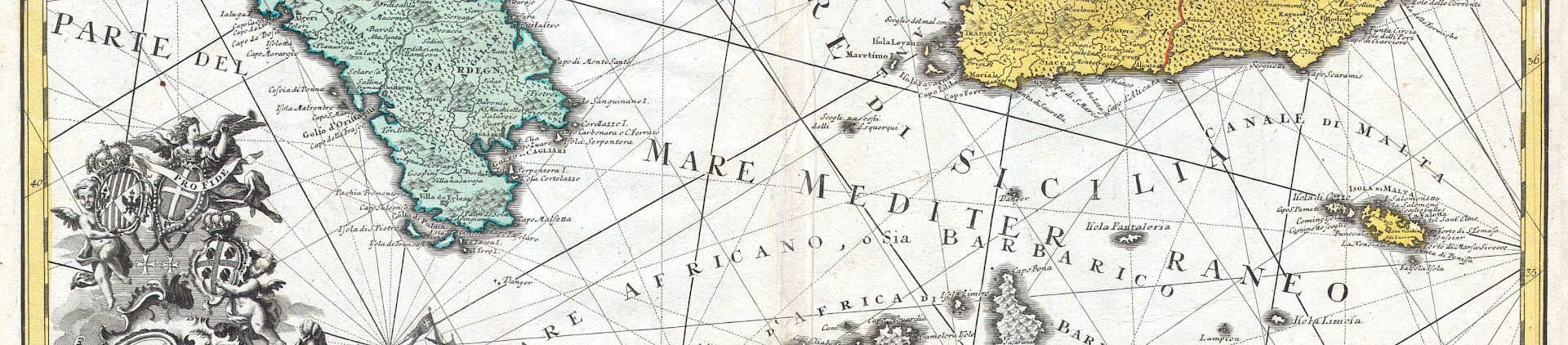
Cover image: 1762 Homann Heirs Map of Sicily, Sardinia, Corsica and Malta (Italy)


